

By the end of this hands-on guide you will be able to find, book and complete an adhd psychiatrist telehealth assessment in Australia, understand the diagnosis pathway, and begin a tailored treatment plan; realistic time: initial steps 1–3 hours spread over 1–2 weeks, full diagnostic and treatment start 2–12 weeks; skill level: beginner—no prior clinical knowledge required.
Before you start
- Valid Medicare or private health information (Medicare card number if eligible).
- Current GP details and any previous mental health records or school reports (scanned PDFs).
- List of current medications, doses and prescriber names.
- A quiet, private room with reliable internet (minimum 5 Mbps up/down) and a device with camera/microphone for video consultations.
- Pen and paper or digital notes app for intake questions and assessment screening tools.
What Is an ADHD Psychiatrist and When to See One
A psychiatrist who specialises in ADHD is a medical doctor trained in psychiatry and neurodevelopmental disorders: they diagnose according to standard criteria, prescribe medication, and manage complex cases. See a psychiatrist when adult ADHD symptoms significantly impair work, relationships, or safety despite self-help or psychological therapy.

What psychiatrists do differently: psychiatrists have prescribing authority and a medical framework for differential diagnosis (for example ruling out mood disorders, substance use, or thyroid dysfunction) and can coordinate medication management alongside psychotherapy. If you want a concise distinction, read more on psychologist vs psychiatrist roles in ADHD care.
Adult ADHD psychiatrist care focuses on executive function, medication optimisation for working adults, driving and safety considerations, and often coordination with employers or educational supports. Adult assessments commonly require collateral history from a partner, parent or employer to confirm lifelong patterns.
DSM-5 and ICD-11 are the primary diagnostic frameworks used: psychiatrists map symptoms to DSM-5 criteria for ADHD (symptom clusters, onset before age 12, cross-situation impairment) or ICD-11 equivalents and rule out other causes. For clinical guidance see the Royal Australian and New Zealand College of Psychiatrists: RANZCP.
Transition: now that you know what a psychiatrist does, the next section walks you step-by-step through an online ADHD assessment in Australia.
Understanding ADHD Assessment with a Psychiatrist Online in Australia
This section is a practical, sequential walkthrough of the entire telehealth assessment process—from initial enquiry to diagnosis and treatment planning. Follow each numbered step literally; each step includes timing, what documents to prepare, and typical outcomes.
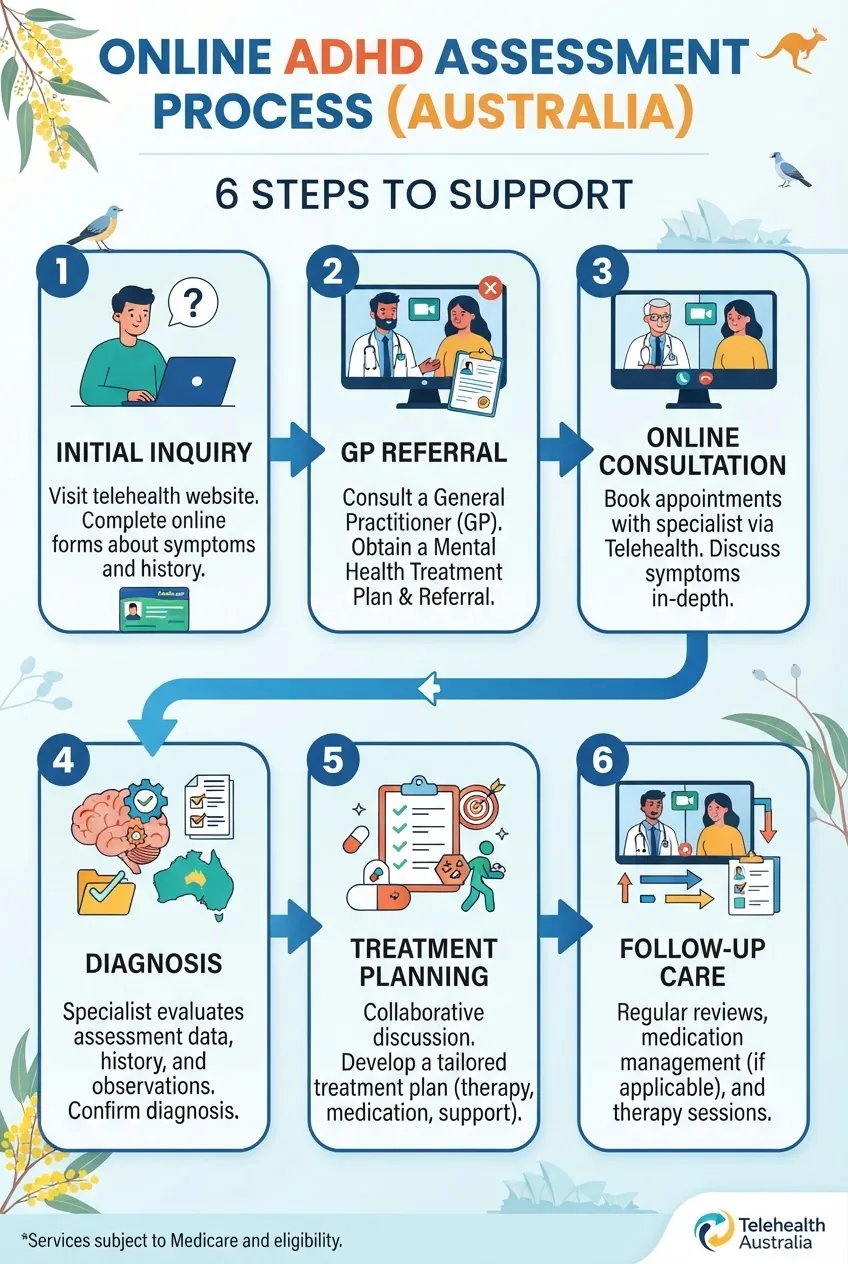
-
Contact and initial triage (0–30 minutes):
Action: Call or use the clinic’s online booking form to request an ADHD assessment. Expect a short triage call (10–20 minutes) to confirm whether you need a general psychiatric appointment or a dedicated ADHD assessment slot.
Prepare: Medicare details, brief list of presenting issues, and availability for a 60–90 minute initial video appointment.
Outcome: Administrative booking and pre-appointment paperwork emailed—complete within 48 hours.
-
Complete intake forms and screening tools (15–45 minutes):
Action: Fill standardised screening tools your psychiatrist will ask for. Common tools used in Australian telepsychiatry include the Adult ADHD Self-Report Scale (ASRS v1.1), Conners’ Adult ADHD Rating Scales, and mood screening tools (PHQ-9, GAD-7).
Prepare: Have previous school reports, work performance reviews, or family history documents ready; upload as PDF. Note exact dates for symptom onset and examples from childhood/adolescence.
Timing: Complete within 24–72 hours before your consultation; accurate answers reduce the need for extra assessment time.
-
Gather collateral information (10–60 minutes to request; ongoing to collect):
Action: Request brief written statements (email or form) from a partner, parent, or employer who can describe behaviour across settings—ask them to include specific examples and timeframes.
Why: Collateral confirmation is essential to meet DSM-5 criteria that symptoms are present in multiple settings.
Timing: Aim to collect within 1–2 weeks; many clinics proceed with preliminary assessment if collateral will follow within 4 weeks.
-
Initial telehealth psychiatric assessment (60–90 minutes):
Action: Attend a secure video consultation. The psychiatrist performs a structured clinical interview, reviews screening tools and collateral, completes medical and psychiatric history, and discusses differential diagnoses (mood disorders, anxiety, substance use, sleep disorders, thyroid problems).
Assessment tools used: ASRS, Conners, clinical diagnostic interview mapped to DSM-5/ICD-11 criteria, cognitive screens if required (e.g., brief attention tasks), and where indicated, recommendation for neuropsychological testing. Clinicians may use validated online tools and documented templates to ensure comprehensive coverage.
Outcome possibilities: (a) Meets diagnostic criteria for ADHD—treatment plan offered; (b) Does not meet criteria—alternative diagnosis and referrals; (c) Requires further collateral/neuropsychology—follow-up arranged.
-
Medical work-up and baseline tests (1–7 days to arrange):
Action: If medication is likely, the psychiatrist will request baseline blood tests (full blood count, thyroid function, liver function, and, where relevant, ECGs or blood pressure readings). For stimulant prescribing, a cardiovascular risk screen is standard.
Timing: Arrange tests within 1–2 weeks prior to starting medication; clinics commonly accept GP-performed pathology with results uploaded to the psychiatrist.
Why: Mitigates risk and documents baseline physiological status for safe prescribing.
-
Diagnosis discussion and written report (2–14 days):
Action: Receive a clear diagnostic summary and management plan—this will include whether the psychiatrist applies DSM-5 or ICD-11 criteria and the evidence used to reach the diagnosis.
Delivery: Most clinics email a PDF report within 2 weeks; urgent cases receive same-week documentation.
What’s in the report: Diagnosis status, recommended medications (if any), dosing strategy, non-pharmacological referrals, follow-up schedule, and consented sharing plan with GP or other allied health providers.
-
Medication initiation or therapy referral (1–4 weeks):
Action: If medication is prescribed: start at the psychiatrist’s recommended dose with a defined titration schedule (for example, methylphenidate 10 mg twice daily for 1 week then review). If therapy-only: psychiatrist will provide a referral to a psychologist or allied health provider with suggested CBT, coaching or skills-based interventions.
Remote prescription: Australian telepsychiatry can issue electronic prescriptions that are valid at local pharmacies. For certain Schedule 8 medications (some stimulants), the psychiatrist may require initial in-person or local-prescriber agreements depending on state regulations.
-
Follow-up and monitoring (weekly to monthly initially):
Action: Expect a 2–6 week follow-up by telehealth or phone for medication response and side-effect monitoring, then 3-monthly once stable. Psychiatrists will document symptom rating scales (ASRS scores) at each review to track outcomes.
Timing specifics: First medication review at 2–4 weeks, dose adjustments with 1–2 week intervals, and more extensive review at 3 months including functional outcomes (work, relationships, driving).
Realistic example scenario
I recently worked with a 32-year-old teacher who booked an online ADHD assessment. Timeline: triage and forms in 2 days, video assessment in 7 days, blood tests arranged with GP same week, diagnosis confirmed and low-dose stimulant started 10 days after assessment, first review at 3 weeks with dose adjusted. Functional improvements at 8 weeks. This mirrors many Australian telehealth pathways.
Common mistakes and how to avoid them
I often see patients book an assessment without gathering collateral history—this delays diagnosis because we must wait for third-party confirmations. I now advise clients to request collateral upfront and upload it before the appointment.
Another frequent error: starting medication without baseline blood pressure or liver function tests. To avoid this, arrange the specified pathology with your GP within a week of your assessment.
Checklist: before you finish the assessment steps
- Completed ASRS and PHQ-9 within 72 hours of consult.
- Collateral statements requested and at least one uploaded.
- Baseline pathology ordered with GP (FBC, TFTs, LFTs, ECG if indicated).
- Clear written report and management plan received within 14 days.
- Follow-up appointment scheduled (2–6 weeks for medication starts).
When to call in a professional instead
Call emergency services or your psychiatrist/GP immediately if you experience severe side effects (chest pain, syncope, severe agitation), suicidality, or a sudden decline in functioning. For complex co-occurring disorders (e.g., bipolar disorder, severe substance dependence), seek an urgent specialist appointment; telehealth may be an initial triage but will usually require in-person assessments for safety planning.
Transition: with the assessment process covered in depth, the next section explains the referral mechanics you’ll encounter in Australia.
The Referral Process: Do You Need a GP Referral for an ADHD Psychiatrist?
In Australia, the referral pathway determines Medicare rebate eligibility and smooth specialist access. Below is a practical numbered guide to referrals and when they matter for telehealth psychiatry.
- Decide if you want a GP Mental Health Care Plan (optional but recommended):
A GP Mental Health Care Plan can facilitate psychologist rebates and structured care. For more on GP roles see GP mental health care and referrals. Medicare rebates for psychiatrists often require a referral for some services—check your clinic’s policy.
- Obtain a GP referral for Medicare rebate eligibility (when needed):
Medicare allows rebates for some specialist psychiatric services with a valid GP referral. The referral should state the reason (e.g., suspected ADHD), duration (commonly 12 months), and whether ongoing review is planned. If you want detail on psychologist referrals, see referral process for psychologists.
- Bulk billing vs private billing nuances:
Some psychiatrists bulk bill initial consultations; others charge privately. Bulk billing availability varies by clinic and location. For Adelaide-specific bulk billing options see ADHD psychiatrist Adelaide bulk bill services.
- Telehealth-specific referral rules:
Telehealth psychiatry usually accepts electronic GP referrals. Some telehealth platforms require a specific telehealth referral or confirmatory GP note to access Medicare rebates—confirm this with your psychiatrist practice before booking.
- Special circumstances—interstate or international patients:
If you live interstate, your GP referral should specify that telehealth is requested. International residents generally cannot claim Medicare rebates; private billing applies.
- When no referral is required:
You can often book a private psychiatrist without a GP referral, but you may forfeit Medicare rebates. If uncertain, request the clinic’s billing policy before booking.
Transition: the next section explains exactly what happens inside a telehealth appointment so you feel prepared and confident.
What to Expect During an ADHD Psychiatrist Telehealth Appointment
A telehealth session mirrors an in-person psychiatric assessment but uses secure video platforms. Below is a practical description plus a bullet checklist of the operational and clinical elements to expect.
Opening (5–10 minutes): clinician confirms identity, consent and explains how the telehealth platform and privacy protections work. They will ask you to show ID if required and to confirm you are in a private location. Expect preamble about recording (most clinics prohibit recording without consent).
- Clinical interview (40–60 minutes): Structured DSM-5/ICD-11 interview covering inattention, hyperactivity/impulsivity, age of onset (before 12 years), and impairment across settings.
- Review of screening tools: ASRS results and other scales are reviewed in real time.
- Medication history and medical review: The psychiatrist asks about current/past medications, substances, sleep, cardiovascular history, and family psychiatric history.
- Functional assessment: Questions target work, study, relationships, driving, and safety.
- Collateral and consent: Discusses how and when collateral information will be sought and whether reports will be shared with your GP or other clinicians.
- Immediate safety check: Suicidality or severe risk triggers a safety plan—this can include urgent local referrals and in-person care.
- Next steps explained: Lab tests, prescriptions, referrals to psychologists, or neuropsychology are clarified with timelines.
Privacy considerations: clinicians use secure, encrypted telehealth platforms that comply with Australian privacy law. Confirm that the platform is compliant and ask how your data will be stored and who can access notes. If you want to read government telehealth policy, see the Department of Health: Australian Government Department of Health.
Technical tips: test your camera and microphone 10 minutes prior, ensure battery >30% or device plugged in, use headphones for privacy. If technical failure occurs, arrange a phone consult as backup.
Transition: once you know the appointment flow, the next section compares treatment options psychiatrists provide so you can weigh choices.
ADHD Treatment Options Provided by Psychiatrists

Psychiatrists tailor treatment using medication, therapy, or a combined approach. Below is an evidence-focused comparison to help you decide with your clinician; references to DSM-5/ICD-11 and RANZCP guidance underpin clinical choices.
| Approach | What it involves | Benefits | Limitations / Risks |
|---|---|---|---|
| Medication (stimulants, non-stimulants) | Prescribed and titrated by psychiatrist; common drugs: methylphenidate, dexamphetamine (Schedule 8), atomoxetine, guanfacine. | Rapid symptom reduction (days–weeks), improved attention, executive function and functioning at work/study. | Side effects (insomnia, appetite loss, increased HR/BP); Schedule 8 controls add prescribing restrictions; requires monitoring. |
| Therapy (CBT, coaching) | Referral to psychologist for CBT for ADHD, organisational coaching, skills training, and mindfulness-based interventions. | Improves coping strategies, planning, time management; no medication side effects; durable functional gains. | Slower onset (weeks–months), dependent on patient engagement and session frequency; less effective alone for severe core attention symptoms. |
| Combined approach | Medication for symptom control plus structured therapy for skills and coping; psychiatrist coordinates care. | Best evidence for adult ADHD—symptom control and functional rehabilitation together. | Requires coordination, potentially higher upfront cost, and ongoing follow-up for medication monitoring and therapy progress. |
Medication management specifics: stimulant titration usually begins low and increases in set increments every 1–2 weeks with targeted symptom and side-effect monitoring; atomoxetine titration is slower (2–6 weeks). For Schedule 8 stimulants, psychiatrists must comply with state-based prescription rules—this may require a shared-care arrangement with a local GP for ongoing scripting.
Therapy and follow-up care: psychiatrists commonly refer to psychologists for CBT for ADHD, executive skills coaching, or occupational therapy for workplace adjustments. Evidence summaries and clinical guidelines are available from the NHMRC and RANZCP; see NHMRC for guideline summaries.
Transition: having compared treatments, the next section helps you choose the right online ADHD psychiatrist in Australia.
Choosing the Right Online ADHD Psychiatrist in Australia: Tips and Considerations
Selecting a psychiatrist for online care requires checking credentials, telehealth experience, and billing practices. Use the bullet checklist below when evaluating options.
- Check specialist registration: confirm FRANZCP or equivalent on the RANZCP directory via RANZCP.
- Read patient reviews and ask about telehealth volume—higher telehealth caseloads mean streamlined processes and documented telepractice policies.
- Confirm bulk billing or private fees and rebate estimates; some clinics offer mixed models and concession options.
- Ask whether they have specific adult ADHD expertise and whether they work with comorbidities (anxiety, depression, substance use).
- Verify ability to coordinate with your GP and allied health providers and willingness to provide written reports for employers or study support.
- For gender preference or local options consider targeted listings such as best female psychiatrist options in Perth.
- If you need psychology alongside psychiatry, use this guide for complementary care: finding a psychologist in Australia.
Practical checks before booking: confirm telehealth platform encryption, average wait times for initial assessment (aim under 4 weeks for private clinics), and whether the psychiatrist has experience prescribing Schedule 8 stimulants if needed.
Transition: cost and rebate mechanics can be a barrier—next section explains Medicare, bulk billing and out-of-pocket expenses for online psychiatry.
Costs, Bulk Billing, and Medicare Rebates for ADHD Psychiatrist Services Online
Practical numbered guide to understanding costs and how to reduce out-of-pocket expenses when using telehealth psychiatry in Australia.
- Check if the clinic offers bulk billing for telehealth:
Some practices bulk bill initial or follow-up psychiatry telehealth consultations for concession cardholders or under specific programs. For broader online options, see bulk bill psychiatrist options for online care. For Adelaide-specific bulk billing see ADHD psychiatrist Adelaide bulk bill services.
- Medicare rebates and telehealth eligibility:
Medicare may rebate part of the fee for specialist psychiatry consultations when a valid referral is provided. Medicare rebate amounts change; confirm current rates on the Department of Health website: health.gov.au.
- Private billing and out-of-pocket estimates:
Private psychiatrist telehealth fees vary widely—typical initial assessments range AUD 250–500, with follow-ups AUD 150–300. After Medicare rebate, out-of-pocket depends on fee set by the clinic. Ask for a fee estimate before booking.
- Safety-net and concession options:
Some clinics offer concession pricing for students, pensioners, or unemployed clients. If cost is prohibitive, public community mental health services can provide alternatives though wait times are often longer.
- Pharmacy and prescription costs:
Medication costs depend on PBS listing and private script types. If prescribed stimulant medication off-PBS, costs can be higher; discuss PBS eligibility or private script pricing with your pharmacist.
- Telehealth platform or platform fees:
Some telehealth providers add a platform or administration fee—confirm this in the booking confirmation and ask for itemised billing if needed.
- Rebates for psychological therapy:
If you receive a GP Mental Health Care Plan you may be eligible for Medicare rebates for sessions with a registered psychologist; discuss coordination with your psychiatrist and GP. For more on mental health GP pathways see Mental Health Care Plan Guide for Australian GP Referrals.
Transition: after costs, the final section explains long-term monitoring and practical self-management via telehealth.
Managing Follow-Up and Long-Term ADHD Care via Telehealth
Long-term ADHD care resembles chronic disease management: scheduled reviews, symptom tracking, medication monitoring and coordinated allied health support. Below are practical rules-of-thumb for remote management.
Monitoring schedule: for medication starts—2–4 week reviews, then monthly until stable, then every 3 months. For stable patients on a fixed regimen, 6–12 monthly reviews are common but require symptom rating scales at each contact (ASRS). If side effects emerge, contact your psychiatrist within 48 hours.
Remote therapy and support: psychotherapies (CBT, coaching) transition well to telehealth; use weekly or fortnightly sessions initially (6–12 sessions) then step down as skills consolidate. Occupational therapists can provide workplace assessments remotely using structured interviews.
Medication adjustments: psychiatrists will keep a written titration schedule with exact dose changes and monitoring windows (e.g., increase methylphenidate by 10–20 mg every 1–2 weeks until target response or side effects). Keep a daily symptom and side-effect diary for the first 6–8 weeks to present at reviews.
Coordination with GPs: shared-care arrangements are common—your psychiatrist will often send a management letter and ask your GP to continue scripts once stable. If you prefer continued specialist scripting, confirm the practical arrangements and any local prescribing rules for Schedule 8 medications.
Data security and privacy: request the clinic’s privacy statement and ask where notes are stored, who can access them, and how long records are retained. Use private Wi‑Fi, and avoid public networks during video consults.
Practical long-term self-management tips
- Use the ASRS self-rating every 3 months to track progress.
- Keep medication in a locked container, log doses daily for 4 weeks after change.
- Set calendar reminders for follow-ups and pathology due dates (e.g., annual physicals).
- Maintain open communication with your GP and therapist; share reports and consent to shared care.
Transition: below are concise answers to common patient questions to finish the practical guide.
Conclusion
Key takeaways: an online adhd psychiatrist in Australia can provide complete diagnostic assessments, prescribe and monitor medication, and coordinate therapy—all via telehealth when properly prepared. Start by gathering collateral and screening tools, secure necessary referrals or GP support for rebates, and expect structured telehealth reviews. For immediate next steps, book an initial telehealth triage, complete your ASRS today, and arrange baseline pathology if medication may be considered.
Call to action: If you’re ready, contact a registered psychiatrist experienced in adult ADHD telehealth for a triage call; prepare your Medicare details and collateral to speed the process.