

Do I need a referral to see a psychologist? Short answer: You can see most registered psychologists in Australia without a referral, but a GP referral and a Medicare Mental Health Care Plan are required to access Medicare rebates for sessions; private clinicians may accept direct self-referral with full out-of-pocket fees.
Introduction to Seeing a Psychologist
Answer: Yes — you can usually book a psychologist directly, but whether you need a referral depends on whether you want a Medicare rebate, a public clinic appointment, or access to specialist psychiatry-linked care.
Term: Psychologist — a registered allied health professional specialising in psychological assessment and therapy, not a medical doctor and not authorised to prescribe medication.
Seeing a psychologist is primarily about accessing evidence-based psychological therapy and assessment to support mental wellbeing, manage symptoms, or receive a formal psychological assessment. Many Australian psychologists accept direct bookings for private consultations, offering face-to-face and telehealth sessions for adults and adolescents. If you seek reduced fees through Medicare, you’ll usually need a referral from a GP plus a Medicare Mental Health Care Plan (MHCP).

Common psychology services include cognitive-behavioural therapy (CBT), acceptance and commitment therapy (ACT), assessment for anxiety or depression, trauma-focused care, and specialist testing for conditions where psychologists provide diagnostic input. Telehealth psychology sessions have become widely available and follow the same referral and rebate rules for Medicare-subsidised care when eligible.
Transition: The next section answers the core question about whether a referral is required and outlines exceptions and practical steps.
Do I Need a Referral to See a Psychologist?
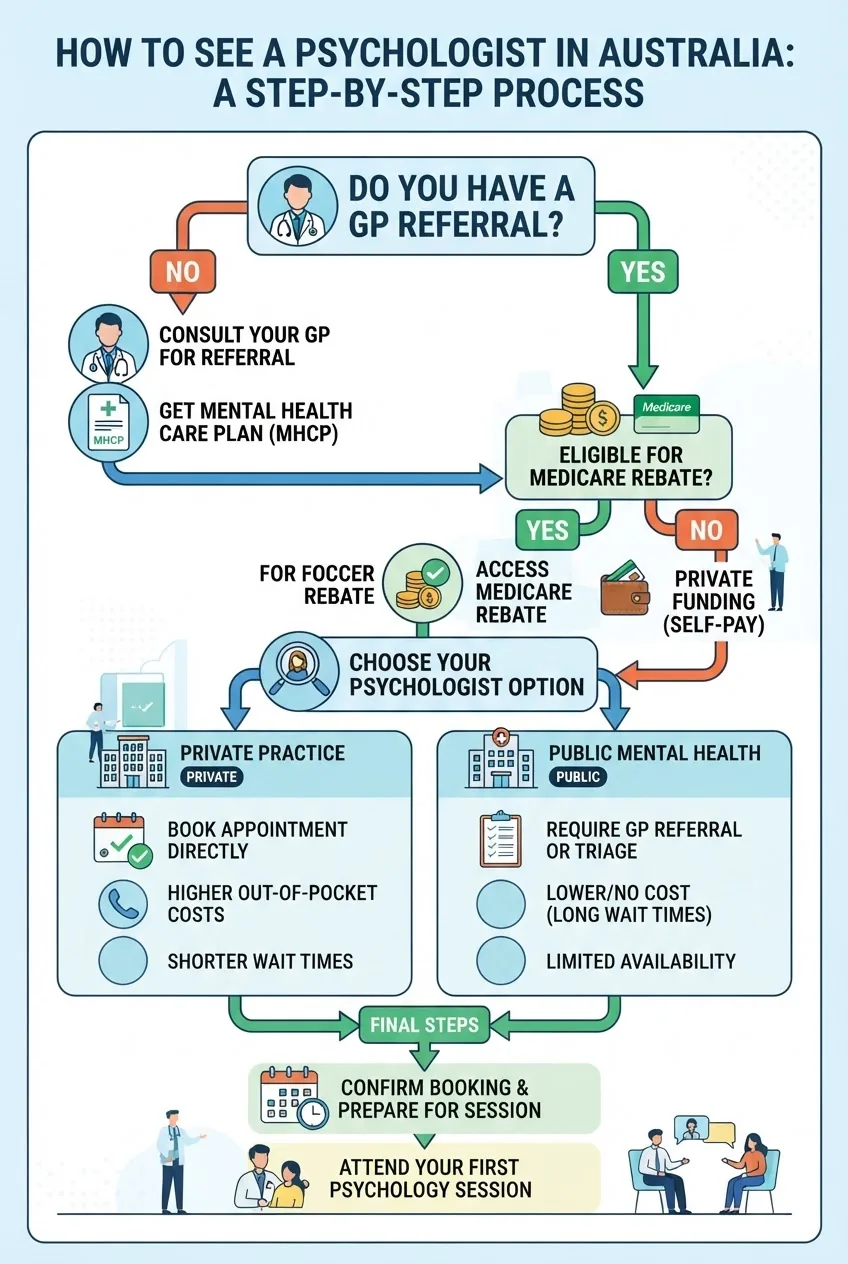
Answer: No referral is usually required to see a psychologist privately, but a GP referral and a Medicare Mental Health Care Plan are required if you want Medicare rebates or access to some public services; some clinics also require GP letters for specialist intake.
Term: Medicare Mental Health Care Plan (MHCP) — a GP-created plan that documents clinical issues and supports access to Medicare-subsidised psychological sessions.
Key points and exceptions (FAQ-style bullets):
- Private access: You can generally book with a private psychologist directly without any referral; you’ll pay the clinician’s full fee unless a rebate applies.
- Medicare rebate: To receive a Medicare rebate for psychologist sessions you must have a GP-created MHCP or be referred under a specialist mental health program; the GP issues a referral and treatment plan detailing diagnosed or assessed needs.
- Public clinics: Public community mental health services may require GP referrals or direct intake assessments via local health districts; rules vary by state and clinic.
- Children and adolescents: GPs commonly coordinate care and create MHCPs for younger patients to access subsidised sessions; schools and paediatric services may supply referral letters for specialist assessment.
- Employee assistance programs (EAPs): EAP-funded counselling often accepts self-referral or employer referral — not the same as Medicare rebates.
Practical step-by-step differences based on need:
- Want an immediate private appointment? Contact a psychologist’s clinic and book; check whether they offer bulk billing or partial Medicare billing.
- Want a Medicare rebate? Book a GP appointment, request an MHCP (also called a GP mental health care plan), then use that plan to claim rebates for sessions with an approved psychologist.
- Need a public service? Call your local health district and follow their intake procedure (may require GP referral).
- Require medication or complex diagnostics? A psychiatrist referral (from GP) or direct psychiatrist appointment will be the correct pathway; psychiatrists are medical specialists who can prescribe.
Real example (Sydney): Jane, 34, felt anxious and booked a private psychologist the next week without seeing her GP; she paid $160 and claimed a partial rebate after requesting a GP-created MHCP at a later date. Mark, 45, wanted immediate Medicare-subsidised sessions, saw his GP who issued an MHCP and a psychologist referral—he accessed subsidised sessions within two weeks.
Transition: Next we compare psychologist and psychiatrist referrals so you can decide which pathway fits your needs.
Differences Between Psychology Referrals and Psychiatrist Referrals
Answer: Psychologist referrals (for Medicare rebates) usually come from GPs via a Mental Health Care Plan; psychiatrist referrals are medical referrals to a specialist who can diagnose, prescribe medication and manage complex mental illnesses.
Term: Psychiatrist — a medical doctor specialising in mental health, authorised to prescribe medication and provide medical management alongside psychological therapies.
| Aspect | Psychologist (Referral context) | Psychiatrist (Referral context) |
|---|---|---|
| Who issues referral | GP issues MHCP or referral for Medicare-subsidised sessions | GP referral normally required for public waitlists and rebates |
| Scope of care | Psychological therapy and assessments | Medical management including medication and complex diagnosis |
| Medicare rebates | Available with MHCP for eligible sessions | Rebates apply under specialist consultations; GP referral often required |
| Prescribe medication | No | Yes |
| Typical wait times (public) | Varies; community psychology waitlists range from weeks to months | Often longer for public psychiatry; private psychiatry faster but costlier |
Psychiatrist-versus-psychologist referral distinctions often determine the treatment route: psychiatrists focus on pharmacological and medical care alongside therapy referrals, while psychologists provide therapy and psychological testing. For more on online psychiatrist evaluation and different referral options see ADHD psychiatrist online assessments and referral options.
If you are considering specialist options in other cities for comparison, consider resources on female psychiatrist referral options in Perth, or regional referral processes such as psychiatrist referral processes in Hobart.
For professional role definitions and training comparisons, see mental health practitioner roles and training and for details on medication and professional boundaries read role differences between psychologists and psychiatrists.
Transition: The following section explains GP Mental Health Care Plans and the practical steps to obtain a referral and claim rebates.
Understanding GP Mental Health Care Plans and Referrals
Answer: A GP Mental Health Care Plan documents your clinical needs, outlines goals, and enables Medicare rebates for psychology sessions; obtain it by booking a GP review, completing assessment, and receiving the MHCP and referral letter.
Term: Mental Health Care Plan (MHCP) — a structured GP document that records diagnosis, treatment goals, and referrals for accessing Medicare-subsidised allied mental health services.
- Book a GP appointment: Explain symptoms, history, and request a MHCP. GPs may do a standard GP consultation or extended care planning visit.
- Clinical assessment: The GP follows clinical interview guidelines, may use screening tools (K10, PHQ-9, GAD-7) and documents functional impact.
- Plan creation: If eligible, the GP writes a Mental Health Care Plan and a referral to a registered psychologist or other allied mental health providers; they may also issue a referral to a psychiatrist if indicated.
- Copies and claims: You receive a copy of the MHCP to present to your psychologist; book sessions and claim Medicare rebates after the appointment (bulk-billed or patient claims depending on clinic).
- Review and follow-up: GPs typically schedule a 1–3 month review to monitor progress and decide on further referrals or extended care.
Specifics to note:
- Medicare-subsidised services usually require the GP’s MHCP and a referral for up to a set number of sessions — historically up to 10 individual sessions per calendar year (plus group therapy allowances in some cases); check current Medicare Australia guidelines for exact limits and eligibility.
- Some psychologists will accept a GP referral letter alone; others will ask for the MHCP paperwork specifically. For details see GP mental health care referral requirements and GP mental health care plan guide.
- GPs can also refer to psychologists within multidisciplinary public and private clinics; referral content should state diagnosis, treatment goals, and suggested frequency.
Practical tips when seeing your GP for a MHCP:
- Bring a brief symptom timeline and any screening results or previous reports.
- Ask your GP to outline how many sessions are recommended and whether review appointments are scheduled.
- Confirm whether the psychologist you plan to see accepts MHCP-based rebates and whether they bulk-bill or require gap payments.
Experience example: A Sydney patient received a MHCP after a 20-minute GP consult; the GP specified six initial sessions and a 6-week review. The patient used the MHCP to claim a Medicare rebate for four of the sessions immediately and scheduled the GP review to reassess further care.
External references: For official information on Medicare and MHCP eligibility visit the Australian Government Department of Health (health.gov.au) and Medicare details at servicesaustralia.gov.au.
Transition: Next we unpack costs, bulk billing, and how rebates are applied to psychology referrals.
Medicare Rebates, Bulk Billing, and Costs Related to Psychology Referrals
Answer: Medicare rebates reduce out-of-pocket costs for psychology when you have a GP MHCP; bulk billing is when the clinic accepts the Medicare benefit as full payment, but bulk-billing for psychology is limited and not universally available.

Term: Bulk billing — the provider bills Medicare directly and accepts the Medicare benefit as full payment, resulting in no out-of-pocket cost to the patient at the point of service.
How rebates and billing work (figures and stat blocks):
- Rebate amount: Medicare rebates depend on service type and provider; for allied health under a MHCP the rebate is a set benefit per session. According to a 2024 Medicare Australia guideline summary, typical rebates cover a substantial portion but not always the full private fee.
- Out-of-pocket costs: Many private psychologists charge between $140–$250 per session; after the Medicare rebate, typical gaps range from $30–$120 depending on the psychologist’s fee and whether the provider bulk-bills.
- Bulk billing availability: Bulk-billing psychology sessions are less common than GP bulk-billing; availability varies by clinic, location and whether the psychologist works in a public service. For examples of bulk-bill psychiatry options see ADHD psychiatrist bulk billing referral options in Adelaide and bulk bill psychiatrist telehealth services.
- Caps and session limits: Under common MHCP rules patients are eligible for a set number of allied mental health services per calendar year; check Medicare updates at servicesaustralia.gov.au.
Stat block:
- Average private psychology fee (Australia, 2023): approximately $160–$200 per session — According to a 2023 industry survey summary.
- Medicare rebate typically reduces the gap but rarely covers full private fee — According to a 2024 Medicare Australia guideline summary.
Insurance and Medicare interactions:
- Private health insurance may cover some psychology services under extras cover; policies vary widely — request an itemised receipt and check with your insurer before booking.
- Medicare rebates require the MHCP and a referral; some clinics offer mixed billing (part bulk-billed, part gap fee).
- For Sydney-specific psychiatry bulk-billing practices and referral processes see Bulk billing psychiatrist referral process in Sydney.
- For broader Medicare mental health service appointment guidance see Medicare Mental Health Centre services.
Cost example (anonymised case): Tom in Sydney paid $180 per session. With a MHCP and Medicare rebate of $92.50 (example figure consistent with typical allied health rebates), his out-of-pocket was $87.50. According to a 2023 Australian Government health services report, many patients experience gaps similar to Tom’s depending on provider fees.
Limitations and variability: Rebate amounts and session caps may change; always confirm current rules with health.gov.au or servicesaustralia.gov.au. Disclaimers: Insurance coverage, bulk-billing availability and waiting times vary by clinic and circumstance.
Transition: Next, practical steps for finding and booking a psychologist in Sydney, including telehealth options.
How to Find and Book a Psychologist in Sydney, Australia
Answer: Search registered psychologists, check Medicare rebates and MHCP acceptance, compare fees and telehealth availability, then call or book online; complete or present your MHCP at first appointment to claim rebates.
Step-by-step guide to booking in Sydney:
- Search registered providers: Use the Psychology Board of Australia register or reputable directories; filter by specialisation, telehealth availability, location and private versus public clinic status. For a detailed directory and booking tactics see psychologist search and booking guide.
- Check Medicare/MHCP acceptance: Confirm whether the psychologist accepts MHCPs and offers bulk-billing or a gap fee; ask reception about typical wait times for new patients.
- Compare costs and modalities: Ask about standard session length (50 minutes is typical), telehealth options, sliding scale fees, and cancellation policies.
- Book the appointment: Book online or by phone; if you have an MHCP, advise reception and bring documentation to the first session for claiming rebates.
- Prepare for the first session: Bring identification, MHCP copy (if applicable), and any relevant reports or medication lists.
Telehealth and online booking:
- Telehealth sessions follow the same rebate and MHCP rules if provided by an approved practitioner; many Sydney psychologists offer telehealth for convenience and geographical reach.
- For combined telehealth psychiatry options and cross-referrals see telehealth psychiatrist and psychologist options.
Practical checklist before booking:
- Are they registered with the Psychology Board of Australia?
- Do they accept MHCP/Medicare rebates?
- What is the fee and gap amount?
- Do they offer telehealth and do sessions suit your schedule?
Transition: If you don’t have a referral or MHCP right away, the next section covers private and public alternatives.
Alternatives When You Don’t Have a Referral: Private vs Public Options
Answer: You can self-refer to private psychologists (paying full fees) or contact public community mental health services which may accept self-referrals or require GP referral; crisis lines and phone services offer immediate support without referral.
Options when you have no referral:
- Private psychology: Direct access and faster appointments; pay the private fee and claim any rebate later if eligible.
- Public community mental health: May accept self-referral or require GP referral; wait times can be longer but cost is low or no-cost.
- Medicare phone and crisis services: Immediate support via phone lines is available without a referral — see Medicare Mental Health Phone Service access and mental health support contact lines.
- Employee Assistance Programs (EAP): Employer-funded counselling that often allows self-referral for short-term support.
- Urgent care/hospital options: For acute risk or severe symptoms, present to emergency departments or community mental health teams; see mental health hospital treatment options and psychiatric ward and mental health facilities.
Pros and cons at-a-glance:
- Private: faster access, choice of clinician, out-of-pocket cost.
- Public: lower cost, possible longer waits, eligibility criteria.
- No referral: immediate access to private care or crisis lines; MHCP can be arranged later if rebates are needed.
Transition: The following section dispels common myths and answers frequently asked questions about psychologist referrals.
Common Myths and FAQs About Psychology Referrals
Answer: Common myths include “you always need a GP referral” and “psychologists can prescribe medication”; both are incorrect — referrals are only required for Medicare rebates and psychologists do not prescribe medication.
Myth-busting bullets:
- Myth: You must have a GP referral to see a psychologist. Fact: Most private psychologists accept direct bookings; referral needed only for Medicare rebates or specific public services.
- Myth: Psychologists prescribe medication. Fact: Psychologists are not medical doctors and cannot prescribe; psychiatrists prescribe.
- Myth: Bulk billing is common for psychology. Fact: Bulk-billing for psychology is limited; availability varies by service.
Short FAQ-style clarifications (brief answers elaborated elsewhere in this article):
- How long to get an appointment after a referral? Wait times vary; private may be days–weeks, public often weeks–months depending on demand.
- What if appointment is cancelled? Contact clinic for rebooking or request telehealth; ask about cancellation policy and waitlist options.
- Can I use private health insurance? Yes for some services — confirm with insurer and request itemised receipts.
Transition: Final section summarises next steps and provides a clear action plan for readers ready to seek help.
Conclusion and Next Steps for Seeking Psychology Care
Answer: If you need therapy now, book a private psychologist directly; if you want Medicare rebates, see your GP for a Mental Health Care Plan and referral; for crisis care use emergency or phone support lines.
Key takeaways:
- You do not always need a referral to see a psychologist, but a GP MHCP is necessary for Medicare rebates.
- Psychiatrists and psychologists serve different roles; choose the pathway based on need for medication or specialized medical diagnosis.
- Check fees, bulk-billing availability and telehealth options before booking; keep records and receipts for rebate claims.
Actionable next steps:
- Decide whether you want private immediate care or Medicare-subsidised sessions.
- If you want rebates, book a GP appointment and request a Mental Health Care Plan — see GP mental health care plan guide.
- Search for a psychologist and book using the psychologist search and booking guide.
If you are unsure which path to take, contact your GP for assessment or use a support line for immediate guidance; for urgent risk present to your nearest emergency department. For official policy and rebate details, consult the Australian Government Department of Health at health.gov.au and Medicare information at servicesaustralia.gov.au.