

Symptoms of depression include persistent low mood, anhedonia (loss of pleasure), and changes in sleep, appetite and concentration; recognising the full symptom pattern and duration enables clinicians to tailor personalised treatment plans combining therapy, lifestyle change and, when needed, medication.
What are the core emotional, physical and cognitive symptoms of depression?
Answer: Depression commonly produces emotional symptoms (sadness, hopelessness, anhedonia), physical symptoms (fatigue, sleep and appetite changes, psychomotor changes) and cognitive symptoms (concentration problems, indecision, negative thinking) that together impair daily functioning.
Emotional Symptoms
Answer: Emotional symptoms are persistent negative mood states and reduced capacity for enjoyment that colour thoughts, motivation and relationships and often prompt people to seek help.
Major depressive disorder (MDD): a clinical diagnosis characterised by a cluster of depressive symptoms that impair functioning for at least two weeks.
Emotional symptoms are often the most visible: persistent sadness, pervasive hopelessness, increased irritability and anhedonia (reduced ability to feel pleasure). Anhedonia may present as loss of interest in hobbies, social withdrawal, or lack of emotional reactivity to previously meaningful events. Patients sometimes describe emotions as “flattened” or “numb.”
Clinically relevant emotional signs include:
- Low mood most of the day, nearly every day.
- Marked loss of interest or pleasure in nearly all activities.
- Pronounced irritability, especially in adolescents or men.
- Persistent feelings of worthlessness, excessive guilt or hopelessness.
These emotional states influence treatment selection: severe hopelessness or suicidality prompts urgent safety planning and may prioritise pharmacotherapy or more intensive care, while isolated low mood with intact motivation may be addressed first with psychotherapy and behavioural activation.
Physical Symptoms
Answer: Physical symptoms of depression include persistent fatigue, sleep disturbances, appetite and weight changes, and psychomotor slowing or agitation, often causing functional impairment and informing medication or behavioural interventions.
Psychomotor agitation: a visible increase in purposeless movement or restlessness; psychomotor retardation: slowed speech, thinking or movements.
Patients frequently report low energy and fatigue that is not relieved by rest, which directly affects work and daily tasks. Sleep changes vary: insomnia (difficulty falling or staying asleep), early-morning waking, or hypersomnia (oversleeping). Appetite can decrease or increase, causing weight loss or gain. Somatic complaints—headaches, gastrointestinal upset, unexplained aches—are common and can be misattributed to physical illness.
- Fatigue and low energy limiting daily activities.
- Insomnia or hypersomnia affecting daytime function.
- Appetite or weight changes inconsistent with intentional dieting.
- Psychomotor agitation or retardation observable on exam.
Physical symptom patterns guide treatment choices: prominent insomnia may lead a clinician to prioritise sleep hygiene interventions and certain antidepressants with sedative properties, whereas significant hypersomnia and weight gain might shift away from agents that exacerbate these issues and towards stimulating antidepressants and lifestyle plans focusing on activity and diet.
Cognitive Symptoms
Answer: Cognitive symptoms include impaired concentration, memory slips, slowed thinking, indecisiveness and pervasive negative thoughts—these reduce workplace performance and can predict slower response to some treatments unless directly addressed.
Concentration difficulties: reduced ability to focus on tasks; negative cognitive bias: tendency to interpret experiences pessimistically.
Cognitive symptoms span difficulty concentrating, slowed decision-making, rumination (repetitive negative thoughts), and memory complaints. Patients may report “brain fog,” difficulty reading, or trouble following conversations. These symptoms can be mistaken for neurocognitive disorders in older adults, so clinicians assess onset, course and context.
- Impaired attention and reduced processing speed.
- Indecision impacting everyday choices (even small ones).
- Persistent negative automatic thoughts and rumination.
- Memory retrieval issues linked to attentional deficits.
Cognitive symptoms affect treatment planning: cognitive behavioural therapy (CBT) targets negative thoughts and rumination; cognitive remediation or activity scheduling addresses concentration and processing speed. When cognitive impairment is severe, medication selection and psychosocial support should consider functional capacity and occupational needs.
Diagnostic Criteria and Symptom Duration
Answer: Diagnosis relies on DSM-5 criteria: at least five symptoms present nearly every day for two weeks with one core symptom (low mood or anhedonia); severity and functional impact determine treatment urgency.
- At least five of nine depressive symptoms present most of the day, nearly every day, for at least two weeks.
- One symptom must be depressed mood or loss of interest/pleasure (anhedonia).
- Symptoms cause clinically significant distress or impairment in social, occupational, or other important areas of functioning.
- Symptoms are not attributable to substance use, a medical condition, or another psychiatric disorder (consider differential diagnosis).
- Severity (mild, moderate, severe) and presence of suicidal ideation or psychotic features guide urgency and setting of care.
For precise guidance, clinicians reference the DSM-5; see authoritative diagnostic frameworks when confirming MDD and planning treatment.
DSM-5: the Diagnostic and Statistical Manual of Mental Disorders, Fifth Edition, published by the American Psychiatric Association, provides standard diagnostic criteria for psychiatric disorders.
Transition: Understanding the symptom profile is the first step; the next section explains how recognising specific symptoms shapes an effective, personalised treatment plan.
How does recognising specific depression symptoms inform effective treatment plans?
Answer: Symptom recognition informs personalised care by matching dominant symptoms, severity and duration to specific treatment modalities, prioritising interventions that address the most impairing symptoms and patient preferences.
Effective treatment planning combines clinical assessment, validated screening tools, patient history and preferences, and local service access. A practical clinic workflow used by many practitioners includes: initial screening (PHQ-9), structured clinical interview for DSM-5 criteria, safety risk assessment, collaborative goal-setting, and a written treatment plan with monitoring points.
Clinic workflow example: 1) Patient completes PHQ-9; 2) clinician reviews scores and conducts suicide risk screen; 3) structured interview confirms diagnosis; 4) shared decision-making produces a treatment plan specifying therapy, medication options, lifestyle goals and follow-up timetable.
Composite patient case: A 34‑year‑old Sydney professional reports six weeks of fatigue, low mood, loss of pleasure in social sport, insomnia, and concentration problems; PHQ-9 score 15. Through assessment the clinician documents occupational impairment and no bipolar history; they propose CBT plus targeted sleep intervention and close follow-up rather than immediate antidepressant medication.
Two practical how-to steps clinicians and patients use to turn symptom recognition into a plan:
- Prioritise the most impairing symptoms: Identify which symptom cluster (emotional, physical, cognitive) causes the greatest functional loss and select interventions that most directly target those symptoms.
- Use shared decision-making: Review evidence-based options, side-effect profiles, and patient preferences to construct a short-term and longer-term plan with measurable goals and monitoring checkpoints.
Matching Symptoms to Treatment Modalities
Answer: Choose therapies and interventions that map onto dominant symptoms—CBT and behavioural activation for rumination and anhedonia; sleep-focused approaches for insomnia; exercise and dietary plans for fatigue and appetite changes; consider antidepressants when severity or risk is high.
CBT: cognitive behavioural therapy focuses on identifying and modifying unhelpful thoughts and behaviours.
How-to steps with examples:
- If emotional symptoms (rumination, hopelessness, anhedonia) predominate:
- Start evidence-based psychotherapy such as CBT or behavioural activation (example: 8–20 sessions of CBT focused on cognitive restructuring and activity scheduling).
- Consider antidepressant medication if symptom severity impairs safety, functioning, or if patient prefers combined treatment.
- If physical symptoms (insomnia, fatigue, appetite changes) predominate:
- Implement sleep interventions (sleep hygiene, stimulus control, CBT for insomnia), graded exercise programmes and dietary review with a dietitian.
- Choose medications mindful of side effects: for example, avoid sedating agents if hypersomnia is the main issue; select antidepressants with more activating profiles when fatigue and lethargy dominate.
- If cognitive symptoms (concentration, indecision) predominate:
- Integrate cognitive remediation strategies, workplace adjustments, and brief psychotherapies that teach problem-solving and planning skills.
- Monitor work capacity and consider pharmacotherapy if cognitive symptoms fail to improve with non-pharmacological interventions.
Treatment trade-offs example: a young parent with moderate MDD and breastfeeding concerns may prioritise psychotherapy and lifestyle strategies over medication; conversely, a patient with severe MDD and suicidal ideation often requires combined therapy plus antidepressants and more frequent monitoring.
Monitoring Symptom Changes for Treatment Adjustment
Answer: Regular symptom tracking (weekly PHQ-9 or mood diaries), scheduled follow-ups and pre-defined response thresholds allow timely adjustment of therapy or medication and early detection of relapse.
Step-by-step symptom monitoring walkthrough:
- Establish baseline: administer a screening tool (PHQ-9 or Beck Depression Inventory) and document functional impact.
- Set measurable goals: e.g., reduce PHQ-9 score by 50% in 8–12 weeks or improve sleep hours by 1–2 hours per night.
- Track weekly: patient completes brief symptom tracker; clinician reviews progress at 2–4 week intervals.
- Define response criteria: partial response (25–50% improvement) triggers treatment optimisation; non-response by 6–8 weeks prompts medication switch or therapy augmentation.
- Relapse detection: re-emergence of core symptoms or rising scores prompts rapid reassessment and intensified intervention.
Example workflow in a Sydney clinic: baseline PHQ-9 at intake, follow-up at 2 weeks (safety check), 6 weeks (treatment response review), and 12 weeks (outcome evaluation). If PHQ-9 reduces by less than 50% at 8–12 weeks, the team discusses dose optimisation, switching antidepressants, or adding psychotherapy.
Treatment response indicators: improved sleep and appetite, return of interest in activities, and measurable PHQ-9 score reductions; lack of functional improvement despite symptom changes might require occupational or social interventions.
Transition: Recognising symptoms helps select treatments, but overlapping features with anxiety and other conditions require careful differential diagnosis; the next section compares these patterns.
How do depression symptoms overlap with anxiety and how is differential diagnosis made?
Answer: Depression and anxiety share symptoms like sleep disturbance, concentration problems and irritability, but they differ in core features: depression centres on low mood and anhedonia; anxiety centres on excessive worry and hyperarousal—accurate differential diagnosis directs appropriate interventions.
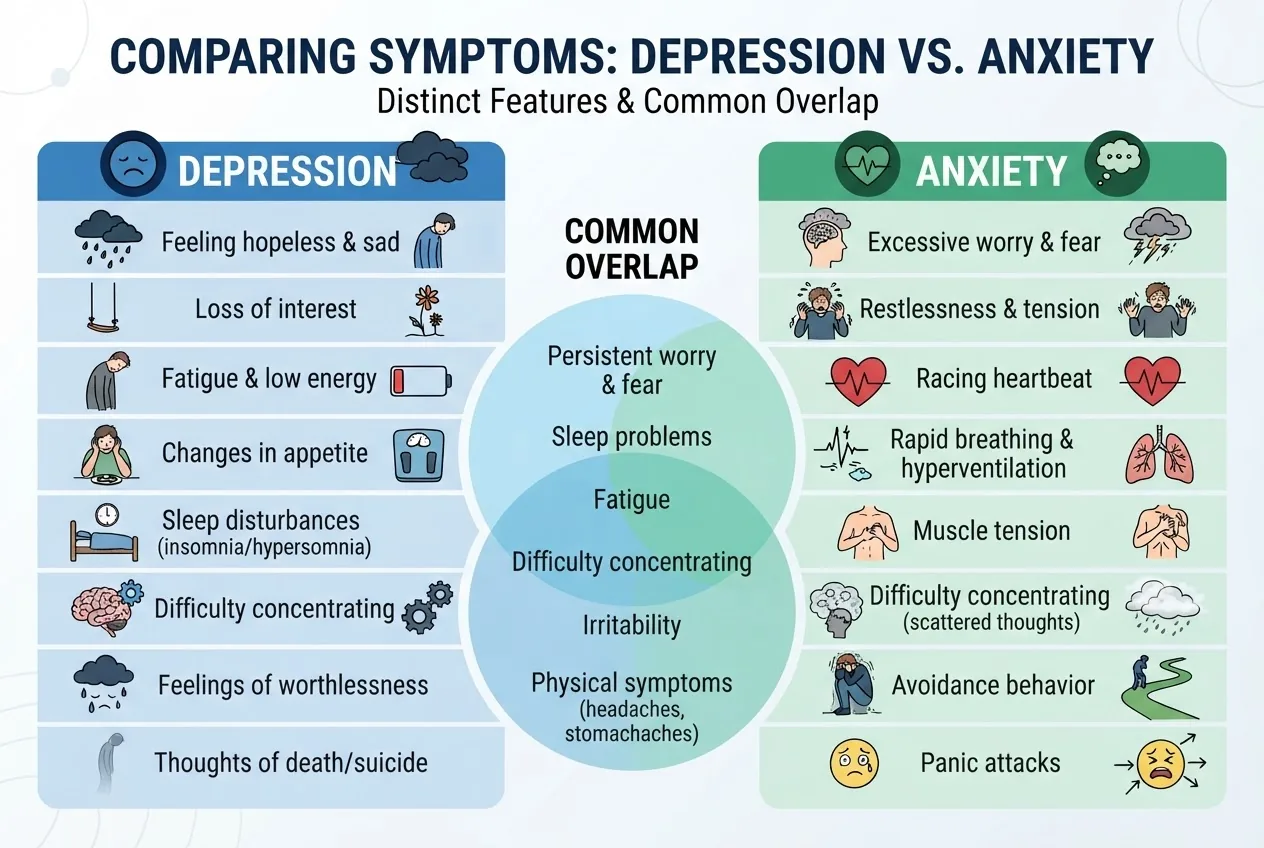
| Feature | Depression | Anxiety | Overlap / Distinction |
|---|---|---|---|
| Core affect | Persistent low mood, anhedonia | Excessive worry, fear | Distinct: mood vs worry |
| Energy | Fatigue, slowed | Tension, restlessness | Overlap: agitation possible |
| Sleep | Insomnia/hypersomnia | Insomnia, difficulty relaxing | Overlap: insomnia common |
| Cognition | Negative bias, slowed thinking | Worry-focused attention, rumination | Overlap: rumination; distinction in content |
| Somatic symptoms | Aches, appetite change | Palpitations, sweating | Overlap possible; quality differs |
| Functional effect | Withdrawal, reduced activity | Avoidance, hypervigilance | Distinct behavioural patterns |
Differential diagnosis considerations:
- Rule out bipolar disorder: screen for history of hypomania/mania before starting antidepressants.
- Evaluate comorbid medical conditions (thyroid dysfunction, anaemia) and substance use that can mimic mood symptoms.
- Assess for primary anxiety disorders when worry and hyperarousal predominate; comorbidity is common and may require combined approaches.
When symptoms overlap, clinicians determine the primary driver of impairment and choose treatment accordingly. For anxiety-dominant presentations where medication is not preferred, consider referring to our pillar on clinical interventions for anxiety treatment without medication.
Misdiagnosis risk rises when providers focus on single symptoms instead of patterns; structured interviews and longitudinal symptom timelines help clarify diagnosis.
According to a 2024 clinical review report, comorbidity between depression and anxiety disorders occurs frequently and worsens prognosis if untreated (source: clinical review report).
Transition: Accurate diagnosis uses standardised screening tools and clinical interviews; the next section summarises widely used symptom screening instruments.
Which symptom screening tools are used in clinical practice and what are their strengths and limitations?
Answer: Clinicians commonly use the PHQ-9 and Beck Depression Inventory (BDI) alongside structured clinical interviews; each tool offers quick screening, with trade-offs in depth, sensitivity and suitability for monitoring.
PHQ-9: the Patient Health Questionnaire-9 is a 9-item self-report scale aligned with DSM criteria, widely used for screening and monitoring.
Beck Depression Inventory (BDI): a 21-item self-report scale providing a broader symptom profile and severity grading.
Tool descriptions, pros and cons:
- PHQ-9 — Pros: brief, maps to DSM-5, validated in primary care, easy repeat administration; Cons: limited nuance on atypical features and bipolar screening.
- Beck Depression Inventory (BDI) — Pros: comprehensive, sensitive to change; Cons: longer, may include somatic items that overlap with medical conditions.
- Clinical interview (structured or semi-structured) — Pros: gold standard for diagnosis, captures context and differential diagnosis; Cons: time and clinician training required.
- Mood diaries and symptom trackers — Pros: capture temporal patterns and triggers; Cons: require patient engagement and consistent use.
Screening accuracy and evidence: According to a 2023 meta-analysis of screening tools, PHQ-9 demonstrates high sensitivity and moderate specificity for major depressive disorder in primary care settings (source: meta-analysis report).
Practical use in a clinic workflow:
- Initial screening: patient completes PHQ-9 prior to consultation to flag severity.
- Diagnostic interview: clinician uses a structured interview (e.g., MINI or SCID) when PHQ-9 suggests moderate-to-severe depression.
- Monitoring: repeat PHQ-9 every 2–4 weeks to assess response and guide adjustments.
Limitations to communicate to patients: screening tools are not diagnostic alone; they are aids to clinical judgement. Mention potential false positives (e.g., medical illness causing somatic items) and false negatives (e.g., masked depression in some cultural presentations).
External resources for clinicians and patients: NIMH: depression overview and screening, and the APA DSM-5 resources provide authoritative guidance on tools and diagnostic criteria.
Transition: Screening and monitoring must be adapted to cultural and local contexts; the following section covers Sydney-specific considerations.
How do cultural and local factors in Sydney, Australia affect symptom presentation and treatment?
Answer: Cultural beliefs, stigma, healthcare access, and urban stressors in Sydney influence how symptoms are reported and which services people use; tailoring assessment and treatment to local needs improves engagement and outcomes.
Local statistics and access: According to a 2024 Australian Government mental health report, one in five Australians reported a mental health condition in the prior year, with urban areas showing high service demand (source: Australian Government Department of Health report).
Key local and cultural considerations:
- Stigma and language: some cultural groups may somatise mood symptoms or prefer family-based approaches; clinicians should use culturally sensitive screening and interpreters when needed.
- Indigenous mental health: Aboriginal and Torres Strait Islander peoples have distinct presentations and service preferences; culturally safe care models and community-led services are essential.
- Healthcare access in Sydney: although multiple public and private services exist, wait times for specialist psychology may be long; stepped-care approaches in primary care help bridge gaps.
- Urban stressors: housing costs, transport, work-related stress and social isolation can exacerbate depressive symptoms and should be part of the psychosocial formulation.
Clinician strategies for local adaptation:
- Use translated, validated screening tools and culturally adapted therapy where available.
- Integrate community resources: link patients to local supports, e.g., headspace for youth, beyondblue, Lifeline, and Aboriginal community-controlled health services.
- Adopt flexible care models: telehealth, group therapy or brief interventions to reduce wait times and increase access.
For up-to-date local guidance and resources see the Australian Government Department of Health mental health pages: Australian Government Department of Health – Mental Health.
Transition: Knowing when to escalate care is essential—next is a practical checklist for seeking professional help.
When should someone seek professional help for depression symptoms and how should they do it?
Answer: Seek professional help when symptoms persist beyond two weeks, cause functional impairment, or if there are safety concerns such as suicidal thoughts; start with a GP, emergency services for urgent risk, or mental health clinics for specialised care.

- Urgent signs requiring immediate help:
- Active suicidal thoughts, plans or intent—call emergency services or Lifeline immediately.
- Severe psychomotor retardation or agitation with inability to care for self.
- When to see your GP:
- Symptoms lasting two weeks or more that affect work, relationships or daily tasks.
- Physical symptoms without clear medical cause—GP can rule out medical contributors (e.g., thyroid disease) and initiate treatment/referrals.
- When to see a mental health specialist:
- Moderate-to-severe depression, suicidal ideation, history of bipolar disorder, or poor response to initial treatment.
- Consider referral to a psychiatrist for medication management or to a psychologist for evidence-based psychotherapy (e.g., CBT).
- Practical steps to prepare for a first appointment:
- Bring a symptom timeline, PHQ-9 or other completed screening if available, medication and medical history, and a list of current stressors and goals.
- Discuss preferences for medication versus therapy, work constraints, and social supports.
Local Sydney resources: book a GP appointment, access community mental health teams through local health districts, or contact crisis lines for immediate risk. If symptoms worsen during treatment, contact your clinician promptly; escalation may include medication changes or brief admission for safety and intensive treatment.
Checklist before seeking help:
- Document symptom onset, duration and severity.
- Complete a PHQ-9 or similar tool to summarise severity.
- Prepare questions about treatment options, side effects and expected timelines.
Disclaimer: This guide explains symptom patterns and treatment considerations; only a qualified clinician can make a formal diagnosis and prescribe medication. If you are in immediate danger, contact emergency services now.
Conclusion: Accurate recognition of emotional, physical and cognitive symptoms, use of standardised screening, careful differential diagnosis and culturally sensitive care enable personalised, effective treatment plans that improve outcomes. For tailored support in Sydney, consult your GP or a specialised mental health service to start a collaborative plan.
Call to action: If you or someone you care for is experiencing these symptoms, book a GP assessment or contact a local mental health clinic to begin a documented treatment plan with regular symptom monitoring.