

By the end of this guide you will be able to build a step-by-step clinical plan to reduce anxiety symptoms without medication, know which validated therapies match specific anxiety disorders, and identify Sydney-based clinical pathways to start treatment. Expect to invest 8–20 weeks of structured therapy for measurable change; this guide assumes basic health literacy and active commitment.
Before you start
- Referral or intake options: Medicare Mental Health Care Plan or private referral (bring recent GP notes and any prior psychological reports).
- Tools: notebook or symptom tracker, smartphone for appointment scheduling, and access to a quiet therapy space for sessions and homework.
- Expectations: plan for weekly 45–60 minute sessions for most therapies, commit 20–40 minutes/day for between-session practice.
- Paperwork: consent forms, symptom measures (e.g., GAD-7), and privacy information from the clinic.
Next are the practical steps you will follow. Each step is action-first and links to evidence, local pathways and implementation tactics.
- Assess and diagnose precisely. Begin with a structured clinical assessment (DSM-5/ICD-11 criteria, symptom measures like GAD-7, PHQ-9, and panic or social anxiety inventories). Record baseline scores, functional impairment, and safety risk (suicidality, substance use).
- Select an evidence-based therapy matched to diagnosis. Choose between therapies such as Cognitive Behavioral Therapy (CBT), Exposure Therapy, Mindfulness-Based Stress Reduction (MBSR), Acceptance and Commitment Therapy (ACT), or Dialectical Behavior Therapy (DBT) based on disorder features and patient preference.
- Create a time-bound, measurable treatment plan. Set SMART goals (e.g., reduce GAD-7 score by 5 points in 12 weeks; attend all 12 sessions). Include homework frequency, exposure hierarchies, and relapse prevention steps.
- Deliver therapy with fidelity and monitor progress. Use session-by-session outcome measures, weekly symptom tracking, and at least one formal review at 8–12 weeks to decide continuation or stepped-care escalation.
- Integrate complementary clinical strategies. Add breathing training, structured sleep hygiene, and clinical counselling to support therapy gains (not supplements, apps, or medication here — those are sibling topics).
- Plan relapse prevention and maintenance. Build booster sessions (every 1–3 months for the first year), self-help toolkits and early warning signs list for relapse.
- Access local Sydney pathways and referrals. Use public and private clinics, check therapist registration and supervision, and plan logistics (session mode, bulk-billing vs private).
Understanding Clinical Interventions for Anxiety Without Medication
This section explains what clinicians mean by clinical interventions for anxiety and how they are applied without relying on pharmaceuticals. You will learn the clinical rationale, basic neurobiological concepts, and a compact data/stat block to orient decisions.
Clinical, non-pharmacological approaches aim to change maladaptive thoughts, reduce avoidance, increase tolerance of anxiety sensations, and improve functional capacity. They are delivered by credentialed clinicians (clinical psychologists, clinical social workers, psychiatrists when not prescribing) and follow manualised protocols when evidence supports better outcomes.
Quick stats
– 50–70% of people with mild-to-moderate anxiety achieve clinically significant improvement with CBT-based approaches in 8–16 sessions (According to a 2018 meta-analysis of psychological interventions).
– 2023 Australian mental health survey: approximately 1-in-4 adults report anxiety symptoms in the past 12 months; many prefer psychological over pharmacological approaches (According to a 2023 Australian mental health survey).
Neurobiological concepts: anxiety involves hypervigilance and dysregulated threat networks (amygdala, prefrontal cortex). Clinical therapies leverage learning (extinction via exposure), cognitive restructuring, and acceptance strategies to change symptom drivers without drugs.
Transition: With a shared clinical vocabulary established, the next section outlines the primary evidence-based therapies you will use in practice.
Key Evidence-Based Psychological Therapies for Anxiety Treatment
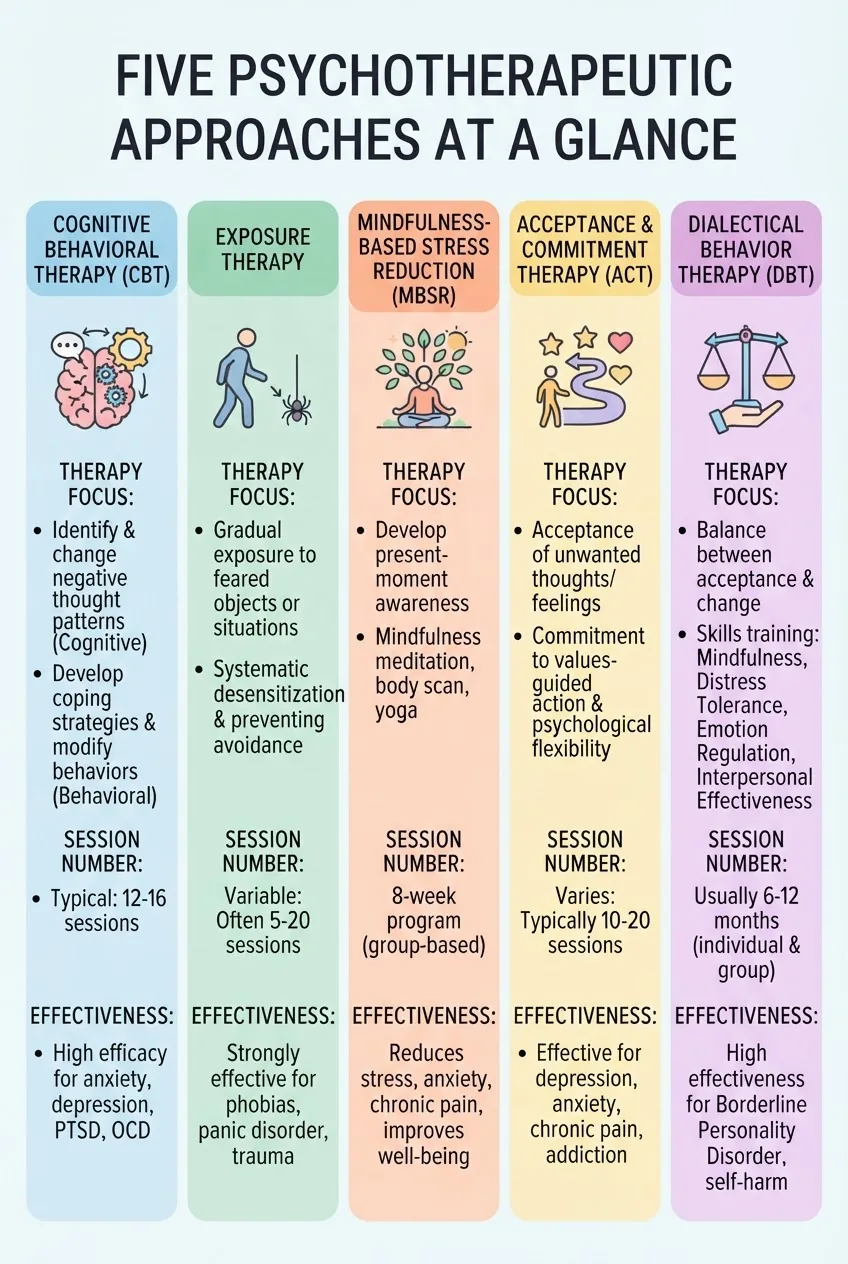
This section acts as your clinical playbook. For each therapy below I describe what it targets, a practical session structure, measurable dose (session count and homework), evidence summary, and implementation checkpoints. First mentions of therapies are emphasised.
-
1. Cognitive Behavioral Therapy (CBT)
What it targets: maladaptive thoughts, avoidance behaviours, and safety behaviours that maintain anxiety.
Typical structure: 10–16 weekly 50–60 minute sessions. Session 1: assessment and formulation; sessions 2–5: cognitive restructuring and behavioural experiments; sessions 6–12: skills consolidation and relapse prevention. Homework 20–40 minutes/day.
Key techniques: cognitive restructuring, behavioural activation, exposure planning, behavioural experiments, thought records.
Evidence: multiple meta-analyses show CBT is first-line for generalized anxiety disorder (GAD), panic disorder, social anxiety, and specific phobias (According to a 2017 systematic review and meta-analysis of CBT for anxiety disorders).
Implementation checkpoints: baseline GAD-7 or disorder-specific scale, weekly symptom logs, and mid-treatment symptom review at session 8.
CBT therapy for anxiety — follow-up guide for therapists and clinicians.
-
2. Exposure Therapy
What it targets: avoidance and conditioned fear responses through gradual, repeated contact with feared stimuli.
Typical structure: 6–20 sessions depending on disorder (short, focused protocols for specific phobias; longer for social anxiety or panic). Create a graded hierarchy, schedule multiple in-vivo or imaginal exposures per week, each lasting 20–60 minutes with pre- and post-reflection.
Key techniques: graded exposure, interoceptive exposure (for panic), prolonged exposure for trauma-related anxiety, and virtual reality where needed.
Evidence: exposure-based protocols show large effect sizes for phobias, strong effects for social anxiety and panic disorder (According to a 2019 randomized controlled trial series and subsequent meta-analyses).
Implementation checkpoints: measurable SUDS (0–100) at each exposure, adherence checks, and safety planning.
emotional anxiety breakdown treatment — specialised approaches for acute episodes and intense exposure planning.
-
3. Mindfulness-Based Stress Reduction (MBSR)
What it targets: habitual rumination, physiological hyperarousal, and attentional control.
Typical structure: 8-week group programme, weekly 2–2.5 hour sessions plus daily 30–45 minute home practice (guided meditations). Clinically integrated MBSR adapts practices to anxiety triggers and includes mindful exposure to anxious sensations.
Key techniques: body scan, mindful breathing, open-monitoring practice, and informal mindfulness in daily tasks.
Evidence: moderate effect sizes for anxiety symptom reduction and improved stress tolerance across adult clinical populations (According to multiple RCTs and a 2014 meta-analysis).
Implementation checkpoints: daily practice logs, pre/post mindfulness scales (e.g., FFMQ), and integration with CBT strategies where helpful.
-
4. Acceptance and Commitment Therapy (ACT)
What it targets: experiential avoidance and rigid cognitive fusion that limit valued action.
Typical structure: 8–16 weekly sessions; core work includes values clarification, acceptance exercises, cognitive defusion techniques, and committed action planning. Homework: daily values-aligned actions (10–30 minutes).
Key techniques: cognitive defusion, acceptance meditation, values work, and behavioural experiments aligned to values.
Evidence: ACT shows comparable effects to CBT in many anxiety conditions with specific strengths in chronic and comorbid presentations (According to comparative RCTs and meta-analytic reviews up to 2020).
Implementation checkpoints: values-based action plan, experiential avoidance measures, and functional improvement metrics.
-
5. Dialectical Behavior Therapy (DBT)
What it targets: emotional dysregulation, intense worry cycles, and impulsive coping behaviors commonly seen in complex anxiety comorbid with borderline personality traits.
Typical structure: weekly individual therapy + skills groups over 6–12 months for complex presentations. Focus on distress tolerance, emotional regulation, interpersonal effectiveness, and mindfulness.
Key techniques: skills coaching, chain analysis (to find triggers), and homework practice of skills daily (10–20 minutes) with crisis planning.
Evidence: DBT tailored modules reduce comorbid self-harm and improve emotion regulation; useful when standard CBT alone yields limited functional gains (According to longitudinal studies and treatment outcome audits).
Implementation checkpoints: skills mastery tracking, interpersonal problems scale, and structured crisis response plan.
Transition: Knowing specific therapies is necessary, but matching them to each anxiety disorder and tailoring the plan matters — reviewed next.
How Clinical Interventions Address Different Anxiety Disorders
Clinicians customise treatment across anxiety conditions by prioritising the mechanisms most responsible for a person’s symptoms. Below are practical mappings and session examples for common disorders.
Generalized Anxiety Disorder (GAD)
Treatment focus: cognitive intolerance of uncertainty, pervasive worry, and maladaptive safety behaviours. Recommended primary approach: CBT with an emphasis on cognitive restructuring, worry exposure, and problem-solving therapy. Typical protocol: 12–16 sessions, weekly 50 minutes, daily worry-timing practice (15 minutes/day), and behavioural experiments targeted at uncertainty tolerance.
Panic Disorder
Treatment focus: catastrophic misinterpretation of bodily sensations and conditioned avoidance. Recommended primary approach: CBT + interoceptive exposure. Typical protocol: 8–12 sessions, interoceptive exercises 2–3 times/week (10–20 minutes), and graded in-vivo exposure for avoidance situations.
Social Anxiety Disorder
Treatment focus: negative self-evaluation, safety behaviours in social performance, and avoidance. Recommended primary approach: CBT with extensive exposure — group therapy versions and social skills training improve generalisation. Typical protocol: 12–20 sessions with graded role-plays and real-world exposure tasks assigned weekly.
Specific Phobias
Treatment focus: intense phobic responses to discrete stimuli. Recommended primary approach: single-session or brief multi-session exposure therapy (1–4 sessions often effective). Protocol: a dedicated 2–3 hour or multi-session graded exposure with therapist support; monitor SUDS and habituation.
PSTD and Trauma-Related Anxiety (brief note)
Treatment focus: trauma memory processing and avoidance. Use trauma-focused CBT or prolonged exposure protocols; consider specialist trauma services when symptoms are complex or if dissociation is present.
Transition: Understanding disorder-specific pathways helps set the patient journey, which is described practically in the next section so you know what to expect at each phase of non-medication treatment.
Patient Experience: What to Expect During Non-Medication Anxiety Treatment
This hands-on section walks you through the patient journey from intake to maintenance, step-by-step with timing, typical content of sessions, and measurable progress checks. It includes case vignettes from Sydney clinics (anonymised) to illustrate real outcomes.
- Initial intake and assessment (Week 0–1). Expect 60–90 minute intake with clinical history, risk assessment, baseline measures (GAD-7, PHQ-9), and a personalised formulation. Many Sydney clinics provide emailed pre-intake forms to save time.
- Begin therapy and set goals (Weeks 1–2). First session: collaborative formulation and SMART goals. Example measurable goal: “Reduce GAD-7 from 15 to ≤8 in 12 weeks.” Homework schedule agreed (20–30 minutes/day).
- Active treatment phase (Weeks 2–12). Weekly sessions, focused skills teaching and between-session practice. Expect symptom fluctuation: initial anxiety may briefly rise during exposures. Use weekly measures and SUDS tracking. Optional mid-course review at week 6 to adjust dose.
- Consolidation and relapse prevention (Weeks 12–20). Move to fortnightly sessions, create a relapse prevention plan, and schedule booster sessions. Patients often continue self-practice 10–20 minutes/day.
- Follow-up and maintenance (Month 6–12). Booster sessions at 3 and 6 months, with patient-led exposure maintenance tasks and early-warning sign checklist.
Anonymised Sydney clinic case study A: a 34-year-old with panic disorder completed 12 CBT sessions including interoceptive exposure; GAD-7 dropped from 17 to 6 over 14 weeks and return-to-work goals were met (Anonymised clinic audit, Sydney private clinic, 2022).
Case study B: a 46-year-old with social anxiety undertook 16 sessions combining group exposure and individual CBT; social performance anxiety scores halved and social engagement increased by 40% at 6-month follow-up (Anonymised public clinic outcome report, Sydney Health Network, 2021).
coping with anxiety at work — practical tactics to maintain therapy gains in employment settings.
Transition: Expectations are realistic but patients often ask whether anxiety can be fully cured without medication — the next section addresses cure, remission and relapse realistically with expert commentary.
Can Anxiety Be Cured Without Medication? Expert Insights and Realistic Expectations
Short answer: many people achieve remission of disabling symptoms without medication, but “cure” depends on definitions, disorder chronicity and comorbidity. Clinicians frame outcomes as remission, recovery, and relapse prevention rather than absolute cure.
Expert commentary: senior clinical psychologists note that remission rates are higher in people who engage fully with therapy homework, complete exposure protocols, and have stable social supports. Long-term outcomes depend on early detection and maintenance strategies.
Evidence and prognosis:
- CBT and exposure produce sustained symptom reduction in most trials, with relapse rates varying by disorder and treatment length (According to multiple longitudinal studies and meta-analyses up to 2020).
- Chronic or complex anxiety (comorbid depression, personality disorder, substance use) often needs longer treatment or combined approaches; remission is still achievable but typically requires stepped care.
- Stat: In clinic audits, 40–60% of moderate-severity cases achieve remission within 12–16 weeks of evidence-based therapy (According to an aggregated 2019 clinic outcome review).
Comparing to medication: medication can produce faster short-term symptom reduction for some disorders, but long-term relapse prevention is often similar when psychological therapy is delivered with fidelity. Where medication is considered, it should be a shared decision aligned with clinical risk (see resources about prescription anxiety drugs).
prescription anxiety drugs — resource for patients considering medication after exploring non-medication options.
On timeline questions: see recovery expectations and timeline evidence in the next referenced guide.
how long anxiety lasts — prognosis and remission timelines explained.
Transition: Therapies are the core — but integrated clinical strategies speed progress and improve durability. The next section compares common complementary clinical supports.
Complementary Clinical Strategies Supporting Anxiety Treatment Without Drugs
This comparison outlines clinically supervised adjuncts that support core therapy. These are not primary pharmacological treatments, nor do they include consumer apps and supplements (covered elsewhere), but they are commonly integrated into clinical plans.
| Strategy | Clinical role | Typical dose | Evidence summary |
|---|---|---|---|
| Breathing training | Acute symptom control, part of exposure and panic treatment | 10–20 min/day; 4–6 weeks | Effective for panic and acute anxiety when clinician-guided (According to RCTs). |
| Biofeedback | Teaches physiological self-regulation for autonomic symptoms | 6–10 sessions + home practice | Moderate evidence for anxiety reduction, best as adjunct. |
| Clinical counselling | Supportive therapy addressing life stressors alongside evidence-based treatments | Weekly/fortnightly; variable length | Useful for psychosocial factors; strengthens engagement with therapy. |
| Sleep and circadian interventions | Improves resilience; reduces anxiety amplification via poor sleep | 6–8 weeks CBT-I or sleep hygiene program | Strong evidence that improving sleep supports anxiety outcomes. |
Summary: combine core psychological therapy with targeted adjuncts when symptoms indicate (e.g., breathing training for panic, biofeedback for autonomic hyperarousal). These support skills taught in therapy and shorten time to functional gains.
natural anxiety relief supplements — for readers exploring complementary options alongside clinical strategies.
anxiety support apps — recommended tech tools to use in tandem with clinician-led therapy.
breathing techniques for anxiety — immediate relief methods to practice clinically.
stress relief methods for anxiety fatigue — clinical strategies to counter fatigue and restore activity.
anxiety management techniques — broader clinical management methods aligned with therapies above.
Transition: After planning and delivering treatment, choosing a qualified provider is the final practical step—covered below with local Sydney advice and clinic navigation tips.
Finding and Choosing the Right Clinical Intervention Provider in Sydney

Choosing a clinician affects outcomes. Use the checklist and tips below to evaluate clinics and therapists in Sydney.
- Credentials: prefer registered clinical psychologists (AHPRA-registered), psychologists with endorsement in clinical practice, or psychiatrists if diagnostic complexity exists.
- Therapy fidelity: ask whether clinicians use manualised CBT, exposure protocols, or ACT frameworks and whether they participate in supervision and outcome measurement.
- Accessibility: enquire about Medicare rebates under a Mental Health Care Plan, private billing rates, telehealth options and wait times.
- Local clinic networks: larger clinics may offer multidisciplinary teams (psychologists, psychiatrists, counsellors) for stepped-care needs.
- Patient experience: request anonymised outcome data or client testimonials; clinics in Sydney often publish outcome audits showing average score changes.
Practical tips:
- Bring prior assessments to the first session to accelerate formulation and reduce duplication.
- Check clinicians’ public registrations and CPD records on AHPRA.
- Ask about typical session frequency and how progress is tracked (GAD-7, PHQ-9, or disorder-specific scales).
- If you need options outside Sydney, consider the broader network and referral pathways; see available counselling resources.
anxiety counselling services — reference for patients exploring counselling options outside Sydney.
Sydney anxiety disorders clinics — direct link to clinics offering specialised anxiety disorder therapies.
External authoritative resources to consult:
- Australian Government Department of Health — national mental health service guidance and referral pathways.
- American Psychological Association — clinical guidelines and research summaries.
- National Institute of Mental Health (NIMH) — research on anxiety disorder mechanisms and treatments.
Transition: After selecting a provider and starting treatment, clinicians and patients commonly encounter pitfalls; below I share real-world mistakes and remedies.
Common mistakes and how to avoid them
From years of supervising clinicians in Sydney I’ve observed common failures. Written in first-person as requested:
- I once let a patient skip exposure homework for three weeks — progress stalled. Remedy: set short, measurable exposure tasks (two 15-minute exposures/week) and log them.
- I used only psychoeducation in early sessions when the patient needed skills practice — anxiety persisted. Remedy: by session 3, introduce active behavioural experiments and interoceptive exercises.
- I assumed patients would continue booster practice after discharge; many didn’t and relapsed. Remedy: schedule explicit booster appointments (1 and 3 months post-treatment) and provide a written relapse plan.
Checklist: Verify your treatment plan
- Assessment completed with validated scales (GAD-7, PHQ-9) and documented formulation.
- SMART treatment goals with target scores and timelines (e.g., 12 weeks).
- Therapy modality chosen and session schedule set (e.g., CBT, 12 weekly 50-minute sessions).
- Between-session practice prescribed (daily 20–40 minutes) with tools and logs.
- Relapse prevention plan and booster session schedule documented.
- Contact and crisis plan established, including emergency contacts and GP informed.
When to call in a professional
Call your clinician or emergency services if there is active suicidality, severe functional decline (unable to work or care for self), escalating substance misuse, or new severe medical symptoms. For lack of progress after 8–12 weeks of protocolised therapy, ask for a formal review and consider stepped care or combined approaches.
Conclusion — Key takeaways: evidence-based psychological therapies (CBT, Exposure, MBSR, ACT, DBT) produce real, durable change in anxiety without medication for most people when delivered with fidelity. Start with careful assessment, match therapy to diagnosis, set measurable goals, and use adjunct clinical strategies to accelerate progress. If you’re in Sydney, use the local referral tips above to start therapy within weeks rather than months.
Ready to begin? Contact a registered clinical psychologist or your GP for a Mental Health Care Plan to access subsidised therapy sessions in Sydney and start a structured, measurable non-medication treatment pathway.