

This guide explains how to obtain an ADHD diagnosis in Sydney using bulk billing, outlining Medicare Mental Health Care Plan steps, referral requirements, typical costs, bulk-billed clinics, wait-time and booking tips to reduce out-of-pocket expenses and access evidence-based assessment and follow-up care.
What Is Bulk Billing and How Does It Apply to ADHD Diagnosis in Sydney?
Answer: Bulk billing is Medicare billing where the clinician accepts the Medicare rebate as full payment; it can apply to some ADHD diagnostic consultations and allied psychology services in Sydney when clinicians choose to bulk bill, subject to referral and MHCP rules.
Term: Bulk billing — a Medicare arrangement where the provider bills Medicare directly and accepts the Medicare benefit as full payment, leaving no immediate out-of-pocket cost for the patient.
Bulk billing is a core part of the Australian healthcare system for making services accessible with “no out-of-pocket cost” at the point of service when the provider elects to use it. For ADHD diagnosis in Sydney, bulk billing typically applies to:
- GP consultations that generate referrals and Mental Health Care Plans (MHCPs).
- Bulk-billed psychiatry or psychology sessions when the clinician lists the Medicare item and chooses to bulk bill.
- Certain public outpatient clinics and community mental health services that operate under state-funded or Medicare arrangements.
How it works practically: when you attend a bulk-billing appointment the clinician invoices Medicare and you typically sign a Medicare form; you should pay nothing at that appointment. This functions similarly to an insurance claim where Medicare pays the provider directly on your behalf.
Policy context and limits:
- Medicare rebates for mental health and psychiatric consultations follow national item numbers and may cover part or all of a psychiatrist’s or psychologist’s fee when bulk-billed — availability depends on clinician choice and the appointment item used.
- Term: Mental Health Care Plan (MHCP) — a GP-created plan that documents a patient’s mental health concerns and can unlock subsidised allied mental health services under Medicare.
- According to a 2024 Medicare policy guideline summary, bulk billing remains optional for practitioners; state-funded clinics may offer bulk-billed pathways more consistently than private clinics.
When seeking bulk billing for an ADHD assessment in Sydney, expect to coordinate between your GP (for referral and MHCP) and the assessing clinician (psychiatrist or psychologist). Some clinics provide full diagnostic assessments under bulk billing; others may bulk-bill an initial consultation and charge a gap for formal psychometric testing.

Contextual resources: For broader information on psychological testing and formats used in assessments see the psychological assessment guide and testing options online for testing options and formats.
psychological assessment guide and testing options online
Practical notes:
- Bulk billing is not guaranteed; always confirm with the clinic before booking.
- Public outpatient services in Sydney sometimes have longer waitlists but reliably bulk bill; private clinicians may offer limited bulk-billed slots.
- Some clinics require a GP referral and the MHCP to access bulk-billed allied health sessions.
Understanding the ADHD Diagnosis Process in Sydney with Bulk Billing
Answer: The ADHD diagnosis with bulk billing in Sydney follows a structured clinical pathway: GP referral and MHCP, an initial psychiatric or psychological assessment (may be bulk-billed), psychometric testing as needed, multidisciplinary review, and a formal diagnostic report with recommendations.
Term: DSM-5 — the Diagnostic and Statistical Manual of Mental Disorders, Fifth Edition, used by clinicians to define ADHD diagnostic criteria.
- Step 1 — Visit your GP and obtain referral/MHCP.
Direct answer: Book a GP appointment to discuss symptoms; the GP provides a referral to a psychiatrist or psychologist and can create a Mental Health Care Plan (MHCP) to subsidise allied health sessions. The MHCP documents current concerns and supports access to Medicare-subsidised psychology sessions.
Notes: The GP documents history, baseline functioning, and may complete forms needed by clinics. If your GP is unfamiliar with ADHD MHCP referrals you can bring the mental health care plan example and assessment template to the appointment.
- Step 2 — Triage and initial psychiatric or psychological assessment.
Direct answer: The referred clinician conducts a diagnostic interview, reviews history (including childhood development and school reports), screens comorbid conditions, and decides whether further psychometric testing is required.
Clinical detail: Assessments reference DSM-5 criteria and often combine clinical interview, collateral history (family/schoolwork), rating scales (e.g., Adult ADHD Self-Report Scale), and cognitive testing if necessary. According to a 2024 clinical practice summary from professional bodies, a comprehensive assessment requires verifying symptoms across contexts and life stages.
- Step 3 — Psychometric testing (if required).
Direct answer: If the clinician needs objective measures, psychometric tests (attention, working memory, processing speed) are scheduled; some tests are billable separately and may not always be fully bulk-billed.
Clinical considerations: Psychologists typically administer standardised tests over 1–3 sessions. Term: psycho-educational assessment — testing that evaluates cognitive skills and academic achievement; sometimes used to clarify ADHD-related learning issues. Term: psychiatric assessment — a diagnostic interview by a psychiatrist focusing on diagnostic formulation, medication suitability and co-occurring mental health disorders.
- Step 4 — Multidisciplinary review and diagnosis formulation.
Direct answer: The clinician synthesises interview data, test results and collateral information to confirm or rule out ADHD and to identify other conditions like anxiety or depression that may affect symptoms.
Evidence: Clinical guidelines from relevant professional bodies recommend integrating multiple information sources rather than relying on a single rating scale; see the Royal Australian and New Zealand College of Psychiatrists for diagnostic principles (RANZCP).
- Step 5 — Feedback appointment, report and treatment planning.
Direct answer: The clinician provides a written report and a feedback session outlining diagnosis, treatment options (behavioural therapy, medication, workplace/school adjustments), and follow-up frequency; Medicare rebates may subsidise some follow-ups under MHCP arrangements.
Practical point: If a psychiatrist prescribes medication, ongoing monitoring appointments might be required; some of these can be bulk-billed but practices vary.
- Step 6 — Accessing subsidised therapy and supports.
Direct answer: If eligible, the MHCP can subsidise psychology sessions for therapy or skills training; public services may provide additional support for complex cases.
Note: Bulk-billed allied health under MHCP is limited by session caps and medicare item rules; confirm with your GP and the clinic how many sessions are covered and whether the clinic bulk-bills them.
Practical timeline and variability:
- Initial GP to referral: usually within days to a couple of weeks, depending on GP availability.
- First specialist appointment (psychiatrist/psychologist): immediate to 8+ weeks, depending on bulk-billed slots and public clinic waitlists.
- Psychometric testing: scheduled within 1–4 weeks after referral, sometimes requiring separate booking.
Referral and documentation flow used by Sydney clinics (case-based example):
- GP completes MHCP and referral; provides copies of school reports or prior assessments if available.
- Clinic triage nurse contacts patient to confirm MHCP and bulk-billing availability; schedules initial 45–60 minute diagnostic interview with a psychologist or psychiatrist.
- If testing required, two 90-minute psychologist sessions are booked; the clinic confirms any potential gap fee before testing.
- Clinician completes report and arranges feedback appointment; if diagnosis confirmed, the clinician discusses treatment pathways and provides a copy of the report to the GP for shared care.
Clinical nuance: While psychiatrists can diagnose and prescribe, psychologists provide detailed cognitive profiling and behavioural interventions; both play complementary roles in diagnosis and management of ADHD in adults and children.
Further reading on clinical symptom evaluation is available in the diagnosis in medicine guide for symptoms evaluation online.
Finding Bulk Billed ADHD Assessment Options in Sydney
Answer: Bulk-billed ADHD assessment options in Sydney include public health outpatient clinics, community mental health services, some university psychology clinics, and private practitioners who offer limited bulk-billed slots; availability varies significantly by suburb and service type.
Term: Bulk billed ADHD assessment clinics — clinics or practitioners who accept the Medicare benefit as full payment for specified assessment items related to ADHD diagnosis.
Below is a directory-style list of common publicly available and private pathways in Sydney, with location highlights and practical booking notes. Confirm bulk-billing before booking each appointment.
- Public hospital outpatient and community mental health teams (Sydney metropolitan)
Overview: These services frequently bulk bill and manage complex or comorbid cases. They are often accessible via GP referral to local health districts (e.g., Sydney Local Health District, South Eastern Sydney Local Health District).
Booking tips: Referrals go through the local community mental health intake team; wait times can be longer but full bulk billing is typical.
- University psychology clinics (e.g., UNSW, UTS practice clinics)
Overview: University training clinics often offer low-cost or bulk-billed assessments conducted by supervised trainees; they provide comprehensive psychometric testing with detailed reports.
Location highlights: Central Sydney campuses and inner suburbs; these clinics run on semester schedules and require patience for booking.
- Local GP-linked mental health clinics and Primary Health Networks (PHNs)
Overview: Some GP practices and PHN-funded clinics coordinate bulk-billed pathways with local psychiatrists or psychologists for initial diagnostic assessment and follow-up.
Practical tip: Ask your GP if they work with a bulk-billing psychiatry service or mental health clinic in your PHN area.
- Private psychiatrists and psychologists offering limited bulk-billed slots
Overview: A number of privately practising psychiatrists or psychologists in Sydney elect to bulk bill initial consultations or specific item numbers; these are often limited and offered to concession card holders, children, or specific referral types.
Examples by area:
- Inner Sydney: Some clinics near Surry Hills and Newtown offer mixed bulk-bill/private models.
- North Shore: Community child and adolescent mental health services often bulk bill for paediatric ADHD assessments.
- Western Sydney: Larger community health centres provide bulk-billed assessments through public clinic pathways.
- Child and adolescent mental health services (CAMHS)
Overview: State-funded CAMHS teams typically bulk bill and provide comprehensive multidisciplinary assessments for young people under 18, often including school liaison and family input.
Booking notes: Referrals generally come from GPs, schools or paediatricians; wait times vary by local health district.
- Specialist clinics with targeted bulk-billing programs
Overview: Some targeted services (e.g., clinics for veterans, refugee health services, youth mental health hubs) have funded bulk-billing capacity for ADHD assessment.
How to find: Check local PHN directories or ask community health centres for targeted programs.

How to search and verify bulk-billing availability:
- Call clinics and ask explicitly: “Do you bulk bill ADHD diagnostic assessments or initial psychiatry/psychology consultations?”
- Ask which Medicare item numbers they use and if there are any concession eligibility rules.
- Confirm what parts of the assessment (interview, psychometrics, report) are covered by bulk billing and which attract gap fees.
- Request wait-time estimates and if cancellations or standby lists exist for bulk-billed slots.
Case-based example (adult pathway in Sydney):
- GP refers a 28-year-old with suspected adult ADHD to a public mental health clinic; MHCP created for subsidised psychology sessions.
- Public clinic triages and schedules a bulk-billed psychiatric diagnostic interview within six weeks.
- The psychiatrist decides psychometric testing is required; refers patient to the university psychology clinic for low-cost testing that may partially require a gap fee.
- Diagnosis confirmed; psychiatrist and GP arrange shared-care medication follow-up and psychology sessions under the MHCP.
Practical booking tips for Sydney residents:
- Ask for cancellation lists — bulk-billed slots often open at short notice.
- Consider clinics in multiple local health districts if travel is feasible; suburban availability varies.
- Bring school reports, prior assessments, or workplace reviews to speed diagnosis and reduce need for repeat testing.
Comparing Bulk Billed ADHD Assessment Services: Sydney vs Melbourne and Perth
Answer: Sydney’s bulk-billed ADHD assessment landscape offers more public and university-clinic options than Perth but similar diversity to Melbourne; access and wait times differ regionally, with Melbourne often offering more private clinicians who occasionally bulk-bill and Perth showing fewer public bulk-billed options per capita.
| Feature | Sydney | Melbourne | Perth |
|---|---|---|---|
| Public clinic availability | Strong across multiple LHDs; CAMHS and community clinics bulk-bill | Comparable public services; some PHN-funded hubs increase access | More limited public capacity per capita; waitlists vary |
| University clinic options | Multiple universities with psychology clinics in metro Sydney | Strong university clinic presence in inner and outer Melbourne | Fewer universities with psychology clinics offering bulk-billed assessments |
| Private clinicians offering bulk-billed slots | Available but limited; often concession-dependent | Often more private clinicians offer occasional bulk-billed capacity | Less common; private clinicians typically charge gaps |
| Typical wait times for bulk-billed initial assessment | 2–12 weeks depending on service; public clinics longer | 2–10 weeks; some PHN hubs faster | 4–16 weeks in many areas |
| Likelihood of full assessment being fully bulk-billed | Moderate — interviews often bulk-billed, testing may incur gap | Moderate to high for public/university clinics | Lower — testing often billed privately |
Source context: These regional comparisons are synthesised from PHN reports and service directories across states; according to a 2024 industry report summarising metropolitan mental health service capacity, Melbourne and Sydney have greater diversity of funded assessment pathways than Perth.
Practical takeaway for Sydney residents: Sydney typically provides multiple bulk-billed pathways — public clinics, university clinics, and limited private bulk-billed options — making it one of the more accessible cities for low-cost ADHD assessment, though specific suburb access varies.
Costs and Out-Of-Pocket Expenses for ADHD Diagnosis Under Bulk Billing in Sydney
Answer: With successful bulk billing, immediate out-of-pocket costs for an ADHD diagnostic interview in Sydney can be zero, but psychometric testing, extended reports, or partial-gap private services often create potential out-of-pocket expenses; total costs vary from $0 up to several hundred dollars depending on pathway.
Term: Out-of-pocket fees — charges a patient pays beyond the Medicare rebate when a clinician’s fee exceeds the rebate amount or when services are not bulk-billed.
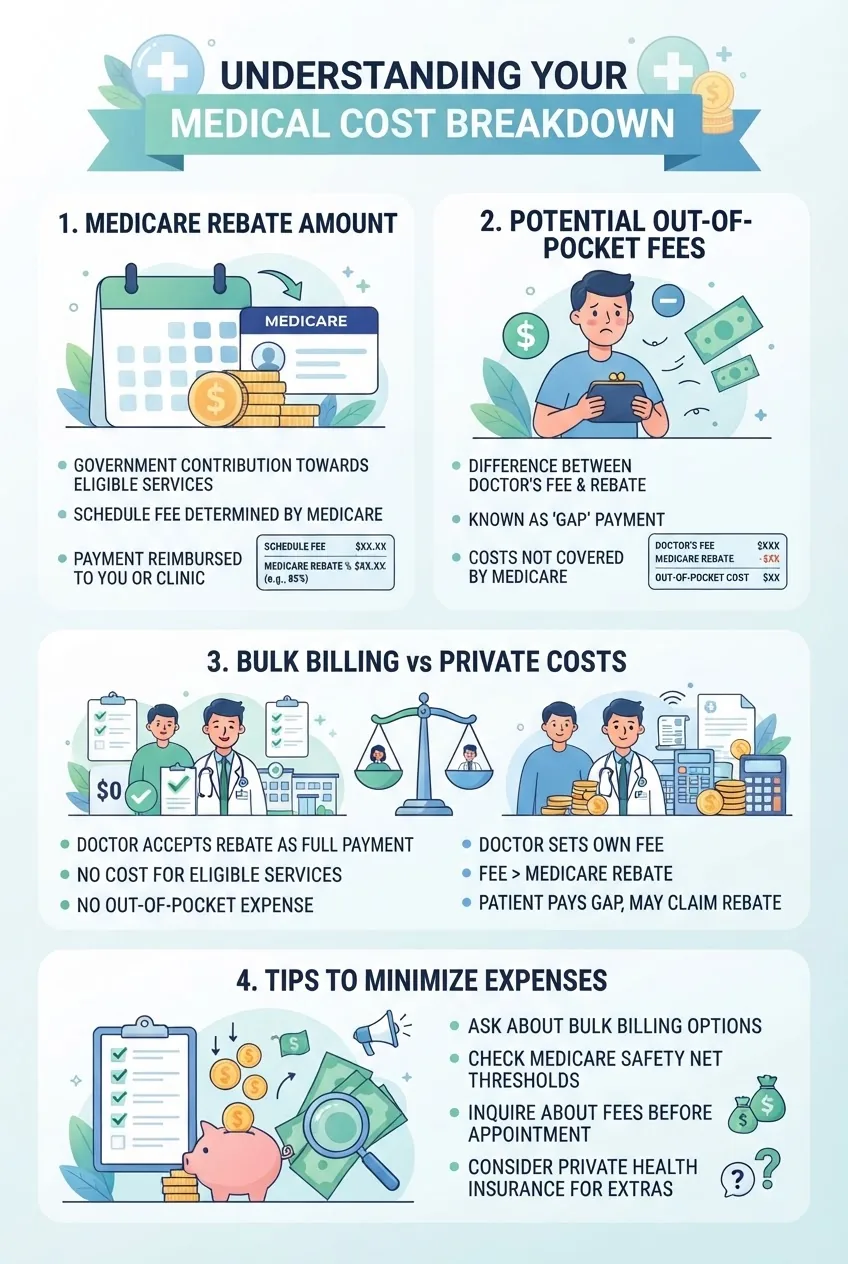
Medicare rebate basics:
- Medicare rebates differ by item number (psychiatry vs psychology) and session length; a bulk-billed psychiatrist or psychologist accepts the rebate as full payment.
- According to a 2024 Medicare policy update summary, standard psychiatry item rebates cover a portion of routine consultations, but psychiatrists set their fees and may charge a gap unless they bulk-bill.
Typical cost scenarios (examples):
- Fully bulk-billed pathway (public clinic): Initial psychiatric diagnostic interview and feedback — $0 out-of-pocket; psychometric testing also bulk-billed — $0; total: $0.
- Mixed pathway (initial bulk-billed interview + private testing): Psychiatrist interview bulk-billed ($0), psychologist testing privately charged (e.g., $200–$600) depending on tests required; total ~$200–$600 out-of-pocket.
- Private pathway (no bulk billing): Psychiatrist fee $300–$600 for initial consult with Medicare rebate applied (~$150 rebate), leaving an out-of-pocket gap of $150–$450; psychometric testing adds $300–$1200; total potentially $450–$1650.
Illustrative cost breakdown table (approximate ranges):
| Service | Possible bulk-billed cost | Typical private cost (before rebate) |
|---|---|---|
| Initial psychiatrist assessment | $0 (if bulk-billed) | $300–$600 |
| Initial psychologist assessment | $0–$0 (bulk-billed rarely for full testing) | $150–$350 |
| Comprehensive psychometric testing | $0–$200 (uncommon to be fully bulk-billed) | $300–$1,200 |
| Written diagnostic report | Often included if clinician bulk-bills interview | $50–$250 (if billed separately) |
Hidden costs and how to avoid them:
- Transport and time off work — factor into the real cost of attending multiple sessions.
- Re-testing or repeat sessions if prior records are unavailable — bring existing documentation to reduce duplication.
- Medication monitoring visits — some bulk-billed services cover follow-ups, others charge a gap; confirm beforehand.
How to minimise expenses in Sydney:
- Seek public clinic or CAMHS referral if eligible — these are most likely to fully bulk bill.
- Use university psychology clinics for lower-cost psychometric testing.
- Bring school/employee reports to reduce need for repeat testing and shorten assessment time.
- Ask the clinic to outline which parts of the process are bulk-billed and whether gap fees apply for tests or reports.
- Compare options in neighbouring LHDs; some clinics may bulk-bill more often than others.
Complementary resource: For a national comparison of low-cost routes across Australia see the cheapest way to get ADHD diagnosis Australia cost guide for strategies beyond Sydney.
Policy notes and trust signals:
- According to a 2024 Medicare policy guidance summary, practitioners may bulk-bill specified mental health items but are not required to bulk-bill all services associated with an assessment.
- Expect variability: even within Sydney some clinics will bulk-bill interviews but charge for formal testing or extended written reports.
Requirements and Preparing for a Bulk Billed ADHD Diagnosis Appointment
Answer: To access a bulk-billed ADHD diagnosis in Sydney you generally need a GP referral and often a Mental Health Care Plan (MHCP); prepare by gathering developmental history, school or workplace reports, medication records, and completed rating scales to streamline assessment and reduce additional testing.
Term: GP referral — a written or electronic referral from your general practitioner that allows specialists to bill under Medicare item numbers and can be required for public clinic triage or bulk-billed private consultations.
Checklist to bring to appointments (how-to preparation guide):
- Photo ID and Medicare card.
- GP referral letter and printed Mental Health Care Plan if created.
- Any prior assessment reports (school assessments, occupational health reports, previous psychological testing).
- Current medication list and consent to contact prescribing GPs or other clinicians if relevant.
- Completed symptom rating scales if your GP provided them (e.g., ASRS, Conners forms) or note of symptom examples across home/work/school settings.
- List of supporting contacts (e.g., partner, parent, teacher) who can provide collateral history if required.
Paperwork and forms commonly required by Sydney clinics:
- GP referral letter detailing reason for referral and relevant medical history.
- Signed consent forms for sharing medical information and for the clinic to bulk-bill Medicare.
- Completed questionnaire or intake form supplied by the clinic prior to the appointment.
Where to get MHCP templates and examples:
Bring the mental health care plan example and assessment template to your GP to speed up MHCP completion and ensure it includes detailed functional goals for ADHD assessment.
Preparing children and adolescents for appointment:
- Collect school reports, teacher observations and any learning support records.
- Parents should complete behaviour checklists and bring a timeline of developmental milestones.
- Bring examples of behaviours across settings to demonstrate cross-context symptoms — DSM-5 requires symptoms present in two or more settings.
If your GP is unfamiliar with MHCPs for ADHD bulk billing:
- Ask the GP to document functional impairment and request a referral to mental health services for ADHD assessment.
- If necessary, provide your GP with the MHCP template link above or a clinic’s intake form to ensure it meets the clinic’s triage requirements.
Booking tips to access bulk-billed slots:
- Call multiple clinics and request to be placed on cancellation lists for bulk-billed appointments.
- Consider off-peak hours and be flexible with venue — some suburban clinics have more bulk-billed capacity.
- Ask if telehealth bulk-billed options are available for initial triage interviews — some clinicians bulk-bill telehealth under Medicare rules.
After Diagnosis: Next Steps Following a Bulk Billed ADHD Assessment in Sydney
Answer: After a bulk-billed ADHD diagnosis in Sydney you should receive a formal report and a recommended care plan — next steps typically include shared-care with your GP, consideration of medication (if appropriate), referral to psychology for behavioural therapy, workplace/school adjustments, and linkages to community supports.
Term: Treatment pathways — the combination of medical, psychological and social supports recommended after a diagnosis, which may include medication, therapy, skills coaching and accommodations.
Immediate actions post-diagnosis:
- Obtain a written diagnostic report for your records and for any institutional support applications.
- Discuss medication options with your psychiatrist or GP if indicated; monitoring plans should be clearly documented.
- Set up psychology sessions (some subsidised via your MHCP) for cognitive-behavioural strategies, organisation and planning skills.
Support services and coordination in Sydney:
- Workplace adjustments: discuss a formal plan with HR using evidence from the diagnostic report.
- School supports: provide the school with assessment reports and request an Individual Education Plan if appropriate.
- Peer and community supports: local ADHD support groups and PHN-funded programs can offer coaching and skill-building.
Comorbidity screening and referrals:
Clinicians often screen for anxiety and depression at assessment. For additional screening and resources you can consult the anxiety test online guide with quizzes and assessment and the depression test online guide with screening and assessment to understand co-occurring conditions that may influence treatment choices.
Long-term monitoring and follow-up:
- Medication monitoring: if prescribed stimulants or non-stimulant medication, expect regular follow-ups (frequency varies by clinician, often monthly initially).
- Therapy progress: cognitive and behavioural interventions typically involve weekly to fortnightly sessions initially, which may be subsidised under MHCP limits.
- Review plans: schedule periodic multidisciplinary reviews to reassess functioning and adapt supports.
Additional resources and training:
- Consider skills coaching programs focused on organisation, time management and executive functioning.
- Access PHN or community-based ADHD education workshops where available.
Cross-referral note: Post-diagnosis pathways often include screening for other conditions; for structured symptom evaluation methods see the diagnosis in medicine guide for symptoms evaluation online.
FAQs About ADHD Diagnosis and Bulk Billing in Sydney
Answer: The FAQ below gives concise, actionable answers to common questions about ADHD diagnosis and bulk billing in Sydney including coverage, timelines, referral issues and verifying clinician qualifications.
Term: Bulk billed ADHD assessment — an assessment where Medicare rebates are accepted as full payment for one or more diagnostic services related to ADHD.
Below are detailed and practical answers interspersed with trust signals and references to guidelines where relevant.
Important information:
This article is general information only and is not medical advice. It was written from publicly available sources by a non-clinician, and this website is not a clinic. Please speak with your GP or another qualified health professional about your own situation. If you need urgent help, call 000, or contact Lifeline on 13 11 14 or Beyond Blue on 1300 22 4636.