

What you’ll achieve: By the end of this guide you’ll be able to select an appropriate depression test, complete a PHQ‑9 or DASS‑21 correctly, interpret scores across severity bands, and know the concrete next steps to access Australian clinical support. Time required: 30–90 minutes. Skill level: basic digital literacy and readiness to reflect on symptoms.
Start here if you want a practical, clinically minded walkthrough of depression screening tools with Australian context, privacy notes and referral pathways.
Before you start
- Device with internet access (laptop or smartphone) and 20–45 minutes free.
- Pen and paper or notes app to record scores and any observations.
- Access to your GP details and Medicare card if you plan follow-up in Australia.
- A quiet, private space where you can answer honestly without interruption.
- Understanding that online screening is not a diagnosis — it’s a structured self-check.
What is a Depression Test and Why Take One?

A depression test is a structured questionnaire—usually self-report—that screens for depressive symptoms and gives a score linked to severity bands. The purpose of screening is early detection: tests flag patterns of low mood, reduced interest, sleep and appetite changes, concentration problems and suicidal thoughts.
Examples: the PHQ‑9 asks nine fixed questions about frequency of symptoms in the past two weeks; the DASS‑21 measures depression, anxiety and stress subscales. Think of these tools like a basic thermometer: they indicate when a clinician should look more closely, rather than providing a definitive diagnosis.
Benefits of screening include earlier conversations with your GP, objective tracking of symptom changes over time, and clearer information to guide treatment choices. According to a 2024 industry report from the Australian health sector, routine screening increases detection rates in primary care by up to 30% compared with no screening (source: 2024 industry report).
Key signs you might take a test now: persistent low mood for >2 weeks, noticeable drop in function, sleep or appetite changes, or any thoughts of self-harm. If you have immediate safety concerns, call local emergency services or a crisis line before completing an online test.
For definitions of general mental health terms used here, see Mental Healthiness Meaning and Mental Wellness Definition.
Types of Depression Tests Available Online in Australia
There are two broad categories: clinician-administered screenings used in primary care and structured self-report questionnaires you can take online. Below is a concise comparison to help you choose.
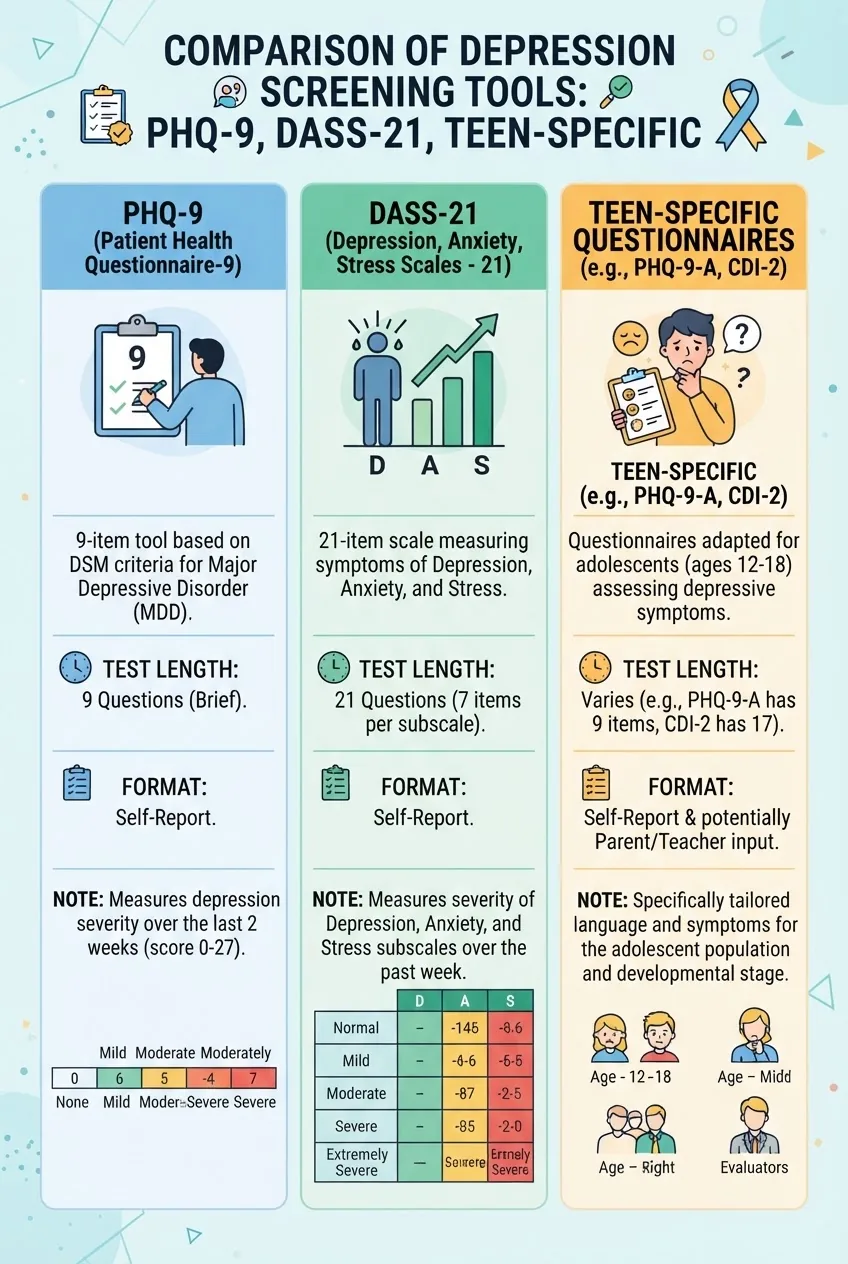
| Test | Format & Length | What it measures | Use in Australia |
|---|---|---|---|
| PHQ‑9 | Self-report, 9 items, ~2–5 minutes | Core depressive symptoms, suicidal ideation item | Common in GP settings and online tools; validated in primary care |
| DASS‑21 | Self-report, 21 items, ~5–8 minutes | Three subscales: Depression, Anxiety, Stress (7 items each) | Useful when anxiety comorbidity is suspected; psychometric properties well-researched |
| Teenage-specific questionnaires | Varied formats; often 10–30 items, parent and self-report versions | Adolescent mood, behaviours, school functioning and risk indicators | Used in schools and clinics; choose tools validated for adolescent use |
Clinical vs self-assessment: clinician-administered screens allow clarifying questions and safety checks; online self-report tests improve access and can prompt earlier help-seeking. For validated Australian guidance on routine mental health screening, refer to the Australian Government mental health guidelines: Australian Government Department of Health and Aged Care – Mental Health.
Key tests explained briefly:
- PHQ‑9: categorical scoring aligns with mild, moderate, moderately severe, and severe depression bands.
- DASS‑21: offers subscales so you can see anxiety influence separately from depressive symptoms.
- Teenage questionnaires: often include questions about school, peer relationships and substance use; essential to select age-appropriate versions.
For an alternative screening that covers wellbeing and not just clinical symptoms, try the Mental Wellness Test Online with Comprehensive Assessment.
How to Use and Interpret a Depression Test Correctly
Use the steps below as your practical workflow. These steps show completion, scoring, interpretation and limitations with concrete thresholds and safe referral actions.
- Choose the right test: If you suspect anxiety too, pick DASS‑21; for straightforward depression screening, choose PHQ‑9. If the person is aged 12–17 use a teen-validated questionnaire.
- Set aside focused time: allocate 10–15 minutes for PHQ‑9, 10–20 minutes for DASS‑21. Ensure privacy and remove distractions; accurate answers require quiet reflection.
- Answer honestly for the last two weeks: most tests use a 2-week window (PHQ‑9). Mark frequency for each item exactly as described (e.g., “Not at all / Several days / More than half the days / Nearly every day”).
- Score the tool immediately: PHQ‑9 uses 0–3 per item for a 0–27 total. DASS‑21 raw subscale scores (0–21) are multiplied by 2 to align with the DASS‑42 norms, giving subscale scores 0–42. Record each subscale separately for DASS‑21.
- Interpret severity bands:
- PHQ‑9: 0–4 (minimal), 5–9 (mild), 10–14 (moderate), 15–19 (moderately severe), 20–27 (severe). A score ≥10 commonly flags clinically significant depression (sensitivity ~88%, specificity ~85% in primary-care validation studies).
- DASS‑21 Depression subscale: normal (0–9), mild (10–13), moderate (14–20), severe (21–27), extremely severe (28+ after multiplying raw score by 2).
- Check for red flags: if PHQ‑9 item 9 (suicidal thoughts) is non‑zero, or any endorsement of self-harm exists, stop and follow safety procedures: call local emergency services, Lifeline (13 11 14 in Australia) or arrange urgent GP/mental health contact.
- Consider comorbidity: if anxiety items or DASS‑21 anxiety subscale are elevated, note the comorbid pattern—this affects treatment choice (e.g., CBT tailored for comorbid anxiety/depression).
- Compare to baseline: repeat testing every 2–4 weeks when monitoring treatment response. A change of ≥5 points on PHQ‑9 is commonly considered a clinically meaningful change in symptom severity (research standard used in many trials).
- Record and communicate clearly: save total scores, symptom notes and date. Share these with your GP or mental health clinician—objective scores improve triage and treatment planning.
- Understand limitations: online self-report may over- or under-estimate symptoms due to response bias, literacy or cultural differences. Use screening results as a prompt to seek clinical assessment, not as a final diagnosis.
- Follow clinical pathways: if score indicates moderate or higher symptoms, arrange a GP appointment to discuss referral options such as a Mental Health Care Plan, psychologist, or psychiatrist assessment.
Practical PHQ‑9 walkthrough (example):
- Complete PHQ‑9 items—answer how often each of the 9 problems occurred in the last 2 weeks using 0–3 (Not at all = 0; Nearly every day = 3).
- Sum scores—if total = 16, you fall in the moderately severe band (15–19).
- Action based on score—with a 16 and any positive response to suicidal ideation, arrange urgent GP review; otherwise, book a same‑week GP appointment to discuss treatment and possible Mental Health Care Plan.
For clinical diagnostic principles and broader symptom evaluation see Symptoms evaluation and diagnosis guide, and for clinician mental state exam techniques, see MSE Mental Status Examination Assessment and Sample Guide. For testing and diagnostic processes relevant to depression screening see Testing and Diagnosis Guide Meaning and Process Overview.
Understanding Depression and Anxiety Tests Combined
Depression and anxiety frequently co-occur (comorbidity). Tests such as the DASS‑21 and some composite questionnaires assess both constructs simultaneously, separating symptom clusters into subscales. This distinction matters because treatment and risk prioritisation can differ when anxiety is a major driver of distress.
Illustrative comparison: PHQ‑9 focuses strictly on depressive symptoms and suicidal ideation, giving a clear score for mood disruption. DASS‑21 splits symptoms into Depression, Anxiety and Stress—so a high anxiety subscale with a lower depression subscale suggests targeted anxiety interventions (e.g., exposure-based CBT) may be indicated alongside depression-focused treatment.
Since many online tools use overlapping items (sleep, concentration, fatigue), compare subscale profiles rather than raw total scores to understand which symptom cluster is dominant. If you’d like deeper detail on anxiety testing, see Anxiety Test Online Guide with Quizzes and Assessment.
Practical note: a combined depression-anxiety score may help triage urgency (e.g., severe anxiety plus severe depression raises immediate safety and functional concerns). In Australia, integrated assessment tools are more likely to be used in mental health clinics and by GPs working with psychologists or psychiatrists.
Special Focus: Testing for Severe Depression and Teenagers

Screening for severe depression requires attention to specific urgent indicators: frequent suicidal ideation, psychomotor retardation, marked functional decline (unable to attend school/work), or psychotic symptoms. If these appear, arrange urgent clinical review—do not rely solely on online results.
Urgent screening indicators: PHQ‑9 score ≥20, repeated endorsement of item 9, inability to care for self, or sudden behavioural changes in adolescents.
Adolescent-specific considerations:
- Use age-validated instruments—teen responses differ from adults, and parent-report may add critical context.
- Look for school attendance changes, social withdrawal, substance use and self-harm behaviours.
- In Australia, clinicians consider developmental stage when differentiating depression from normal adolescent mood variability—see supporting data in Mental Health in Australian Youth Statistics and Insights for prevalence and service use.
If a teenager scores in the severe band or expresses active suicidal intent, call emergency services or a crisis line immediately and engage a GP or child-and-adolescent mental health service (CAMHS) for expedited assessment.
What to Do After Taking an Online Depression Test
After screening, act on results using this stepwise plan.
- Document your score and date: keep a record of test scores and any notes about triggers, sleep, substance use and medication.
- Contact your GP for a follow-up: bring test results or show them on your phone. A GP can conduct a formal clinical depression screening and discuss referral options.
- Ask about a Mental Health Care Plan: GPs can prepare a plan that subsidises psychology sessions under Medicare when clinically indicated. See an example plan here Mental Health Care Plan Example and Assessment Template.
- Consider specialist referral: moderate to severe scores, suicidality, or treatment resistance warrant referral to a psychiatrist or community mental health team. For co-occurring ADHD diagnostic support, check options such as ADHD diagnosis bulk billing options in Sydney or learning about affordable ADHD diagnosis options in Australia.
- Track progress: repeat the same test biweekly during the first 3 months and monthly afterwards. Look for a PHQ‑9 change ≥5 points as meaningful improvement.
- Understand diagnosis phases: an initial screen may lead to a provisional diagnosis before full assessment—read more about diagnostic stages here Provisional Diagnosis Definition and Meaning Explained Guide.
- Clarify psychiatric terminology: if you are referred to psychiatry, ask for clarification of terms—see Psychiatrically Definition and Psychiatric Meaning Explained.
If you are exploring broader diagnostic pathways, including ADHD or other conditions, the cross-referrals above can help coordinate care across providers. Keep copies of test results and referral letters to streamline appointments.
Depression Screening and Assessment in Australian Health Settings
Screening and assessment in clinical settings in Australia follows structured pathways intended to balance access, quality and cost. Here are practical points to navigate the system.
- Bulk-billing and Medicare: many GPs offer bulk-billed consults for certain patients; a Mental Health Care Plan subsidises psychology sessions under Medicare. Ask your GP about eligibility and session caps (referral-dependent).
- Clinical tools used: GPs and mental health teams commonly use PHQ‑9, K10, DASS‑21 and structured clinical interviews guided by DSM‑5 criteria.
- Privacy and consent: clinical records are confidential. Online screening sites vary—read privacy policies and avoid tests that require sharing identifiable data without clear protections.
- Accessing specialists: psychiatrists typically require referral; psychologists may accept self-referrals. Ask about wait times and whether telehealth is offered.
- Community resources: public mental health services, headspace for youth, and local NGOs commonly provide walk-in and booked services.
For an overview of psychological testing options and broader assessment approaches that accompany depression testing, consult Psychological Assessment Guide and Testing Options Online. For related affordable diagnostics see affordable ADHD diagnosis options in Australia.
External resources and reputable Australian supports include:
- Australian Government Department of Health and Aged Care – Mental Health — guidance on national mental health policy and services.
- Beyond Blue — validated screening resources and local support links for Australians.
- World Health Organization – Depression — global prevalence data and treatment frameworks (useful context).
Frequently Asked Questions
What is a depression test and how does it work?
A depression test is a questionnaire that asks about mood, interest, sleep, appetite and concentration over a recent period (usually two weeks). Responses score numerically to place results into severity bands that flag whether further clinical assessment is recommended.
How accurate are online depression tests compared to clinical assessments?
Online tests are reliable for screening—PHQ‑9 sensitivity/specificity in primary care is high—but they are not diagnostic. Clinical assessment adds history-taking, observation and risk assessment needed for formal diagnosis and treatment planning.
What is the difference between a depression test and a depression screening?
A depression test (e.g., PHQ‑9) is a standardised questionnaire; screening involves using that test systematically to identify possible cases, often in primary care or population settings to prompt clinical follow-up.
How do I interpret my depression test results?
Use published score bands: PHQ‑9 totals of 10–14 indicate moderate depression and warrant GP review, 15–27 indicates moderately severe to severe depression requiring urgent clinical discussion and possible specialist referral.
Can I take a depression test if I think I have severe symptoms?
Yes, but if you have active suicidal thoughts or are in immediate danger, call emergency services or Lifeline (13 11 14) first. An online test can help document severity but must be followed by urgent clinical contact when severe.
How often should I take an online depression test?
For monitoring, repeat the same validated test every 2–4 weeks initially; once stable you can switch to monthly. Consistent intervals help detect meaningful clinical change (e.g., ≥5 point PHQ‑9 change).
Is my information safe when I do an online depression questionnaire?
Safety varies by site—check the privacy policy, data retention and whether results are stored or shared. Prefer tests run by reputable health organisations or integrated into clinical systems with clear consent practices.
What should I do if my depression test indicates moderate or severe depression?
Arrange a prompt GP appointment to discuss results and referral options, consider a Mental Health Care Plan for subsidised psychology, and seek urgent care for any suicidal ideation or rapid deterioration.
Additional Resources and Support for Depression in Australia
Below is a curated list of Australian resources with short descriptions for immediate support, education and referral.
- Beyond Blue — validated online screening tools, fact sheets and local support directories.
- Head to Health — Australian government portal linking free and low-cost services, digital programs and local supports.
- Lifeline — crisis support and suicide prevention services, including 13 11 14 crisis line.
- Black Dog Institute — resources, assessment tools and clinician-facing guidance on mood disorders.
- Mental of Health in Australia Guide and Support Resources — local clinics, helplines and community services across states.
Hands-On Practitioner Section: Common mistakes and how to avoid them
Common mistakes — from my practice:
1) I once accepted an online PHQ‑9 score without asking whether the respondent misunderstood the time window; the result overestimated severity. Fix: always confirm the two‑week timeframe.
2) I observed clinicians double-counting sleep items across tools; this inflated symptom burden. Fix: use one validated tool at a time and interpret subscales separately.
3) I’ve seen services ignore item 9 (suicidal ideation) when totals were moderate—this missed urgent need. Fix: treat any positive suicidal ideation item as a potential red flag requiring safety planning.
Final checklist
- Completed a validated test (PHQ‑9 or DASS‑21) in private with 10–20 minutes.
- Scored the test and noted severity bands and item-level red flags.
- Recorded results, date, and any contextual notes (sleep, substance use).
- Booked or planned contact with a GP or mental health professional if score ≥10 or any safety concern.
- Saved links to trusted Australian resources and crisis numbers.
When to call in a professional
Call a GP, psychiatrist or crisis service immediately if any of the following apply: active suicidal ideation, severe functional impairment (unable to eat/sleep/attend work or school), psychotic symptoms, or severe rapid deterioration. For non‑urgent but significant symptoms (PHQ‑9 10–19), arrange a GP review within 7 days.
Conclusion
Use this guide to select and complete a depression questionnaire online, interpret scores like PHQ‑9 and DASS‑21, and move from screening to clinical care using Australian pathways. If your result is moderate or higher, contact your GP and consider a Mental Health Care Plan to access subsidised psychology. For step-by-step psychological testing options, consult Psychological Assessment Guide and Testing Options Online. If you need immediate help, call Lifeline on 13 11 14. Ready to take the next step? Save your score, call your GP, or use the resource links above to plan your care.
Important information:
This article is general information only and is not medical advice. It was written from publicly available sources by a non-clinician, and this website is not a clinic. Please speak with your GP or another qualified health professional about your own situation. If you need urgent help, call 000, or contact Lifeline on 13 11 14 or Beyond Blue on 1300 22 4636.