

A psychiatrist in Brisbane provides specialist assessment, diagnosis and medical treatment for mental health conditions; this guide explains services available, how to obtain a GP referral or Mental Health Care Plan, booking steps for adult psychiatry, local northside options and what new patients can expect.
Overview of Psychiatrist Services in Brisbane
Answer: Psychiatrists across Brisbane offer medical diagnosis, medication management, specialist assessments and coordinated care for adults with mood, anxiety, psychotic and complex presentations, delivered from private clinics, public hospitals and community health centres with varying billing options and wait times.
Psychiatrist: a medical doctor specialising in diagnosing and treating mental disorders, including prescribing medication.
Brisbane’s psychiatry services include private outpatient clinics, public hospital outpatient psychiatry, community mental health teams and consultant psychiatrists who provide second-opinion assessments. Adult psychiatrist Brisbane services most commonly treat depression, bipolar disorder, anxiety disorders, schizophrenia and complex co-occurring conditions; many clinics also coordinate with GPs, psychologists and allied health.
Mental Health Care Plan: a GP-issued plan that documents treatment goals and may be used to access subsidised allied mental health services under Medicare.
Service locations are concentrated in the CBD, southside suburbs and the northside suburbs (e.g., Chermside, Aspley, Nundah). Northside psychiatrist clinics often advertise adult psychiatry appointments and shorter travel times for residents north of the Brisbane River. Many psychiatrists offer both face-to-face and clinic-based telehealth appointments, with private billing and some bulk-billing options available depending on eligibility.

Specialties commonly available in Brisbane psychiatry clinics:
- General adult psychiatry (diagnosis, medication, long-term management)
- Mood and anxiety disorder clinics
- Psychotic disorder (schizophrenia) management and community follow-up
- Consultation-liaison psychiatry (hospital-based assessments)
- Geriatric psychiatry and neuropsychiatry referral pathways
Availability varies: metropolitan clinics in Brisbane typically publish approximate wait times and new patient intake rules; public services tend to prioritise acute and high-risk cases while private psychiatrists set their own appointment lists and fees. According to a 2024 industry report, metropolitan areas have higher psychiatrist density than regional Queensland (source: Australian Institute of Health and Welfare, cited below).
Example (anonymised): A northside Brisbane clinic reported triaging new adult referrals within 2–6 weeks for urgent cases and 8–12 weeks for routine new-patient assessments during 2023, with follow-up arrangements made with the referring GP.
Transition: Now that you know what services exist across Brisbane, the next section explains practical criteria to choose the best psychiatrist for your needs.
How to Find the Best Psychiatrist in Brisbane
Answer: Choose a psychiatrist by verifying qualifications, reviewing patient feedback and clinic reputation, confirming adult psychiatry experience, checking billing arrangements and accessibility, and matching treatment style to your needs—use clear criteria to shortlist and contact clinics directly.
Term: Bulk billing means the doctor bills Medicare directly and accepts the Medicare benefit as full payment, so the patient pays nothing extra at the point of service.
- Confirm qualifications and registration: Ensure the psychiatrist is a Fellow of the Royal Australian and New Zealand College of Psychiatrists (RANZCP); check training and specialist scope via RANZCP listings or public registers. For professional standards consult Royal Australian and New Zealand College of Psychiatrists.
- Match clinical experience to your condition: Prioritise adult psychiatrist Brisbane specialists with documented experience in mood disorders, anxiety, psychosis, or the specific diagnosis you need; clinics often list special interests on their websites.
- Assess patient reviews and clinic reputation: Read verified patient reviews and seek GP or local mental health service recommendations to evaluate bedside manner, thoroughness and follow-up quality.
- Check new patient availability and wait times: Ask clinics about current waitlists, triage for urgency and cancellation lists; northside clinics may offer shorter travel times and different availability windows.
- Understand billing, Medicare rebates and out-of-pocket costs: Confirm if the psychiatrist offers private billing, partial rebating or bulk billing for eligible patients; also ask how long appointments take and whether longer initial assessments incur higher fees.
- Consider multidisciplinary coordination: The best psychiatrist will coordinate with your GP, psychologists and allied health, offer a clear care plan, and be willing to liaise with other services if required.
- Practical access criteria: Check location, parking and public transport, telehealth options, after-hours contact arrangements and how urgent matters are handled.
- Assess personal fit: Book an initial consult to test rapport, communication style and shared decision-making; you can change providers if the therapeutic fit is poor.
For a national perspective on what to look for when choosing psychiatrists, see criteria to find best psychiatrist.
Transition: With selection criteria in hand, the next section gives a step-by-step walkthrough of the referral process specific to Brisbane appointments.
Understanding the Referral Process for Psychiatrists in Brisbane
Answer: The usual referral flow in Brisbane starts with a GP consultation (often with a Mental Health Care Plan), written referral to a psychiatrist, referral submission by email/portal, booking confirmation from the clinic, and attending an initial psychiatry assessment—billing and wait times vary.
Referral: a written document from a GP or referrer that describes clinical concerns and requests specialist assessment.
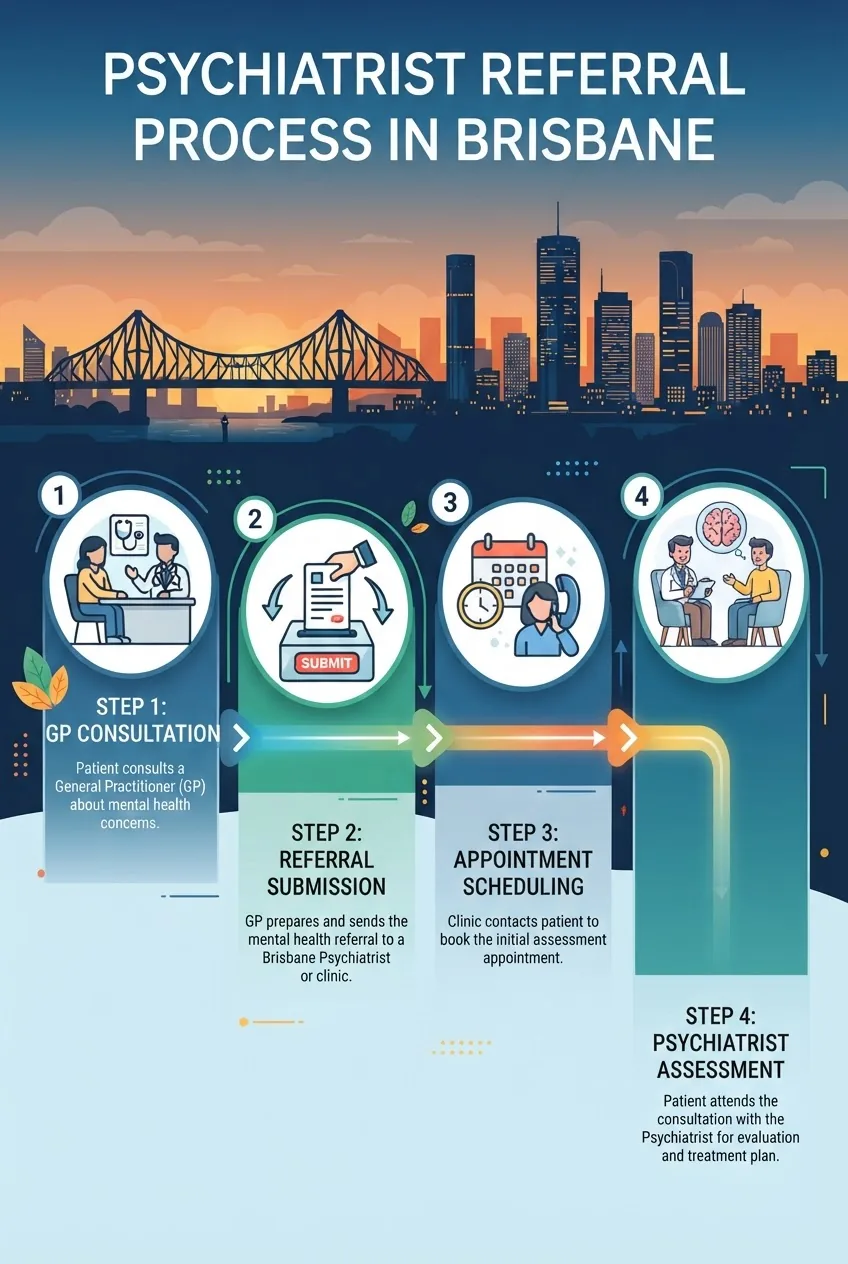
- Step 1 — Book a GP appointment: Discuss your symptoms and concerns; the GP documents history and may prepare a Mental Health Care Plan or formal referral letter. For guidance on GP referral roles see GP mental health referral.
- Step 2 — Decide if you need a Mental Health Care Plan: A Mental Health Care Plan supports access to subsidised allied mental health services and helps the psychiatrist and GP coordinate treatment; it is not always mandatory for a psychiatry referral but often recommended.
- Step 3 — Obtain the written referral: Your GP will provide a referral letter outlining clinical issues, medication history and any risk factors; some clinics accept electronic referrals via secure portals or fax.
- Step 4 — Submit the referral to a psychiatrist clinic: Clinics typically request the referral, relevant medical history and previous mental health reports; private psychiatrists may also require Medicare details and contact information.
- Step 5 — Clinic triage and booking: The psychiatry clinic triages referrals for urgency, offers available appointment slots or places you on a waitlist, and confirms booking by phone or email; ask about cancellation lists to be seen sooner.
- Step 6 — Prepare for the first appointment: Attend with your referral letter, medication list, consent to share information with your GP and any prior psychological or hospital records; some clinics provide pre-appointment questionnaires.
- Step 7 — After the assessment: The psychiatrist provides diagnosis, treatment options (including medication if appropriate), and coordinates follow-up with your GP and other allied health services; a shared care plan is common for ongoing management.
Billing and Medicare nuance: private psychiatrists set fees; Medicare rebates apply to consultations with credentialed psychiatrists but rarely fully cover private fees—some psychiatrists offer partial bulk billing for eligible patients (concession holders, referral from public services) while others charge a gap. For comparative approaches to bulk billing and ADHD-specific workflows see bulk bill services for ADHD psychiatry.
Comparative note: Sydney clinics have different bulk-billing prevalences and public service pathways; for direct comparison refer to bulk billing psychiatry referrals.
According to a 2024 Australian Government Department of Health overview, GP referral and documentation remain the primary gateway to specialist mental health services and can influence triage priority and access to subsidised supports. Australian Government Department of Health provides guidance on Medicare items and referral frameworks.
Transition: After referral is lodged, what new patients experience at their first psychiatry visit is covered next.
Psychiatrist Brisbane Taking New Patients: What to Expect
Answer: If a psychiatrist in Brisbane is taking new patients you can expect referral confirmation, an initial assessment lasting 45–90 minutes, a clinical interview and medical review, a provisional diagnosis if applicable, a treatment plan and communication with your GP about follow-up.

New patient assessment: the initial consult focuses on presenting problem, psychiatric history, medical history, substance use, current medications and risk assessment. Clinics often request medication lists and previous reports beforehand to make the most of the appointment.
Term: Mental Health Care Plan — a documented plan from your GP outlining treatment goals and referrals for allied health; useful for coordinated care but not always a referral requirement for psychiatry.
- Referral confirmation and triage: Clinics confirm receipt of referral and advise on urgency-based wait time; they may allocate longer slots for complex cases.
- Appointment logistics: Expect 45–90 minutes for the first consultation; bring photo ID, a medication list and any previous assessment reports.
- What happens clinically: Psychiatrist takes a psychiatric and medical history, performs a mental state examination and may order medical tests (e.g., blood tests) if medication initiation is considered.
- Outcome of first visit: You will usually receive a diagnosis or working formulation, a treatment plan (psychotherapy referral, medication options or monitoring), and a follow-up schedule; the psychiatrist will often communicate recommendations back to the referring GP.
- Waiting list and cancellations: If wait times are long clinics will place you on a cancellation or urgent list; if a referral is declined clinics should explain reasons and sometimes suggest alternative services or re-referral with additional information.
Availability tips: ask clinics about early-bird slots, cancellation lists and whether short telehealth check-ins are available for interim medication monitoring. Remember that individual wait times can vary by clinician demand and clinical urgency; a 2023 community report noted variability across metropolitan clinics in Queensland (source: Australian Institute of Health and Welfare).
Transition: The following section outlines the specific services adult psychiatrists commonly provide in Brisbane and how they differ from psychologists.
Services Offered by Adult Psychiatrists in Brisbane
Answer: Adult psychiatrists in Brisbane provide assessment, medical management (including prescribing), psychotherapy integration, crisis assessments, long-term care for severe mental illness and coordination with community and inpatient services—services focus on complex or medically-managed conditions.
Term: Medication management — ongoing prescription, monitoring and adjustment of psychiatric medicines by a psychiatrist.
Core services and typical scope (bulleted highlights):
- Comprehensive psychiatric assessment: Diagnostic interviewing, mental state examination and formulation of management plans.
- Medication management: Prescribing and monitoring antidepressants, mood stabilisers, antipsychotics and anxiolytics; ongoing review of side effects and physical monitoring.
- Psychotherapy and integrated care: While psychiatrists are medical doctors, many provide brief psychotherapy or refer to psychologists and clinical services for long-form therapy.
- Mood disorder clinics: Evidence-based management for depression and bipolar disorder, including medication optimisation and relapse prevention plans.
- Anxiety disorder treatments: Diagnosis and stepped-care planning that may combine medication with CBT-based referrals.
- Schizophrenia and psychotic disorders: Long-term care plans, community outreach coordination and collaboration with public mental health teams.
- Crisis assessment and management: Urgent risk evaluation and liaison with emergency departments for inpatient needs when required.
- Complex comorbidity management: Dual diagnosis (mental health + substance use), neuropsychiatric assessment and coordination with other specialists.
For a clear explanation of role differences, see the internal guide on difference between psychiatrists and psychologists.
| Service | Provided by Psychiatrist | Typical funding / Billing |
|---|---|---|
| Diagnosis & medical treatment | Yes — full medical management | Private billing with Medicare rebate |
| Psychotherapy (long-form) | Some psychiatrists, often brief; referrals to psychologists common | Private or publicly funded options |
| Crisis & inpatient liaison | Yes — liaison with hospitals and community teams | Public services funded; private inpatient billed separately |
Clinical pathways: psychiatrists develop short- and long-term care plans and often coordinate prescribing with GPs for shared care. According to a 2023 AIHW report, integrated psychiatrist-led care pathways improve continuity for complex cases (source: Australian Institute of Health and Welfare).
Transition: After understanding services offered, the next section lists community support and resources across Brisbane to assist access and affordability.
Mental Health Support and Resources in Brisbane
Answer: Brisbane has a network of mental health supports including community health centres, public outpatient psychiatry, crisis lines, support groups, telehealth psychiatry options and referral hubs—use local services to bridge wait times and access subsidised care.
Local support examples and pathways:
- Public community mental health teams providing assessment and care coordination for acute needs.
- Medicare-funded allied health sessions when referred via a Mental Health Care Plan.
- Local non-profits and peer support groups offering condition-specific support and group programs.
- Crisis and helpline services for immediate risk management and emergency triage.
- Private clinics offering telehealth psychiatry and in-person appointments, some with partial or bulk-billing availability.
Affordable telehealth options: some services provide bulk-billed telehealth psychiatry for eligible patients; for nationwide telehealth bulk-billing models see bulk bill telehealth psychiatry.
Practical resources:
- Finding and booking psychologists: Use local directories and the national Find a Health Service portals — see finding and booking psychologists for allied support.
- Community health centres: Provide low-cost counselling and referral to psychiatry triage.
- Support lines: 24/7 crisis lines and Medicare Mental Health Phone Service options for immediate advice.
According to a 2023 AIHW dataset, metropolitan Queensland has multiple community mental health access points per 100,000 population, helping reduce acute emergency presentations when integrated with specialist outpatient psychiatry (source: Australian Institute of Health and Welfare).
Transition: Below are concise answers to common questions patients ask about psychiatrists and referrals in Brisbane.
Common Questions About Psychiatrists and Referrals in Brisbane
Answer: This FAQ-style section answers eligibility, costs, wait times, prescribing and scope—practical, brief responses to help you move forward with referrals and bookings.
Below are clear guidance points and actionable suggestions for each common question you’ll encounter when seeking psychiatric care in Brisbane.
Referral eligibility and GP role
Most psychiatrists accept referrals from GPs, and a Mental Health Care Plan may support allied services; some clinics accept referrals from other specialists. For specific GP referral documentation and requirements, see GP mental health referral.
Consultation costs and Medicare rebates
Costs vary by provider; Medicare rebates apply to psychiatric consultations but often do not fully cover private fees. Many clinics publish fee schedules; ask for a cost estimate before booking. For Australian Medicare policy and item numbers see Australian Government Department of Health.
Appointment wait times and availability
Wait times depend on urgency and clinician demand; public outpatient services prioritise acute cases while private psychiatrists vary. Ask clinics about urgent triage lists and cancellation options to reduce waiting time.
Medication prescribing and scope
Psychiatrists can prescribe psychiatric medication and manage complex pharmacotherapy; psychologists cannot prescribe medication. For role definitions and training requirements consult psychiatrist training guidance or difference between psychiatrists and psychologists.
According to a 2024 RANZCP advisory, psychiatrist oversight is recommended for complex psychotropic regimens (source: Royal Australian and New Zealand College of Psychiatrists at ranzcp.org).
Transition: The next short summary pulls key takeaways together and directs you to act on a referral today.
Conclusion: Brisbane offers a comprehensive mix of private and public psychiatrist services for adults; start by seeing your GP for a referral or Mental Health Care Plan, confirm clinic billing and wait times, prioritise a psychiatrist with relevant adult psychiatry experience, and use local community resources to bridge waits. Reach out to your GP or contact a nearby clinic to begin the referral and booking process—your first step is the GP consultation that sets the referral in motion.