

Answer: To become a psychiatrist in Australia you must complete a medical degree (MBBS or MD), a supervised internship and residency, then enter the RANZCP specialist training program as a registrar and achieve Fellowship—plus ongoing registration with the Medical Board/AHPRA and mandatory CPD to maintain practice (about 12–15 years total).
Overview of Psychiatrist Degree vs Other Related Degrees in Australia
Answer: A psychiatrist is a medically qualified specialist who prescribes and manages medical treatments for mental disorders; a psychiatry “degree” is not a standalone undergraduate award—psychiatry is a specialty earned after medical training, unlike psychology degrees which are non-medical and focus on psychological assessment and therapy.
Term: MBBS/MD: the undergraduate (MBBS) or graduate (MD) medical degree that grants primary medical qualification. Term: Psychiatrist: a medical doctor who has completed specialist psychiatry training and holds Fellowship of the Royal Australian and New Zealand College of Psychiatrists (RANZCP).
This section explains how a medical pathway leads to psychiatry, clarifies the myth of a “Bachelor of Psychiatry”, and compares psychiatry qualifications with psychology and allied mental health training.
| Qualification | Typical entry | Leads to |
|---|---|---|
| MBBS / MD (medical degree) | Undergraduate or graduate entry | Medical registration → psychiatry registrar → RANZCP Fellowship |
| Bachelor/Master of Psychology | Undergraduate/graduate | Clinical psychologist (cannot prescribe medicines) |
| Nursing / Social Work | Undergraduate | Allied mental health roles (non-prescribing) |
Key distinctions:
- Only medically qualified doctors (MBBS/MD holders) can train as psychiatry registrars and obtain the RANZCP Fellowship to be recognised as specialist psychiatrists.
- There is no “Bachelor of Psychiatry” in Australia; psychiatry is achieved through postgraduate specialist training after medical school.
- Psychologists complete psychology degrees and registration pathways through the Australian Psychology Accreditation Council (APAC) and Psychology Board, and they do not have prescribing rights in standard practice.
For a focused comparison of clinical roles and prescribing rights, see the difference between psychiatrists and psychologists.
If you want broader access to allied mental health contacts, see our guide on finding mental health professionals in Australia.
Step-by-Step Pathway: How to Be a Psychiatrist in Australia
Answer: The psychiatrist pathway in Australia runs: complete MBBS/MD → 1-year internship → 1–2 years of residency (PGY2+) → apply to RANZCP registrar program → ~5 years of RANZCP specialist training including exams → attain Fellowship and maintain AHPRA registration.

Below is the stepwise guide with practical entry requirements, application tips, and links to referral and GP processes used by practicing psychiatrists.
- Complete a recognized medical degree (MBBS or MD).
- Undertake a supervised 1-year internship and obtain general medical registration with AHPRA.
- Work as a resident doctor (PGY2–PGY3) to build experience and meet RANZCP application criteria.
- Apply and be selected as a psychiatry registrar in the RANZCP training program.
- Complete ~5 years of RANZCP training (clinical rotations, supervision, exams) to achieve Fellowship (FRANZCP).
- Hold Specialist Registration with the Medical Board of Australia and engage in CPD.
GP referrals and mental health care planning are integral to psychiatric practice; after qualification psychiatrists frequently work with GPs for shared-care and Medicare items. See GP referrals for psychiatric assessment and mental health care plans and referrals for operational detail.
Undergraduate Medical Degree Requirements
Answer: Entry into Australian medical degrees requires relevant secondary/undergraduate scores and prerequisites; MBBS is undergraduate entry while MD is postgraduate entry—both qualify you to progress to internship and specialist training.
Term: Entry prerequisites: usually include ATAR or Graduate Australian Medical School Admission Test (GAMSAT)/UMAT, relevant tertiary study, and interviews.
Details and common pathways:
- Undergraduate MBBS: direct entry from secondary school in some universities (usually 5–6 years).
- Graduate-entry MD: requires a prior bachelor degree and GAMSAT or equivalent application testing (usually 4 years).
- Domestic vs international students: domestic applicants typically apply through state admissions schemes; international students follow university-specific international entry rules.
- Key non-academic requirements: clinical placements, referees, demonstrated communication and professionalism.
Many students choose medical schools with strong psychiatry clinical exposure. When selecting schools, review clinical rotation structures and psychiatry placement availability because early exposure aids specialty selection.
Internship and Residency Training
Answer: After graduation you must complete a 1-year supervised internship (PGY1) to gain general registration with AHPRA, then at least 1–2 additional years as a resident to meet RANZCP eligibility—these include hospital rotations and supervised clinical practice.
Term: Internship: a supervised 12-month hospital program required for medical registration; Residency: subsequent junior doctor years (PGY2+) building clinical competence.
- Internship: core rotations (medicine, surgery, emergency) and competency assessments required by the Australian Medical Council (AMC).
- Residency (PGY2–PGY3+): opportunities to take psychiatry rotations, gain supervised clinical experience and secure references for RANZCP applications.
- International Medical Graduates (IMGs): must satisfy AMC assessment and supervised practice pathways before applying to registrar programs.
Psychiatry Specialist Training and Fellowship
Answer: Psychiatry specialist training is administered by the RANZCP; registrars complete structured clinical rotations, coursework modules, supervision, and examinations over approximately five years to achieve Fellowship (FRANZCP).
Term: Registrar: a doctor enrolled in specialist training; Fellowship (FRANZCP): the RANZCP award that recognises completion of specialist psychiatry training.
- Application and selection: competitive entry requiring evidence of clinical experience, referees and often interview; selection processes vary by state and hospital.
- Core training years: supervised rotations across general adult psychiatry and key settings (inpatient, community, liaison) with logged clinical hours.
- Advanced training: focused placements in sub-specialties (child and adolescent, forensic, old age, addiction) depending on interests and availability.
- Assessments and exams: progress assessments, written and clinical exams set by RANZCP; successful completion is mandatory for Fellowship.
- Supervision and portfolios: maintain training portfolio, formal supervision sessions, and workplace-based assessments.
According to a 2024 RANZCP report, the standard RANZCP training duration to Fellowship is approximately five years for most candidates, though combined or interrupted pathways can extend this (source type: professional college report).
Navigating RANZCP processes: use the RANZCP online training portal for application timelines, training requirements and exam dates—see the RANZCP site for the most current details: Royal Australian and New Zealand College of Psychiatrists (RANZCP).
Once Fellowship is granted (FRANZCP), apply for specialist registration with the Medical Board of Australia via AHPRA to practise as a recognised psychiatrist.
For guidance on referral practice and post-qualification assessment processes used in clinics, review our pillar page on the referral process for psychiatric assessment.
Key Psychiatrist Qualifications and Licensing Requirements
Answer: To work legally as a psychiatrist in Australia you need a primary medical degree, completion of internship for general registration, RANZCP Fellowship for specialty recognition, and ongoing specialist registration with the Medical Board of Australia managed by AHPRA.
Term: AHPRA: the Australian Health Practitioner Regulation Agency that administers registration on behalf of the Medical Board of Australia; Medical Board of Australia: the regulatory body setting registration standards and scopes of practice.
Essential qualifications and documents checklist:
- Primary medical qualification (MBBS or MD) from an AMC-accredited university or an AMC-assessed equivalent.
- Completion certificate for a 1-year internship (required to obtain general registration with AHPRA).
- Evidence of RANZCP training completion (Fellowship) for specialist registration.
- Current AHPRA registration and an up-to-date working with children/clearance checks where required.
- Verification of identity, referees, and documented CPD activity logs.
International Medical Graduates (IMGs): must follow AMC pathways (assessment/examination or competency assessment) before provisional or general registration—see the Australian Medical Council: Australian Medical Council (AMC) for accreditation and assessment processes.
Licensing and registration steps:
- Graduate medical degree completion.
- Apply and complete the 1-year intern program; obtain general registration through AHPRA.
- Complete required postgraduate experience (PGY2+) and apply to the RANZCP training program.
- On successful Fellowship, apply for specialist registration with the Medical Board of Australia via AHPRA.
- Meet ongoing recency of practice, recertification and CPD requirements set by the Medical Board and RANZCP.
Telehealth and billing: psychiatrists may offer telehealth services; registration, telehealth practice standards and Medicare item eligibility are governed by AHPRA and Medicare guidelines. For information on telehealth service provision pathways see our resource on telehealth psychiatry services in Australia.
Bulk-billing and service models: many psychiatrists work in mixed private/public models; bulk-billing availability varies by location and service type—see examples such as bulk billing psychiatrist services in Australia for practical illustrations.
Maintenance and compliance:
- RANZCP requires registrars and Fellows to complete CPD and formal supervision; the Medical Board requires evidence of recency and fitness to practise.
- According to a 2024 Medical Board guidance document, registered specialists must maintain CPD records and provide evidence during audits (source type: regulatory guidance).
For regulatory details and to confirm up-to-date registration rules consult the Medical Board/AHPRA: Medical Board of Australia / AHPRA.
Duration and Timeline Expectations for Becoming a Psychiatrist in Australia
Answer: Typical timelines: 4–6 years medical degree + 1 year internship + 1–2 years residency + ~5 years RANZCP training; expect approximately 11–14 years from school to Fellowship for most pathways, with variation for graduate-entry and IMG routes.
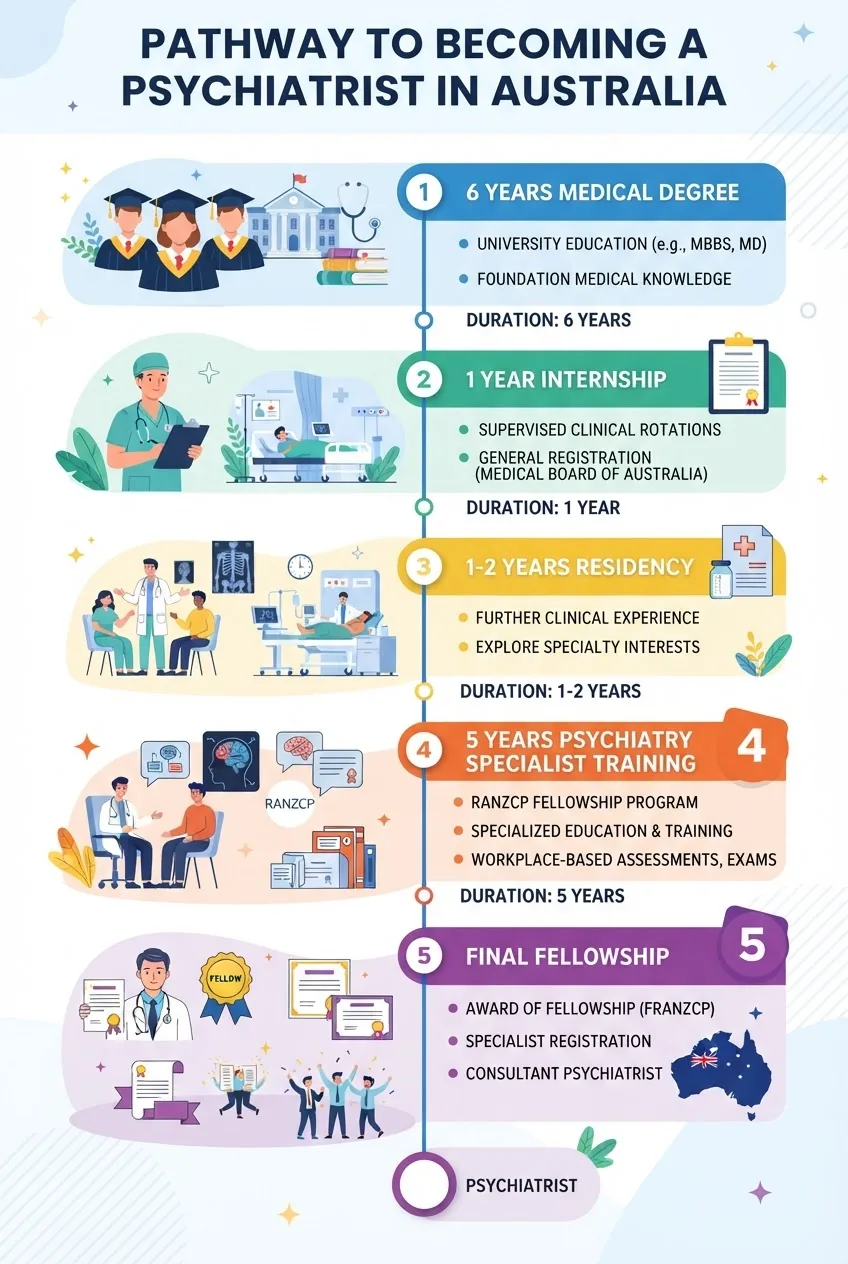
Example timeline scenarios:
| Pathway | Typical duration |
|---|---|
| Undergraduate MBBS (direct entry) | 6 years + 1 + 1–2 + 5 = ~13–14 years |
| Graduate MD (after bachelor) | 4 years + prior degree + 1 + 1–2 + 5 = variable (~12+) years |
| International Medical Graduate (IMG) | Time to AMC assessment + supervised practice + training; often longer due to assessments |
According to a 2024 industry report, most Australian-trained psychiatrists complete specialist training within five years of entering the RANZCP program, though interruptions, part-time training or dual-specialty paths extend the timeline (source type: professional training report).
Psychiatry Sub-specialties and Continuing Professional Development
Answer: Psychiatry offers sub-specialties—child & adolescent, forensic, geriatric, addiction, consultation-liaison—each requiring targeted advanced training within or after RANZCP training; ongoing CPD is mandatory to maintain competence and registration.
Common sub-specialties and examples:
- Child and adolescent psychiatry — focused developmental psychiatry and complex assessments.
- Forensic psychiatry — interface with legal systems and courts.
- Old-age (geriatric) psychiatry — dementia and late-life mental health.
- Addiction psychiatry — substance use disorders and dual diagnosis management.
- Consultation-liaison psychiatry — collaborative work with medical/surgical specialties.
ADHD is commonly managed within psychiatry; specialised training and experience are needed for accurate diagnosis and medication management—see our guide on ADHD psychiatrist assessment and treatment options for training implications and clinical models.
Gender representation and workforce diversity matter in patient choice; for information on private and bulk-bill options with women specialists see our resource on qualified female psychiatrists in Australia.
Career environments: psychiatrists work in hospitals, outpatient clinics, community mental health services, prisons, private practice, and telehealth platforms—explore career options for trained psychiatrists to understand workplace variations.
Continuing Professional Development (CPD): RANZCP and the Medical Board require annual CPD: peer review, clinical audits, professional development activities and recorded learning hours to maintain standards. According to RANZCP 2024 guidance, CPD must include reflective practice and evidence of recency (source type: college guidance document).
Common Myths and FAQs About Psychiatrist Degree and Training
Answer: Common myths include the existence of a “Bachelor of Psychiatry” and equating psychiatrists with psychologists; psychiatry is a medical specialty requiring MBBS/MD plus RANZCP training, while psychologists complete distinct psychology qualifications and registration.
Myth-busting points:
- Myth: “Bachelor of Psychiatry exists.” Fact: No—psychiatry is a speciality after medical school.
- Myth: “Psychologists can prescribe psychiatric medications.” Fact: Psychologists in Australia generally cannot prescribe; prescribing is a medical function held by psychiatrists and some GPs.
- Myth: “Specialist training is only exams.” Fact: RANZCP training combines supervised clinical work, coursework, workplace-based assessments and formal exams.
- Myth: “IMGs cannot become psychiatrists.” Fact: IMGs can but must meet AMC/AHPRA assessments and demonstrate competency prior to RANZCP entry.
Practical FAQs embedded here (short answers):
- Can you study psychiatry as an undergraduate? No—study medicine first, then specialise.
- Is psychiatry only medication? No—psychotherapy, psychosocial interventions and integrated care are core components.
- Do psychiatrists need ongoing training? Yes—CPD and recency requirements are mandatory for maintaining registration.
If you are comparing mental health roles, our article on mental health practitioner qualifications offers a structured comparison of training and scopes of practice.
Evidence and regulatory sources referenced in this article include official guidance from the Australian Medical Council (AMC), the Royal Australian and New Zealand College of Psychiatrists (RANZCP), and the Medical Board of Australia/AHPRA. For accreditation and training standards consult these authorities directly: Australian Medical Council (AMC), RANZCP, Medical Board of Australia / AHPRA.
Conclusion: Becoming a psychiatrist in Australia is a structured multi-stage process: obtain a medical degree (MBBS/MD), complete internship and residency, enter and complete RANZCP specialist training to achieve Fellowship, then maintain AHPRA registration and CPD. If you’re ready to begin, review entry requirements for local medical schools and plan clinical exposure to psychiatry during residency—next steps: check RANZCP training intake dates and AHPRA registration pathways to start your specialist journey.
Ready to learn more about referrals and how psychiatrists work with GPs? See our guide on the referral process for psychiatric assessment to plan clinical workflows and patient access.