

To become a cognitive behavioural therapist in Melbourne you typically complete a recognised mental health qualification (diploma or postgraduate), undertake supervised clinical placements and meet accreditation criteria from professional bodies; fees vary by provider and level, often ranging from short-course fees (~$1,200) to postgraduate degrees (~$15,000–$40,000) as of 2026.
Introduction to Cognitive Behavioural Therapy and Therapist Roles in Melbourne?
Answer: In Melbourne, becoming a cognitive behavioural therapist involves formal training in Cognitive Behavioural Therapy (CBT), defined clinical practice hours and alignment with Australian accreditation frameworks to work in clinics, hospitals or private practice.
Term: Cognitive Behavioural Therapy (CBT) is a structured, time-limited psychotherapy focusing on the links between thoughts, emotions and behaviours to reduce distress and change maladaptive patterns.
CBT is a widely taught therapy modality across Victorian universities, private training institutes and hospital-run continuing professional development (CPD) programs. Melbourne’s mental health workforce includes varied roles: allied mental health clinicians, accredited counsellors, clinical psychologists and CBT therapists who practice evidence-based CBT interventions. The title “CBT therapist” is typically used by clinicians trained specifically in CBT techniques but not necessarily registered psychologists; scope depends on the base qualification (e.g., diploma vs postgraduate degree).
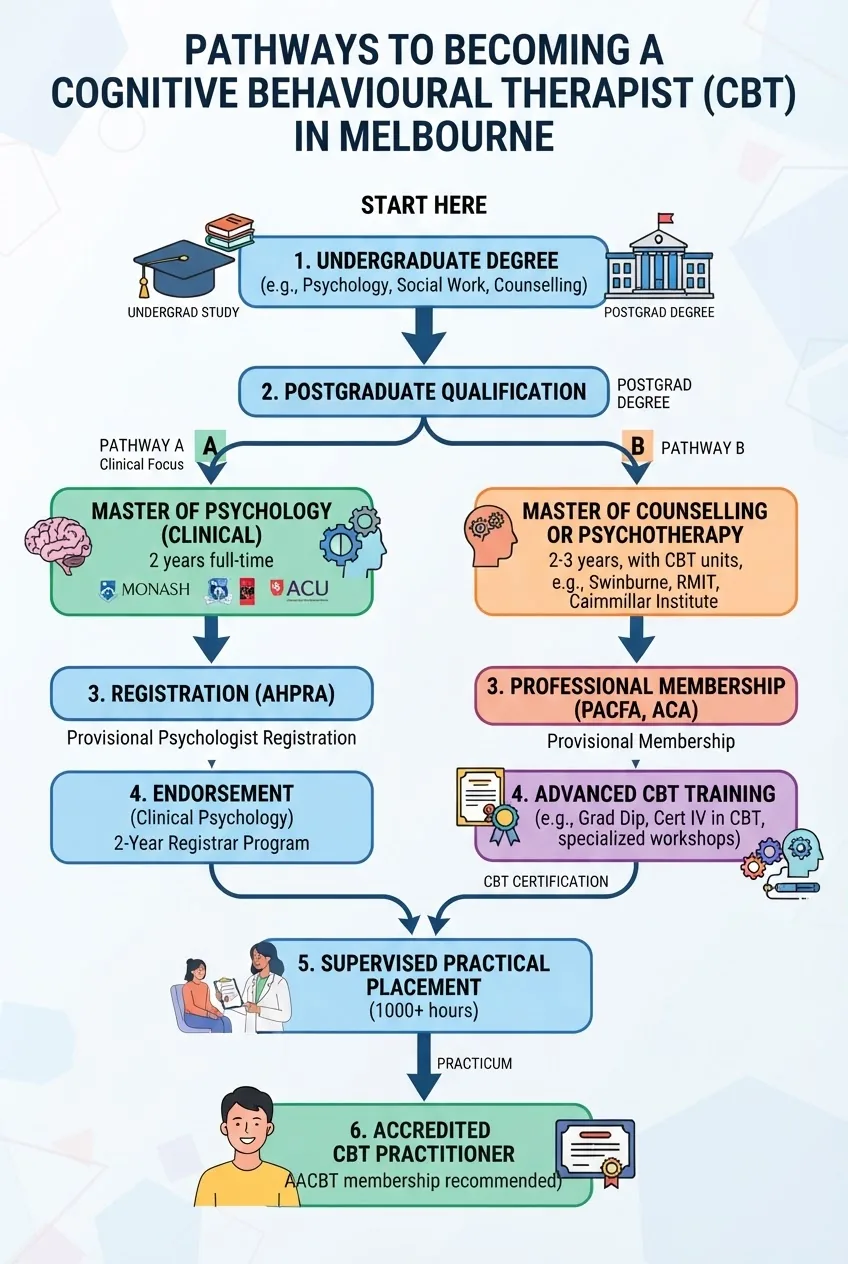
Training commonly sits in two streams:
- University postgraduate pathway leading to psychologist registration (if the degree is an accredited sequence).
- Non-psychologist CBT pathways via accredited diplomas, short courses and specialist CBT certificates for counsellors, social workers and allied health professionals.
Practical realities in Melbourne: metropolitan placement availability is generally good but competitive; private clinics and public mental health services rotate placement placements in partnership with local providers. Many trainees supplement face-to-face learning with online modules for theory and use supervised practice hours to build competence in CBT assessments, case conceptualisation and manualised interventions such as cognitive restructuring and exposure techniques.

Real-world example: a recent graduate from a Melbourne postgraduate clinical psychology stream described completing 1,000 practicum hours across a university clinic and a public hospital outpatient service, plus a 12-week specialist CBT skills course delivered by an accredited private institute — this blended model is common for those seeking both clinical competence and employability in Victorian services.
Psychology Session: Therapy Setup and Service Guide
therapist role and certification guide
As of 2026, Australian practice expectations emphasise ongoing supervised practice and CPD; many Melbourne employers expect an evidence-based CBT skillset plus registration or membership with a professional body for credibility in public and private roles. Licensing to bill Medicare for psychological services typically requires a psychology registration pathway, while allied health clinicians may provide CBT-informed therapy under different referral frameworks.
Transition: the next section describes course types and the practical training pathways you can follow in Melbourne.
Overview of Cognitive Behavioural Therapy Training Pathways in Melbourne?
Answer: Melbourne offers three main CBT training pathways—university postgraduate degrees (clinical psychology), vocational diplomas and short specialist certifications—each with differing durations, placement requirements and fee structures; choice depends on prior qualifications and intended scope of practice.
Term: Postgraduate course refers to graduate-level university study (Graduate Certificate, Graduate Diploma, Masters, or Doctorate) that can lead to registration or advanced clinical roles.
Overview of main course types available in Melbourne:
- Postgraduate clinical psychology degrees (e.g., Master of Psychology (Clinical) or Doctor of Psychology) — route to AHPRA registration as a psychologist with intensive clinical placements.
- Graduate certificates and diplomas in CBT or evidence-based therapies — designed for allied health professionals and counsellors to gain CBT specialist skills without full psychologist registration.
- Short courses and workshops (e.g., 8–12 week CBT skills courses) — upskill existing clinicians, often CPD-accredited and focused on manualised approaches like CBT for anxiety.
- Vocational education and training (VET) diplomas or advanced diplomas in counselling with CBT units — pathway for attendees seeking registered counsellor credentials via PACFA or similar.
- Online modular certificates offering blended delivery (theory online, practical components in-person or via local supervisors) for flexibility.
Example Melbourne providers and how their pathways typically compare (examples of course structure, not endorsements): Victoria university clinical programs offer structured supervised placements in public health networks; private institutes like those partnered with Victorian hospitals provide specialist CBT certificates and supervised clinics; TAFE/VET providers offer diploma-level counselling with CBT modules.
Case summary: A Melbourne-based social worker (example case) completed a Graduate Certificate in Cognitive Behavioural Therapy (6 months, blended), completed 200 hours of supervised clinical practice through a community mental health clinic, joined a state-recognised training body for CPD, and now runs CBT-focused groups in an NGO. This illustrates the non-psychologist route where credentialing is through coursework plus supervised practice rather than AHPRA registration.
Specialist modules commonly available on Melbourne courses include CBT case formulation, behavioural experiments, exposure therapy, schema-focused adaptations, trauma-informed CBT (see specialised trauma modules), relapse prevention and service delivery in community and private practice settings. For trauma-specific competence, many providers offer CBT for PTSD training.
Alternatives and related modalities: some trainees pair CBT training with Acceptance and Commitment Therapy (ACT) modules to broaden therapeutic tools; if you want that path, review the ACT Therapy training guide. Dialectical Behaviour Therapy (DBT) pathways are another nearby specialisation available through specific Melbourne programs: DBT training and certification.
Practical placement examples in Melbourne (experience signal): placements often occur in:
- Public hospital outpatient clinics (supervised by registrars and senior clinical psychologists).
- University psychology clinics offering low-cost services to the community.
- Community health services and NGOs that provide supervised casework for trainees.
- Private practice supervision arrangements where trainees co-facilitate sessions with a supervisor.
As of 2026, Victorian students should check the Victorian Registration and Qualifications Authority (VRQA) listings for recognized VET providers and confirm university accreditation status before enrolment. For government-held lists of eligible training providers and funding options, review the VRQA and Department of Health guidance below in the accreditation and fees sections.
Transition: after mapping pathways, the next section explains the key accreditation and certification bodies governing CBT training quality and practice in Victoria.
Key Accreditation and Certification Bodies for CBT Therapists in Victoria?
Answer: Accreditation in Victoria involves multiple bodies—Australian Psychological Society (APS) for psychologist practice standards, PACFA for counsellors, and VRQA for course recognition—each setting different certification and practice requirements that affect your scope and ability to bill.
Term: PACFA stands for the Psychotherapy and Counselling Federation of Australia; it is a peak body that provides membership and voluntary accreditation for counsellors and psychotherapists.
Key organisations and their roles:
| Accreditation Body | Primary Role | Typical Certification Requirements | Impact on Practice |
|---|---|---|---|
| Australian Psychological Society (APS) | Sets professional standards, practice guidelines and specialist interest groups for CBT | Membership, endorsed training pathways and CPD hours for chartered status | Guides psychologist credentialing; relevant for those seeking registered psychologist status |
| Psychotherapy & Counselling Federation of Australia (PACFA) | Voluntary accreditation for counsellors and psychotherapists | Completion of accredited coursework, supervised hours and adherence to ethical code | Useful for counsellors branding as accredited CBT therapists; not a substitute for AHPRA registration |
| AHPRA/Board of Psychology | Regulates registered psychologists and registration pathways | Accredited sequence degrees, supervised practice, national exams where applicable | Necessary to use the title “psychologist” and to access Medicare psychological rebates |
| Victorian Registration & Qualifications Authority (VRQA) | Registers and audits VET providers and school-level qualifications in Victoria | Course accreditation and provider registration | Ensures vocational courses meet state standards; check VRQA listings for diploma-level CBT providers |
| Australian Counselling Association (ACA) / Other membership bodies | Professional membership, CPD frameworks and insurance support | Membership application, supervised practice evidence and CPD completion | Useful for private practice insurance and client confidence |
As of 2026, the APS publishes CBT training expectations and practice guidelines; for authoritative standards see the Australian Psychological Society: Australian Psychological Society (APS). For state-recognised training providers and course approvals consult the VRQA: Victorian Registration and Qualifications Authority (VRQA). For funding and government policy on workforce development, see the Australian Government Department of Health guidance: Australian Government Department of Health.
Key differences in credentialing:
- If you intend to call yourself a “psychologist” and access Medicare rebates for psychological services, you must satisfy AHPRA registration and complete an accredited psychology sequence (Masters/Doctorate as specified by the Psychology Board of Australia).
- If your background is in allied health or counselling, PACFA or ACA accreditation supports a CBT therapist title, but legal practice boundaries and Medicare billing differ.
- Many Melbourne employers look for a combination of recognised coursework plus supervised clinical hours; voluntary membership in PACFA/ACA increases employability in community settings.
counsellor training and certification
psychologist certification guide
depression psychologist training
Practical advice: match the accreditation to the role you want. For private practice focused on CBT within scope as a counsellor or social worker, PACFA/ACA membership plus diploma/grad-certificate CBT training is commonly sufficient; for independent Medicare-rebated psychological services and hospital senior roles, an AHPRA-registered psychology pathway is required.
Transition: next we unpack how training modules are typically structured, how long they take and which delivery formats Melbourne providers offer.
Typical Training Course Content, Duration, and Delivery Formats?
Answer: CBT training in Melbourne generally combines theory modules, supervised clinical practice, assessment and case formulation training; duration ranges from short 8-week courses to multi-year postgraduate degrees delivered face-to-face, online or hybrid.
Term: Supervised practice means clinically supervised client contact hours where an experienced clinician provides oversight, feedback and competence sign-off.
-
Core theory modules:
Topics include CBT models, cognitive restructuring, behavioural activation, exposure therapy, and assessment measures; university programs add research methods and psychopathology units.
-
Skills and practice labs:
Role-plays, video-recorded sessions, manualised therapy exercises and skills labs to practice interventions.
-
Supervised clinical placements:
Required supervised hours vary: short courses may require 50–200 supervised hours for accreditation bodies; psychology registration requires significantly more supervised practice across accredited placements.
-
Assessment and competency checks:
Written assignments, case studies, objective structured clinical examinations (OSCEs) in some university programs, and supervisor reports verifying competence.
-
Specialist elective modules:
Trauma-focused CBT, CBT for chronic pain, CBT for OCD, CBT for substance-use comorbidity and adaptations for group therapy.
-
Continuing professional development (CPD):
Short CPD workshops delivered by Melbourne institutes and hospital departments to update clinical practice and obtain membership-required hours.
-
Delivery formats:
Options include:
- Fully in-person intensive programs (ideal for hands-on practice).
- Fully online theory modules with local supervisory arrangements for practice components.
- Hybrid/blended courses combining weekend intensives, online lectures and local clinical placements.
-
Supervision models:
Individual supervision, group supervision and peer supervision; effective models in Melbourne combine biweekly individual supervision plus monthly group case review meetings.
-
Assessment of cultural competence:
Victorian programs increasingly include modules on working with CALD (culturally and linguistically diverse) communities and Indigenous mental health considerations.
-
Entry-to-practice practicalities:
Some short courses allow clinicians to use CBT techniques immediately under supervision; full independent practice often requires completion of supervised hours and membership with a professional body.
Typical durations (as of 2026) you can expect in Melbourne:
- Short specialist CBT course: 8–16 weeks (theory-heavy, 20–100 hours of instruction).
- Graduate Certificate in CBT: 6 months full-time or 1–2 years part-time, often includes 100–300 supervised hours.
- Graduate Diploma / Master of Counselling with CBT specialisation: 1–2 years, includes placements and assessment tasks.
- Master of Psychology (Clinical) / Doctor of Psychology: 2–4 years plus internship/registrar period with intensive supervised clinical hours required for AHPRA registration.
Online versus in-person trade-offs:
- Online benefits: flexibility, lower travel costs, often faster completion of theoretical components.
- Online drawbacks: fewer spontaneous role-play opportunities, reliance on local supervisors for practical hours, potential limitations for hands-on skills like exposure in vivo.
- In-person benefits: richer skills practice, immediate feedback, easier integration into local clinical networks for placements.
- Hybrid options: often the best compromise for Melbourne trainees balancing work, offering intensive in-person labs and flexible online theory.
For flexible distance learners, review the guide to online courses: online CBT training options.
Practical example of a course structure in Melbourne: a Graduate Certificate might include five modules (CBT foundations; assessment and measurement; neurobiology and psychopathology; clinical practice and ethics; elective), 120 hours of teaching and 150 supervised clinical hours completed over 9–12 months, with supervisor assessment at key milestones.
Transition: next we outline typical fee ranges and available funding options for CBT training in Melbourne.
Fees and Funding Options for CBT Training in Melbourne?
Answer: CBT training fees in Melbourne vary widely—short courses cost ~AUD 600–3,000, graduate certificates/diplomas ~AUD 3,000–15,000, and postgraduate degrees ~AUD 15,000–40,000+; funding options include scholarships, HECS-HELP (for eligible university courses), employer sponsorship, and government workforce development programs.
Term: HECS-HELP is the Australian Government loan scheme that helps eligible domestic students pay university tuition fees deferred via tax-linked repayment.

Fee range examples (as of 2026):
- Short specialist CBT workshops: AUD 600–3,000 (single-topic, 1–12 days).
- Graduate Certificate in CBT: AUD 3,000–8,000 (depending on university vs private provider).
- Graduate Diploma / Master of Counselling with CBT focus: AUD 8,000–20,000.
- Master of Psychology (Clinical) / Doctor of Psychology: AUD 20,000–40,000+ per year for international-fee equivalents (domestic fees often eligible for HECS-HELP and lower per-year costs).
Funding and affordability options:
- HECS-HELP or FEE-HELP for eligible university coursework (check your eligibility for domestic enrolment).
- University scholarships and bursaries for postgraduate students (merit-based or need-based).
- Employer sponsorship or study leave arrangements for clinicians employed in public health, NGOs or private clinics.
- State and federal workforce training grants available intermittently for shortages in mental health professions (refer to the Department of Health funding announcements).
- Payment plans offered by private training providers to spread the cost over months.
- Professional association discounts or scholarships for members (PACFA, ACA or APS often list opportunities).
According to a 2024 industry report on vocational mental health training costs, entry-level CBT short courses averaged AUD 1,200 nationally; in Melbourne, premium provider courses trend 10–20% higher due to metropolitan delivery costs. Always confirm exact costs with the provider because fees and subsidy eligibility change frequently.
How to access government and institutional funding:
- Check HECS-HELP/FEE-HELP eligibility on institution websites when applying for university courses.
- Search Department of Health workforce programs for active grants: Australian Government Department of Health.
- Confirm whether the VRQA recognises a VET provider to ensure access to state training subsidies: VRQA.
Practical tips to reduce cost:
- Combine employer-funded placements with university coursework to offset fees.
- Prioritise accredited modules that count toward recognised certification to avoid duplicate spending.
- Use CPD workshops to progressively build competencies rather than immediately enrolling in a full degree.
Trust note: fees and funding availability are provided here as of 2026 and may vary; contact training providers and financial aid offices for current figures and eligibility. Transition: the next section describes the career outlook and typical earnings for CBT therapists in Melbourne.
Career Opportunities and Outlook for Cognitive Behavioural Therapists in Melbourne?
Answer: CBT-trained clinicians in Melbourne can work in private practice, hospitals, community mental health clinics, schools and employee assistance programs; demand is steady with competitive private practice rates and diverse public sector openings—average private-session fees range and salaried roles vary by qualification.
Career pathways include:
- Private practice as a CBT therapist (often requires private indemnity insurance and, depending on title used, professional membership).
- Public sector roles in hospital outpatient services and community mental health teams (typically require higher-level qualifications for senior positions).
- NGO and community health work delivering group and individual CBT programs.
- Employee Assistance Programs and workplace mental health services.
- Academic and teaching roles in Melbourne universities or training institutes delivering CBT curriculum and supervision.
Stat block — job outlook and typical fees (as of 2026):
| Metric | Value / Range | Source Type |
|---|---|---|
| Estimated demand growth (melbourne region) | Moderate increase; steady demand for CBT skills in public and private sectors | According to a 2024 industry workforce report |
| Average private-session fee (50–60 mins) | AUD 150–280 depending on clinician level | According to a 2025 practitioner survey |
| Public sector entry-level salary | AUD 70,000–95,000 FTE (varies by role and discipline) | According to a 2024 Victorian government health employment report |
Clinical focus areas often served by CBT therapists include anxiety, depression, OCD, PTSD and comorbid presentations. For an overview of clinical applications, see related resources on anxiety and mood disorders: anxiety and depression treatment applications.
Real-world employment example: a Melbourne trainee with a Graduate Diploma in CBT started as an allied health clinician in a community mental health service earning an entry salary and later transitioned to private practice, increasing session fees as they built supervised hours and PACFA membership.
Transition: the next section explains how to choose a training course and what practical criteria to assess when selecting a Melbourne provider.
How to Choose the Right CBT Training Course in Melbourne?
Answer: Choose a CBT course by matching your career goal (registered psychologist vs accredited counsellor), verifying provider accreditation, checking supervised hours, trainer credentials and graduate outcomes, and comparing fees, delivery mode and CPD pathways.
Step-by-step selection checklist:
- Define your career target: Do you want psychology registration (AHPRA) or specialist CBT skills as a counsellor/allied health clinician?
- Verify accreditation: Confirm if the course contributes to APS/AHPRA recognition or PACFA/ACA accreditation; check VRQA for VET provider listings.
- Inspect supervised practice requirements: Ensure the program includes adequate supervised clinical hours and clear supervisor qualifications.
- Assess trainer qualifications: Look for trainers with AHPRA registration or recognised specialist training in CBT and track records of published clinical work or teaching experience.
- Check graduate outcomes and employment links: Request graduate destination data or employer partnerships for placements.
- Compare delivery formats and support: Evaluate the balance of online theory vs in-person skills labs and local supervision support for placements.
- Review cost and funding options: Compare tuition, available scholarships, and payment plans.
- Read course reviews and speak to alumni: Seek firsthand accounts from recent graduates or current supervisors in Melbourne services to validate training claims.
Criteria checklist (quick reference):
- Does the course provide documented supervised clinical hours?
- Are trainers experienced and credentialed in CBT?
- Does the course map to an accreditation body (APS/PACFA/VRQA)?
- Is the delivery format suited to your learning style and time commitments?
- Are graduate employment outcomes transparent?
- Is there clear guidance on scope of practice post-completion?
Trade-offs to consider:
- A shorter, cheaper course may provide immediate skills but not the supervised hours or accreditation needed for independent practice.
- A longer university pathway is more expensive and time-consuming but opens broader career doors including Medicare rebate access when combined with AHPRA registration.
Practical step: contact training providers directly, request unit outlines and supervisor qualification requirements, and ask for a sample timetable for placements. Where possible, attend information nights or sit in on a workshop to assess teaching quality.
Transition: the final section summarises the pathway and suggests next steps to begin CBT training in Melbourne.
Summary and Next Steps to Becoming a Cognitive Behavioural Therapist in Melbourne?
Answer: Start by deciding whether you need a psychology registration route or a specialist CBT credential; then select an accredited Melbourne program that provides supervised clinical hours, secure funding, and complete CPD and membership requirements to launch your CBT practice.
Key takeaways:
- There are multiple Melbourne pathways—postgraduate psychology programs for registration and diplomas/certificates for specialist CBT skills.
- Accreditation matters: AHPRA/APS eligibility is distinct from PACFA/ACA membership and affects Medicare billing and hospital roles.
- Supervised clinical practice is the decisive element for competence; ensure clear supervisor arrangements and documented hours.
- Fees vary widely; explore HECS-HELP, scholarships and employer support to manage costs.
- Build local networks during placements to improve employment prospects in Melbourne’s mental health sector.
Practical next steps you can take today:
- Decide your intended professional title and practice setting (private practitioner vs public clinician).
- Shortlist 3 Melbourne providers matching your needs and request their unit outlines, supervisor requirements and graduate outcomes.
- Investigate funding: contact university finance offices or your employer about sponsorship.
- Attend a taster workshop or information session to judge teaching and supervision quality.
- Plan for CPD and association membership to maintain skills after initial qualification.
Final trust note: training requirements, costs and funding schemes change; verify details with the training provider and accreditation body. If you’re ready to compare programs, start with providers that publish clear supervised-practice pathways and graduate employment data. Ready to take the next step? Review course pages, reach out to training coordinators and book information sessions to confirm the best Melbourne pathway for your career goals.