

Anxiety vs depression: Anxiety is characterised by persistent worry, hyperarousal and avoidance; depression presents with prolonged low mood, loss of interest and slowed thinking. Both can overlap; this guide explains how to tell them apart, outlines diagnostic criteria and evidence-based treatments, and shows when to seek help in Sydney.
What are anxiety and depression — a clear overview?
Answer: Anxiety and depression are distinct but often comorbid mental health disorders; anxiety features excessive worry and bodily arousal, while depression centres on persistent low mood and loss of interest. Both affect thinking, behaviour and daily functioning and require assessment against formal diagnostic criteria.
Term: anxiety — an anxiety disorder is a group of conditions marked by excessive fear, worry, or nervousness that impairs functioning.
Term: depression — a depressive disorder is defined by persistent low mood, loss of interest or pleasure, and cognitive or physical symptoms lasting weeks or longer.
Anxiety disorders (including generalized anxiety disorder, panic disorder, and specific phobias) are grouped under anxiety disorders; major depressive disorder and persistent depressive disorder (dysthymia) are types of depressive disorders. When both sets of symptoms appear, clinicians consider comorbidity or the diagnostic category often referred to as anxiety depressive disorder (symptoms of both conditions). Definitions here follow common psychiatric frameworks used in Australia and internationally (see DSM/ICD links below).
Prevalence and impact in Australia: According to a 2023 Beyond Blue report, one in five Australians experienced an anxiety or depressive disorder in the last year (source: national NGO prevalence report, 2023).
Transition: The next section directly compares the symptoms you can observe and measure to help differentiate anxiety vs depression in day-to-day life.
How do the key symptoms of anxiety and depression differ?
Answer: Anxiety primarily shows as persistent worry, physical arousal and avoidance; depression primarily shows as persistent low mood, loss of interest and psychomotor changes — but there is significant overlap, so symptom duration, onset and functional impact guide diagnosis.
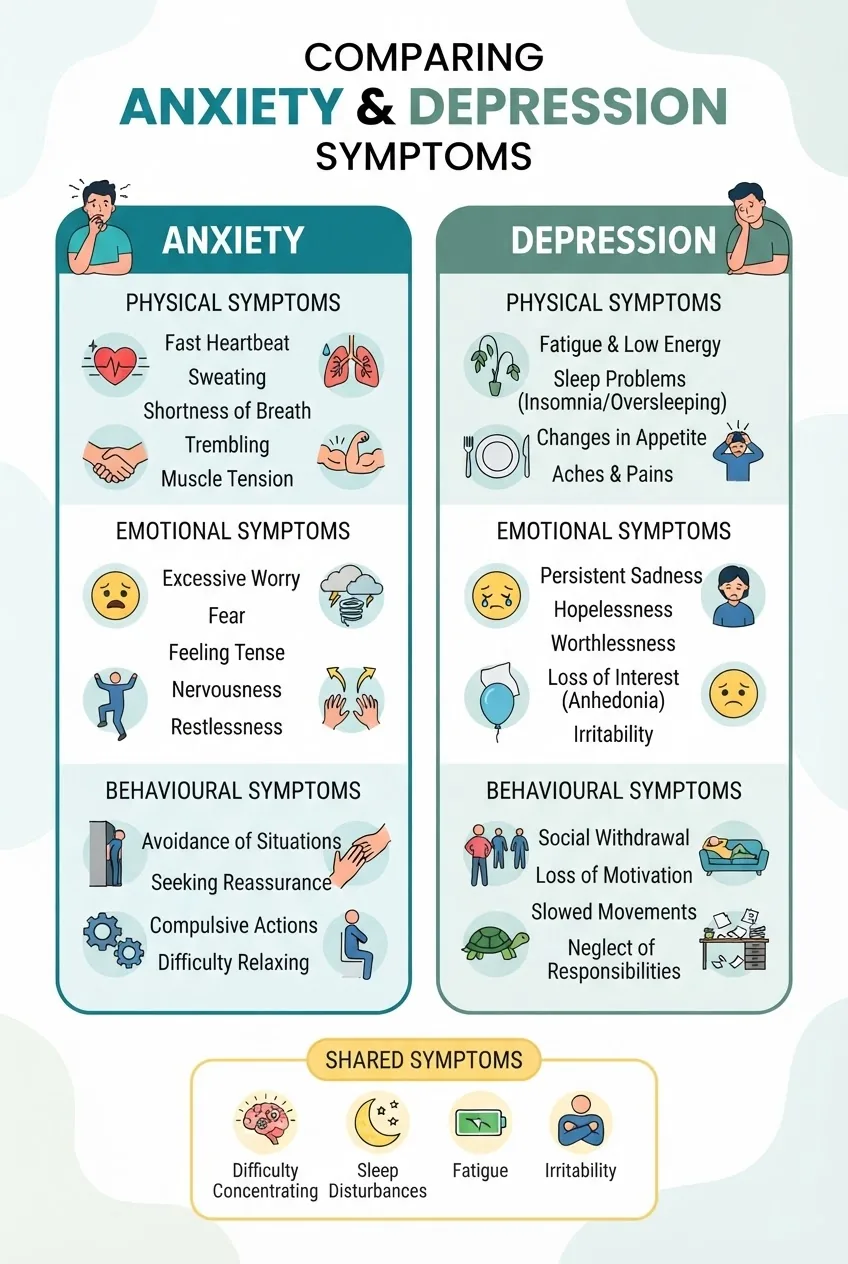

| Symptom Category | Anxiety — typical signs | Depression — typical signs |
|---|---|---|
| Core emotional experience | Excessive worry, fear, dread, anticipatory anxiety | Persistent low mood, emptiness, hopelessness |
| Time course | Often situation-linked or pervasive worry; may have sudden panic episodes | Symptoms persist for weeks to months; can be episodic or chronic |
| Physical symptoms | Palpitations, sweating, trembling, dizziness, GI upset, muscle tension | Fatigue, sleep disturbance (early morning waking or hypersomnia), appetite/weight change, slowed movement |
| Cognitive symptoms | Racing thoughts, catastrophic thinking, difficulty concentrating due to worry | Negative thinking, guilt, slowed thought, poor concentration, indecisiveness |
| Behavioural signs | Avoidance of triggers, restlessness, checking, reassurance-seeking | Withdrawal, reduced activity, neglecting responsibilities, loss of motivation |
| Social/functional impact | Interferes with work or relationships due to avoidance or panic | Marked impairment: work absence, relationship strain, reduced self-care |
| Suicidal ideation | Less common as core symptom but risk can rise with severe anxiety | Significant risk in moderate–severe depression; assess immediately |
| Overlap | Shared symptoms include sleep disturbance, concentration problems, irritability and fatigue; degree and dominant symptom cluster guide diagnosis | |
Elaboration: The table outlines common physical, emotional and behavioural differences so you can map your experience. Signs of anxiety or depression can be subtle: for example, insomnia with early-morning waking suggests depression, while difficulty initiating sleep due to worry suggests anxiety.
Diagnostic criteria (technical reference): Clinicians use DSM-5/ICD-11 criteria to determine whether symptom clusters meet thresholds for a disorder; duration (e.g., two weeks for major depressive episode) and functional impairment are key. For DSM-5 summaries see the American Psychiatric Association and WHO ICD-11 (external links below).
Experience signal: In clinic intake assessments we use structured symptom checklists and a functional impact grid (work, relationships, self-care) to map dominant symptom clusters before proposing treatment — this helps avoid mislabeling anxiety as depression and vice versa.
Transition: Many readers will have both sets of symptoms — the following section explains why diagnosis is sometimes challenging and how clinicians approach combined presentations.
Why is diagnosing anxiety versus depression sometimes difficult, and what is anxiety depressive disorder?
Answer: Diagnosis is challenging because symptoms overlap, onset can be gradual, and comorbidity is common; clinicians use temporal patterns, severity, and functional impairment plus DSM/ICD criteria to distinguish or diagnose combined presentations like anxiety depressive disorder.
Overlap examples and diagnostic considerations:
- Symptom overlap: Sleep problems, concentration difficulties and irritability occur in both disorders; severity and context (worry-focused vs mood-focused) clarify diagnosis.
- Temporal pattern: Sudden panic onset suggests an anxiety disorder; progressive withdrawal and anhedonia over weeks suggest major depression.
- Functional impairment: Clinicians weigh workplace, social and self-care decline when applying criteria.
Clinical vignette (anonymised): A 34-year-old client in Sydney presented with months of sleeplessness, persistent worry and declining work performance. Structured assessment revealed worry-driven rumination (anxiety) and three weeks of reduced pleasure in hobbies (depressive symptoms). The working diagnosis was comorbid generalized anxiety disorder with a moderate depressive episode; treatment combined CBT strategies and a short medication trial.
Bulleted diagnostic tools used in practice:
- Standardised questionnaires (e.g., GAD-7 for anxiety, PHQ-9 for depression) to quantify symptom severity.
- Clinical interview mapping onset, triggers and functional impact.
- Collateral history where safe and appropriate (family or GP) to confirm duration and risk.
Differential diagnoses to consider (brief list):
- Bipolar disorder — manic or hypomanic history may reframe depressive episodes; see bipolar depression treatment options.
- PTSD — trauma-related re-experiencing may mimic anxiety/depression; see PTSD treatment and depression support.
- Medical causes — thyroid disease, vitamin deficiencies and certain medications.
Experience signal: A standard clinic intake framework typically records symptom onset, triggers, duration, medication history and suicidal risk in the first one to two sessions; this structured approach reduces diagnostic uncertainty and informs safe care planning.
Transition: When depression becomes prolonged or recurrent, clinicians describe stages and long-term effects — the next section maps these changes and what they mean for treatment planning.
What are the stages and long-term effects of depression?
Answer: Depression can progress through identifiable stages — initial episode, acute episode, recovery, remission, and potential relapse or chronicity (dysthymia); long-term effects include functional decline, cognitive slowing and increased relapse risk without maintenance strategies.
- Prodromal / early warning stage: Mild symptoms such as low energy, reduced interest and sleep changes that often precede a full episode.
- Acute episode: Full-threshold major depressive episode with marked low mood, anhedonia, functional impairment and possible suicidal ideation; typically lasts at least two weeks.
- Partial recovery / residual symptom stage: Core mood improves but residual symptoms like sleep problems, low motivation or cognitive slowing remain and increase relapse risk.
- Remission: Symptoms subside and daily functioning returns to baseline; maintenance treatment decisions are made here to prevent relapse.
- Relapse or chronic stage (dysthymia/persistent depression): Ongoing low-level symptoms for two years or repeated episodes; requires long-term management strategies.
Long-term depression symptoms include persistent fatigue, cognitive difficulties (memory, processing speed), social withdrawal and occupational impairment. According to a 2022 systematic review meta-analysis, residual symptoms after treatment predict relapse risk by a substantial margin (source: peer-reviewed meta-analysis, 2022).
Special subtype notes: Post-natal depression and seasonal affective disorder (SAD) are recognised patterns with specific timing and triggers; for targeted guidance see post natal depression support in Australia and seasonal affective disorder treatment.
Clinical implication: Early detection of prodromal signs and addressing residual symptoms during partial recovery reduces the chance of relapse and the development of chronic depression; maintenance psychotherapy or medication is commonly recommended.
Transition: Stress commonly triggers or worsens both anxiety and depression — below we explain the stress link with practical examples.
How does stress link to anxiety and depression?
Answer: Stress activates the body’s stress response (fight/flight) and, when prolonged, can precipitate or worsen anxiety and depression by altering sleep, mood regulation and cognitive resources; chronic stress is a common proximal trigger for both disorders.
Mechanism summary: Acute stress triggers physiological arousal (adrenaline, cortisol) producing anxiety-like symptoms; chronic stress dysregulates mood-related systems and sleep, increasing vulnerability to depression. Stressors include work pressure, interpersonal conflict, financial strain and traumatic events.
Illustrative examples:
- Case example: A client under prolonged workplace performance pressure developed pervasive worry (anxiety) that later evolved into exhaustion and low mood (depression) when coping strategies failed.
- Trigger sequence: Relationship breakup → acute stress and insomnia → heightened rumination → persistent low mood and withdrawal.
Coping and buffering: Effective stress management (sleep hygiene, activity scheduling, problem-solving, social support) reduces the risk that stress becomes chronic and leads to anxiety depressive presentations. Structured interventions that target stress responses are an early step in clinical care plans.
Transition: With symptoms, diagnostic clarity and stress links described, the next major section summarises evidence-based treatment options and how clinicians combine approaches in practice.
What treatment options are available for anxiety and depression?
Answer: Effective treatments include psychological therapies (e.g., CBT, ACT, DBT), pharmacological options (antidepressants, anxiolytics where appropriate), and lifestyle or psychosocial interventions; clinicians often combine modalities tailored to severity, comorbidity and patient preference.

Treatment selection is driven by severity, diagnosis, prior response and access. Below are commonly used evidence-based options and practical notes for Sydney-based care access.
Psychological therapies (overview)
Term: CBT — Cognitive Behavioural Therapy (CBT) is a structured, time-limited therapy focusing on links between thoughts, emotions and behaviours.
- Cognitive Behavioural Therapy (CBT) — First-line for many anxiety disorders and depression; focuses on cognitive restructuring, behavioural activation (for depression) and exposure techniques (for anxiety). See local therapist options: Cognitive Behavioural Therapist in Melbourne, and online learning resources: CBT online courses.
- Acceptance and Commitment Therapy (ACT) — Emphasises values-based action and acceptance strategies; effective for mixed anxiety/depression presentations. For deeper training and application see ACT therapy for anxiety and depression.
- Dialectical Behaviour Therapy (DBT) — Focuses on emotion regulation, distress tolerance and interpersonal effectiveness; helpful where emotional dysregulation is prominent. See DBT therapy benefits and training.
- Counselling and supportive psychotherapy — Short-term counselling can help with coping and problem-solving; check local qualifications via counsellor training and certification in Australia and psychologist certification guide.
Pharmacological treatments
Answer-first note: Antidepressants (SSRIs, SNRIs) are commonly used for moderate–severe depression and many anxiety disorders; benzodiazepines are occasionally used short-term for severe anxiety but carry dependency risks.
- Antidepressants (SSRIs, SNRIs, atypicals): Evidence supports their use for moderate–severe depression and several anxiety disorders; trial periods are typically 6–12 weeks to assess response.
- Benzodiazepines: Rapid anxiolytic effects but recommended only short-term due to dependence; often avoided as first-line care in Australia.
- Add-on options: For treatment-resistant depression, augmentation strategies may include atypical antipsychotics or mood stabilisers under specialist supervision.
Efficacy note: According to a 2021 Cochrane review meta-analysis, CBT and antidepressants each produce clinically significant improvements versus placebo for major depression (source: peer-reviewed meta-analysis, 2021).
Combined and stepped-care approaches
Answer: Clinicians commonly use stepped care — starting with low-intensity psychological interventions and escalating to more intensive therapy or medication if symptoms persist; combined CBT plus medication is common for moderate–severe cases.
- Step 1: Low-intensity psychosocial interventions (guided self-help, online CBT).
- Step 2: Individual psychotherapy (CBT, ACT) and review of social supports.
- Step 3: Medication initiation ± psychotherapy for moderate–severe illness.
- Step 4: Specialist referral for treatment-resistant cases, severe suicidality or complex comorbidity.
Experience signal — common real-world combinations used in clinics:
- CBT + SSRI for moderate depression with comorbid anxiety.
- ACT + brief medication trial when experiential avoidance and life values are central issues.
- CBT with graded exposure alongside short-term anxiolytic support for severe panic disorder.
Other interventions and supports
- Psychosocial supports: peer groups, occupational support, family interventions and workplace adjustments; see depression support and treatment at work.
- Rehabilitation and intensive programs: day programmes or residential care for severe/complex cases; see depression rehabilitation centers.
- Complementary approaches: exercise, sleep regulation, nutrition and mindfulness can complement core treatments — see resources on natural remedies and therapies for depression and local course offerings: depression support and treatment courses Australia.
Access in Sydney: Public and private options exist; the Australian Government Department of Health provides information on subsidised psychological services and GP referral pathways (see external link below).
Transition: If treatments are available, when should you seek professional help and what happens at the first appointment? The next section walks through that process.
When should I seek professional help and what should I expect?
Answer: Seek professional help if symptoms cause functional impairment, persist beyond two weeks, include suicidal thoughts, or if you’re unsure; expect an assessment of symptoms, risk, history, and a collaborative care plan including referrals or immediate safety measures.
How-to steps for seeking help:
- Recognise red flags: severe low mood, suicidal ideation, psychosis, incapacity to care for self — seek urgent care (call local emergency services).
- Book an appointment with your GP for medical assessment, referral and possible mental health treatment plan (Medicare rebates in Australia may apply).
- Schedule a psychology or psychiatry assessment where available; initial sessions include history, symptom measures (PHQ-9/GAD-7), risk assessment and treatment planning.
- Discuss options: psychotherapy, medication, combined care and follow-up frequency.
Service navigation and credentials: Understanding practitioner roles helps — see resources on therapist role and certification overview, psychotherapist role and training, and professional training for depression care: training and certification of depression psychologists.
Accessible options: For low-cost or no-cost options see free online therapy and counselling options, and for remote care consider online psychologist services or online therapy and support services.
Practical expectation: Initial assessment typically lasts 45–60 minutes and results in a written care plan, agreed goals and either immediate therapy scheduling or medical management; clinics often use follow-up review at 2–6 weeks to gauge response.
Transition: Long-term maintenance is essential to reduce relapse — below are practical strategies and supports to maintain mental health over time.
How can I maintain mental health and manage long-term support?
Answer: Long-term management combines ongoing therapy or maintenance medication when indicated, routine self-care (sleep, exercise, social support), relapse prevention planning and utilisation of community and workplace supports.
Practical long-term tips:
- Continue agreed treatment: complete recommended therapy sessions and maintain medication under medical supervision where indicated.
- Relapse prevention plan: identify early-warning signs, coping strategies and emergency contacts; review this annually with your clinician.
- Daily routines: prioritise sleep, regular physical activity, structured mealtimes and social engagement.
- Workplace adjustments: negotiate modified duties or phased return to work when recovering; see workplace resources at depression support and treatment at work.
- Support networks: engage family or peer support and consider carer education resources: supporting a depressed person and depression support resources and guidance.
Evidence and monitoring: Routine outcome monitoring (PHQ-9, GAD-7) every 4–12 weeks supports timely adjustments; clinics use this data to decide continuation or stepping up of care.
Final takeaway: Creating a simple written relapse-prevention plan with your clinician and sharing it with a trusted person greatly improves safety and recovery outcomes.
Conclusion — key takeaways and next steps
Distinguish anxiety vs depression by observing primary symptoms (worry/arousal vs low mood/anhedonia), duration and functional impact; use structured assessment tools and seek help if symptoms persist, cause impairment or include suicidal thoughts. For practical preparation for therapy see psychology session setup and service guide. If you’re in Sydney and unsure where to start, contact your GP or a local mental health service for an assessment and personalised care plan.