

What bipolar is: Bipolar disorder is a brain-based mood disorder characterised by alternating mood episodes of elevated energy, activity or irritability (mania or hypomania) and low mood with loss of interest (depression), which significantly affects thinking, behaviour and daily functioning.
Understanding What Bipolar Is
Answer: Bipolar disorder is an affective mood disorder that causes clear shifts between manic or hypomanic episodes and depressive episodes, producing fluctuations in mood, energy and functioning that are more severe than ordinary mood changes and require clinical assessment and tailored management.
Term: bipolar disorder — a long-term mood disorder marked by alternating elevated (manic/hypomanic) and low (depressive) mood episodes.
Bipolar disorder (sometimes called a mood disorder or affective disorder) is characterised by distinct mood episodes: periods of abnormally elevated mood and activity called mania or hypomania, and periods of depressed mood and low energy called depressive episodes. These episodes are not simple mood swings; they are clinically significant changes in cognition, sleep, energy and behaviour that impair function or carry risk (for example financial harm or self-harm).
Term: manic episode — a period of markedly elevated, expansive or irritable mood and increased goal-directed activity or energy lasting at least one week (or any duration if hospitalization is necessary).
Term: hypomanic episode — a milder form of mania lasting at least four consecutive days without marked impairment in social or occupational functioning.
Term: depressive episode — a sustained period (generally two weeks or more) of low mood or loss of interest with cognitive, sleep and appetite changes and reduced functioning.
Symptoms vary in intensity, frequency and duration. Some people have classic high/low cycles separated by normal moods, while others experience rapid cycling or chronic subthreshold symptoms. Bipolar disorder exists on a spectrum and is diagnosed clinically using standardised criteria that consider episode type, duration and impact.
Transition: The next section breaks down the main clinical subtypes and the specific symptom patterns clinicians look for when assessing mood episodes.
Types of Bipolar Disorder and Their Symptoms
Answer: The main diagnostic subtypes—Bipolar I, Bipolar II and cyclothymic disorder—are distinguished by the presence, severity and duration of manic, hypomanic and depressive episodes; each subtype has characteristic symptom sets clinicians use to guide diagnosis and treatment.
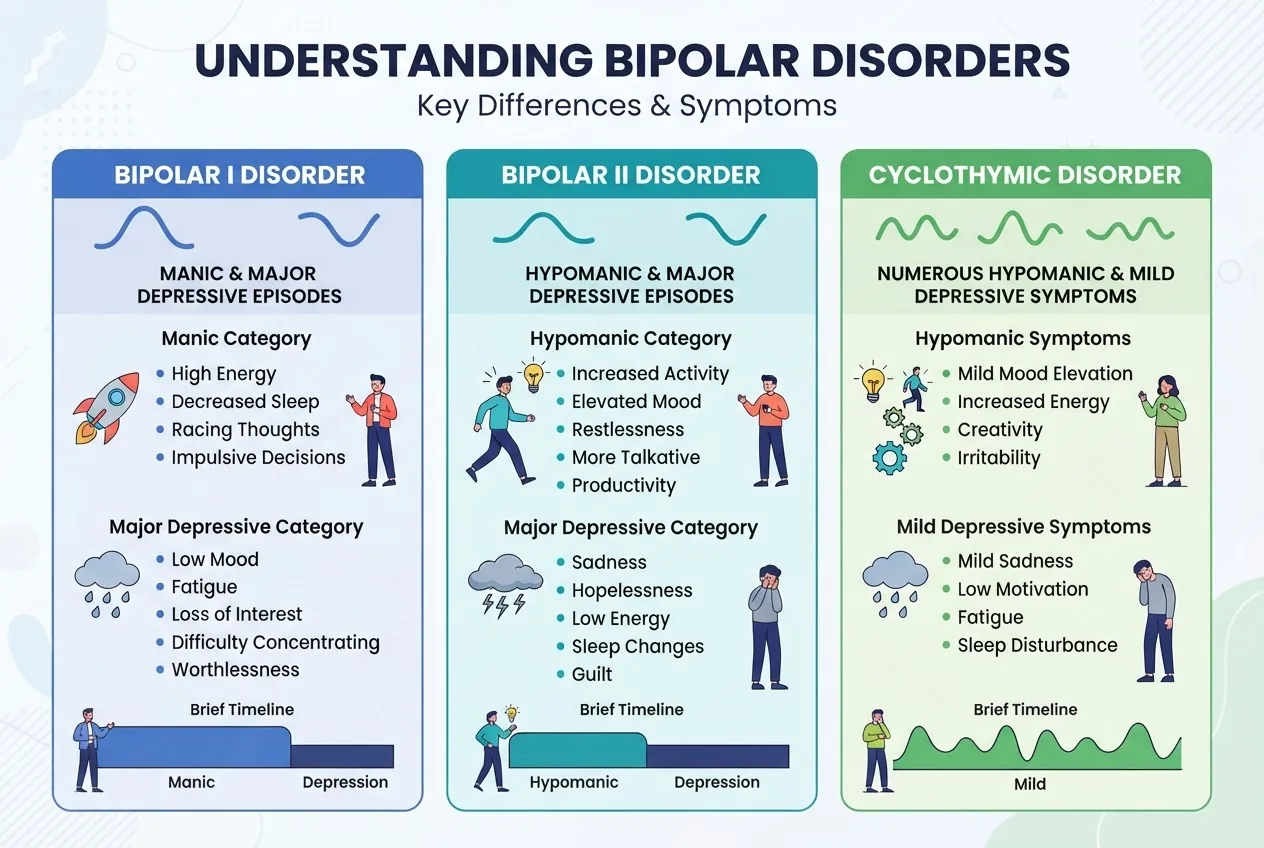
Term: Bipolar I disorder — characterised by at least one manic episode, which may be preceded or followed by major depressive episodes.
- Key features of Bipolar I:
- Manic episodes last ≥7 days or require hospitalisation (if severe) and may include psychosis.
- Symptoms during mania: inflated self-esteem or grandiosity, decreased need for sleep, pressured speech, racing thoughts, more risk-taking behaviours (spending sprees, unsafe sex), marked impairment or danger.
- Depressive episodes commonly follow or precede mania, with low mood, anhedonia, sleep/appetite disturbance, fatigue, suicidal thoughts.
Term: Bipolar II disorder — defined by at least one hypomanic episode and at least one major depressive episode, without any full manic episode.
- Key features of Bipolar II:
- Hypomanic episodes last ≥4 days, with observable changes but not severe enough to cause marked impairment or psychosis.
- Hypomania symptoms: elevated mood, increased productivity or talkativeness, decreased need for sleep—often experienced as positive but can lead to risky choices.
- Depression in Bipolar II tends to be longer and more disabling than hypomania and carries substantial suicide risk.
Term: Cyclothymic disorder — a chronic fluctuating mood condition with numerous periods of hypomanic and depressive symptoms that do not meet full criteria for hypomanic or major depressive episodes, persisting for at least two years in adults.
- Key features of cyclothymia:
- Chronic subthreshold mood swings with less severe highs and lows but ongoing functional disruption.
- Often a precursor to Bipolar I or II in some individuals, or a long-standing disruptive mood pattern.
Recognising manic versus hypomanic symptoms (clinical detail)
- Grandiosity or inflated self-esteem — mania often includes psychomotor agitation and severely impaired judgement.
- Reduced need for sleep — true mania may involve minimal sleep for days without tiredness.
- Pressured speech, flight of ideas or racing thoughts — observable by family or coworkers.
- Increase in goal-directed activity or risky behaviour — job loss, relationship problems or legal/financial consequences can result.
Common depressive symptoms across bipolar types
- Persistent low mood, feelings of hopelessness or guilt.
- Marked loss of interest or pleasure (anhedonia).
- Changes in appetite/weight, sleep disturbances (insomnia or hypersomnia).
- Difficulty concentrating, psychomotor slowing, fatigue, recurrent thoughts of death.
Clinical assessment pays attention to episode duration, severity, and pattern (e.g., rapid cycling defined as ≥4 mood episodes in 12 months). Subtle hypomanic episodes may be missed because they can increase productivity; thorough collateral history is essential.
Anonymised case examples (experience signals):
- Case A (Bipolar I): “Alex,” mid-30s, presented after a week-long manic episode with hospitalization due to risky driving and psychosis; prior depressive episodes documented over five years.
- Case B (Bipolar II): “Maya,” late-20s, sought help for severe depressive episodes; retrospective mood charting revealed multiple 4–6 day hypomanic phases previously mistaken for high productivity.
- Case C (Cyclothymic): “Sam,” early-40s, experienced fluctuating mild highs and lows for a decade, impairing relationships though never meeting full episode criteria.
Transition: Knowing the types helps focus investigation; the next section explores what causes bipolar disorder and the risk factors clinicians consider during assessment.
Causes and Risk Factors of Bipolar Disorder
Answer: Bipolar disorder results from an interaction of genetic predisposition, neurobiological differences in brain circuits and chemistry, and environmental/stress triggers; family history is a strong risk factor, with life events often precipitating the first episode.
Term: genetic predisposition — inherited susceptibility to a condition based on family history and identified genetic variants.
Evidence shows bipolar disorder has substantial heritability: twin and family studies estimate heritability between 60–80% (source: peer-reviewed genetic studies). According to a 2023 Australian mental health survey (government survey), family history increases individual risk markedly, though most people with affected relatives will not develop bipolar disorder on their own.
Neurobiological contributors include dysregulation in neurotransmitter systems (e.g., dopamine, serotonin, glutamate), altered circadian rhythms and differences in brain regions that regulate mood and reward processing. Neuroimaging studies (peer-reviewed research) show structural and functional differences in prefrontal-limbic circuits in people with bipolar disorder.
Environmental and psychosocial risk factors commonly cited in clinical literature include:
- Significant stressors or traumatic events (loss, abuse, major life changes) — these may precipitate onset or recurrence of episodes.
- Substance use (alcohol, stimulants) — can trigger manic or depressive episodes and complicate diagnosis.
- Sleep disruption and circadian rhythm disturbances — night shift work or travel can precipitate mood episodes.
- Medical conditions (thyroid disease, neurological disorders) — can mimic or exacerbate mood symptoms.
Example of multifactorial causation: a person with a family history of bipolar disorder who experiences a prolonged period of insomnia and stimulant use after a stressful life event is at higher risk of a mood episode than a person without those combined risk factors.
Research context and sources: the neurobiology and genetics of bipolar disorder have been summarised in systematic reviews and meta-analyses (peer-reviewed journal sources). For authoritative diagnostic criteria and epidemiology, see the American Psychiatric Association’s DSM-5 guidance and Australian Department of Health resources.
Australian Department of Health provides national mental health guidance and service information.
DSM-5 (American Psychiatric Association) summarises diagnostic criteria used internationally.
Peer-reviewed reviews provide overviews of genetic and neurobiological findings.
Transition: Because causes are complex, diagnosis relies on a structured clinical assessment; the next section explains that process step-by-step.
How Bipolar Disorder Is Diagnosed: Clinical Mental Health Assessment
Answer: Diagnosis is a multi-step clinical process: psychiatric evaluation using DSM-5 criteria, detailed history-taking (including collateral sources), mood charting, use of structured assessment tools, physical and laboratory screening, and careful differential diagnosis to rule out medical or substance-related causes.

- Initial presentation and clinical interview: A comprehensive psychiatric interview gathers the chief complaint, onset, duration and pattern of mood symptoms, impact on functioning, suicidality, substance use and medical history. Collateral history from family, partners or employers is often essential because hypomania may be under-reported.
- Apply DSM-5 diagnostic criteria precisely:
Term: DSM-5 — the Diagnostic and Statistical Manual of Mental Disorders, Fifth Edition, published by the American Psychiatric Association, used to define psychiatric diagnoses.
Clinicians check whether the patient meets DSM-5 criteria for Bipolar I (one manic episode ± major depressive episodes), Bipolar II (one hypomanic + one major depressive episode), or cyclothymic disorder (≥2 years of subthreshold symptoms). Criteria specify symptom type, number, duration and functional impairment.
- Mood charting and longitudinal data collection: Patients are encouraged to keep daily mood charts or use validated apps to record sleep, mood, activity, medication adherence and triggers for several weeks. Mood charts help differentiate chronic mood instability from discrete episodes and detect rapid cycling.
- Use of assessment tools: Structured and semi-structured instruments often used include the Mood Disorder Questionnaire (MDQ) as a screening tool, Young Mania Rating Scale (YMRS) to quantify mania severity, and standard depression rating scales (e.g., PHQ-9) to measure depressive symptoms. These complement, but do not replace, clinical judgement.
- Physical and laboratory investigations: Basic screening includes thyroid function tests, full blood count, metabolic panel and urine toxicology to exclude medical or substance-related causes that can mimic mood symptoms (e.g., hyperthyroidism, steroid use).
- Collateral history and functional assessment: Gathering reports from family, partners or clinicians helps establish onset timing, functional consequences, and the presence of psychotic features or risky behaviour during elevated episodes.
- Ruling out differential diagnoses: Clinicians systematically consider and exclude conditions that mimic bipolar disorder (see the next section). This includes screening for personality disorders, primary unipolar depression, ADHD, substance-induced mood disorder and neurocognitive disorders.
- Formulation and diagnostic disclosure: A diagnostic formulation synthesises biological, psychological and social contributors and communicates diagnosis, prognosis and initial management in a collaborative, non-stigmatising way, with safety planning if suicide risk is present.
- Ongoing monitoring and reassessment: Diagnosis may be revised with new information; clinicians schedule follow-ups, update mood charts and adjust formulation as patterns emerge over months.
Clinical assessment emphasises measurement, corroboration and ruling out medical causes. For legal or occupational matters, clinicians may document history and functioning with structured assessments and provide referrals for specialist opinions (e.g., consultation-liaison psychiatry).
Example of assessment timeline in a Sydney clinic (experience signal): initial consultation (60 minutes), baseline lab tests and mood charting for 4–8 weeks, collateral phone interview with family, followed by a multidisciplinary formulation meeting and shared management plan with the patient and/or family.
Transition: Accurate diagnosis is vital because bipolar disorder can be confused with other conditions; the next section compares key differential diagnoses and explains how clinicians distinguish them.
Differentiating Bipolar Disorder from Other Mental Health Conditions
Answer: Bipolar disorder can resemble several psychiatric conditions — especially unipolar depression, borderline personality disorder and primary anxiety disorders — but clinicians differentiate them by episode duration, symptom onset, pattern over time, presence of full manic episodes or psychosis, and collateral history.
Below is a direct comparison table showing typical distinguishing features clinicians use when assessing bipolar disorder versus two commonly confused conditions.
| Feature | Bipolar Disorder | Unipolar Depression | borderline personality disorder |
|---|---|---|---|
| Mood episodes | Distinct manic/hypomanic and depressive episodes with clear onset/offset. | Recurrent depressive episodes only. | Chronic emotional instability, intense interpersonal reactivity, mood shifts often in response to perceived abandonment. |
| Duration | Mania ≥1 week (or hospitalization); hypomania ≥4 days; depression ≥2 weeks. | Depression episodes ≥2 weeks; no history of mania/hypomania. | Mood changes often hours to days; persistent maladaptive patterns over years. |
| Risk behaviours | Risk-taking during manic episodes (financial, sexual, driving). | Risk mainly via suicidal behaviour in severe depression. | Impulsive behaviours often linked to identity instability and interpersonal crises. |
| Response to treatment | Mood stabilisers and antipsychotics reduce mania risk; antidepressants need careful use. | Antidepressants and psychotherapy are mainstays. | Psychotherapy (DBT, mentalisation) is primary; medication targets symptoms only. |
Clinicians watch for red flags that suggest bipolar disorder rather than unipolar depression: early age of onset, family history of bipolar, history of hypomanic symptoms (even if experienced as increased energy rather than impairment), recurrent brief depressions, and antidepressant-induced mania.
Distinguishing bipolar disorder from borderline personality disorder can be challenging because both conditions involve mood instability. Key differentiators include the episodic nature of bipolar mood episodes versus the pervasive pattern of interpersonal instability and identity disturbance in borderline personality disorder.
borderline personality disorder
Clinicians use longitudinal history, collateral reports and standardised assessments to avoid misdiagnosis. Misclassification matters because treatment strategies differ: mood stabilisers target bipolar mood episodes, whereas evidence-based psychotherapies (e.g., dialectical behaviour therapy) are central to borderline personality disorder treatment.
Transition: With diagnosis clarified, treatment planning integrates medication, psychotherapy and lifestyle strategies to reduce relapse and improve daily functioning.
Treatment Options and Management Strategies
Answer: Effective management combines pharmacotherapy (mood stabilisers, antipsychotics, selective use of antidepressants), evidence-based psychotherapies, lifestyle and psychosocial interventions, crisis planning and ongoing monitoring; treatment is tailored by subtype, episode severity and patient preference.
Term: mood stabilisers — medications (e.g., lithium, valproate, lamotrigine) that reduce frequency and severity of mood episodes.
Pharmacological strategies (clinical trade-offs):
- Lithium: Gold-standard mood stabiliser for prevention of mania and suicide reduction; requires blood monitoring (serum levels, renal and thyroid function). Side effects: tremor, weight gain, thyroid and renal effects; narrow therapeutic window.
- Anticonvulsants (valproate, carbamazepine, lamotrigine): Valproate effective for mania but teratogenic risk in pregnancy and metabolic side effects; lamotrigine useful for bipolar depression prevention with better tolerability but limited efficacy for acute mania.
- Antipsychotics: Several second-generation antipsychotics (e.g., quetiapine, olanzapine, aripiprazole) are effective for acute mania and as maintenance; side effects include metabolic syndrome and sedation for some agents.
- Antidepressants: Used cautiously and usually with a mood stabiliser because antidepressants alone may trigger mania or rapid cycling; clinical judgement and monitoring are essential.
Psychotherapies and psychosocial interventions:
- Cognitive Behavioural Therapy (CBT): Targets depressive symptoms, helps with relapse prevention and adherence strategies.
- Interpersonal and Social Rhythm Therapy (IPSRT): Focuses on stabilising sleep and daily routines to reduce episode triggers by regulating circadian rhythms.
- Family-focused therapy: Engages family to improve communication, detect early warning signs and support adherence.
- Psychoeducation: Increases patient and family understanding of symptoms, medication effects and early warning signs to enable rapid intervention.
Lifestyle and self-management strategies that clinicians recommend include regular sleep schedules, limiting alcohol and stimulant use, stress reduction techniques, consistent medication adherence and development of a personalised relapse prevention plan.
Clinical decision-making balances benefits and side effects. For example, lithium reduces suicide risk (evidence from meta-analyses) but requires regular monitoring; valproate is effective for some patients but is contraindicated in pregnancy due to high teratogenicity. Shared decision-making is essential.
Complementary clinical interventions are sometimes used for comorbid anxiety or to reduce reliance on medication where clinically appropriate; for resources about these approaches see the pillar on clinical interventions for anxiety treatment without medication.
Acute management of mania may require hospitalization for safety, medication adjustments and structured care. For severe depression with suicidal risk, urgent assessment and safety planning are necessary; electroconvulsive therapy (ECT) is an evidence-based option for treatment-resistant depression or life-threatening episodes.
Long-term maintenance includes regular follow-up, monitoring metabolic and renal parameters for medication side effects, psychoeducation, and collaborative care between psychiatrists, GPs and allied mental health professionals.
Evidence base and guidelines: Australian clinical guidelines and international reviews recommend integrating pharmacological and psychosocial treatments tailored to individuals and monitoring for comorbid anxiety disorders which are common in bipolar populations (peer-reviewed sources and national guidelines).
Transition: Treatment reduces symptoms and relapse risk, but bipolar disorder affects many life domains; the final content section outlines living with bipolar and local support in Sydney.
Living with Bipolar Disorder: Impact and Support Systems in Sydney
Answer: Bipolar disorder affects daily functioning, relationships, work and finances; recovery-focused care includes symptom management, social supports, workplace adjustments and local clinical and peer support services available across Sydney to improve quality of life.
Impact on daily life and functioning:
- Work and education: Fluctuating energy and cognition can reduce productivity and attendance; vocational support and workplace adjustments can help maintain employment.
- Interpersonal relationships: Mood episodes may strain relationships; family therapy and communication strategies reduce conflict.
- Financial and legal risks: Manic episodes can lead to impulsive spending or risky decisions; financial safeguards and trusted supporters can limit harm.
- Stigma and misconceptions: Misunderstanding about mood episodes can lead to blame, delayed help-seeking and social isolation; peer support and public education reduce stigma.
Comorbid anxiety disorders are common and worsen course and prognosis if untreated; clinicians routinely assess for anxiety and may integrate targeted anxiety interventions into bipolar care.
Local support and services in Sydney (experience signals):
- Primary care and shared-care: Many people receive initial assessment from GPs who coordinate medication monitoring and specialist referrals.
- Public specialist mental health services: Local Area Mental Health Services (managed by state health) provide acute and community psychiatric care — contact state health portals for referral pathways.
- Private psychiatric and psychological services: Specialist psychiatrists and psychologists in Sydney provide diagnosis, medication management and psychotherapy; Human Health Clinics offers multidisciplinary assessment and follow-up (clinic scenario: initial psychiatric assessment, allied health care coordination, and community referrals).
- Peer support and non-profit organisations: Peer-led groups and national organisations offer education and support (see beyond organisation listing below).
National and authoritative sources for Australian readers:
- Australian Department of Health — national mental health information and service links.
- DSM-5 resources (American Psychiatric Association) — diagnostic criteria references.
- Peer-reviewed literature — clinical reviews and evidence summaries on bipolar disorder.
Finding trustworthy local services in Sydney:
- Start with a GP referral for a psychiatric assessment and to arrange baseline medical tests.
- Ask about multidisciplinary clinics that offer psychiatry, psychology, occupational therapy and peer support.
- For immediate crisis, contact local emergency departments or mental health crisis teams; for non-urgent support, national helplines and local community mental health teams can assist with navigation.
Managing stigma: Participation in structured psychoeducation, peer support groups and public awareness campaigns can reduce internalised stigma and improve help-seeking; clinicians should discuss stigma openly and collaborate on safe disclosure strategies for work or family.
Transition: To help consolidate key points, the final section summarises takeaways and next steps for seeking assessment or support.
Conclusion: Bipolar disorder is a clinically defined mood disorder with distinct manic/hypomanic and depressive episodes requiring careful differential diagnosis, structured assessment using DSM-5 criteria, and a personalised combination of medication, psychotherapy and lifestyle strategies. If you suspect bipolar symptoms, contact your GP or a psychiatrist for assessment and a safety plan; early, collaborative care improves outcomes and reduces relapse risk.
If you are in Sydney and need help now, contact your GP, local mental health crisis services or a multidisciplinary mental health clinic for an assessment and coordinated care plan.