



Answer: tms treatment cost australia typically ranges from AUD 150–400 per session privately, with full course packages AUD 6,000–12,000; Medicare rebates may apply for eligible patients under strict referral and assessment rules, significantly reducing out-of-pocket costs when criteria are met.
Term: Transcranial Magnetic Stimulation (TMS) is a non‑invasive medical procedure using magnetic pulses to stimulate specific brain areas linked to mood and other conditions.
Overview of TMS Treatment Costs in Australia
Answer: The cost of TMS therapy in Australia varies by clinic, treatment type and funding pathway — expect private per‑session fees of roughly AUD 150–400, package pricing for a full course of AUD 6,000–12,000, and reduced patient charges where Medicare rebates or bulk billing apply.
This section breaks down typical pricing, common out-of-pocket scenarios, and where bulk billing or rebates can change the maths. Prices below are representative ranges gathered from Australian clinic fee schedules and practitioner disclosures.
- Initial assessment (specialist psychiatrist/neurologist): AUD 150–400 (one-off)
- Per TMS treatment session (private billing): AUD 150–400
- Standard full course (30–36 sessions) private package: AUD 6,000–12,000
- Accelerated or extended courses: AUD 8,000–15,000 depending on protocol and add-ons
- Bulk billed or subsidised options: variable — may reduce patient cost to AUD 0–200 per visit if eligibility and clinic arrangements align
For local pricing comparisons see TMS Brisbane cost and clinic options.
If you are in Victoria, compare offers in our TMS Melbourne therapy cost and clinics.
Costs vary by:
- Device and protocol used (e.g., standard rTMS, deep TMS, theta-burst)
- Number of sessions and frequency (daily vs accelerated)
- Clinician time (psychiatrist assessment, technician supervision)
- Location and overheads (metropolitan clinics tend to be higher)
- Funding pathway (private pay, Medicare-subsidised, bulk billed)
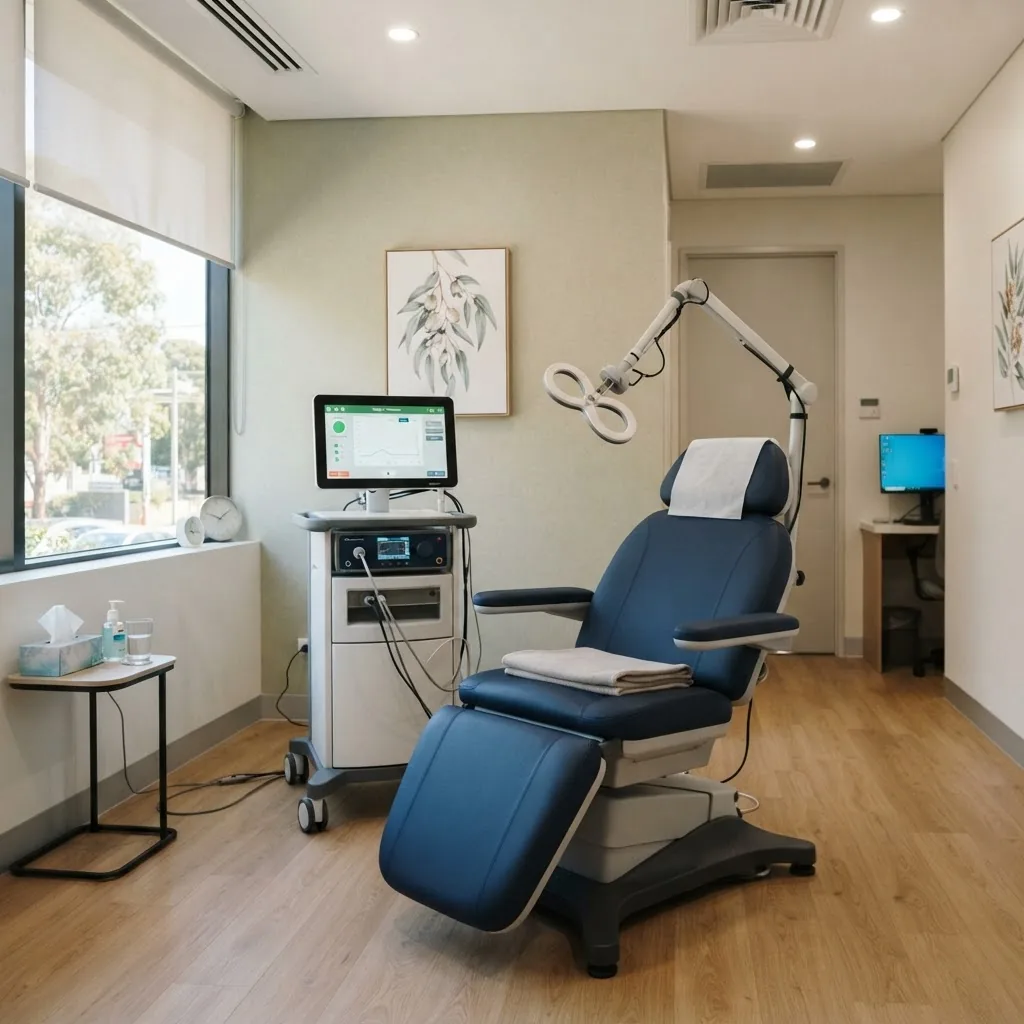
According to a 2024 industry report of Australian clinic fee schedules, per-session private fees commonly sit in the ranges above; individual clinic price lists should be requested in writing for certainty.
Transition: Understanding the headline costs leads directly into who can get Medicare help and how that affects the final patient bill.
Medicare Eligibility for TMS Therapy
Answer: Medicare rebates for TMS are available to a limited group of patients who meet strict eligibility criteria — typically requiring a psychiatrist referral, documented treatment resistance, and an approved clinical pathway; not all TMS indications or clinics qualify for rebate items.
Term: Medicare rebate is the payment made by the Australian Government to a patient (or practitioner) for an eligible medical service listed in the Medicare Benefits Schedule (MBS).
Below is a practical how‑to and a checklist to assess eligibility, followed by an illustrative patient scenario and case‑study cost summary showing timelines and rebate effects.
How-to steps and eligibility checklist
- Step 1: Obtain a referral from your GP to a psychiatrist or authorised specialist — the specialist must document treatment history and current diagnosis.
- Step 2: Specialist assessment confirming treatment-resistant condition or an evidence-based indication for TMS.
- Step 3: Specialist assigns the appropriate MBS item (if available for your indication) and issues a written treatment plan.
- Step 4: Clinic bills against the MBS item and you or the clinic submits a Medicare claim for the rebate.
- Step 5: Patient pays any gap (out-of-pocket) amount when private billing applies; bulk-billing clinics may waive the gap where permitted.
Eligibility checklist (quick):
- Confirmed clinical diagnosis (e.g., major depressive disorder, specified indications)
- Documentation of inadequate response to standard treatments (antidepressants, psychotherapy)
- Specialist psychiatrist assessment and referral
- Treatment plan and appropriate billing item available under current MBS listing
- No contradictions or exclusions based on comorbid medical conditions

Case scenario — patient (illustrative):
Sarah, 38, with major depressive disorder, failed 2 antidepressant trials and a course of CBT over 12 months. She visits her GP, obtains a referral to a psychiatrist, and is assessed as eligible for a Medicare‑listed TMS pathway. The clinic charges AUD 300 per session; after Medicare rebate her out-of-pocket was AUD 120 per session for a 30‑session course, total patient cost ~AUD 3,600. (Timeline: GP referral week 0, psychiatry assessment week 2, treatment weeks 3–8.)
According to the 2024 Medicare Benefits Schedule and Department of Health guidance, exact item numbers, rebate amounts and eligible indications are updated periodically; always confirm current MBS item details with Services Australia.
For concerns about side effects alongside eligibility, read TMS therapy side effects.
External guidance: see the official Medicare guidance on item eligibility and updates at Services Australia / Medicare (verify MBS item listings) and practice guidance from the Australian Psychological Society.
Transition: With eligibility understood, the next step is to unpack the pricing components so you can compare quotes accurately.
Breakdown of TMS Treatment Pricing Components
Answer: TMS pricing breaks down into assessment fees, per‑session treatment fees, package discounts, device or protocol surcharges, and additional professional fees (psychiatrist reviews); compare these line items to understand true out-of-pocket cost.
Define key billing parts on first encounter and then see a typical cost comparison table below.
Term: Bulk billing means the clinic bills Medicare directly and accepts the Medicare rebate as full payment, leaving no or minimal out-of-pocket cost for the patient.
- Initial specialist assessment — one-off fee, often AUD 150–400; required for rebate eligibility.
- Per-session clinical administration — technician time, setup and monitoring (AUD 150–400).
- Device/protocol fees — higher for deep TMS or neuronavigation; may add AUD 50–150 per session.
- Package pricing — clinics often discount full courses by 5–20% vs per-session billing.
- Follow-up psychiatry reviews — billed separately (AUD 100–300 per review).
| Component | Typical private cost (AUD) | Notes |
|---|---|---|
| Initial psychiatrist assessment | 150–400 | Required for treatment plan and rebate application |
| Per TMS session (standard rTMS) | 150–300 | Daily sessions common over 4–6 weeks |
| Per session (deep TMS / advanced protocols) | 200–400 | Higher equipment and training costs |
| Full course package (30–36 sessions) | 6,000–12,000 | Packages often reduce per-session price |
| Psychiatry follow-up reviews | 100–300 | May be billed separately to sessions |
Comparison notes: package discounts vary; confirm whether advertised package includes all psychiatry reviews, device surcharges, and maintenance sessions.
Transition: After itemising prices, compare how Medicare and private insurers impact what you actually pay.
Navigating Healthcare and Insurance Options for TMS
Answer: Medicare rebates and private health insurance can both reduce out-of-pocket costs but operate differently — Medicare rebates apply only where MBS items and specialist pathways exist; private health cover may reimburse some or none depending on the policy and device classification.
Here’s how to assess which route lowers costs best for you, and a comparison table of typical coverage scenarios.
| Funding option | What it typically covers | Outcome for patient |
|---|---|---|
| Medicare rebate (MBS-listed) | Partial rebate on eligible items when specialist pathway followed | Reduces out-of-pocket; gap may remain |
| Private health insurance (extras or hospital cover) | Varies widely; some policies offer partial rebates or hospital admission cover if therapy delivered as an inpatient | May reduce costs if policy includes relevant item; check annual limits |
| Bulk billing clinic | Clinic accepts Medicare rebate as full payment for eligible services | Lowest patient cost when available — but limited availability |
| Out-of-pocket / private pay | Full fees apply; patient pays and may seek partial rebate | Highest immediate patient cost but fastest access in many areas |
Private insurance note: coverage depends on classification of TMS in your policy and whether the treatment is performed inpatient or outpatient; check with your insurer and consult the prudential regulator guidance at APRA for policy standards.
If you are comparing different clinical applications and associated funding, see TMS therapy for chronic pain options and costs for relevant contrasts.
Practical steps to navigate insurance:
- Get an itemised quote from clinics that separates assessment, per-session and device fees.
- Call your private insurer with those item codes to confirm any benefit or limit.
- Ask clinics whether they will bulk bill eligible MBS items or offer a reduced package price if patients cannot access rebates.
Transition: If private costs are still a barrier, there are payment plans and financial assistance options to explore next.
Financial Assistance and Payment Plans for TMS Therapy
Answer: Many Australian TMS providers offer payment plans, sliding-scale fees or hardship programs; other supports include health care concessions, centre-based subsidies, or clinic-specific financing — eligibility and availability differ by clinic.
Options to reduce immediate cost burden commonly include:
- Clinic payment plans — weekly or fortnightly instalments covering the package cost with or without interest.
- Health Care Card or Pensioner concessions — may allow reduced private fees or priority access to subsidised programs.
- Charitable or research programs — limited study-based or compassionate access programs may provide reduced-cost treatment in specific trials (check eligibility).
- Employer-assisted health funds or EAP referrals — occasionally available for work-related mental health treatment.
- Clinic hardship funds — some providers reserve a small number of discounted spots for financial hardship.
Eligibility tips:
- Bring proof of income or concession card when asking for hardship support.
- Negotiate a written instalment plan that specifies total cost, instalment amounts, and consequences of missed payments.
- Ask whether the clinic will hold a treatment spot while funding approvals are finalised.
Transition: With funding and assistance options in mind, the next essential step is how to apply for Medicare rebates correctly — a process often mishandled and causing delays.
How to Apply for Medicare Rebates for TMS Treatment
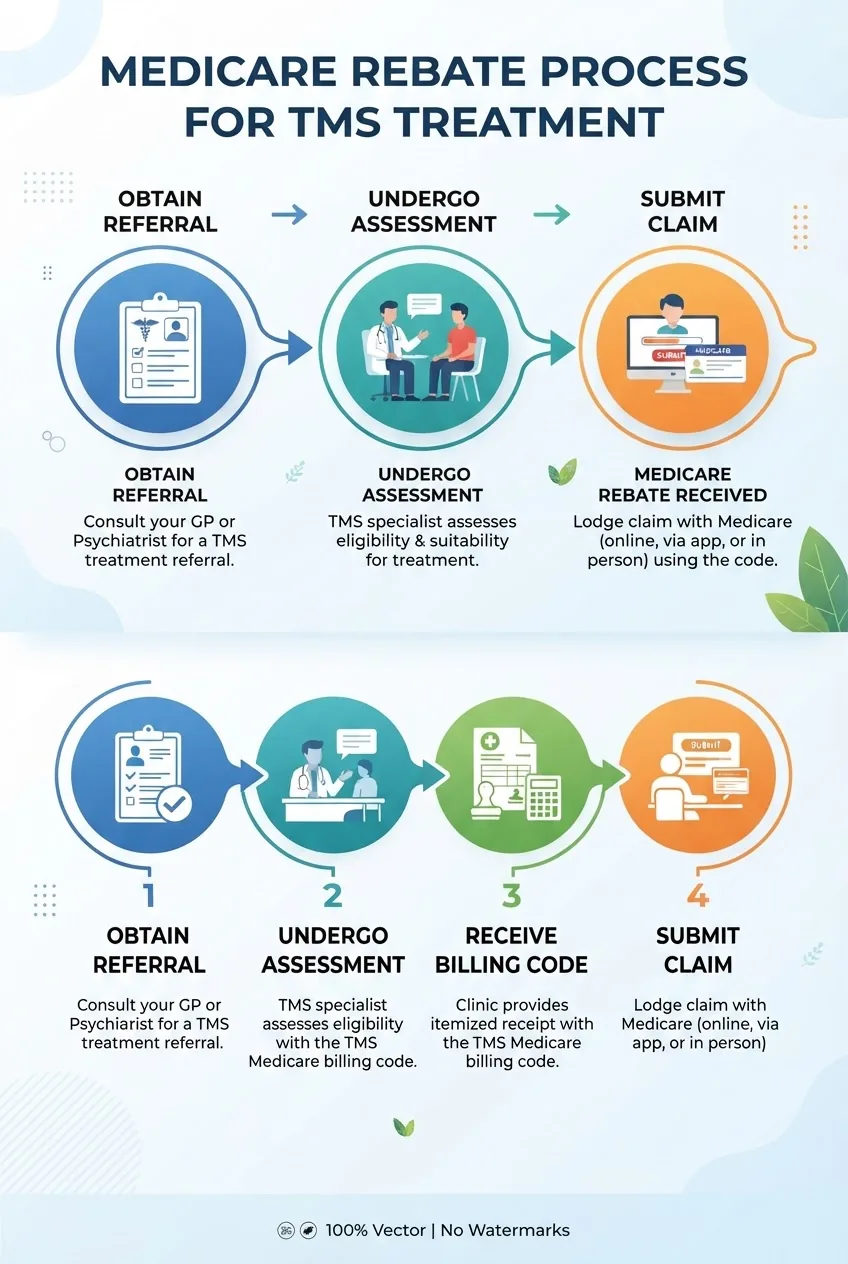
Answer: Apply for Medicare rebates by following a clear referral and claim pathway: obtain GP referral, have a psychiatrist complete an assessment and billing item, receive itemised invoice from the clinic, and submit a Medicare claim — clinics or the patient can submit claims to Services Australia.
Below is a step-by-step how-to guide, a clinic-perspective billing walkthrough, and an infographic placeholder illustrating the process.
Step-by-step how-to guide
- 1) Visit your GP to discuss symptoms and request a referral to a psychiatrist experienced in TMS. Ensure the referral notes possible treatment resistance.
- 2) Specialist assessment: psychiatrist documents diagnosis, previous treatments and clinical justification for TMS. Ask the psychiatrist to specify the MBS item (if applicable) or provide a documented treatment plan.
- 3) Clinic intake: provide the referral, treatment plan and identification; request an itemised quote that separates billable items and indicates whether the clinic will bulk-bill any MBS items.
- 4) Billing: when services are delivered, clinic issues an invoice with MBS item numbers where relevant; the clinic or patient lodges the claim via Medicare online or at a Services Australia office.
- 5) Rebate processing: Medicare pays the rebate to the patient or clinic; patient pays any gap at the time of service if the clinic does not bulk-bill.
Clinic-perspective billing walkthrough (practical)
- Reception verifies referral and creates a patient file noting the MBS item (if present).
- On assessment day, the psychiatrist codes the consultation and treatment plan in the clinic system and attaches supporting notes.
- For each TMS session, technician records session details; billing team codes the session against the MBS item or private billing code.
- Clinic submits the claim electronically to Medicare or provides the patient with a receipt to claim themselves.
- Accounting tracks rebate receipt and reconciles any patient gap invoices; clinic informs patient of rebate outcomes or required follow-up documentation.
Documentation to have ready:
- GP referral letter and psychiatry assessment
- Itemised clinic quote including MBS codes where relevant
- Identification and Medicare card details
- Receipts for each session (for private claims)
According to the 2024 Medicare Benefits Schedule, item numbers and rebate amounts change; clinics and patients should confirm current MBS listings via Services Australia before starting treatment.
For deeper procedural and side‑effect information alongside billing, see our comprehensive TMS treatment guide.
Transition: Even with the process clear, practical tips can reduce your final bill — read the next section for actionable strategies.
Tips to Reduce TMS Treatment Costs in Australia
Answer: Reduce costs by getting multiple itemised quotes, checking MBS eligibility before booking, negotiating package pricing, applying for clinic payment plans or hardship programs, and exploring bulk-billing options where available.
- 1) Compare at least three clinics and request full itemised quotes.
- 2) Confirm MBS item availability with Services Australia before committing.
- 3) Ask clinics about package discounts for full-course prepayment.
- 4) Inquire about payment plans and write down terms before signing.
- 5) Check eligibility for health care concessions or research trial access.
- 6) Time treatment bookings around any available private health policy waiting periods or calendar-based benefit resets.
Practical example: negotiating a 10% package discount on a AUD 9,000 course saves AUD 900 — compare that with potential Medicare rebates to calculate true net patient cost.
Transition to conclusion: Summarising the main cost drivers and next steps helps you act confidently when seeking care.
Conclusion and next steps
Key takeaways: tms treatment cost australia varies widely — expect AUD 150–400 per session or AUD 6,000–12,000 per full course privately. Medicare rebates can significantly lower out-of-pocket costs when eligibility criteria and MBS items are met. Get an itemised clinic quote, confirm MBS applicability via Services Australia, and discuss payment plans or concessions with clinics.
CTA: If you’re considering TMS, start by asking your GP for a specialist referral and request an itemised quote from a clinic — compare options using our regional guides and the TMS Treatment Guide: Therapy, Costs, and Side Effects Info to plan funding and next steps.