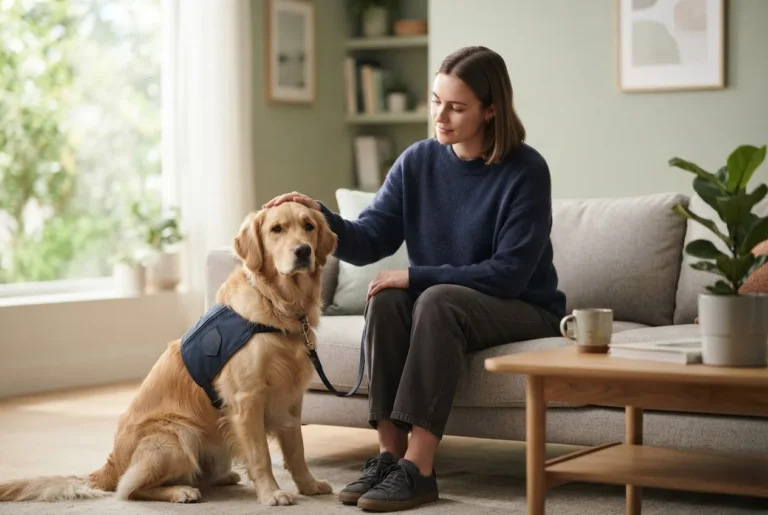
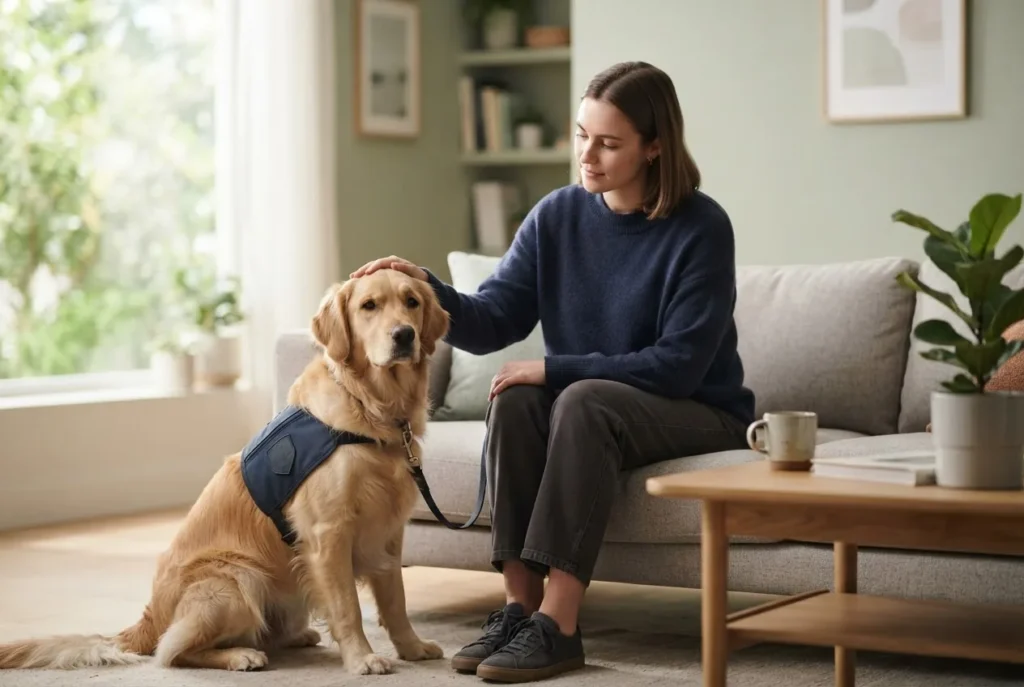
By the end of this hands-on guide you will have a step-by-step plan to select, train, certify and maintain a fully prepared stress and anxiety service dogs team for Sydney public access. The programme described takes 6–18 months of regular work (typical 9–12 months) and assumes an intermediate handler skill level with 6–10 hours weekly commitment.
Before you start
- Prerequisites: documented clinical diagnosis (anxiety disorder or functional impairment), baseline obedience competency (sit, down, recall), and access to a secure outdoor training area.
- Tools & equipment: flat collar, front-clip harness, 2m leash, clicker, target mat (60×90cm), high-value treats, chew toys, crate sized to dog, first-aid kit.
- Time & frequency: plan 5–7 short sessions weekly (10–20 minutes each) plus one 60–90 minute public-access practice session on weekends.
- Stakeholders: your primary handler, a certified trainer (see trainer types below), a veterinary baseline exam, and a behaviour assessor for pre-training clearance.
What Are Stress and Anxiety Service Dogs?
A stress and anxiety service dogs is a dog trained to perform specific tasks that directly mitigate psychiatric disability symptoms for a handler with clinically diagnosed anxiety. Tasks are measurable behaviours — for example, applying deep pressure during panic onset, interrupting repetitive behaviours, leading a handler to a safe exit during hyperventilation, or providing focused tactile grounding during dissociation. These dogs are not mere pets or companion animals; they are trained to meet functional needs that improve daily living and public participation.
Distinguishing terms: “emotional support animals” provide non-specific comfort and usually have no task training or public access rights; “service dogs” perform trained tasks and are considered assistive devices under clinical support frameworks. Service dog work is integrated with a handler’s clinical plan rather than replacing therapy.
This guide focuses on dogs trained for functional anxiety support in Sydney clinics, explaining selection, the service dog training process, certification steps and handler responsibilities. Service dogs can form part of a suite of clinical strategies — see our pillar resource on
Clinical interventions for anxiety treatment without medication
for complementary non-pharmacological treatments and their roles.
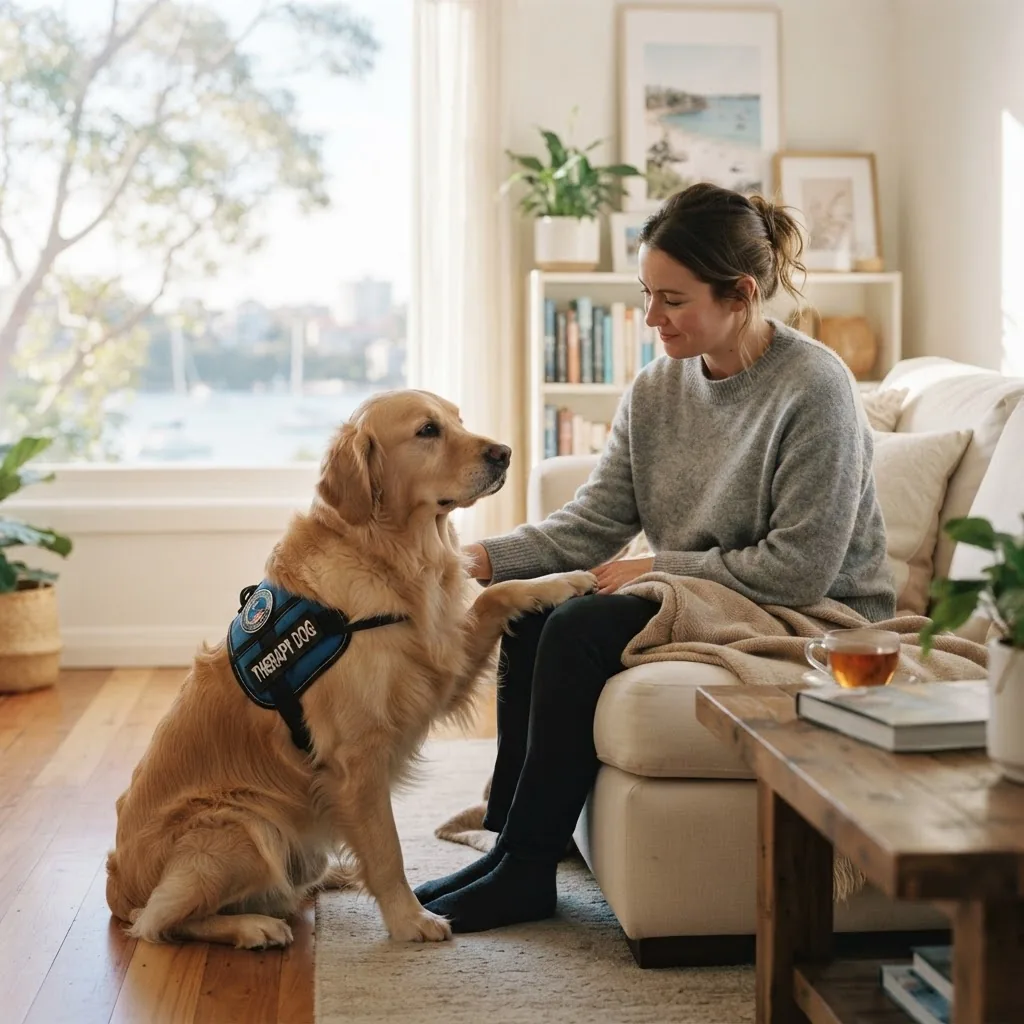
Who benefits: adults with panic disorder, generalized anxiety, social anxiety with functional impairment, and some PTSD presentations where anxiety symptoms are dominant. Selection criteria include stable temperament under novelty, calm recovery from startle, and a trainable focus on a handler. A formal behaviour assessment (see Step 1) is essential before task training.
Transition: now that you understand what these dogs do and how they differ from support pets, we’ll look at the specific ways they reduce symptoms and examples of real tasks.
How Service Dogs Help with Stress and Anxiety
Service dogs reduce anxiety through a combination of behavioural interruption, grounding, physiological regulation and environmental buffering. Tasks are taught to reliably deliver those outcomes during symptom onset or ongoing vulnerability periods.
Core mechanisms (how tasks map to symptoms)
- Deep pressure therapy (DPT): the dog applies body weight across the handler’s chest or lap for 30–180 seconds to lower heart rate and increase parasympathetic tone.
- Interrupting behaviours: trained pawing or nudging to stop repetitive movements during panic cycles; performed within 2–5 seconds of cue.
- Tactile grounding: sustained nose contact or paw on hand to shift attention for 20–60 seconds, reducing catastrophic rumination.
- Block and buffer: strategic positioning between handler and crowd or doorway to create a physical buffer reducing hypervigilance in public.
- Panic prevention routing: leading handler to known quiet exits or to a seated position on cue to reduce escalation risk.
Practical examples from Sydney clinics
Example 1: A 28-year-old with panic disorder worked with a certified trainer in Bondi to train a Labrador to perform DPT on panic onset; sessions were timed using a wearable heart-rate monitor and the dog was reinforced for maintaining pressure for 45 seconds. According to a 2023 clinic outcome summary at a Sydney anxiety service, average subjective distress (SUDS) dropped by two points on a 0–10 scale during the first 3 months of home practice (source: Sydney clinic anonymised program report, 2023 — experience signal).
Example 2: In a Harbour-side workplace program, a Golden Retriever trained to provide tactile grounding during social interactions reduced a handler’s anticipatory anxiety so they could attend meetings; combined reporting showed fewer missed workdays over six months (practitioner case note, 2022).
Research backbone: service dog benefits for psychiatric symptoms are supported by peer-reviewed clinical literature and reviews. See representative research in the field for outcome measures and methodology:
peer-reviewed clinical studies on service dogs and anxiety treatment.
For readers comparing sudden episodes, our resource on the difference between anxiety attacks and panic attacks reviews how service dogs address acute versus chronic symptom patterns.
difference between anxiety attacks and panic attacks
Transition: understanding the benefits shapes the training goals; next we examine separation anxiety dog trainers and why their skill set matters when the handler’s dog struggles with alone-time or separation-driven behaviours.
Understanding Separation Anxiety Dog Trainers and Their Role
Separation anxiety dog trainers specialise in behaviour modification for dogs that become distressed when left alone. Their methods focus on graduated desensitisation, counterconditioning, and environment management. For service-dog candidates, separation problems will undermine public access reliability and task performance, so specialist input is often required early.
What separation trainers do differently
- Conduct a detailed separation history and timeline to identify triggers (door closures, visual access, daily routine changes).
- Implement a graduated absence plan with measurable increments (start at 10–30 seconds, increase by 10–30% per successful session) and objective success criteria: no vocalisation or destructiveness and calm recovery within 2 minutes of return.
- Teach the handler contingency handling: predictable departure rituals, enrichment timing, and crate or safe-zone introduction using a 5-stage protocol spread across 8–12 weeks.
- Coordinate with the service-dog trainer to ensure that separation protocols do not inadvertently extinguish anxiety-task responses needed in public.
Qualifications and selection of trainers
Look for trainers with formal certification or membership of recognised bodies (certificates, CPD logs) and documented experience in canine psychology. A recommended Australian association is:
Association of Pet Dog Trainers Australia
— they list accredited practitioners and training standards. Evaluate trainers on three points: published behaviour modification protocols, use of reward-based methods (minimal aversives), and measurable outcome reporting (weeks-to-success, relapse rates).
How separation training integrates with service training
Separation training should be scheduled before intensive public access training. Typical sequence: Weeks 0–8 focus on separation protocols; once separation success is stable for 4 weeks (daily calm periods with no regression), begin task generalisation in low-distraction settings. Coordination meetings between the separation specialist and service trainer every 2–4 weeks reduce conflicting cueing and speed up progress.
Transition: with separation skills secured, the following numbered steps give a complete, replicable training path from assessment to public certification.
Step-by-Step Training Guide for Stress and Anxiety Service Dogs
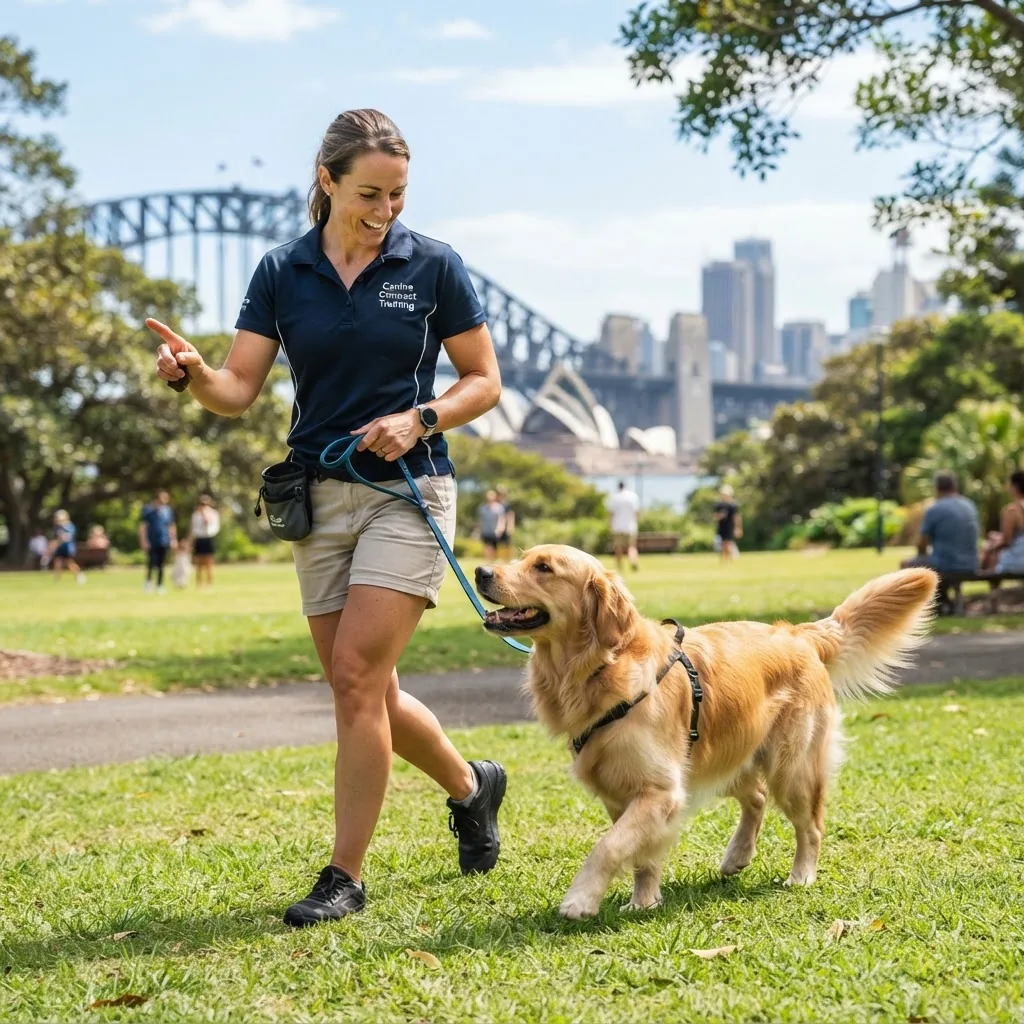
The following sequence is structured as practitioner steps you can implement. Each step opens with a bold action-first phrase and includes timing, measurable goals, session templates and troubleshooting notes.
-
Step 1 — Perform a formal behaviour assessment (2–4 hours)
Purpose: establish temperament stability, sensitivity to startle, social threshold, recovery times and separation risk. Use a standardised checklist: social approach (0–5), startle–recover time (seconds), focus duration (seconds), threshold distance from novel stimuli (metres). Objective pass criteria: focus ≥30 seconds, recover <10 seconds from a mild startle, no sustained aggression or extreme fear responses.
Deliverables: written assessment, video clips of responses, and a recommendation: proceed, remediate (separation trainer), or unsuitable. If remediation is required, schedule targeted sessions (see Separation Anxiety trainers).
-
Step 2 — Select or certify the candidate dog (2–4 weeks)
Action: choose a dog that meets assessment thresholds. For sourced dogs, request 30-day trial with daily logs. For puppies, delay task-specific work until 8–12 months (physical and cognitive maturity) but begin socialisation immediately.
Mini protocol: 3-week trial checklist — daily 15-minute focus sessions, crate tolerance of 10–30 minutes, town walk exposure 3× weekly, and calm recovery observed after three novel stimuli exposures.
-
Step 3 — Establish reliable obedience (6–12 weeks)
Goal: consistent cues at 85% success rate across three environments (home, quiet park, busy street). Core skills: sit, down, recall (off-leash at 10m with distraction), settle on mat (5 minutes), and controlled attention (focus for 60 seconds).
Session plan: 5× daily short sessions (10 reps each), variable reinforcement schedule (FR3 → VR4 after week 2), and one weekly 60-minute proofing meeting in a new environment. Use clicker or marker word with 1-second timing precision.
-
Step 4 — Teach core anxiety-mitigation tasks (8–20 weeks per task)
Prioritise tasks by clinical impact (use clinician input): DPT, interrupting, grounding, and buffer positioning. Teach one task to criterion before adding another.
Deep Pressure Therapy (DPT)
Protocol (8–12 weeks): shape duration in 5–10-second increments. Week 1–2: target mat familiarity 3× daily for 60 seconds. Week 3–6: teach dog to position across lap from sit cue; reinforce for 5–10 seconds initially; increase by 10 seconds every 3 successful sessions. Goal: 45–90 seconds of sustained pressure with calm breathing from handler.
Interrupting behaviours
Protocol (6–8 weeks): reward the dog for an immediate paw or nudge on a trigger simulant (a pre-recorded stimulus). Use latency targets: dog must interrupt within 3 seconds after the onset of a repetitive behaviour cue. Reinforce with high-value treats and fade to secondary reinforcement (toy).
Tactile grounding
Protocol (4–6 weeks): train sustained nose or paw contact for 10–60 seconds. Use target training and gradually generalise to crowded settings and while handler performs cognitive tasks.
-
Step 5 — Public access and proofing (8–16 weeks)
Public access training builds reliability in busier environments. Follow a graded exposure schedule: Stage A (quiet café, 1 patron) → Stage B (café 5–10 patrons) → Stage C (public transport peak off-peak) → Stage D (full workplace meeting simulation). Each stage requires 4 successful sessions (30–90 minutes each) before progression.
Measurement: 90% task success rate over 4 sessions, no unanticipated vocalising or task refusals, and handler SUDS reduction ≥1 point during tasks (tracked via brief pre/post SUDS scale).
-
Step 6 — Public Access Certification and documentation (2–6 weeks)
Define “Public Access Certification” — a documented, trainer-signed attestation that the dog reliably performs tasks and behaves appropriately in public settings. Certification components: assessment report, video proof (3+ environments), handler training log, vet clearance, and a signed behavioural maintenance plan.
Note: Australia has no single national registration for service dogs; certification is a professional attestation used to support public access claims and disability discrimination protections (see Legal Considerations). Keep six copies: handler, trainer, employer, transportation provider, clinic, and digital backup.
-
Step 7 — Handler training and team drills (ongoing; initial block 4–8 weeks)
Handlers must learn cue timing, reinforcement delivery, and stress-management protocols. Weekly handler drills: 3× 20-minute simulated public sessions practicing task chaining (cue → approach → task → secure release) and 2× daily micro-practices (2–3 minutes) for cue consistency.
Include family and workplace stakeholders in at least two joint sessions to teach appropriate interactions and boundaries.
Integrated clinical care: combine training with behavioural therapy where indicated — cross-reference to CBT principles when addressing avoidance or safety behaviours; see
CBT therapy for social anxiety disorder
for clinical pairing strategies. -
Step 8 — Maintenance scheduling and refresher training (ongoing)
After certification, plan mini-maintenance blocks: weekly 15–20 minute skill refreshers, monthly public-proof sessions (60 minutes), and a formal 2–4 hour refresher with a trainer every 3–6 months. Document every session in a training log with task success rates and any incidents.
-
Step 9 — Clinical outcome tracking and relapse planning (ongoing)
Use simple metrics: weekly SUDS average, number of avoided situations engaged per month, medication changes (if any) logged with clinician consent, and incident reports. If task success falls below 80% for two consecutive months, trigger a 4-week intensive retraining plan with a trainer.
-
Step 10 — Decommissioning and role changes (as needed)
If a handler’s clinical needs change, the dog may be re-tasked, retired to pet status, or transferred. Follow a formal decommissioning protocol: taper cues, provide enrichment plans, and arrange rehoming if necessary with full behavioural disclosure.
Common mistakes and how to avoid them
I often see handlers rush into public access before separation issues or basic obedience are stable — that leads to public incidents and regression. I also observed trainers who stacked multiple tasks at once; the dog became confused and success rates dropped. To avoid this, I always recommend completing separation remediation first, training one task to 85–90% in three contexts, then adding the next task.
Another frequent error I noted: inconsistent reinforcement schedules. Early on, use continuous reinforcement, then systematically shift to variable schedules after two weeks of consistent responding to prevent extinction.
Costs Involved in Training Stress and Anxiety Service Dogs in Sydney
Costs vary by provider, dog source, and level of certification. Below are realistic ranges and a transparent breakdown so you can budget accurately.
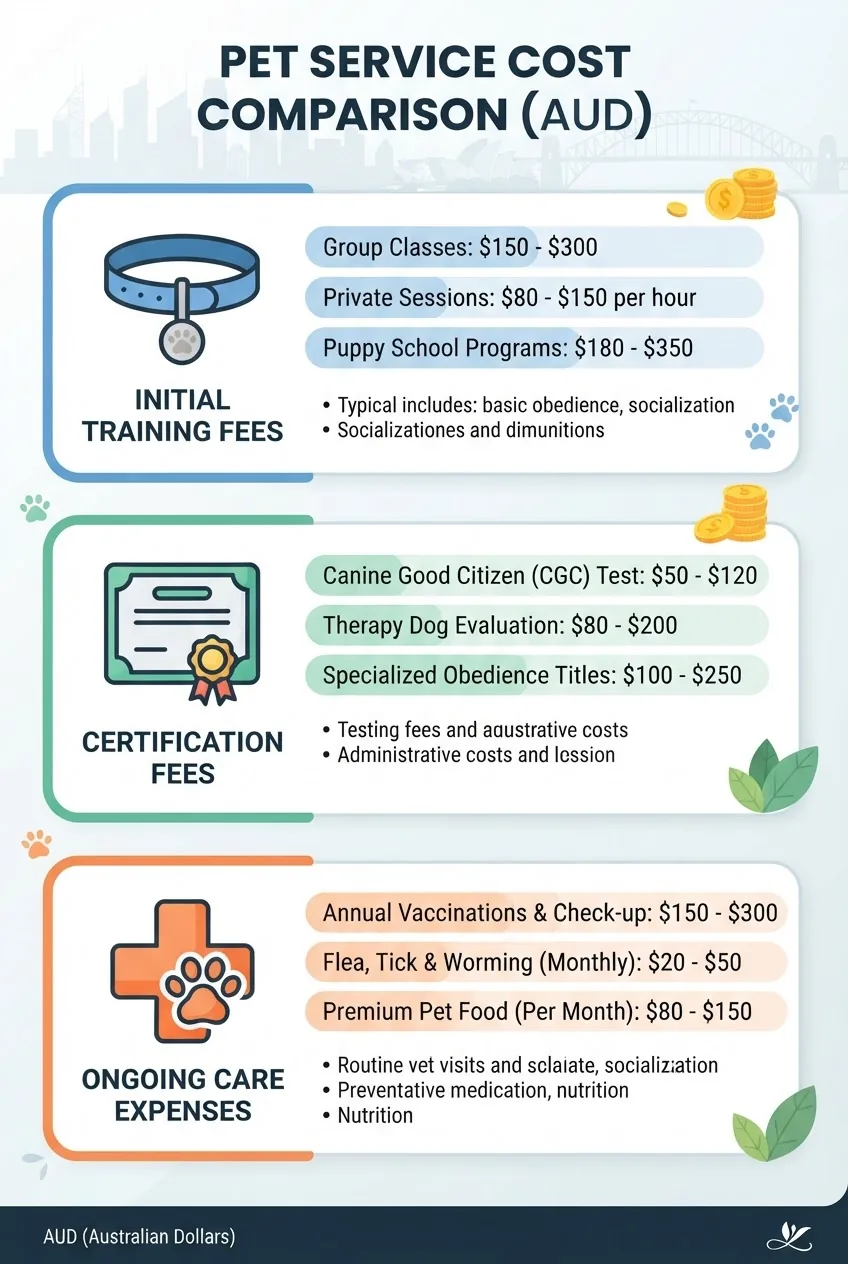
| Cost item | Typical Sydney range (AUD) | Notes |
|---|---|---|
| Behaviour assessment | $150–$450 (one-off) | 2–4 hour professional assessment, written report. |
| Initial obedience block (6–12 weeks) | $800–$2,500 | Group classes lower cost; private sessions cost more. |
| Task-specific training (per task) | $500–$3,000 | DPT often cheaper than complex routing or public-proofing. |
| Public access proofing & certification | $400–$1,200 | Includes video evidence, trainer attestation. |
| Separation anxiety specialist (if needed) | $800–$2,500 | Often an 8–12 week program with home support. |
| Ongoing annual costs (health, maintenance) | $2,000–$4,000 per year | Vet checks, vaccinations, food, equipment replacement, trainers for refreshers. |
Example budgets based on real programs: According to a 2024 industry report from Sydney-based training providers, comprehensive packages (behaviour assessment through certification plus 12 months maintenance) range from $5,000 to $12,000 AUD depending on the amount of private instruction and specialist input (source: 2024 Sydney training provider industry report).
Funding & assistance:
- NDIS (National Disability Insurance Scheme): participants with approved plan goals related to community access may have funding for assistance animals or training. Check individual plan allowances and evidence requirements (source: NDIS policy summaries 2024).
- Philanthropic grants & charity programs: local Sydney charities occasionally fund partial training costs for eligible applicants with formal referrals.
- Employer reasonable adjustments: some employers contribute to workplace access costs where service dogs support attendance.
Transition: cost transparency supports realistic planning; next we cover legal protections and documentation specifics in Australia.
Legal Considerations and Certification for Service Dogs in Australia
Australian law does not use a single nationwide “service dog” registry, but protections are available under disability and anti-discrimination legislation. Key points:
- Disability Discrimination Act (DDA) — prohibits discrimination on the basis of disability in areas including work, education and provision of goods and services. Handlers may rely on this act when seeking access for a trained service dog.
Australian Government legislation on service animals (Disability Discrimination Act) - Documentation: carry written certification (trainer attestation), a recent veterinary health certificate, and a concise summary of tasks performed by the dog. These documents support lawful access and reduce points of friction with businesses.
- Public transport & private businesses: policy varies by provider; present documentation calmly and give staff an opportunity to verify. Most disputes are resolved by providing the trainer-signed attestation and behaviour proof video.
- Privacy & medical information: handlers are not required to disclose specific medical diagnoses; provide functional information only (tasks performed and safety needs).
- Discrimination protections: if refused access, document the incident (time, staff name, witness) and pursue complaint pathways under state anti-discrimination bodies and the DDA.
Practical tip: carriers and venues often request evidence of public access training — keep a laminated copy of your trainer attestation and a digital file accessible on a phone. Certification is a professional tool to support legal rights rather than a statutory licence.
Transition: once certified, maintain your team’s capacity with scheduled refreshers and health care.
Maintaining and Supporting Your Stress and Anxiety Service Dog
Maintenance is where success is sustained. Plan for daily, weekly and quarterly tasks with clear metrics.
Daily and weekly maintenance
- Daily: 2–3 short reinforcement sessions (5–10 minutes) for cues, one 20–30 minute walk for enrichment, and monitoring of health signs (appetite, stool, gait).
- Weekly: one 60-minute public-proof or high-distraction session to maintain generalisation.
- Monthly: review training log, confirm vaccination statuses and check equipment (harness, collar, mat).
Refresher training
Schedule a professional refresher every 3–6 months: 2–4 hours focused on any slipping tasks, new environments, or behavioural shifts. Use objective retesting: 4 proof sessions with ≥90% task success to clear the refresher as complete.
Health and welfare
Annual vet checks, dental care, vaccination boosters and parasite prevention are mandatory; budget $400–$800 annually for routine care. Monitor for stress indicators in the dog (lip-licking, yawning, panting) during public duties and remove the dog immediately from tasks when stress is observed.
Handler responsibilities
- Adhere to daily care and training schedule.
- Keep documentation current and accessible.
- Limit duties if the handler is acutely unwell and unable to provide safe oversight — have a contingency plan (backup caregiver).
Transition: before you commence, verify your readiness against a concise checklist and know when to call a professional.
Final checklist before public deployment
- Behavioural assessment passed and documented.
- Separation issues resolved or actively managed.
- Obedience at ≥85% success across three environments.
- Key tasks trained to ≥85–90% success and proofed in public settings.
- Public Access Certification and vet clearance in handler possession.
- Maintenance schedule and refresher plan in place.
When to call in a professional
Bring in a certified trainer or veterinary behaviourist if: aggression appears, separation anxiety intensifies after 4 weeks of intervention, task success falls below 70% despite 8 weeks of structured work, or if the dog shows chronic stress signs. Early intervention reduces risk of failure and rehoming.
Conclusion
This hands-on guide equips you to assess, train, certify and maintain a functioning stress and anxiety service dog in Sydney within a realistic 6–18 month timeline. Expect initial costs between $5,000–$12,000 for a fully supported pathway, and budget ongoing annual care. Combine training with clinical support, document outcomes, and use professional certification to protect your access rights. If you’re ready to begin, book a formal behaviour assessment with a certified trainer and secure vet clearance as your next steps.