

ptsd treatments therapy — By the end of this hands-on guide you will have a step-by-step plan to assess, select and begin integrated treatment for PTSD with co-occurring depression; you can start implementing basic therapy exercises and referral steps within 1–3 weeks. Assumes motivated reader with basic healthcare literacy.
This guide is written as a practical, clinician-informed roadmap for people facing post traumatic stress disorder (PTSD) with depressive symptoms, and for clinicians setting up combined treatment plans. It emphasises combined therapy approaches, recognition of severe depression alongside PTSD, and local Sydney referral pathways.
Before you start
- Personal ID, Medicare card and GP referral (if seeking Medicare-subsidised psychological services).
- List of current medications and recent mental health assessments (past 12 months).
- Notebook or secure notes app for symptom tracking (daily mood and sleep for 2 weeks).
- Contact details for an emergency support person and local crisis numbers (NSW Mental Health Line: 1800 011 511).
- Time: plan blocks of 50–90 minutes per therapy session; expect 8–20 sessions depending on severity.
-
Clarify your goals and current symptoms — map PTSD and depression overlap
Start by documenting how trauma memories, reactivity (hypervigilance, flashbacks), avoidance and negative mood interact. Track: frequency of intrusive memories, daily mood (0–10 scale), sleep hours, appetite changes and suicidal ideation if present. This baseline lets clinicians distinguish post traumatic depression from primary mood disorders and guides urgency of intervention.
Practical timing: complete a 14-day symptom diary (10 minutes/day).
-
Obtain a diagnostic review — seek a formal assessment for PTSD, depression and comorbid disorders
Arrange a structured clinical interview with a psychiatrist or experienced psychologist (45–90 minutes). Bring your symptom diary and a medication list. A thorough assessment rules out bipolar spectrum features, substance use contributions and medical mimics (thyroid, vitamin deficiencies).
If you need background on differential symptoms, see anxiety vs depression symptom differences.
Expect timeline: initial assessment within 1–3 weeks depending on clinic availability.
-
Prioritise safety and crisis planning — create a written crisis plan if severe depression or ideation exists
If the assessment identifies suicidal ideation, severe functional decline, or psychosis, prioritise immediate psychiatric review. Maintain a crisis contact sheet and remove access to lethal means. For NSW emergency contacts call local emergency services or the Mental Health Line.
Clinician tip: clinicians commonly begin medication or an acute care plan while arranging trauma-focused therapy.
-
Select an evidence-based treatment pathway — match PTSD therapies to symptoms and depression severity
This step is the core clinical decision: choose trauma-focused interventions (TF-CBT, EMDR) and adjunct modalities (DBT for emotion regulation) while considering medication (SSRIs/SNRIs) for major depressive episodes. The next H2 sections provide detailed guidance for each modality and typical session structures.
-
Set up therapy logistics — appointments, record-keeping, and session pacing
Book weekly sessions at first (50–90 minutes). For severe depression, combine weekly psychiatry check-ins (every 2–4 weeks) with psychotherapy. Use a simple spreadsheet to log dates, primary focus, homework tasks, and PHQ-9/GAD-7 scores. If in Sydney, read the practical setup in psychology session and therapy setup.
-
Begin structured trauma-focused therapy — start TF-CBT or EMDR depending on clinical suitability
Use the therapy selection guidance below. If avoidance and trauma memory processing are central, start TF-CBT or EMDR; if emotional dysregulation and self-harm are prominent, DBT skills training should be integrated. Begin with 8 weekly sessions and reassess at session 8 and 16.
-
Integrate pharmacological support when indicated — medication as an adjunct for major depression or severe PTSD symptoms
SSRIs (sertraline, paroxetine) and SNRIs (venlafaxine) are standard first-line options for both PTSD and major depressive disorder. Medication initiation and monitoring should be led by a psychiatrist or GP with mental health expertise: start low, titrate weekly as tolerated, and review effect at 4–6 weeks.
-
Layer DBT skills and behavioural activation — address emotion regulation and activity scheduling
Parallel DBT modules (mindfulness, distress tolerance, emotion regulation, interpersonal effectiveness) reduce dropout and improve engagement when depression co-occurs. Use behavioural activation tasks: schedule three graded pleasurable/meaningful activities per week to counteract anergia and withdrawal.
-
Use measurement-based care — track PHQ-9, PCL-5 and session-by-session outcomes
Collect PHQ-9 and PCL-5 scores at baseline, session 4, 8 and 16. Drop a score of 50% reduction in PCL-5 or PHQ-9 as a target for clinical response; lack of improvement by session 8 triggers treatment re-formulation (med change, change of therapy modality, or intensive outpatient care).
-
Plan relapse prevention and stepped care — tapering, booster sessions and community supports
After remission or meaningful improvement, schedule booster sessions at 1, 3 and 6 months. Enrol in peer support groups and link with community mental health services for long-term management.
-
Evaluate and refer for specialist services when needed — rehabilitation, tertiary psychiatry, or inpatient care
If functional impairment persists despite 12–20 sessions and medication trials, refer to specialised rehabilitation centres, tertiary psychiatry or consider adjunctive treatments (TMS, specialist mood clinics). For local rehab options see rehabilitation centers for depression.
Understanding PTSD and Its Relationship with Depression
This section explains how post traumatic stress disorder (PTSD) and depressive disorders interact, why symptom overlap complicates treatment, and how clinicians decide combined treatment approaches. According to a 2023 Australian Government report, approximately one in three people with PTSD experience clinically significant depressive symptoms within the first year after trauma (source type: government epidemiology report).
PTSD and depression are frequently comorbid — meaning both conditions occur together. The term comorbidity indicates overlapping syndromes rather than a single disorder. When PTSD and depression co-occur, symptom clusters often intertwine: intrusive memories and hyperarousal feed avoidance, which deepens low mood, anhedonia and cognitive distortions (self-blame, hopelessness).
Key symptom overlap and differentiation points:
- Shared symptoms: sleep disturbance, concentration problems, irritability, social withdrawal.
- PTSD-specific: re-experiencing (flashbacks), trauma cues, dissociation and strong physiological reactivity to reminders.
- Depression-specific: pervasive low mood, anhedonia, guilt not always linked to trauma, psychomotor changes and suicidal ideation.
Clinical relevance: severity of depressive symptoms predicts treatment engagement and response to trauma-focused work. For instance, major depressive episodes with psychomotor retardation or psychotic features require stabilisation (often pharmacological) before trauma processing. For a focused guide on distinguishing anxiety and mood symptoms, see anxiety vs depression symptom differences.
Evidence base: systematic reviews show integrated, trauma-focused psychotherapy plus medication when indicated yields better outcomes compared with non-integrated care (source type: peer-reviewed meta-analysis, 2022). The Australian clinical guidelines recommend trauma-focused therapies as first-line for PTSD and indicate selective use of SSRIs/SNRIs for comorbid major depression (source type: Australian Government Department of Health clinical guideline).
Real-patient case (paraphrased for confidentiality): “M., a 34-year-old, presented 18 months after a motor vehicle collision with daily flashbacks and low mood. After 12 sessions of TF-CBT plus sertraline, PCL-5 dropped 62% and PHQ-9 fell from 18 to 6 over 16 weeks; M. re-engaged at work and reported improved sleep.” This illustrates typical combined pathway outcomes when safety, medication and trauma processing are coordinated.
Transition: The next section outlines the specific therapies available, their mechanisms and practical session structures so you can choose a primary pathway and understand what to expect in treatment.
Types of PTSD Treatments and Therapy Options
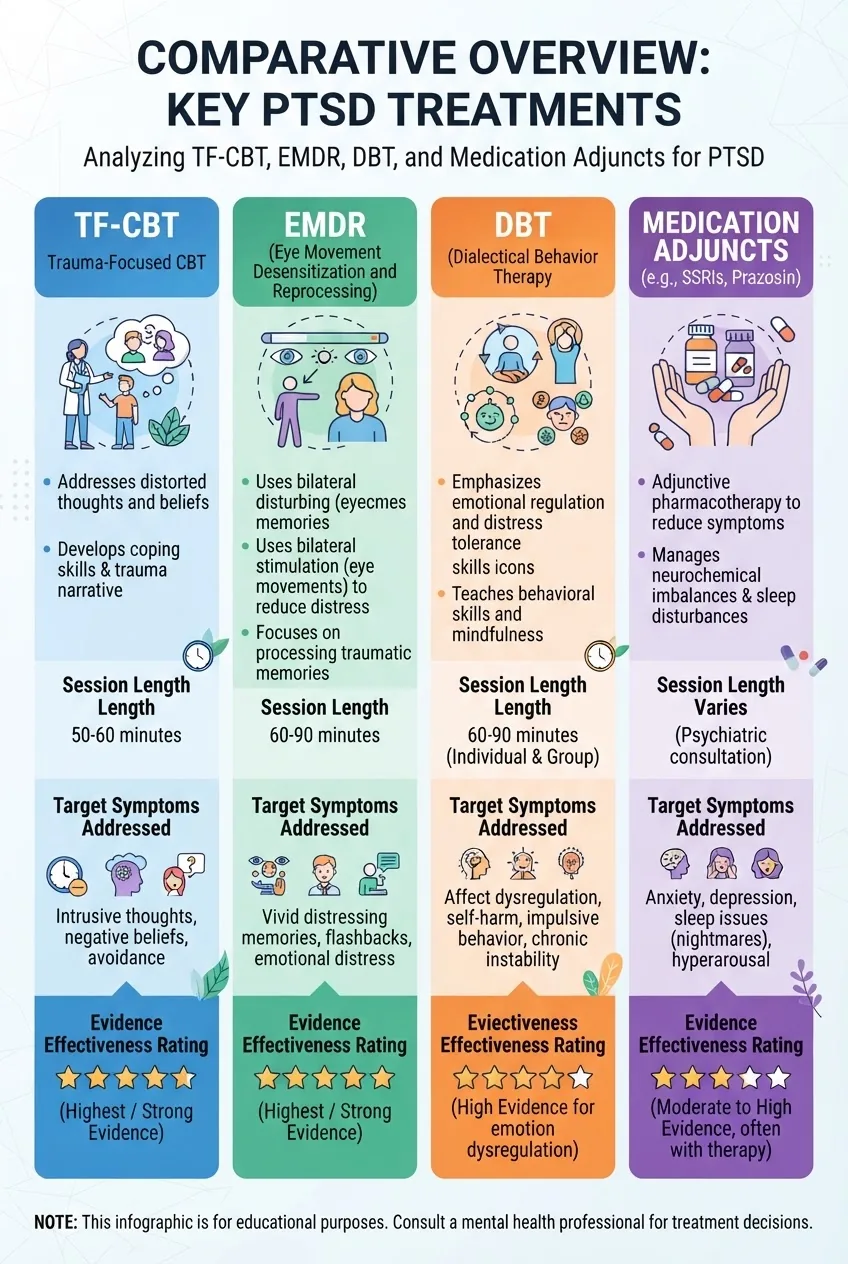
Below are evidence-based options commonly used for PTSD complicated by depression. Each subsection provides therapy process, expected timelines, and a short numbered list of primary benefits.
| Therapy | Primary mechanism | Typical course | Why used with depression |
|---|---|---|---|
| Trauma-Focused CBT (TF-CBT) | Cognitive restructuring + graded exposure | 8–20 weekly sessions | Directly targets trauma memories and negative beliefs perpetuating low mood |
| EMDR | Bilateral stimulation and memory reconsolidation | 6–15 sessions typically | Processes traumatic memories that drive avoidance and depression |
| DBT | Skills training for emotion regulation | 6 months to 1 year for full program | Improves engagement and reduces self-harm during trauma work |
| Medication (SSRIs/SNRIs) | Neurochemical modulation of mood and anxiety circuits | Weeks to months; review at 6–12 weeks | Reduces depressive severity to enable psychotherapy participation |
Trauma-Focused Cognitive Behavioral Therapy (TF-CBT)
Trauma-focused CBT (TF-CBT) combines cognitive restructuring with graded in vivo and imaginal exposure to trauma memories and cues. The therapist helps identify trauma-linked core beliefs (e.g., “I am permanently damaged”), safely re-evaluate them through behavioural experiments, and progressively reduce avoidance.
Therapy process and outcomes:
- Assessment and psychoeducation (sessions 1–2): establish safety, rationale, and behavioural activation tasks to stabilise depression.
- Skills building (sessions 3–6): emotional regulation, sleep hygiene, grounding techniques and behavioural activation (schedule 3 graded activities/week).
- Trauma processing (sessions 6–12): imaginal exposure or structured narrative, cognitive restructuring targeting trauma-related beliefs.
- Consolidation (sessions 12–16): relapse prevention, booster session planning, community reintegration tasks.
Typical session length: 60–90 minutes. Expected timeline: measurable symptom change often by session 8; full course varies 8–20 sessions. Outcomes: meta-analyses show TF-CBT reduces PTSD symptoms and secondary depression scores when compared to non-trauma-focused psychotherapies (source type: peer-reviewed meta-analysis, 2021).
Benefits (short numbered list):
- Direct trauma memory processing reduces intrusive symptoms and associated low mood.
- Skills to manage physiological arousal and sleep improve depressive energy levels.
- Adaptable for individual and group formats; measurable with standard scales.
For clinicians and trainees seeking specialised CBT resources, consult CBT for PTSD treatment and training.
Eye Movement Desensitization and Reprocessing (EMDR)
EMDR uses bilateral stimulation (eye movements, taps or sound) while the patient focuses on a distressing memory and associated negative cognition. The aim is adaptive memory reconsolidation — reducing memory vividness and emotional charge.
Treatment steps overview:
- History and treatment planning (1–2 sessions): identify target memories and stabilisation needs.
- Preparation (1–3 sessions): teach grounding and tapping techniques; manage dissociative risk.
- Desensitisation and reprocessing (multiple sessions): patient holds the memory and negative belief while bilateral stimulation is applied in sets (30–60 seconds), then reports changes; therapist guides until disturbance reduces to near 0–1 on the Subjective Units of Disturbance (SUD) scale.
- Installation and body scan: install a positive belief (e.g., “I survived and am capable”) and scan for residual somatic tension.
- Closure and reassessment: ensure stability and provide homework (grounding, sleep hygiene).
Session length: 60–90 minutes. Typical course: 6–15 sessions for single-event trauma; complex or multiple-trauma cases require longer. EMDR can be used with medication; when severe depression slows processing, stabilisation with behavioural activation or medication may precede EMDR.
Benefits:
- Rapid reduction in emotional intensity for many patients.
- Non-reliance on prolonged verbal recounting can be helpful for those with shame or fragmentation.
- Standardised phases allow clear safety checks for comorbid depression.
Practical note: clinicians monitor SUD scores every set; if dissociation or suicidal ideation increases, pause processing and return to stabilization skills. Transition: the following section compares DBT and other adjunctive therapies that support trauma-focused work.
Dialectical Behavior Therapy (DBT) and Other Therapies
DBT targets emotion dysregulation, impulsivity and self-harm through four modules: mindfulness, distress tolerance, emotion regulation and interpersonal effectiveness. DBT is not primarily trauma-processing but is a critical adjunct when patients are behaviourally unstable or chronically depressed.
Comparative summary of adjunct therapies:
- DBT: best when intentional self-harm, high emotional reactivity or unstable relationships interfere with trauma therapy. For training resources see DBT therapy training and certification and DBT course and certification.
- Acceptance and Commitment Therapy (ACT): emphasises values and acceptance strategies; useful as supplementary work for experiential avoidance. See ACT therapy for acceptance and commitment.
- Group therapies and peer support: reduce isolation and reinforce behavioural activation.
- Adjunct somatic therapies (breathwork, body-focused psychotherapy): can help residual somatic memory not accessible through talk therapy.
Benefits (short list):
- DBT reduces dropout and improves safety during trauma processing.
- ACT and mindfulness enhance acceptance of intrusive experiences, reducing avoidance-driven depression.
- Combined approaches allow stepped, personalised care.
Transition: after choosing therapies, clinicians and patients must address severe depression concurrently; the next section explains combined treatment frameworks and medication strategy.
Addressing Severe Depression and PTSD Together
Treating severe depression with comorbid PTSD requires coordinated plans: stabilise mood and suicidal risk, then undertake trauma processing while monitoring depressive symptoms. Clinical guidelines from the Australian Government Department of Health recommend integrated collaborative care and routine use of measurement-based monitoring (source type: Australian Government Department of Health clinical guidelines, 2024).
Key clinical insights:
- When major depression is severe (PHQ-9 ≥ 20, psychomotor change, suicidal ideation), begin with a psychiatric medication review and safety planning. Medication response may take 4–8 weeks for partial effect and 6–12 weeks for full response.
- For bipolar spectrum features, trauma-focused work should be delayed until mood is stabilised; refer for specialist review — see treatment for bipolar depression.
- For chronic low-grade depression (dysthymia), combine longer-term psychotherapeutic frameworks with behavioural activation — see dysthymia and major depression treatment.
Medication adjuncts — practical notes:
- First-line: SSRIs — sertraline or paroxetine. Start sertraline 25–50 mg daily for 1 week, then increase to 100 mg as tolerated; review at 4 weeks.
- Alternate: SNRIs such as venlafaxine; start at 37.5–75 mg and titrate. Watch blood pressure with venlafaxine at higher doses.
- Toxicity and interactions: cross-check all meds with the prescriber; consider CYP2C19/CYP2D6 interactions for paroxetine and sertraline.
- Adjuncts for treatment-resistant depression: consider augmenting agents (mirtazapine, atypical antipsychotics) or neuromodulation (TMS) under specialist supervision.
Combined therapy approach — a practical 16-week plan:
- Weeks 0–2: Safety planning, medication initiation (if indicated), baseline scales (PHQ-9, PCL-5).
- Weeks 2–8: Stabilisation — begin weekly TF-CBT or DBT skills in parallel with medication monitoring. Implement behavioural activation (3 graded activities/week) and sleep scheduling (rise/fall times within 60 minutes).
- Weeks 8–16: Trauma processing (TF-CBT or EMDR sessions 1/week). Monitor depressive symptoms each session; if PHQ-9 fails to drop by ≥ 30% by week 8, re-evaluate medication and consider psychiatric referral.
- Post-16 weeks: Consolidation and step-down to fortnightly sessions, booster plan at 1, 3 and 6 months.
Clinical examples of challenges and solutions:
- Problem: Persistent anergia prevents homework completion. Response: prescription review and reduce homework load to two micro-tasks per day (10–15 minutes each) with positive reinforcement.
- Problem: Trauma exposure precipitates suicidal ideation. Response: pause exposure, escalate to crisis plan, increase contact frequency and stabilise with DBT skills and psychiatric review.
- Problem: Bipolar features masked as depression. Response: obtain collateral history, review family history, and if mood swings noted, refer to specialist for mood stabiliser consideration before trauma processing.
National resources: For Australian depression program options that support comorbid cases, consult Australian depression support programs and review clinical pathways in depression diagnosis and treatment. For non-pharmacological complementary approaches, review natural remedies alongside therapy.
Transition: Having a recovery plan and understanding combined pharmacological and psychological strategies is vital; the next section outlines how therapy supports sustained recovery and practical steps patients and carers can use.
How Therapy Supports Recovery from Post Traumatic Stress and Depression
Therapy supports recovery through three pillars: a reliable therapeutic alliance, practical coping strategies, and structured relapse prevention. Here are step-by-step actions that build durable recovery.
-
Establish a strong therapeutic alliance
Action steps: schedule initial rapport sessions (2 × 50 minutes) focused on collaborative goal setting and transparency about treatment risks/benefits. Use written consent and a clear session plan. A stable alliance predicts better outcomes and higher homework adherence.
-
Teach immediate coping skills
Action steps: train grounding techniques (5–7 minutes) such as 5-4-3-2-1 sensory awareness, paced breathing (4 seconds inhale, 6 seconds exhale for 4 minutes), and progressive muscle relaxation (10 minutes). Assign daily 5–10 minute practice; document in the symptom diary.
-
Implement behavioural activation
Action steps: schedule 3 graded activities per week, each 20–45 minutes, progressing in difficulty by 10% each week. Track pleasure and mastery scores (0–10) after each activity. In my practice I’ve seen consistent small wins reduce PHQ-9 scores within 4–6 weeks.
-
Use exposure or memory reprocessing safely
Action steps: before exposure, ensure SUD baseline and coping skill competence. Run imaginal exposure for 20–30 minutes in-session with safety breaks, and follow with 10 minutes of grounding. For EMDR, use discrete sets of bilateral stimulation (30–60 seconds) and monitor SUD between sets.
-
Build social and peer supports
Action steps: join a weekly support group (in-person or online) and nominate two supportive contacts. Encourage family sessions (2–4 sessions) to educate carers on triggers and appropriate responses — see practical carer guidance at helping someone with depression and additional materials at resources for supporting depression.
-
Plan relapse prevention
Action steps: co-create a written relapse plan with warning signs (increased isolation, sleep loss >2 nights, PHQ-9 rise >5 points), scheduled booster sessions at 1, 3 and 6 months, and rapid access pathways to the treating clinician. Keep emergency numbers visible.
-
Use therapy tools and measurable resources
Action steps: use worksheets, smartphone apps for mood tracking, and structured tools like exposure hierarchies. See therapy tools and resources for printable worksheets and clinician aids.
Practical tip: maintain a minimum of 10–15 minutes/day of structured self-care tasks (hydration, sunlight exposure, movement) to support medication efficacy and cognitive work — small daily thresholds compound into measurable recovery.
Accessing PTSD Treatments and Depression Support in Sydney
This actionable guide lists how to find qualified clinicians, funding pathways and local options in Sydney, plus online alternatives.

- GP referral and Medicare rebates: Obtain a GP mental health treatment plan to access Medicare-subsidised sessions. Ask your GP for an urgent mental health referral if risk is elevated (same-week appointment request).
- Find a trauma-focussed clinician: Seek psychologists with PTSD-specific training, EMDR accreditation or TF-CBT experience. Check practitioner profiles for supervised EMDR certification and CBT training hours.
- Professional credential checks: For training and accreditation readers can review cognitive behavioural therapist training, counsellor training and certification, and psychologists certification and courses.
- Online therapy and telehealth: Most Sydney clinics offer telehealth; for structured online training or therapy options see online CBT courses, online psychologist services, and online mental health support.
- Training and workforce information: For those assessing practitioner qualifications see therapist roles and certification and psychologist training for depression.
- Cost and subsidised programs: enquire about bulk-billing, private health rebates and state-funded programs. Low-cost options include community mental health teams and NGO-run peer groups — search local LHD services in Sydney.
- Free services for limited budgets: if cost is a barrier, explore free online therapy options and community counselling services.
- Rehabilitation and intensive programs: for high-intensity needs, ask about day programs and rehab facilities: see rehabilitation centers for depression.
- Training enquiries: clinicians in Sydney can access local and interstate training — see resources on therapy types and training benefits and DBT therapy training and certification.
External professional bodies and guidelines:
- Australian Government Department of Health — clinical guidelines and funding pathways (source type: government clinical guidelines).
- National Institute of Mental Health (NIMH) — epidemiology and symptom guidance (source type: international research institute).
- Australian Psychological Society — professional standards and therapy frameworks (source type: professional association).
Transition: Next we address common treatment challenges and how to plan for them in practice.
Challenges and Considerations in PTSD and Depression Treatment
Treatment of comorbid PTSD and depression faces predictable barriers: stigma, treatment adherence, cultural factors, and the need for personalised approaches. Below are pragmatic cautionary notes and recommended clinician and patient responses.
Stigma and help-seeking: patients with trauma-related shame or cultural mistrust often delay care. Practical response: offer initial psychoeducation sessions that normalise reactions and provide anonymous online resources.
Treatment adherence: I have observed that patients often drop out after early exposure sessions due to increased distress. To avoid this, we begin with shorter exposure sets (10–15 minutes), pair them with DBT-derived distress-tolerance strategies, and set micro-goals (complete one exposure task between sessions).
Cultural and contextual factors: tailor trauma narratives to cultural idioms of distress. Engage interpreters where language barriers exist and use culturally adapted interventions when available.
Personalisation and comorbidity: when substance use or chronic pain co-occurs, adopt integrated pathways (concurrent specialist referrals) and set realistic timelines: expect slower but steady progress.
Workplace challenges: many patients struggle to disclose mental health needs at work. Employers can provide phased return-to-work and reasonable adjustments. For workplace-specific strategies see depression support in the workplace.
Ethical and safety considerations: always prioritise life-safety and informed consent for trauma exposure interventions. Document discussions about potential symptom exacerbation and create written contingency plans.
Transition: Below are practical common mistakes gathered from clinical experience and how to avoid them.
Common mistakes and how to avoid them
I once started trauma processing in a patient who had untreated severe depression and limited sleep; they disengaged after two sessions. Now I always stabilise mood (4-week monitoring with small behavioural tasks) before prolonged exposure work.
- Starting intensive trauma processing without stabilised sleep or mood — avoid by scheduling 4 weeks of stabilisation skills and behavioural activation first.
- Assuming medication is optional — if PHQ-9 ≥ 15, discuss medication as a tool to enable psychotherapy engagement; document the plan and review at 4–6 weeks.
- Using exposure sets that are too long — use 20–30 minute imaginal or structured EMDR sets with frequent grounding.
- Failing to check for bipolar features — screen family history and mood variability; err on the side of specialist referral when uncertain.
Checklist before ending initial treatment phase (8–16 weeks)
- PHQ-9 reduced by ≥ 30% or moved at least two severity bands.
- PCL-5 reduced by ≥ 30% or patient reports markedly fewer intrusions and avoidance.
- Safety plan in place with crisis contacts and accessible emergency resources.
- Two booster sessions scheduled and community supports (peer group or rehab program) identified.
- Medication review completed and follow-up with prescriber booked (if applicable).
When to call in a professional
Seek urgent professional help if suicidal ideation with intent emerges, if psychosis develops, or if mood destabilisation (e.g., emerging mania) is suspected. For referral to a psychiatrist or tertiary service, prioritise timely access (within 1–2 weeks for high risk, immediate for imminent danger).
Final notes and disclaimer: This guide synthesises clinical best practice and practitioner experience. Individual responses vary — always seek personalised assessment. The content references Australian clinical guidance and international research; use it as a decisional aid, not a substitute for professional diagnosis.
Key takeaway: Integrated, measurement-based care that sequences stabilisation, trauma-focused therapy and medication when needed gives the best chance for recovery from PTSD with co-occurring depression. Start with safety, track symptoms, and use stepped, combined interventions.
If you are in Sydney and ready to begin, review appointment setup in psychology session and therapy setup to prepare your first visit.