
Where psychiatrist work ranges across public hospitals, private clinics, community mental health centres and telehealth services; many also work in academic, research or liaison roles. This overview explains workplace types in Australia, how career paths diverge by subspecialty and how psychiatrists interact with GPs, psychologists and multidisciplinary teams.
Overview of Psychiatrist Workplaces in Australia
Answer: Psychiatrists commonly work in public hospitals, private practices, community clinics and via telepsychiatry, with location and role shaped by subspecialty, local demand and funding arrangements such as Medicare.
Term: Telepsychiatry is psychiatric assessment and treatment delivered remotely using secure audio-visual technology.
Public hospitals are major employers: inpatient wards, emergency liaison services and specialised units provide acute care and training. Private clinics and rooms are a frequent setting for outpatient assessment, long-term medication management and psychotherapy. Community mental health centres focus on coordinated care for people with severe or complex needs. Regional and rural areas rely heavily on telepsychiatry and visiting psychiatrists.
Example workplace profiles:
- Public hospital consultant psychiatrist overseeing inpatient wards, supervising registrars and participating in multidisciplinary team meetings.
- Private practice psychiatrist conducting outpatient medication reviews, diagnostic assessments and private psychotherapy sessions.
- Community clinic psychiatrist providing shared-care plans with GPs and case managers, often focusing on continuity and rehabilitation.
- Telehealth psychiatrist offering remote consultations to rural patients and follow-ups for people with mobility limitations.

Case study summary: a metropolitan public hospital consultant typically divides the week between ward rounds, outpatient clinics, supervision and administrative duties; a regional private psychiatrist may split time between telehealth follow-ups and an on-site clinic day each week. According to the Royal Australian and New Zealand College of Psychiatrists (RANZCP), settings vary by training stage and subspecialty (RANZCP).
Regional examples and referral context: many patients access psychiatrists after GP referral or under Mental Health Care Plan arrangements; for a regional example, see Hobart psychiatrist services and referrals and urban options like psychiatrist Brisbane referral and services or psychiatrist Melbourne referral and appointment.
Public inpatient settings include specialised psychiatric wards, secure units and separate child/adolescent beds in some hospitals; see mental health hospitals and psychiatric wards for an overview of inpatient arrangements.
Transition: The places psychiatrists work inform the career paths available; the next section outlines those paths in detail.
Common Career Paths for Psychiatrists
Answer: Psychiatrists can follow clinical practice, subspecialty practice (child/adolescent, forensic, addiction, geriatric), academic roles, research or consultation‑liaison positions, each with distinct responsibilities and typical workplaces.
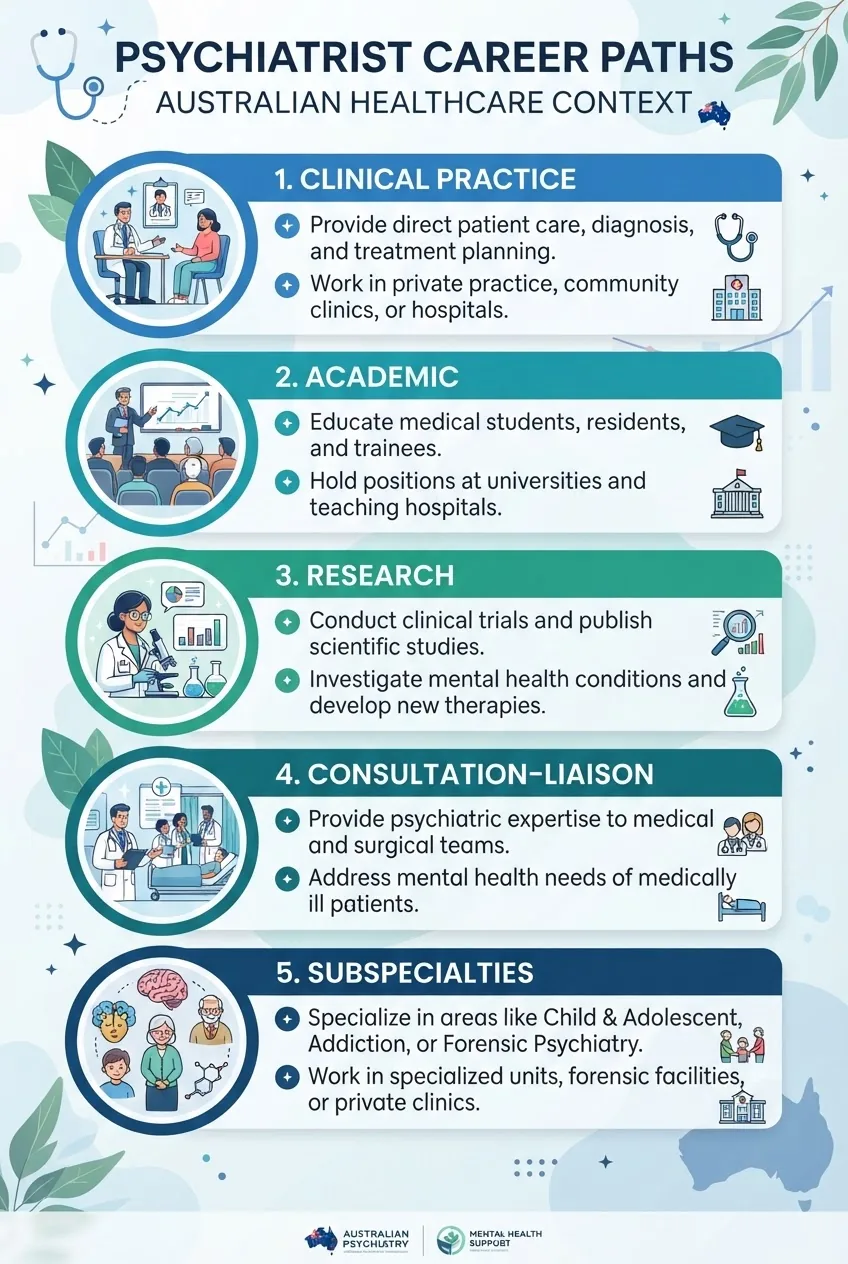
Term: Consultation-liaison psychiatry is a subspecialty where psychiatrists work alongside other medical teams to manage psychiatric aspects of patients in general hospitals.
- Clinical general psychiatry — Hospital consultant or private outpatient psychiatrist providing acute and long-term care; workplaces: public inpatient wards, outpatient clinics, community mental health centres. Training anchor: psychiatrist degree and Australian training requirements.
- Child and adolescent psychiatry — Specialists in developmental and adolescent disorders, often working in children’s hospitals, community child mental health teams and specialty clinics.
- Forensic psychiatry — Work in prisons, forensic hospitals or court liaison teams, focusing on assessment, risk management and court reports.
- Addiction psychiatry — Specialists in substance use and dependence working in detox units, rehab services and community clinics; some run outpatient clinics and telehealth follow-ups.
- Geriatric psychiatry — Focus on cognitive disorders and late-life mental health within aged-care services, geriatric wards and community outreach.
- Consultation-liaison and perinatal psychiatry — Hospital-based roles aiding medical teams and perinatal units; often involve multidisciplinary rounds and rapid assessments.
- Academic psychiatry and research — University or hospital-affiliated positions combining teaching, supervision and investigator-led or collaborative research; workplaces include university departments, research institutes and clinical trial centres.
- Mixed private/public practice — Many psychiatrists split sessions between public hospital appointments and private practice, balancing teaching, supervision and private billing.
- Policy and leadership roles — Senior psychiatrists in health departments, health services or NGOs influencing service design, workforce planning and clinical governance; external resources include the Australian Government Department of Health for system frameworks (Department of Health).
- Telehealth and remote outreach — Growing pathway delivering specialist consultation and supervision remotely, supporting rural clinicians and local services via telepsychiatry platforms.
Training nuance: specialist subspecialty fellowship requires additional RANZCP-accredited training; early-career psychiatrists typically complete basic training rotations through public hospitals before elective subspecialty training (RANZCP).
Day-in-the-life walkthroughs (examples):
- Hospital consultant morning ward rounds, midday outpatient clinic, afternoon supervision and admin — high-acuity caseload with multidisciplinary meetings.
- Private psychiatrist morning telehealth triage, midday face-to-face diagnostic assessments, late-afternoon inpatient review at affiliated hospital — blended workflow with billing considerations.
- Academic psychiatrist teaching students, running research interviews, supervising registrars and meeting with grant collaborators — less clinical load, more teaching and writing time.
For more on the formal pathway to become a psychiatrist, see psychiatrist degree and Australian training requirements.
Transition: Understanding where psychiatrists work clarifies how their workplaces differ from psychologists; the next section compares those roles.
Differences Between Psychiatry and Psychology Work Settings
Answer: Psychiatrists are medical doctors who can prescribe medication and work in medical settings (hospitals, clinics), while psychologists focus on psychotherapy and assessment, working in clinics, community services and private practice; training, scope and workplace duties differ.
Term: Psychiatrist — a medical specialist trained in psychiatry; Psychologist — a clinician trained in psychology (generally not a medical doctor).
| Feature | Psychiatrist | Psychologist |
|---|---|---|
| Training | Medical degree + specialist psychiatry training (RANZCP pathways). | Undergraduate + honours/master/doctoral training in psychology; clinical supervision. |
| Prescribing rights | Can prescribe psychiatric medications. | Generally cannot prescribe medications in Australia. |
| Common workplaces | Hospitals, clinics, forensic/prison settings, community teams. | Private practice, schools, community health services, research centres. |
| Clinical focus | Diagnosis, biological treatments, complex case management. | Psychotherapy, psychological assessment, behaviour therapies. |
| Collaboration | Works closely with GPs, psychologists and allied health in multidisciplinary teams. | Often part of multidisciplinary teams and shares care with psychiatrists when medication or complex assessment is needed. |
Explanation and collaboration: Psychiatrists focus on medical aspects and complex diagnostics, frequently seeing patients with comorbid medical conditions; psychologists provide evidence-based psychotherapies and assessments. For a detailed discussion of scope and prescribing, see psychologists prescribing medication vs psychiatrists and mental health practitioner roles and training.
Training differences: psychiatrists’ medical background leads to work in acute medical settings (ED, inpatient wards) and prescribing responsibilities, while psychologists’ training emphasises therapeutic modalities and psychological testing applied across community and private contexts.
Transition: Technology is changing where psychiatrists work — telepsychiatry expands access and reshapes clinic workflows, which we cover next.
Telepsychiatry: Expanding Psychiatrist Workplaces
Answer: Telepsychiatry extends psychiatric assessment and treatment to remote and urban patients via secure platforms, improving access and continuity while requiring attention to privacy, platform security and clinical best practice.

Term: Telehealth is the use of telecommunications to provide healthcare services remotely.
Telepsychiatry settings include outpatient follow-ups, initial diagnostic assessments, group therapy and remote supervision. It is particularly important for rural psychiatry access and continuity when face-to-face appointments are limited. According to a 2024 industry report, telehealth psychiatry consultations increased significantly following pandemic-era reforms and remain a substantial part of outpatient care (source: industry report summary).
Best practice tips for clinicians:
- Use secure, encrypted platforms that meet Australian privacy standards and local health service policies.
- Confirm identity and location at the start of each session and document consent for telehealth delivery.
- Ensure emergency plans and local contact details are available for remote patients, especially in rural areas.
- Be aware of Medicare telehealth item rules and local bulk billing options; for bulk billed telehealth resources see bulk bill options for telepsychiatry and remote service guides like telehealth psychiatrist services and online care.
- For telephone-based support, the Medicare mental health phone service can be an adjunct resource for brief support.
Affordability and access: Telepsychiatry can reduce travel time and increase appointment flexibility; some services offer bulk billing for eligible consultations, expanding affordability for patients. See resources on Canberra telehealth psychiatrist referral guide for regional examples.
Transition: The choice between public and private workplaces shapes culture, billing and career development; the next section compares those sectors.
Public vs Private Sector Psychiatry: Workplace Culture and Opportunities
Answer: Public sector psychiatry focuses on comprehensive, multidisciplinary care with teaching and large caseloads, while private practice emphasises outpatient care, patient choice and billing autonomy — many psychiatrists work across both sectors.
Term: Bulk billing is when a medical practitioner bills Medicare directly and accepts the Medicare benefit as full payment for the service.
Public sector
Public psychiatry offers exposure to acute inpatient care, multidisciplinary teams, registrar training and opportunities for quality-improvement projects. Caseloads can be high and administrative duties substantial. Funding is primarily through state health services and Medicare-funded programs; see the Department of Health for public sector frameworks (Australian Government Department of Health).
Public workplaces often include allied staff: psychiatry registrars, psychiatric nurses, social workers, occupational therapists and psychologists, enabling team-based care models for complex patients.
Private sector
Private practice provides autonomy over caseload, scheduling and billing; many psychiatrists offering private care also provide psychotherapy. Private outpatient settings usually have lower immediate medical acuity but may involve longer-term medication management and continuity care.
Examples of billing and regional options: Some private psychiatrists offer bulk billing for particular patient groups or telehealth sessions; readers seeking local bulk-billing examples can review psychiatrist Sydney bulk billing and referral process and options in Adelaide like bulk billing psychiatrist options in Adelaide. Patient preferences for clinician gender or location are served by services such as female psychiatrists private and bulk billing Perth for those seeking female clinicians.
Career advancement: Public roles may offer clearer pathways into leadership, teaching and subspecialty training; private practice can offer higher earnings per hour and client choice but requires business skills and administrative time.
Publicly funded services such as Medicare mental health centres provide structured outpatient support and referral pathways; see Medicare mental health centre services for service-level detail.
Transition: Subspecialties place psychiatrists in specialised settings — the following section outlines those roles and where they work.
Subspecialties and Specialized Psychiatric Settings
Answer: Subspecialties such as child and adolescent, forensic, addiction and geriatric psychiatry place clinicians in specialised hospitals, prisons, community services and outpatient clinics tailored to specific patient populations.
Term: Subspecialty — a focused area of clinical practice within psychiatry that requires additional training or experience.
Child and adolescent psychiatrists often work in paediatric hospitals, school-linked clinics and specialised outpatient services. Forensic psychiatrists work within correctional health services, forensic hospitals and court liaison teams. Addiction psychiatrists can be found in detox units, community addiction services and rehabilitation facilities. Geriatric psychiatrists often provide outpatient memory clinics, aged-care outreach and inpatient liaison with geriatric medicine.
Specialised inpatient care is provided in psychiatric ward services and older adult units; see psychiatric ward services and facilities for more on ward-level care. Secure forensic units and prison healthcare require additional risk training and collaboration with legal systems.
Example: ADHD services — ADHD is a common referral reason for child, adolescent and adult psychiatrists; some provide online assessments. For guidance on remote ADHD assessment, see ADHD psychiatrist online assessments.
Training and workplace crossover: Many subspecialists maintain mixed roles—clinic sessions, inpatient commitments and academic responsibilities—which supports continuity of care and teaching opportunities.
Transition: Psychiatrists rarely work in isolation; collaboration with other practitioners is core to patient outcomes, detailed next.
Collaborative Mental Health Care: Psychiatrists’ Role Among Other Practitioners
Answer: Psychiatrists provide medical diagnosis, medication management and leadership within multidisciplinary teams, collaborating closely with GPs, psychologists, social workers and allied health via referral, shared plans and co-managed care.
Term: Multidisciplinary team — a group of professionals from different disciplines working together on a patient’s care plan.
Psychiatrists often receive referrals from GPs and work with psychologists to combine pharmacotherapy and psychotherapy. Shared care models use mental health care plans for referrals to structure collaborative treatments. For patients seeking psychological services, psychiatrists may advise on the referral process to see a psychologist as part of coordinated care.
referral process to see a psychologist
Practical referral dynamics: GPs commonly initiate referrals; see guidance on how GPs support psychiatric referrals at GP mental health care and referral requirements. Psychiatrists may request psychological input, cognitive testing or ongoing therapy; resources for finding therapists include finding and booking a psychologist in Australia and a clear explanation of the referral to psychologist process explained.
referral to psychologist process explained
Example collaborative pathways:
- GP refers a patient with depression to a psychiatrist for complex diagnostic work-up; psychiatrist stabilises medication and recommends psychotherapy.
- Psychiatrist and psychologist co-manage a bipolar disorder patient: psychiatrist manages mood stabilisers and risk, psychologist provides CBT and relapse prevention.
- Community mental health teams coordinate case management, housing supports and vocational rehab with psychiatrists serving as clinical leads.
Resources on referral mechanics and allied roles include finding and booking a psychologist in Australia and the mental health care plans for referrals.
Transition: Working in these settings carries specific challenges and rewards, summarised next with workforce data and wellbeing considerations.
Challenges and Rewards of Psychiatric Workplaces
Answer: Psychiatric work offers high job satisfaction through patient impact and varied roles but carries stress from complex caseloads, on-call duties and administrative burdens; workforce data show pressures in staffing and burnout risk.
According to a 2023 AIHW report, psychiatrists report high workload intensity and rising demand for mental health services; workforce distribution remains uneven across regions (source: AIHW workforce report 2023).
Common stress factors:
- High-acuity inpatient responsibilities and on-call rotations in public hospitals.
- Administrative load including certification, report writing and medico-legal tasks.
- Emotional strain from managing suicidal or highly distressed patients.
- Workforce shortages in rural and regional areas requiring broader on-call coverage.
Rewards and protective factors:
- Meaningful patient improvement, long-term therapeutic relationships and multidisciplinary collaboration.
- Opportunities for academic work, teaching and research that diversify workload.
- Flexible arrangements such as part-time private practice, telehealth sessions and job-sharing to improve work-life balance.
Support resources and professional development are essential; ongoing CPD and supervision are standard expectations from colleges like RANZCP. For clinician and patient support lines, see mental health support lines and services.
According to a 2024 industry workforce analysis, targeted interventions — supervision, workload management and integrated care models — reduce burnout risk and improve retention (source: 2024 industry workforce analysis).
Transition: The article concludes with key takeaways and next steps for readers seeking psychiatric care or a career in psychiatry.
Conclusion: Psychiatrists work across hospitals, private clinics, community services and telehealth, with diverse career paths including subspecialties, research and academic roles. Choice of workplace affects caseload, culture and opportunities; collaboration with GPs and psychologists is central to effective care. If you’re seeking care, start with a GP referral or explore telehealth and local clinic options to match your needs.
Call to action: If you need help finding services or understanding referrals, review referral guides and the local service pages linked throughout this article to identify appropriate next steps.