

This guide explains the anxiety different types, core symptoms, common causes, Australia-specific and global statistics, and practical treatment options — distinguishing everyday nervousness from clinical anxiety disorders and clarifying whether anxiety commonly resolves on its own.
Understanding Anxiety: Definition and Impact?
Answer: Anxiety is a normal emotional response to perceived threat or stress; when frequent, intense or impairing daily life it becomes an anxiety disorder requiring assessment and treatment.
Term: anxiety — a psychological and physiological state characterised by worry, heightened arousal, and behavioural changes in response to perceived threats.
Anxiety covers a spectrum from situational nervousness (for example, pre-exam jitters) to persistent clinical conditions that reduce functioning. Impact ranges across work, relationships, sleep, cognition and physical health; chronic anxiety can increase risk for substance misuse, depressive disorders and cardiovascular issues.
Clinical tools commonly used in assessment include structured interviews (e.g., MINI), screening scales (GAD-7, PHQ-9 co-screen), and functional assessments used by psychologists and psychiatrists in clinics across Sydney and Australia.
An anonymised clinical vignette: a 28-year-old Sydney professional reports daily uncontrollable worry, insomnia and concentration problems for six months, meeting criteria for a clinical disorder after screening and functional assessment flagged workplace impairment.
Transition: Next, examine how common anxiety is, both globally and within Australia, to put prevalence and service needs into context.
Anxiety Statistics: How Many People Have Anxiety?
Answer: Anxiety disorders are among the most common mental health conditions worldwide; prevalence estimates vary by study, with roughly 10–20% of people experiencing a clinically significant anxiety disorder at some point each year.
Key statistics (selected, recent):
| Region / Measure | Estimate | Source |
|---|---|---|
| Global annual prevalence (anxiety disorders) | ~10–15% of adults | According to a 2022 World Health Organization report (WHO mental health) |
| Australia annual prevalence (any anxiety disorder) | About 1 in 7 Australians (14%) reported an anxiety condition in the last 12 months | According to a 2023 Australian Bureau of Statistics report (ABS) |
| Lifetime risk (developing an anxiety disorder) | Estimated 20–30% of people across lifespan | According to a 2021 peer-reviewed epidemiological review (clinical review) |
Note: prevalence figures vary by diagnostic method and reporting year; screening surveys capture symptoms while clinical interviews provide more conservative disorder rates. In Australia, presentation rates rose during the COVID-19 period according to government monitoring.
Transition: With prevalence established, we can map how anxiety presents across a spectrum from mild nervousness to severe, named disorders.
Anxiety Different Types Overview: Mild to Severe Spectrum?
Answer: Anxiety exists on a spectrum from transient mild anxiety and nervousness to clinically significant anxiety disorders that impair functioning; recognising the level helps decide when to seek help.

- Normal situational anxiety — short-term worry tied to an identifiable stressor (e.g., exam, job interview); typically resolves when situation passes.
- Heightened or persistent nervousness — recurring worry or physiological arousal without major life disruption; self-help and lifestyle changes often suffice.
- Mild anxiety disorder — regular symptoms (worry, sleep disturbance) that cause mild functional impairment; therapy and brief interventions usually effective. levels of anxiety symptoms and diagnosis
- Moderate to severe anxiety disorder — persistent, disabling symptoms (panic attacks, avoidance, social impairment), usually meeting diagnostic thresholds and often needing specialist care.
- Anxiety neurosis — a historical term formerly used to describe chronic anxiety states; today we classify these under specific DSM disorders (see below for modern terms).
- Comorbid presentations — anxiety frequently co-occurs with depression, substance use or physical conditions, increasing complexity and risk.
Examples: minor anxiety might be feeling jittery before a presentation and sleeping poorly for two nights; a clinical anxiety disorder could be someone avoiding work because of panic attacks or experiencing daily uncontrollable worry for months.
Transition: The named clinical disorders are the standard categories used by clinicians; the next section details the 11 types commonly referenced in practice.
The 11 Types of Anxiety Disorders Detailed?
Answer: Clinicians commonly refer to 11 anxiety-related diagnoses—including generalized anxiety disorder, panic disorder, social phobia and specific phobias—each with distinct symptom clusters, typical course and treatment approaches.
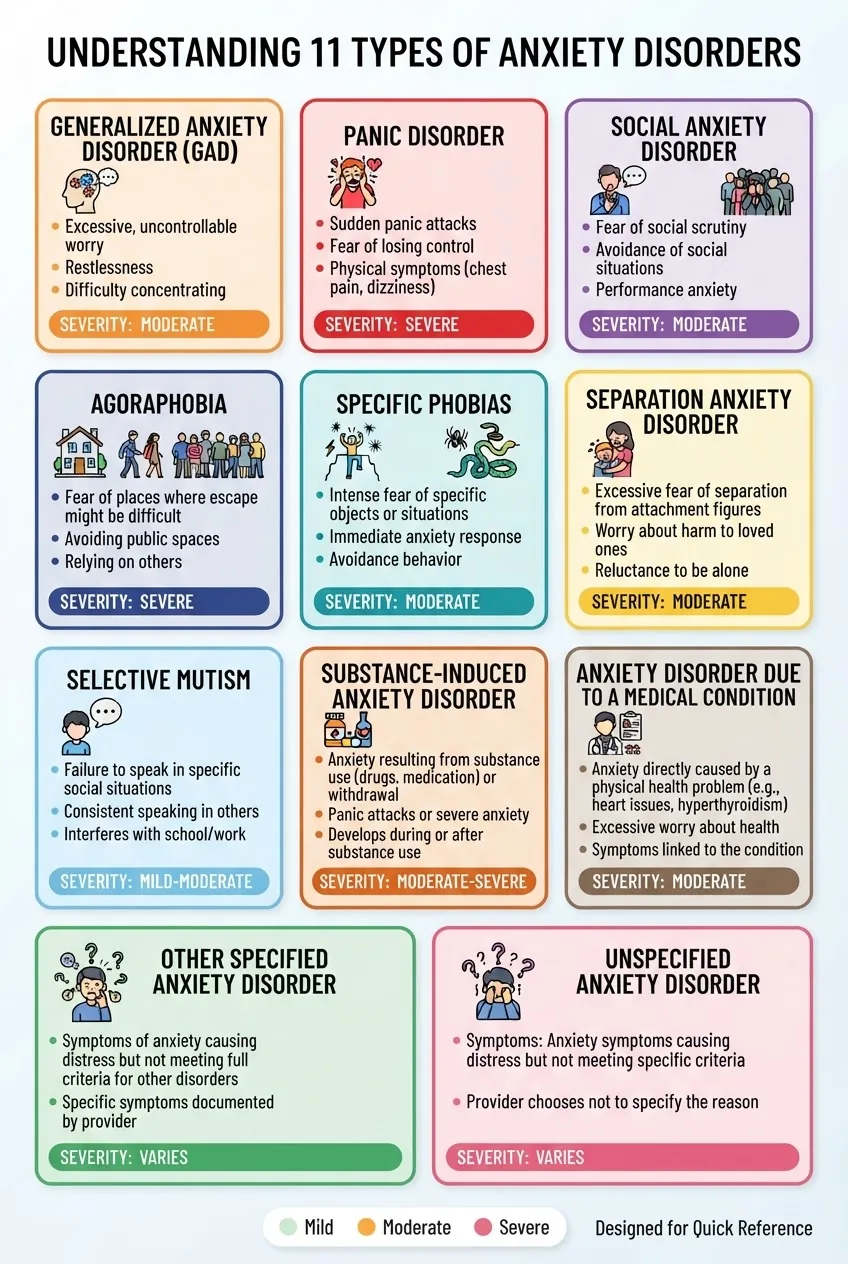
-
1. Generalised Anxiety Disorder (GAD)
Answer: GAD features persistent, excessive worry about multiple domains (work, health, family) for months, with physical symptoms like fatigue and muscle tension.
Term: generalised anxiety disorder (GAD) — chronic worry and related symptoms lasting at least several months and causing functional impairment.
- Core symptoms: pervasive worry, restlessness, difficulty concentrating, sleep disturbance, muscle tension.
- Onset: often in early adulthood but can begin at any age.
- Treatment note: see generalised anxiety disorder symptoms and treatment for a deeper dive.
-
2. Panic Disorder
Answer: Panic disorder involves recurrent unexpected panic attacks—sudden surges of intense fear with physical symptoms—and persistent worry about future attacks or their consequences.
- Symptom highlights: abrupt palpitations, shortness of breath, chest pain, dizziness, fear of losing control.
- Course: attacks can be brief but lead to anticipatory anxiety and avoidance.
- Clinical tool: panic symptom scales and attack diaries help in assessment.
-
3. Agoraphobia
Answer: Agoraphobia is intense fear or avoidance of places/situations where escape might be difficult (e.g., crowds, public transport), often following panic attacks.
- Symptoms: avoidance, need for companion, clinic-assessed functional impairment.
- Treatment note: see medication treatment for agoraphobia for medication context.
-
4. Social Anxiety Disorder (Social Phobia)
Answer: Social anxiety disorder involves marked fear of social or performance situations where one may be judged, leading to avoidance or extreme distress during social interactions.
- Symptoms: fear of embarrassment, avoidance, physical signs (blushing, trembling, nausea).
- Severity range: from mild discomfort to severe social withdrawal.
- Clinical resources: detailed DSM criteria found in social phobia disorder DSM-5 criteria.
-
5. Specific Phobias
Answer: Specific phobias are intense, disproportionate fears of particular objects or situations (e.g., heights, needles) that provoke immediate anxiety and avoidance.
- Symptoms: instantaneous fear response, avoidance, sometimes panic-like reactions.
- Treatment typically effective with exposure-based methods and systematic desensitisation.
- See also systematic desensitisation therapy.
-
6. Separation Anxiety Disorder
Answer: Separation anxiety involves excessive fear of separation from attachment figures, causing distress and refusal to be apart; not limited to children and can present in adults.
- Symptoms: persistent worry about losing attachment figures, refusal to be alone, nightmares about separation.
- Assessment: clinicians evaluate developmental context and functional impairment.
-
7. Selective Mutism
Answer: Selective mutism is a childhood-onset condition where a child consistently fails to speak in certain social settings despite speaking in others; it is anxiety-driven rather than oppositional.
- Symptoms: silence in school or public spaces, normal speech at home or with trusted people.
- Early intervention often improves outcomes.
-
8. Obsessive–Compulsive Disorder (OCD)
Answer: OCD involves unwanted intrusive thoughts (obsessions) and repetitive behaviours or mental acts (compulsions) performed to reduce anxiety related to those thoughts.
- Symptoms: contamination fears, checking rituals, intrusive thoughts; compulsion reduces anxiety temporarily.
- Note: OCD is now classified separately from anxiety disorders in some diagnostic systems but remains anxiety-related.
-
9. Post-Traumatic Stress Disorder (PTSD)
Answer: PTSD is a disorder following exposure to traumatic events, marked by intrusive memories, avoidance, negative mood/cognition changes and hyperarousal.
- Symptoms: flashbacks, nightmares, startle response, avoidance of reminders.
- Importance: PTSD often requires trauma-focused psychotherapies and specialist care.
-
10. Substance-/Medication-Induced Anxiety Disorder
Answer: Anxiety symptoms may result directly from intoxication, withdrawal, or exposure to certain medications or substances.
- Examples: stimulant use causing anxiety, alcohol withdrawal producing severe anxiety or panic.
- Clinical step: review medications, substances and medical causes when assessing anxiety.
-
11. Anxiety Disorder Not Otherwise Specified / Other Specified Anxiety Disorder
Answer: When anxiety symptoms cause significant distress or impairment but do not fit a single category, clinicians may use an unspecified or other specified anxiety disorder label to guide treatment.
- Use: provides clinical flexibility while assessment continues or when presentations are mixed.
- Follow-up: further assessment often clarifies diagnosis over time.
Clinical note: For diagnostic depth and DSM framework references, consult DSM criteria for anxiety disorders.
Transition: Understanding triggers and root causes helps explain why types differ and guides prevention and treatment planning.
What Can Cause Nervousness and Anxiety? Common Triggers and Root Causes?
Answer: Nervousness and anxiety have multifactorial causes: genetic predisposition, brain chemistry, personal history, ongoing stressors, medical conditions and substances can all contribute.
Biopsychosocial contributors include:
- Genetic and neurobiological factors: family history and temperament influence susceptibility; altered neurotransmitter regulation (serotonin, GABA) plays a role.
- Psychological factors: cognitive styles (catastrophising), learned avoidance, attachment insecurity and early life stress increase risk.
- Environmental stressors: financial strain, relationship problems, workplace stress and traumatic events commonly trigger or worsen anxiety.
- Medical conditions and substances: thyroid disease, cardiac arrhythmias, stimulants, caffeine and withdrawal states can manifest as anxiety symptoms.
- Social determinants: social isolation, unemployment and lack of access to care affect onset and prognosis.
Common immediate triggers that precipitate episodes:
- Acute stressors (presentation, exam, bereavement)
- Interpersonal conflict or rejection
- Health scares or chronic illness
- Substance intoxication or withdrawal
- Major life transitions (moving city, job loss)
Transition: Many people ask whether anxiety counts as a disability or psychiatric disorder — the next section clarifies legal and clinical perspectives.
Is Anxiety a Mental Disability or Psychiatric Disorder? Clarifying Misconceptions?
Answer: Anxiety can be a psychiatric disorder when diagnostic criteria are met; whether it is legally a disability depends on impairment level, jurisdictional definitions and eligibility for support services.
Term: psychiatric disorder — a clinically defined mental health condition diagnosed by health professionals; disability — a legal/functional status based on significant limitations in major life activities.
Clinical perspective: A diagnosis (e.g., GAD, panic disorder) indicates a psychiatric disorder when symptoms meet duration and impairment thresholds. Clinicians use validated tools and structured interviews to determine this.
Legal and support perspective in Australia: Eligibility for disability support (e.g., NDIS, Centrelink) is assessed on functional impairment, need for ongoing care and how symptoms limit daily activities. Not all diagnosed individuals qualify for disability-level supports.
FAQ-style clarifications:
- Does a diagnosis mean you’re disabled? Not necessarily — diagnosis documents a clinical condition; disability status depends on severity and functional impact.
- Can anxiety be hidden or invisible? Yes — many with severe anxiety maintain outward functioning while experiencing internal distress; assessments consider both observable and reported impairment.
- Is there stigma? Stigma remains but clinical education, workplace accommodations and public health efforts reduce barriers to care.
Transition: Recognising the signs — psychological, physical and behavioural — helps people and clinicians detect anxiety early; the next section lists common symptoms.
Symptoms of Anxiety: Psychological, Physical, and Behavioural Signs?
Answer: Anxiety symptoms include cognitive/emotional signs (worry, fear), physical symptoms (palpitations, stomach upset) and behavioural changes (avoidance, agitation); severity and pattern vary by disorder.

Common symptom checklist:
- Psychological/cognitive: persistent worry, catastrophising, difficulty concentrating, intrusive thoughts.
- Emotional: apprehension, irritability, dread, feeling detached or on edge.
- Physical: heart palpitations, sweating, trembling, breathlessness, gastrointestinal upset, headaches, dizziness.
- Behavioural: avoidance of feared situations, reassurance-seeking, safety behaviours, social withdrawal.
Specific physical symptom emphasised clinically: stomach and gut symptoms (nausea, diarrhoea, abdominal pain) are common in anxiety presentations; for focused guidance see stomach symptoms related to anxiety.
Clinical caveat: When physical symptoms are new or severe, clinicians rule out medical causes (cardiac, endocrine, neurological) before attributing them to anxiety; collaborative care with GPs is common in Sydney clinics.
For more on physical manifestations and management strategies, refer to the sibling article anxiety manifesting physically effects.
Transition: With symptoms clear, the following section summarises treatment options mapped to different anxiety types and severities.
Treatment Approaches for Different Types of Anxiety?
Answer: Treatment is tailored to disorder type and severity and typically involves evidence-based psychotherapy (especially cognitive and exposure-based therapies), medications when indicated, and lifestyle interventions to support recovery and resilience.
Core treatment categories:
- Psychotherapy: evidence-based therapies include cognitive behavioural therapy (CBT), exposure therapy and trauma-focused therapies for PTSD; for social anxiety, see cognitive behavioural therapy for social phobia.
- Medication: selective serotonin reuptake inhibitors (SSRIs), SNRIs and other agents may be recommended for moderate–severe presentations or to augment psychotherapy; medication choices depend on disorder and medical profile — see medication treatment for agoraphobia for example guidance.
- Lifestyle and self-management: sleep hygiene, regular exercise, limiting stimulants (caffeine), structured worry time, mindfulness and paced breathing support symptom reduction.
- Group and peer support: group therapy and community support can be effective for social anxiety and generalised anxiety; see anxiety support groups and mental health resources.
- Specialist interventions: for severe or treatment-resistant cases, combined care with psychiatrists, consideration of intensive outpatient programs, and multi-disciplinary input are common.
Practical comparison (brief):
| Approach | Typical use | Notes |
|---|---|---|
| CBT / exposure | First-line for many anxiety disorders | Skill-based, time-limited, strong evidence base |
| Medication (SSRIs/SNRIs) | Moderate–severe or persistent cases | Requires medical oversight; consider side effects |
| Lifestyle / self-help | Mild symptoms and relapse prevention | Accessible, complements formal treatment |
Clinical tools commonly used in treatment planning include symptom measures (GAD-7, PHQ-9), exposure hierarchies, functional assessments and collaborative care plans developed with GPs and mental health clinicians.
For specialised social anxiety pathways and clinician directories, consult the pillar resource social phobia therapist and social anxiety treatment options.
Other useful resources: medication guidance for specific disorders (see medication treatment for agoraphobia) and exposure-based guides like systematic desensitisation therapy.
Transition: People commonly wonder whether anxiety will ever resolve — the next section addresses prognosis and realistic expectations.
Will Anxiety Go Away? Understanding Prognosis and Management?
Answer: Anxiety can improve substantially with appropriate intervention; some people recover fully while others manage chronic symptoms successfully — early treatment improves outcomes and relapse prevention is possible with ongoing self-care and support.
Key points:
- Many mild anxiety episodes resolve spontaneously, but persistent or impairing anxiety rarely remits without intervention.
- Evidence-based treatments (CBT, exposure, medication when needed) significantly reduce symptoms; response timelines vary (weeks to months).
- For severe or disabling anxiety, specialist and sometimes multi-modal care may be required; see treatment and support for crippling anxiety for intensive resources.
Transition: Final summary and action steps consolidate practical next steps for readers concerned about anxiety.
Conclusion: Key Takeaways and Next Steps?
Answer: Anxiety different types range from normal nervousness to diagnosable disorders; recognise symptom patterns, seek assessment when symptoms persist or impair life, and pursue evidence-based treatments tailored to disorder and severity.
If you are unsure whether your anxiety is mild or clinical, arrange an assessment with a qualified clinician, use validated screening tools, and consider early psychological intervention to improve outcomes. For social anxiety support and specialist pathways, visit the recommended clinic resource earlier in this guide.
Call to action: If anxiety affects your daily life, contact your GP or a licensed mental health clinician in Sydney to start assessment and discuss a personalised plan.