

Answer: Anxiety disorders in the DSM are clinically defined categories of excessive fear or anxiety with specific symptom thresholds and duration; clinicians use these DSM-5 criteria to guide diagnosis and match patients to evidence-based treatments such as CBT, exposure therapy and medication, adapted to local Sydney referral pathways.
Understanding Anxiety Disorders in the DSM-5 Framework?
Answer: The DSM-5 organises anxiety disorders by symptom clusters and diagnostic thresholds so clinicians can reliably identify disorders, rule out medical causes, and plan treatment; it is a diagnostic guide rather than a treatment manual, and clinicians integrate DSM diagnosis into individualised care.
DSM-5: The Diagnostic and Statistical Manual of Mental Disorders, Fifth Edition, published by the American Psychiatric Association, is the standard classification system clinicians use for psychiatric diagnoses.
The DSM-5 groups conditions where fear, anxiety or avoidance are the core problems. For clinicians and patients, the manual provides a checklist-like structure: required symptoms, minimum duration, functional impairment, and exclusion criteria (e.g., not better explained by a medical condition or substance). Using the DSM is like following a clinical checklist to establish whether a pattern of symptoms meets a diagnostic threshold.
Clinicians combine DSM-5 criteria with clinical interviews and validated screening tools (see monitoring section) to form an initial diagnosis. This diagnosis then informs a treatment plan that considers severity, comorbidity, patient preference, safety, and local resources.

The DSM-5 categories commonly encountered in adult clinics include Generalized Anxiety Disorder (GAD), Panic Disorder (with/without Agoraphobia), Social Anxiety Disorder (Social Phobia), Specific Phobias, Separation Anxiety Disorder (adult presentations included), and less common presentations such as Selective Mutism. Each category has defined diagnostic criteria that guide treatment selection and referral urgency.
For further reading on broader presentations, see our different types of anxiety disorders.
Detailed DSM-5 Criteria for Common Anxiety Disorders?
Answer: DSM-5 lists specific criteria for each anxiety disorder that determine diagnosis; below are concise, clinician-oriented summaries for common disorders for use in diagnostic formulation and treatment planning.
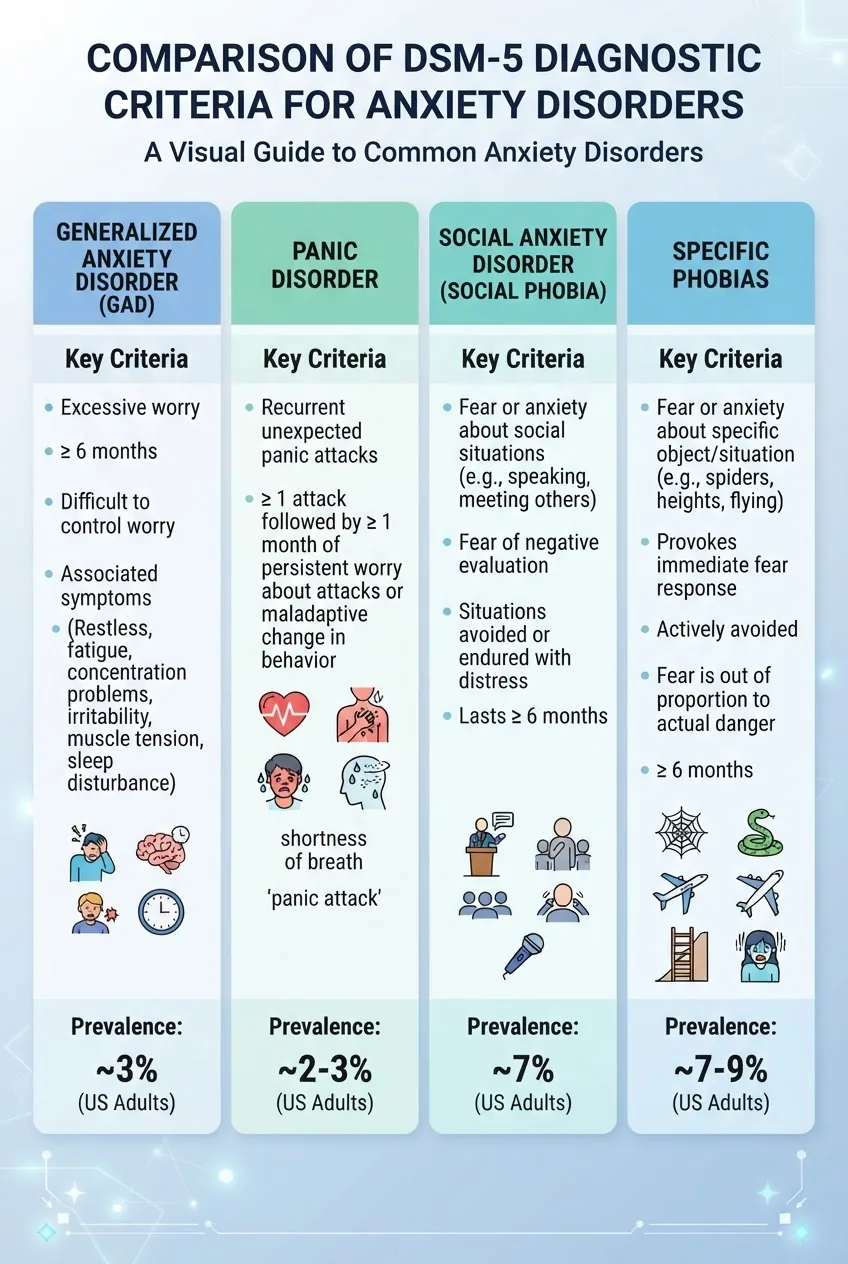
Generalized Anxiety Disorder Criteria
Answer: GAD is diagnosed when excessive anxiety and worry occur more days than not for at least six months, are difficult to control, and are associated with multiple physical or cognitive symptoms causing impairment.
Comorbidity: GAD commonly co-occurs with major depressive disorder and substance use disorders and must be differentiated from medical causes such as hyperthyroidism.
- Core symptom: Excessive worry about multiple domains (work, health, finances) more days than not for ≥6 months.
- Associated symptoms (need ≥3 in adults): restlessness, fatigue, difficulty concentrating, irritability, muscle tension, sleep disturbance.
- Worry is difficult to control and causes clinically significant distress or impairment in social, occupational, or other areas.
- Symptoms not attributable to substances, medication, or another medical condition.
Panic Disorder and Agoraphobia Criteria
Answer: Panic disorder requires recurrent unexpected panic attacks and persistent concern or behavioural change; agoraphobia involves marked fear or avoidance of situations where escape might be difficult, often following panic attacks.
Panic attack: A discrete period of intense fear with abrupt onset and at least four physical/cognitive symptoms (palpitations, sweating, trembling, shortness of breath, choking, chest pain, nausea, dizziness, derealisation, fear of losing control or dying).
- Panic Disorder diagnostic points:
- Recurrent unexpected panic attacks.
- At least one attack followed by ≥1 month of persistent concern about additional attacks or maladaptive behavioural changes related to the attacks.
- Not attributable to a substance or medical condition.
- Agoraphobia diagnostic points:
- Marked fear or anxiety about ≥2 situations (public transport, open spaces, enclosed places, standing in line, being outside alone) due to thoughts escape may be difficult or help unavailable.
- Situations almost always provoke fear/anxiety and are actively avoided, require a companion, or endured with intense fear.
- Fear is out of proportion to actual danger and causes impairment for ≥6 months.
When agoraphobia is present, treatment planning should address both panic symptom prevention and graded re-exposure to avoided situations; pharmacotherapy can reduce panic frequency while exposure-based work reduces avoidance.
medications for agoraphobia and anxiety
Social Anxiety Disorder Criteria
Answer: Social anxiety disorder requires marked fear or anxiety about social situations involving possible scrutiny, with avoidance or distress lasting ≥6 months and causing significant impairment.
- Fear of negative evaluation or embarrassment in social or performance situations.
- Social situations almost always provoke fear and are avoided or endured with intense anxiety.
- Fear is disproportionate to actual threat, persistent ≥6 months, and causes functional impairment.
- Specify if performance-only subtype applies (e.g., public speaking).
Specific Phobias Criteria
Answer: Specific phobia is diagnosed when a marked, persistent fear of a specific object/situation causes immediate anxiety or avoidance and significant impairment, typically lasting ≥6 months.
- Fear is cued by a specific object or situation (animals, heights, needles, flying).
- Exposure to the phobic stimulus provokes immediate anxiety or panic-like symptoms.
- Recognised as excessive or unreasonable but is avoided or endured with intense fear, causing impairment.
- Specify subtype (e.g., blood-injection-injury has distinct physiological responses like vasovagal fainting).
systematic desensitisation therapy
Other Anxiety Disorders (Separation Anxiety, Selective Mutism)
Answer: Separation anxiety and selective mutism are included in DSM-5 and can present in adults; diagnosis follows duration and impairment criteria tailored to the disorder, requiring clinical assessment for adult manifestations.
- Separation Anxiety Disorder in adults: excessive fear or worry about separation from attachment figures, with repeated distress and avoidance of separation, lasting ≥6 months in adults.
- Selective Mutism: consistent failure to speak in specific social situations despite speaking in other contexts, causing impairment and lasting ≥1 month (excluding the first month of school).
For each disorder, clinicians document severity, specifiers, frequency of panic attacks (if present), and functional impact to inform treatment planning. The DSM-5 provides diagnostic thresholds but clinicians often consider symptom dimensionality when designing interventions.
Differential Diagnosis and Comorbidities with Anxiety Disorders?
Answer: Differential diagnosis distinguishes anxiety disorders from medical conditions, substance effects, and overlapping psychiatric disorders—most commonly depression—and identifying comorbidity is essential because it changes treatment sequencing and prognosis.
Comorbidity: Co-occurrence of two or more disorders (e.g., anxiety plus depression) is common and complicates treatment selection and expected outcomes.
Key differential and comorbidity considerations:
- Major depressive disorder often overlaps with anxiety; assess for anhedonia, pervasive low mood, and suicidal ideation separate from anxiety symptoms.
- Bipolar disorder can present with anxiety symptoms during mood episodes; screen for hypomanic/manic history before initiating antidepressants.
- Substance-induced anxiety: stimulant intoxication or withdrawal, alcohol withdrawal, and prescribed stimulants can mimic or exacerbate anxiety.
- Medical mimics: thyroid dysfunction, cardiac arrhythmias, vestibular disorders, pulmonary disease; basic medical screening and consider ECG or thyroid function tests if indicated.
- Post-traumatic stress disorder (PTSD) shares hyperarousal features but includes trauma exposure and re-experiencing symptoms; dissociate these clinically.
- Obsessive-compulsive disorder involves intrusive thoughts and compulsions distinct from generalized worry; differentiate by content and ritualized behaviours.
Clinical red flags prompting urgent medical assessment: acute chest pain, new-onset neurological signs, severe dehydration, or evidence of substance toxicity. Use screening tools such as the GAD-7, PHQ-9 and panic symptom checklists to triage and document baseline severity.
physical manifestations of anxiety
digestive symptoms linked to anxiety
Assessing comorbidity guides sequencing: for example, if major depression with suicidality is present, stabilise mood and safety before focused exposure work; if substance misuse is active, address harm reduction and consider integrated treatment. Multidisciplinary input (GP, psychiatrist, psychologist) is often required.
Evidence-Based Treatments Based on DSM-5 Classification?
Answer: Evidence-based treatments map to DSM diagnoses: psychotherapies like cognitive behavioural therapy (CBT) and exposure therapies are first-line for many anxiety disorders, with pharmacotherapy (SSRIs, SNRIs, benzodiazepines short-term) used according to disorder severity, comorbidity and patient preference.
Psychotherapy: Psychological treatments using structured, evidence-based techniques (e.g., CBT, exposure, acceptance-based approaches) aim to reduce maladaptive thoughts, avoidance and physiological arousal.

Psychological Treatments
Answer: CBT and exposure therapies are primary psychological treatments; they are manualised, time-limited, and adapted to specific DSM diagnoses—treatment planning uses diagnostic detail (e.g., panic frequency, avoidance) to choose techniques.
Core psychological modalities:
- Cognitive Behavioural Therapy (CBT): structured therapy targeting maladaptive thoughts and avoidance; uses cognitive restructuring, behavioural experiments, and homework. Effective for GAD, panic disorder, social anxiety, and specific phobias.
- Exposure Therapy: graduated or prolonged exposure to feared stimuli to reduce avoidance and extinguish fear responses; central for specific phobias, agoraphobia, and social anxiety performance fears.
- Acceptance and Commitment Therapy (ACT): targets experiential avoidance, increasing values-guided action; adjunctive evidence for anxiety disorders.
- Interpersonal Therapy (IPT): addresses interpersonal contributors to anxiety where relationships are central to symptom maintenance (used variably).
- Group therapy: cost-effective for social anxiety and skills training; consider group composition and severity.
Clinician tools commonly used in Sydney clinics for diagnosis and progress monitoring:
- GAD-7 (Generalized Anxiety Disorder-7): screening and severity tracking.
- PHQ-9 (Patient Health Questionnaire-9): depression comorbidity screening.
- Panic Disorder Severity Scale (PDSS): panic disorder monitoring.
- Social Phobia Inventory (SPIN) or Liebowitz Social Anxiety Scale (LSAS): social anxiety measurement.
- Outcome questionnaires such as the K10 or DASS-21 for broad distress monitoring.
Case example (experience signal):
Case: A 29-year-old Sydney professional presents with recurrent panic attacks and avoidance of public transport. Assessment using DSM-5 criteria confirmed Panic Disorder with situational avoidance (incipient agoraphobia); baseline PDSS documented severity, and a combined plan of SSRI initiation with concurrent CBT focused on interoceptive exposure and gradual transport exposure was agreed. Over 16 weeks attacks reduced and avoidance rehearsed successfully.
Therapist selection and session structure:
- Assessment (2–4 sessions): diagnostic interview, GAD-7/PHQ-9, medical screen, safety planning.
- Formulation and psychoeducation: link DSM criteria to behaviour and physiology; set measurable goals.
- Active therapy (8–20 sessions): CBT with exposure/practice, monitoring, relapse prevention.
- Review and step-down: booster sessions and community resources.
Pharmacological Treatments
Answer: Pharmacotherapy is effective and often indicated for moderate–severe anxiety or when symptoms impede engagement in psychotherapy; first-line medications are typically SSRIs/SNRIs, with benzodiazepines used short-term for acute control and adjunctive agents considered for specific presentations.
Medication classes, mechanisms and trade-offs:
| Class | Mechanism | Typical use & trade-offs |
|---|---|---|
| SSRIs (e.g., sertraline, escitalopram) | Increase synaptic serotonin by blocking reuptake | First-line for GAD, panic, social anxiety; delayed onset (2–6 weeks), sexual side effects, GI upset; monitor for activation initially. |
| SNRIs (e.g., venlafaxine) | Block serotonin and norepinephrine reuptake | Effective for GAD and panic; similar onset and side effects; may affect blood pressure at higher doses. |
| Benzodiazepines (e.g., diazepam, alprazolam) | Enhance GABAergic inhibition | Rapid symptom relief but risk dependence, cognitive slowing; reserve for short-term or bridging use under supervision. |
| Buspirone | 5-HT1A partial agonist | Used for GAD; slower onset, minimal sedation and no dependence risk. |
| Adjuncts (antipsychotics, pregabalin) | Various mechanisms | Used selectively for treatment-resistant cases with careful monitoring of metabolic and neurological side effects. |
Prescribing considerations in Sydney clinics reflect Australian practice guidelines: start low, go slow, and monitor for interactions and side effects. Shared decision-making with patients about trade-offs (efficacy vs side effects vs treatment length) improves adherence.
medications for agoraphobia and anxiety
Combining Treatments and Individualising Care
Answer: Combining psychotherapy and pharmacotherapy is often more effective for moderate–severe cases; individualise based on diagnosis per DSM-5, comorbidity, patient preference, previous response, and access to services.
Decision factors for combined vs single-modality treatment:
- Severity and functional impairment (higher severity often warrants combined treatment).
- Rapid symptom control needs (pharmacotherapy can bridge while CBT effects accumulate).
- Comorbid depression or suicidality may prioritise medication and safety planning.
- Patient preference and prior treatment response.
- Access to skilled therapists in specific modalities (e.g., exposure specialists for severe agoraphobia).
Example treatment paths by DSM diagnosis:
- GAD: CBT (12–20 sessions) OR SSRI/SNRI if moderate–severe; combine if poor response or severe impairment.
- Panic disorder with agoraphobia: SSRIs + CBT with interoceptive and in vivo exposure; gradual transport exposure protocol.
- Social anxiety disorder: CBT (individual or group) with exposure and social skills training; SSRIs for performance and generalized subtypes.
- Specific phobia: single-modality exposure treatment (one-session or multi-session) often sufficient.
When integrating care, coordinate between GP, psychologist and psychiatrist: medication management, structured therapy sessions, and regular review meetings if treatment is complex. Document rationale mapping DSM criteria to chosen modalities in the treatment plan.
Applying DSM-5 Criteria to Guide Treatment in Sydney Context?
Answer: In Sydney, DSM-5-based diagnosis leads to structured referral pathways: GP assessment and Medicare Mental Health Treatment Plans can enable subsidised psychology sessions, while psychiatrists manage complex pharmacotherapy and risk; multidisciplinary clinics coordinate stepped care based on DSM classification and patient needs.
Medicare and referral routes: In Australia, a GP can prepare a Mental Health Treatment Plan enabling eligible Medicare rebates for psychologist sessions and facilitate psychiatric referral when indicated.
Practical steps in Sydney clinics:
- Initial GP assessment: screen with GAD-7/PHQ-9, perform medical checks and discuss immediate safety; create Mental Health Treatment Plan if appropriate.
- Psychologist referral: targeted CBT or exposure therapy per DSM diagnosis; request evidence-based modality experience (e.g., exposure specialist for agoraphobia).
- Psychiatrist referral: complex comorbidity, treatment resistance, medication initiation and monitoring, or significant suicidality.
- Local clinics and community services: public community mental health teams, private psychologists, headspace (for young people), and NGO supports.
For social anxiety specifically, accessing a specialist can be crucial when avoidance severely limits functioning; see Social Phobia Therapist and Social Anxiety Treatment Options for local specialist pathways.
support resources for severe anxiety
Local considerations in Sydney:
- Service availability varies across metro and inner-city suburbs; private services offer shorter wait times but cost more.
- Stepped-care approach in public health may start with low-intensity psychological interventions before specialized care.
- Cultural and linguistic diversity in Sydney requires culturally sensitive assessment and access to interpreters when needed.
External resources and guidelines clinicians rely on include the DSM-5 for diagnostic criteria (American Psychiatric Association DSM-5) and Australian clinical guidance from the Department of Health (Australian Department of Health).
Monitoring Treatment Outcomes and When to Reassess DSM Diagnosis?
Answer: Monitor outcomes using validated scales and functional indicators; reassess diagnosis when symptoms persist despite adequate treatment, new symptoms emerge, or treatment response is atypical—adjust diagnosis and plan accordingly.
Tools and strategies for monitoring (examples used in Sydney clinics):
- Routine symptom scales: GAD-7, PHQ-9, PDSS, LSAS administered every 4–8 weeks to quantify change.
- Session-by-session outcome measures: brief questionnaires to track progress and engagement.
- Functional measures: return-to-work status, social participation, and daily living activities.
- Safety monitoring: suicidal ideation checks and emergency plans at each contact for high-risk patients.
When to reassess DSM diagnosis:
- Minimal or no symptom reduction after an evidence-based course (e.g., ≥12 CBT sessions or 8–12 weeks on an SSRI) — consider treatment adherence, dose adequacy, and alternative diagnoses.
- Emergence of mood elevation, psychosis, or substance misuse suggests diagnostic revision.
- Persistent functional impairment despite symptom decline may require adjunctive psychosocial interventions.
Track levels of anxiety symptoms using scaled descriptors and thresholds; for more on grading symptom severity and its implications, see levels of anxiety symptoms.