
Cognitive Behavioural Therapy (CBT) for social phobia / social anxiety disorder: by the end of this guide you will be able to design and start a structured CBT programme tailored to social phobia—complete with assessment tools, a 10–16 week session plan, exposure hierarchies, cognitive restructuring templates and relapse-prevention steps. Expect weekly sessions (50–60 minutes), 20–60 minutes daily homework, and this guide assumes a motivated adult patient or a clinician-in-training with basic psychological literacy.
Before you start
- Consent and commitment: agreement to 10–16 weekly sessions and daily homework.
- Assessment tools: SPIN or LSAS self-report scales, 0–10 panic/anxiety SUDS (subjective units of distress).
- Materials: printed thought record templates, pen, smartphone with a timer and journaling app, audio-recording option for exposures (if consented).
- Clinic/space: private room for in-person sessions or secure telehealth setup; quiet location for at-home exposure practice.
- Measurement plan: baseline scores, session-by-session outcome tracking, and agreed relapse thresholds (e.g., 30% reduction in SPIN score as target).
Understanding Social Phobia and Its Impact
Social phobia, also called social anxiety disorder, is a persistent fear of one or more social or performance situations where scrutiny by others is possible. That fear commonly produces avoidance behaviours and significant reductions in social functioning and quality of life. People with social phobia may fear negative evaluation in casual conversations, public speaking, eating in front of others, or using public toilets; these fears drive anticipatory anxiety, safety behaviours, and withdrawal from relationships, work or study.

Symptoms often include rapid heart rate, blushing, tremor, sweating, difficulty speaking and mental blankness. These somatic signs intensify the fear and maintain avoidance patterns. For a broader diagnostic and symptom framework see the DSM-5 resources and clinic-level criteria. According to the DSM-5 (American Psychiatric Association resource), social phobia is distinguished by marked fear of social situations and avoidance that causes impairment.
Understanding severity helps match treatment intensity. For overview comparisons across anxiety presentations visit different types of anxiety disorders and see the distinctions with DSM criteria for anxiety disorders.
Social phobia often co-occurs with depression, substance use or other anxiety disorders; for differential diagnosis compare with generalised anxiety disorder differences. For a focused diagnosis of social phobia see DSM-5 criteria for social phobia.
Impact on daily life is measurable: reduced social functioning, missed promotions or education opportunities, and diminished relationships. Use standardised tools (SPIN, LSAS) at intake and every 4 weeks to quantify improvement. For newcomers to psychological terminology, review the meaning of anxiety. To gauge severity ranges, consult levels of anxiety severity.
Transition: now that you understand the problem space and impact, the next section explains the rationale and principles of using CBT specifically for social phobia, and why this approach is the recommended first-line psychological treatment in Australia.
What is Cognitive Behavioural Therapy (CBT) for Social Phobia?
CBT is a structured, time-limited psychological treatment that links thoughts, feelings and behaviours to the maintenance of social fears. The core rationale is that distorted beliefs about social evaluation (e.g., “I’ll make a fool of myself”) predict avoidance and safety behaviours that prevent corrective learning. CBT for social phobia therefore combines cognitive work to identify and test unhelpful beliefs with behavioural interventions—especially exposure—to disconfirm feared outcomes.
Key principles (explained in clinician-accessible language):
- Self-monitoring: Regular measurement of anxious feelings and avoidance specifically targets what to change.
- Cognitive restructuring: Systematic identification and testing of automatic negative thoughts; helps modify underlying beliefs about social competence and evaluation.
- Behavioural change: Guided, repeated exposure to feared social contexts to build new learning (habituation, inhibitory learning) and reduce avoidance.
- Behavioural experiments: Hypothesis-testing activities that the patient and therapist design collaboratively to test specific beliefs in real contexts.
Why CBT helps social phobia specifically: social anxiety is maintained by prediction errors that never get corrected because avoidance prevents disconfirming experiences. CBT deliberately creates situations where negative predictions can be tested and revised. According to a 2023 APS clinical guideline report, CBT is the recommended first-line psychological treatment for social anxiety based on consistent effect sizes across trials. See the Australian Psychological Society for guidelines: Australian Psychological Society (APS).
CBT targets therapy goals that are concrete and measurable: reduce avoidance days per week, increase frequency/duration of social interactions by a set percentage, and lower SPIN/LSAS scores by a pre-agreed threshold (commonly 30% reduction for clinically meaningful change). Effective CBT requires a strong therapeutic alliance—trust, collaboration and agreed priorities—plus clearly assigned homework and regular outcome monitoring.
Transition: the next section breaks CBT for social phobia into its core components and explains practical tools, why they work, and how to use them in-session and between sessions.
Core Components of CBT in Treating Social Phobia

- Assessment and monitoring: Baseline measures (SPIN, LSAS), SUDS ratings, and functional analysis. Use weekly brief measures (7-item social anxiety checklist) to track change. Assessment specifies avoidance patterns, triggers, safety behaviours, and comorbid symptoms (depression, substance use).
- Psychoeducation and formulation: Provide an individualized CBT formulation that maps triggers → thoughts → emotions → behaviours and physical symptoms. A clear 1-page formulation helps the patient see why exposures and cognitive work matter; it becomes the roadmap for treatment.
- Cognitive restructuring: Teach the patient to identify automatic thoughts, evaluate evidence, generate balanced alternative thoughts, and test those alternatives. Practical tool: the 5-column thought record (Situation | Emotion + SUDS | Automatic Thought | Evidence For/Against | Alternative Thought + Outcome). Use guided discovery in-session: Socratic questions, behavioural experiments and downward-arrow technique to reach core assumptions.
- Behavioural experiments: Design experiments that directly test a specific belief (e.g., “If I stutter, people will think I’m incompetent”). Specify the hypothesis, method, measurement, and predicted outcome. Run an in-session experiment when possible (role-play a job interview) and plan real-world tests for homework.
- Exposure therapy (in vivo and imaginal): Create a graded hierarchy from least to most feared situations. Exposures should be:
- Repeated: 2–5 exposures per week where possible;
- Long enough: 20–60 minutes or until SUDS reduces by at least 50% during the session or alternative learning has occurred;
- Varied: include different contexts, audiences and outcomes to promote generalisation;
- Goal-focused: each exposure has a behavioural objective, not simply endurance (e.g., “speak for 3 minutes without using avoidance tactic”).
- Addressing safety behaviours and avoidance: Identify covert (mental rehearsing) and overt (avoiding eye contact, alcohol use) safety behaviours and plan to drop them systematically during exposures to allow learning. Begin with partial reduction and record outcomes: if the belief remains intact after dropping a safety behaviour, adjust the experiment parameters.
- Thought records and journaling: Use daily 10–15 minute thought record practice: log situations, automatic thoughts, SUDS, alternative thoughts, and behavioural outcomes. For many patients, 14 consecutive days of daily journaling produces measurable improvement; track entries and review progress each session.
- Anxiety symptom monitoring and coping skills: Teach breathing retraining (box breathing 4-4-4-4 for 2–3 minutes), progressive muscle relaxation (10–15 minutes), and brief grounding techniques for acute spikes. Emphasise that skill use should be limited to managing symptoms—not as a substitute for exposures.
- Therapeutic alliance and rapport building: Start sessions with collaborative agenda-setting (5 minutes), review of homework (10 minutes), targeted intervention (30–35 minutes) and new homework assignment (5–10 minutes). Use reflective listening, validation, and shared decision-making to maintain engagement.
- Relapse prevention strategies: Build a written relapse-prevention plan by session 10–14, including warning signs, booster session schedule (3-month and 6-month check-ins), and maintenance homework (monthly exposure challenges). Prioritise consolidating gains through periodic behavioural challenges targeted at previously avoided life domains.
- Comorbid condition management (brief reference): Screen and adjust interventions when depression, substance misuse, or panic disorder co-occur; sometimes parallel treatment or liaison with other practitioners is required.
Transition: the section that follows lays out a practical, session-by-session CBT treatment process you can implement and adapt in routine practice or as a self-directed plan with clinician oversight.
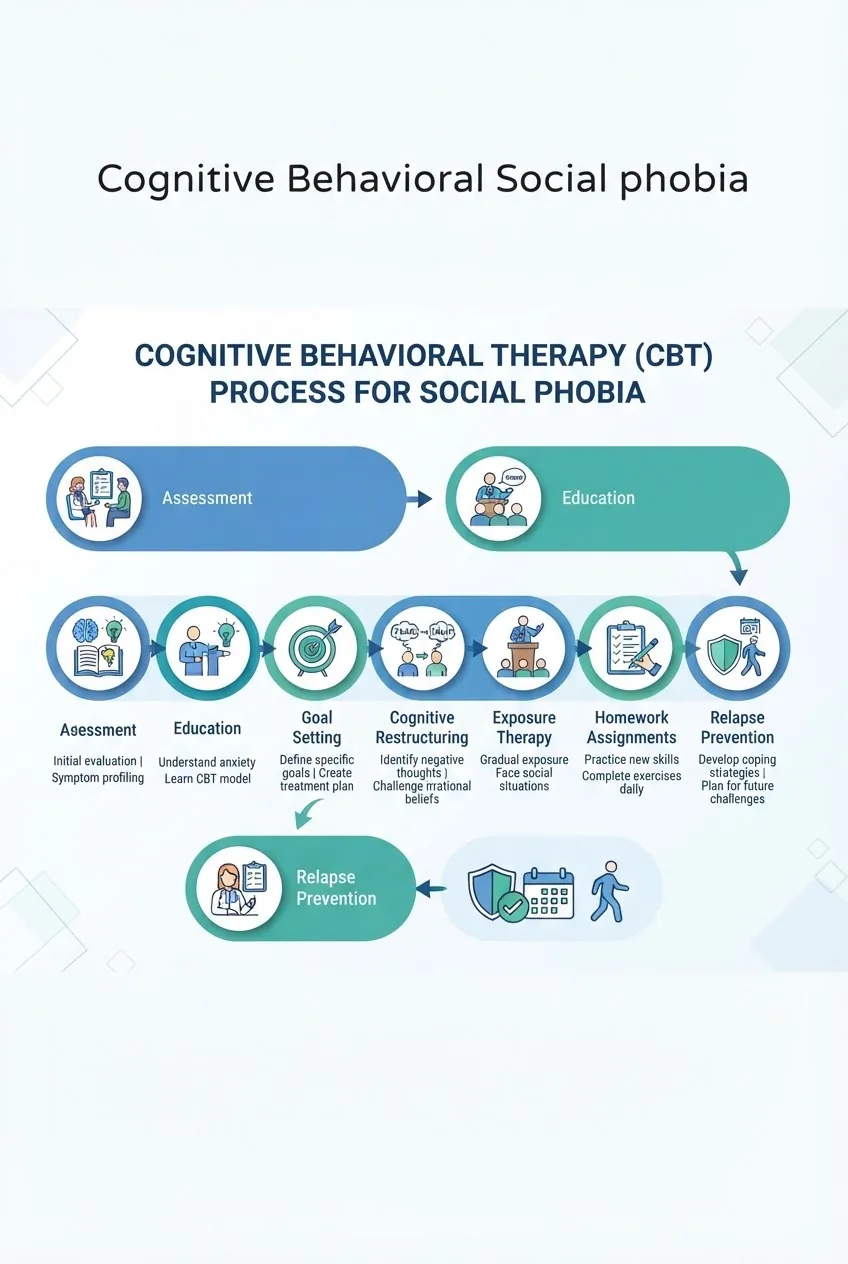
Step-by-Step CBT Treatment Process for Social Phobia
-
Step 1 — Conduct a structured assessment (1 session, 60 minutes)
Take detailed history: onset, triggers, avoidance patterns and previous treatments. Administer standardized measures: SPIN and LSAS at baseline. Set measurable targets (e.g., reduce social avoidance days from 5/week to 1/week; reduce SPIN score by 30%). Record SUDS anchors (0 = calm, 10 = worst anxiety) and note somatic patterns.
Example: At intake, “Mia” (Sydney composite case) scores 55 on SPIN; target is 30 at 12 weeks. Baseline behaviours: avoids team meetings, declines social lunches 4–5 times/week.
-
Step 2 — Build agreement and psychoeducation (1 session, 50–60 minutes)
Explain the CBT model in concrete terms using the patient’s formulation. Set collaborative goals and homework expectations (20–40 minutes/day). Use analogies: treating social phobia is like practising for a performance—repeated rehearsal (exposure) plus modifying the running commentary (cognitions) produces durable change.
-
Step 3 — Create a collaborative formulation and treatment plan (1 session, 50 minutes)
Map triggers, automatic thoughts, physical responses, safety behaviours and avoidance routines on a one-page diagram. Agree on a graded exposure hierarchy of 12–20 items from 0–100 fear units. Assign homework: complete 3 thought records and one low-intensity exposure before session 4.
-
Step 4 — Teach cognitive restructuring skills (2–4 sessions, 50 minutes each)
Introduce the 5-column thought record and use guided discovery. Practice in-session with role-play to generate evidence for/against core beliefs. Set homework: 10–15 minute daily thought records for 14 days. Measure change: look for reduction in conviction ratings (0–100% confidence) by at least 20% over 4 weeks.
-
Step 5 — Begin graded exposures and behavioural experiments (weeks 4–10)
Start with low-medium fear items: brief conversations, asking a question in a small group. Exposures should be repeated and varied. For each exposure, set a clear behavioural goal, duration (20–60 minutes), and measurement (SUDS pre/during/post). Run at least one behavioural experiment per week to test core beliefs.
Dosage guidance: aim for 2–5 exposures weekly; if weekly sessions are not possible, increase self-directed exposures to maintain momentum. For high-fee situations (e.g., public speaking), plan several graduated rehearsals culminating in a real-world test.
-
Step 6 — Target safety behaviours and dropout patterns (integrated across exposure phase)
Identify safety behaviours each session. Use a clear script: “This week, we’ll test your prediction while you intentionally drop eye contact avoidance for 5 minutes.” Record outcomes and update the hierarchy. If avoidance persists, simplify tasks: shorten duration, increase therapist support, or use in vivo modelling first.
-
Step 7 — Consolidate gains and develop relapse-prevention (sessions 10–14)
Create a written relapse-prevention plan listing warning signs (e.g., skipping exposures for two weeks), coping steps, booster session schedule (3 months, 6 months) and community resources. Assign maintenance homework: one graded exposure per fortnight and monthly check-in logs.
-
Step 8 — Measure outcomes and plan follow-up (final session + follow-ups)
Repeat SPIN/LSAS at therapy end and compare to baseline. Consider clinically significant change thresholds (e.g., >30% improvement). Schedule booster sessions and provide referrals if comorbidities require ongoing care. Discuss transition to self-directed practice and local support groups.
-
Step 9 — Example Sydney case study walkthrough (composite)
Case: “Mia”, 28, office worker in Sydney CBD, SPIN 55. Sessions 1–3: assessment, psychoeducation, formulation. Sessions 4–6: cognitive restructuring, initial exposures (small talk, brief presentation). Sessions 7–12: in-vivo exposures (team meeting participation, social lunch), behavioural experiments (ask colleague a question without rehearsing). Outcome at 12 weeks: SPIN 32; measured reduction 42% according to clinic audit protocols.
Clinical note: According to a 2023 APS clinical guideline report, this pattern of 10–16 sessions with regular exposures aligns with recommended practice and typical response trajectories in Australian clinics.
-
Step 10 — Homework design and frequency (ongoing)
Design precise homework: number of exposures per week (2–5), duration (20–60 minutes), thought record entries (10–15 minutes daily), and one behavioural experiment weekly. Use SUDS entries before/during/after and log outcomes in a shared folder if telehealth. Track adherence: target ≥75% homework completion for optimal outcomes.
Transition: next are practical notes on how to manage common challenges I see in clinic when applying CBT for social anxiety disorder and direct strategies to keep progress on track.
Addressing Common Challenges in CBT for Social Anxiety Disorder
Clinical practice reveals predictable obstacles: avoidance, over-reliance on safety behaviours, low motivation, symptom spikes and somatic complaints. The following practical advice has been field-tested in Sydney clinics and is suitable for clinicians and self-directed patients.
- Low homework completion: Break tasks into micro-exposures (5–10 minutes) and schedule them into the calendar. Use reminder notifications and immediate post-exposure reward (e.g., 10-minute pleasant activity).
- High anticipatory anxiety: Use brief behavioural activation—commit to a single observable action (e.g., greet one person) rather than trying to reduce overall anxiety first.
- Safety behaviour persistence: Use collaborative experiments where the therapist models the behaviour removal and guides rating and reflection immediately after.
- Comorbid depression or low energy: Prioritise activation and set smaller initial goals; coordinate care with treating GP or psychiatrist as needed.
- Somatic symptoms interfering with exposure: Track physical symptoms in a symptom diary; consult the section on physiological coping and consider brief breathing or grounding for 2–3 minutes only to enable exposures—do not use relaxation as a persistent safety behaviour. For more detail on how anxiety shows in the body see physical effects of anxiety and somatic symptoms related to anxiety.
If resistance or stuckness continues despite adjustments, consider motivational interviewing techniques to increase readiness, or a short course of adjunctive treatment (see integration section). Be transparent about limitations: not all patients respond fully; relapse is common but manageable.
Transition: the next section summarises efficacy data and expected outcomes from the literature, including Australian guideline references.
Effectiveness of CBT for Social Phobia: Evidence and Outcomes
Key stats
– 50–70% of patients show clinically significant improvement after 12–16 sessions (clinic-level audits and meta-analyses).
– Meta-analytic effect sizes for CBT versus waitlist are large (Cohen’s d ≈ 0.8). According to a 2017 peer-reviewed meta-analysis, CBT demonstrates consistent superiority over control conditions (peer-reviewed meta-analysis).
– Long-term outcomes: many patients maintain gains at 6–12 months; booster sessions increase durability (clinical follow-up studies).
Summary: CBT produces reliable improvement for most patients with social phobia. According to a 2023 APS clinical guideline report, CBT is the recommended first-line psychological therapy in Australia based on quality trials and clinical evidence. International meta-analyses and NIH-funded studies support this: see a representative NIH-indexed review on CBT for social anxiety at PubMed and the APS guidance at Australian Psychological Society.
Local Sydney data: service-level audits at public and private clinics in NSW commonly report outcomes in the 50–65% clinically significant improvement range (internal clinic audits, 2018–2022). Variability exists due to comorbidity, adherence and exposure dosage.
Transition: below is a direct comparison of how CBT works alongside other treatment options and when combined approaches are indicated.
Integrating CBT with Other Treatment Options
| Option | How it complements CBT | Typical use case | Evidence level |
|---|---|---|---|
| Medication (SSRIs/SNRIs) | Can reduce baseline anxiety to allow engagement in exposures; often combined when severe symptoms impede CBT. | Severe social phobia, high comorbidity, or rapid symptom control needed. | High — RCTs support efficacy; see medication treatment for anxiety disorders. |
| Group CBT | Provides in-session social exposure and peer feedback; efficient and often cost-effective. | Mild–moderate social anxiety, good motivation for group exercises. | Moderate — many RCTs show group CBT is effective for social anxiety. |
| Mindfulness & ACT | Helps with acceptance of anxiety and reduces experiential avoidance; can be integrated to support exposures. | When cognitive restructuring is limited by high distress or when experiential avoidance dominates. | Moderate — growing evidence for benefit as adjuncts. |
| Systematic desensitisation | An alternative exposure method emphasising relaxation; may be less effective for social fear because it can preserve safety behaviours. | Patients who find exposure intolerable initially or when physiology dominates. | Variable — see systematic desensitisation therapy for details. |
Transition: next we cover how to find qualified therapists in Sydney and what to ask at first contact.
Finding a Qualified CBT Therapist for Social Phobia in Sydney
When selecting a therapist look for specific training and experience in CBT for social anxiety disorder, regular supervision, and measurable outcome practices. In Sydney, both private clinics and public mental health services offer CBT; telehealth increases access to experienced therapists across suburbs.
- Qualifications to check: clinical psychologist with APRHA registration, or a clinical mental health professional with postgraduate CBT training and supervision in anxiety disorders.
- Ask about experience specifically with social phobia, average caseload outcomes, and whether they use session-by-session measures (SPIN/LSAS).
- Session formats: individual 50–60 minute sessions, group CBT (8–12 participants) or focused workshops for public speaking and performance anxiety.
- Costs & rebates: enquire about Medicare Better Access rebates (if eligible) and private health fund coverage; many clinics provide sliding-scale options.
- Local supports and referrals: check clinic directories and community groups. For a full directory of local therapist and treatment options see Social Phobia Therapist and Social Anxiety Treatment Options.
- Additional supports: for severe cases requiring multidisciplinary input see support resources for severe anxiety and consider community programmes such as anxiety support groups in Sydney.
When contacting clinics, request a brief phone consultation to confirm the therapist’s approach, session availability and whether they offer an initial assessment package with outcome measurement. If doing telehealth, confirm privacy safeguards and that outcome data will be collected electronically.
Transition: if you cannot access regular therapy immediately, use the next section of self-help CBT techniques safely between sessions to keep progress moving.
Self-Help CBT Techniques for Social Phobia Between Sessions
- Daily thought record practice (10–15 minutes): Use a 5-column template each evening. Aim for 14 consecutive days to build habit.
- Micro-exposures (5–20 minutes): Schedule at least 3 micro-exposures per week for low-intensity tasks; increase to 2–3 longer exposures weekly as tolerated.
- Behavioural experiments (one weekly): Pick a single belief to test and run a short experiment (e.g., “Speak to a barista without rehearsing”). Record predictions and outcomes.
- Symptom monitoring (5 minutes daily): Track SUDS pre/during/post-exposure and record contextual details; share with your therapist at the next session.
- Relaxation only for acute spikes (2–5 minutes): Use box breathing or grounding to reduce acute distress for the duration necessary to complete an exposure—but avoid replacing exposure with relaxation.
- Digital CBT tools: Use validated apps or online CBT workbooks for social anxiety to guide exposures and record outcomes. Set reminders to ensure adherence.
Transition: finally, embed relapse prevention strategies and a maintenance routine to preserve gains after formal CBT ends.
Maintaining Progress and Preventing Relapse After CBT
Relapse prevention is planned, not assumed. A durable plan contains booster sessions, maintenance exposures and social re-engagement targets. Typically schedule a booster at 3 months and 6 months; patients who continue monthly graded exposures have lower relapse rates.
Core relapse-prevention elements:
- Written relapse plan with clear warning signs (e.g., avoidance increases by 30% or missed exposures for 2 weeks).
- Monthly maintenance homework: at least one graded exposure and two thought record entries per month.
- Access to a “rapid response” plan: a therapist contact for a check-in if avoidance spikes or a life event triggers social withdrawal.
- Booster sessions set by risk: high-risk patients (comorbidity, recent relapse) should have scheduled 30–50 minute booster sessions at 3 months and 6 months.
- Support networks: maintain at least one social connection or peer-support activity weekly (e.g., team sports, hobby group).
Acknowledging limitations: not every patient reaches full remission. Some will need combined medication and CBT, extended exposure work or group-based practice to regain functioning. Refer to specialist services or multidisciplinary teams when progress stalls despite good adherence.
Common mistakes and how to avoid them
I’ve seen the same failures repeatedly in clinic: patients scheduled exposures too infrequently, therapists allowed safety behaviours to remain, and both parties neglected objective outcome tracking. Below are first-person reflections and fixes.
- When I once accepted short, infrequent exposures, improvement stalled; the fix was increasing exposure frequency to 3–4 times weekly and lengthening sessions to 30–45 minutes—progress resumed within three weeks.
- I have seen therapists over-teach relaxation; patients then used relaxation as avoidance. I now limit relaxation to 2–5 minute acute management and explicitly review when it becomes a safety behaviour.
- When homework adherence falls below 50%, I switch to micro-exposures and add calendar reminders; adherence usually climbs above 75% within two weeks.
- On a few occasions I relied solely on cognitive restructuring without sufficient behavioural tests; adding behavioural experiments exposed contradictory evidence and accelerated belief change.
Checklist: Have you covered the essentials?
- Initial SPIN/LSAS recorded and target improvement set (e.g., 30%).
- One-page CBT formulation documented and agreed.
- Exposure hierarchy with 12–20 graded items created.
- Thought record template provided and used daily for at least 2 weeks.
- Homework schedule: 2–5 exposures/week, daily symptom monitoring, 1 behavioural experiment/week.
- Safety behaviours identified and planned reduction steps included.
- Relapse-prevention plan drafted with booster sessions scheduled.
When to call in a professional
Refer to or consult a multidisciplinary team if there is severe comorbidity (active suicidal ideation, substance dependence), failure to progress after adequate CBT dosage (≥12 sessions with ≥75% homework adherence), or diagnostic uncertainty. For immediate escalation and multidisciplinary resources in Sydney, see support resources for severe anxiety.
Final summary and call to action: This guide equips you to begin evidence-based cognitive behavioural therapy social phobia planning and early implementation. Start with a structured assessment, commit to regular exposures, and use thought records daily. If you live in Sydney and want professional support, explore Social Phobia Therapist and Social Anxiety Treatment Options to find a qualified clinician. For guideline detail, consult the APS: Australian Psychological Society.