

A psychological assessment is a structured evaluation—like a health check-up for the mind—that uses interviews, tests and observation to clarify cognition, personality and emotional functioning; results guide diagnostic formulation, treatment recommendations and practical supports tailored to the person’s goals and context.
What is psychological assessment?
Answer: A psychological assessment is a systematic process using interviews, standardised tests and behavioural observation to evaluate cognitive abilities, personality traits and mental health, producing a written report that supports diagnosis, treatment planning and practical recommendations.
Term: psychological assessment — a formal evaluation using clinical methods and psychometric instruments to describe functioning and assist decisions.
Psychological assessment (also called a mental health evaluation in clinical settings) combines data from multiple sources — clinical interviews, rating scales, cognitive tests and collateral information — to produce an integrated formulation. It differs from a one-off screening by its breadth and structured measurement. According to a 2023 Australian Bureau of Statistics mental health survey, assessment-guided care improves appropriate treatment matching for people seeking help (source: government survey summary, 2023).

What types of psychological assessments are commonly used?
Answer: Psychological assessments fall into major categories—cognitive/intelligence, personality, neuropsychological, behavioural and developmental assessments—each with specific purposes, methods and typical instruments used by clinicians.
- Cognitive (intelligence) testing: Measures general intellectual ability and specific domains (verbal, perceptual, working memory, processing speed). Typical tools: WAIS (Wechsler Adult Intelligence Scale) for adults and WISC for children. These are standardised, administered by trained psychologists.
- Personality assessment: Evaluates enduring traits, mood and interpersonal patterns. Instruments include the MMPI-2/MMPI-2-RF, NEO-PI, and self-report inventories. Useful for differential diagnosis and treatment planning.
- Neuropsychological assessment: Focuses on brain-behaviour relationships, attention, memory, executive function and visuospatial skills; often used after injury, stroke or when cognitive decline is suspected.
- Behavioural and functional assessment: Observations and structured rating scales (e.g., behaviour checklists) used with children and adults to map triggers, consequences and functional impacts of behaviour.
- Developmental and educational assessment: Assesses learning profiles, academic skills and developmental milestones using standardised achievement tests and developmental inventories.
- Mood and symptom-specific screening: Short validated questionnaires such as the Beck Depression Inventory (BDI) or GAD-7 for anxiety to quantify symptom severity and monitor change.
- Forensic and occupational assessments: Target-specific questions about risk, competency, or work-related functioning using specialised batteries and collateral records.
- Screening versus full assessment: Screening tools (brief self-reports) estimate risk or need; comprehensive assessments use standardised tests, structured interviews and collateral information to answer clinical or medico-legal questions.
Each type has distinct psychometric demands — standardisation, normative data, reliability and validity — which clinicians weigh when selecting instruments and interpreting results.
What is the psychological analysis process and what should I expect?
Answer: The psychological analysis process is an ordered set of steps—referral and consent, diagnostic interview, targeted testing, scoring and interpretation, report generation, and feedback—designed to answer the referral questions and plan care.
Term: psychological analysis — the clinician’s integration of test data, interview content and observations into an explanatory formulation and recommendations.
- Referral and intake: A referrer (GP, school, employer) or the client outlines the reason for assessment and scope. Paperwork and consent are completed. If Medicare or bulk billing is sought, referral documentation is checked.
- Pre-assessment planning: The psychologist selects tests appropriate to age, language, cultural background and referral questions; standardised administration materials are organised.
- Diagnostic interview: A structured clinical interview obtains history, symptoms, functional impact and goals.
Term: diagnostic interview — a clinician-led conversation that collects clinical history and current presentation for diagnosis.
- Mental status and observation: Clinicians perform a mental state examination to document appearance, mood, thought content, cognition and behaviour; see mental status examination assessment for detail.
- Test administration: Tests are administered in standardised conditions—paper-and-pencil or computerised—by the psychologist or trained assistant; for WAIS or MMPI these follow strict protocols to ensure valid scores. Example walkthrough: during a WAIS administration a psychologist times subtests, records verbatim responses and uses standard prompts; scoring follows the manual.
- Collateral information: Reports from schools, employers, medical records and family inform interpretation and increase reliability.
- Scoring, analysis and psychometric review: Raw scores are converted to standard scores and compared to normative samples; clinicians evaluate reliability and validity indicators and consider cultural or situational biases.
- Formulation and provisional diagnosis: The clinician integrates findings into a formulation and, if appropriate, a provisional diagnosis — for clarification see provisional diagnosis during psychological assessment.
- Report writing: A structured written report documents methods, results, interpretation, functional impact and recommendations for treatment, accommodations or further testing.
- Feedback session: Results are explained to the client (and referrer if authorised) with time for questions, shared planning and next steps.
Clinical assessment often requires multiple sessions. For example, a neuropsychological battery plus a diagnostic interview commonly takes 3–6 hours over two or more appointments; timing depends on test selection and client stamina. For a deeper framework on how assessments relate to broader symptom evaluation see the diagnostic evaluation process online.
What psychological exams and online testing options are available in Australia?
Answer: Australia offers a range of telehealth psychological exams—from supervised remote WAIS/MMPI administrations to validated online screening tools and clinic-run remote batteries—delivered by registered psychologists under APS telehealth guidelines and local professional standards.
Term: psychological exam online — a remotely delivered, clinician-supervised assessment using secure platforms and adapted administration procedures where validated.
Online psychological testing in Australia includes three main models: (1) clinician-led telehealth assessments where a registered psychologist administers standardised tests via secure video and supervised digital tools; (2) clinic-hosted remote testing where clients complete tests on a secure platform under supervision or proctoring; (3) self-administered commercial questionnaires for screening and wellness monitoring. Each model balances accessibility, test validity and clinical suitability.

Benefits of clinic-based online assessments in Australia include reduced travel time for regional clients, continuity of care during mobility or pandemic restrictions, and the ability for multidisciplinary teams to review digital records. The Australian Psychological Society provides telehealth guidance for remote test selection and consent; see Australian Psychological Society (APS) for standards and ethics.
Limitations and safeguards: some tests (certain neuropsychological tasks and performance-based items) rely on controlled in-person administration for standardised results. Psychologists selecting remote tests must ensure equivalence of digital forms and be transparent with clients about limitations. Recent peer-reviewed meta-analyses show that many structured interviews and some cognitive tests have acceptable equivalence when delivered via telehealth, but effects vary by test and population (source: peer-reviewed telehealth study, 2021, PubMed).
Real-world scenario: a Sydney client with concentration and mood difficulties completed an initial telehealth intake, then attended two supervised remote testing sessions for WAIS subtests and a mood inventory (BDI). The psychologist documented test conditions, interruptions and connectivity; scoring included notes about administration deviations, and feedback was provided via secure video with a written report uploaded to a secure portal.
Practical platform considerations:
- Use encrypted telehealth platforms approved by the clinic and compliant with Australian privacy legislation.
- Secure, clinic-managed digital test licences (e.g., Pearson Q-interactive for some tests) are preferred to consumer-grade quizzes.
- Ensure stable internet, quiet environment and clear camera positioning for observation-dependent tasks.
For non-diagnostic screening and wellness monitoring, clinics may offer comprehensive mental wellness tests online and validated questionnaires for ongoing outcome measurement. Remote administration pathways increase access for rural Australians while preserving professional oversight.
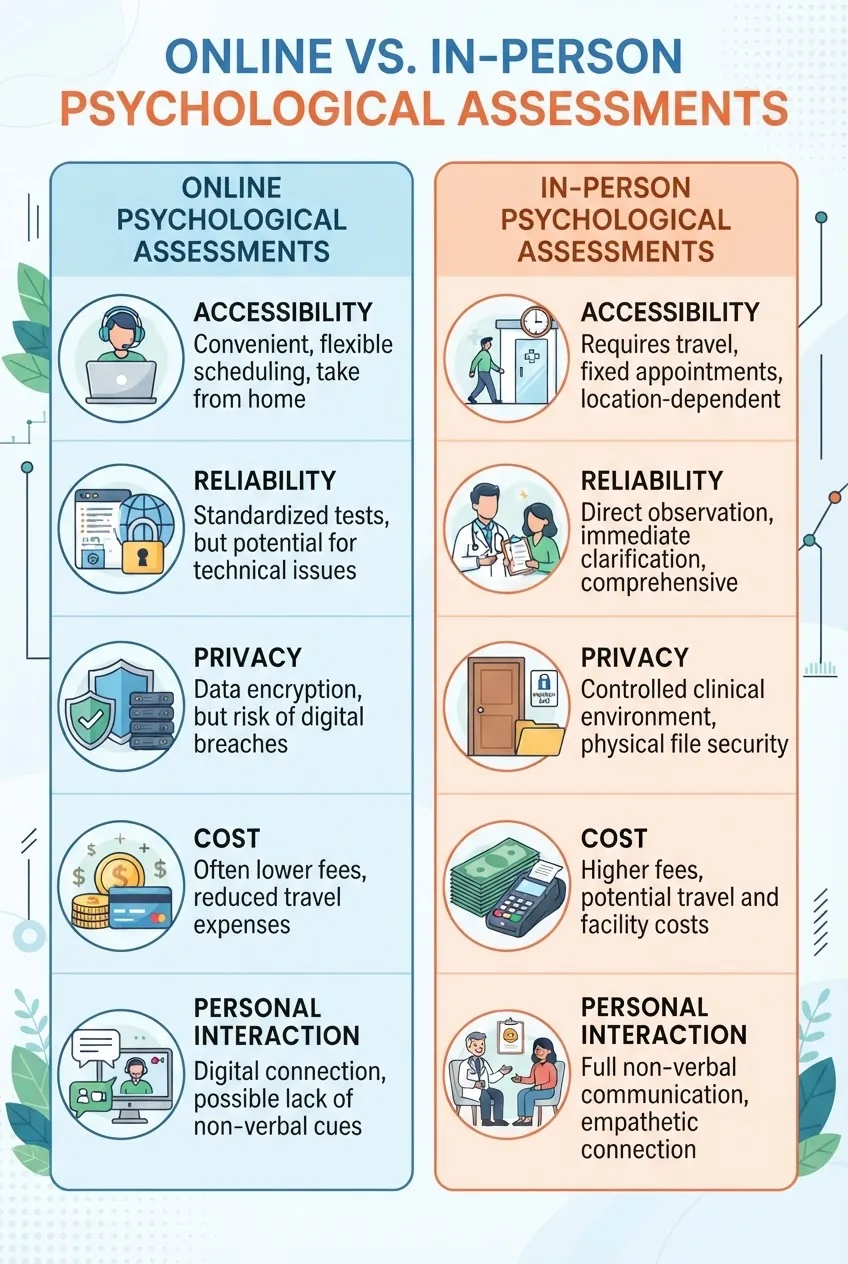
How do online and in-person psychological assessments compare?
Answer: Online assessments increase accessibility and convenience but can introduce limitations in standardisation, environmental control and performance-based measures; in-person testing remains gold standard for complex neuropsychological batteries and medico-legal evaluations.
Below is a direct pros-and-cons comparison to help decide which mode suits the referral question and client.
| Mode | Pros | Cons |
|---|---|---|
| Online (telehealth) | Increased access; convenient for remote clients; can be cost-efficient; allows same clinician continuity. | Potential security/connectivity issues; some tests lack validated digital equivalents; less control over environment. |
| In-person | Full control over testing conditions; access to hands-on performance tasks; ideal for complex neuropsychological batteries and forensic work. | Travel/time burden; may limit access for rural clients; higher overheads can increase cost. |
| Hybrid (mixed) | Selectively administer digitally equivalent measures remotely and performance-based tests in person to balance access and validity. | Requires careful planning and documentation about mode differences in the final report. |
Which psychological tests are commonly used and what do they measure?
Answer: Common tests include IQ measures (WAIS), personality inventories (MMPI), mood scales (Beck Depression Inventory), cognitive batteries and disorder-specific screeners; each has defined psychometric properties that clinicians evaluate for fit and validity.
Term: psychometric test — an instrument that measures psychological constructs using standardised administration and scoring to produce interpretable data.
- WAIS (Wechsler Adult Intelligence Scale): A comprehensive IQ test measuring verbal comprehension, perceptual reasoning, working memory and processing speed; widely used in Australia for cognitive profiling; administration requires training.
- MMPI-2 / MMPI-2-RF: A structured personality inventory assessing psychopathology and personality style; used to inform diagnostic decisions and risk assessment; requires qualified interpretation.
- Beck Depression Inventory (BDI): A brief self-report scale measuring depressive symptom severity; useful for screening and monitoring treatment response — see depression test online screening and assessment.
- GAD-7: A seven-item anxiety screener often used in primary care and online platforms; brief, validated for initial triage.
- IQ tests and short online equivalents: Some online IQ-style tasks offer approximate estimates but lack full standardisation; clinician-administered WAIS remains the reference standard.
- Neuropsychological batteries: Tests for memory (e.g., WMS), attention (e.g., continuous performance tasks), and executive function; sensitive to brain injury and dementia-related changes.
- ADHD-specific rating scales: Conners’ Rating Scales or Adult ADHD Self-Report Scale (ASRS) used with collateral information; for cost-efficient ADHD pathways see local bulk-billing options.
- Screening quizzes and online assessments: Short, validated screeners for anxiety and depression and broader wellness measures; helpful for triage and monitoring — see anxiety test online with quizzes and assessments.
- Behavioural checklists: Standardised forms completed by carers, teachers or employers to document observable behaviour patterns over time.
Clinicians consider each instrument’s reliability (consistency of measurement) and validity (accuracy for the intended construct). For mood and anxiety screening online, clinics commonly offer validated short instruments; for decision-critical diagnoses a full clinician-administered battery is recommended. For depression screening resources see the depression test online screening and assessment and for anxiety tools see anxiety test online with quizzes and assessments.
How can I access psychological assessment services in Sydney and across Australia?
Answer: Access options include private clinics, public mental health services, and telehealth providers; costs and referral pathways vary—Medicare rebates and bulk billing are available in specific circumstances and for designated services in Sydney and elsewhere.
Where to start: contact your GP for a referral, discuss eligibility for a Medicare-funded Mental Health Care Plan which can subsidise psychology sessions, and ask clinics about bulk billing options. The Australian Government Department of Health outlines Medicare and rebate policies — see Australian Government Department of Health.
Practical steps for Sydney residents:
- Obtain a GP referral if you seek a Medicare rebate or formal diagnostic assessment for conditions like ADHD or mood disorders.
- Search for accredited providers offering telehealth assessments; ask whether tests are clinician-administered online and whether the clinic holds digital licences for standardised instruments.
- Confirm cost structure: private fee, partial Medicare rebate, or bulk billing. Some Sydney clinics provide targeted bulk-billed ADHD assessment pathways — see ADHD diagnosis bulk billing options in Sydney.
- For cost-effective options across Australia, review community health services and state-run clinics for subsidised assessments; for national low-cost strategies see affordable ADHD diagnosis options across Australia.
- Ask the clinic about timeframes, required documentation, and whether the assessment report meets third-party requirements (e.g., workplace, NDIS, legal).
Case study (bulk-billed Sydney assessment): A 28-year-old sought assessment for attentional difficulties. GP referral cited workplace impairment; clinic offered a bulk-billed diagnostic interview under a targeted government-funded program. The client completed self-report inventories online, then attended a subsidised in-person cognitive screening; final report documented findings and workplace recommendations. Outcome: employer adjustments agreed and referral for psychological therapy provided.
For an integrated overview of available clinic-run and online options, see our psychological assessment guide and testing options online and contact providers for up-to-date billing policies and telehealth offerings.
psychological assessment guide and testing options online
How should I prepare for a psychological assessment?
Answer: Prepare by completing pre-assessment forms, gathering relevant records, arranging a quiet testing environment (for remote sessions), arriving rested and honest, and bringing photo ID and referral documentation.
Preparation checklist:
- Complete any online intake forms and symptom checklists provided by the clinic.
- Bring or upload previous reports, medical notes, school records and current medications.
- If remote: select a quiet, well-lit room, ensure stable internet and disable notifications.
- If in-person: bring government-issued photo ID and a list of medications and medical history.
- Be ready to describe symptoms clearly and to provide consent for information sharing where required.
- Manage anxiety by planning breaks, discussing length of sessions with the clinic, and asking about hybrid administration if needed.
How do I understand and interpret my psychological assessment results?
Answer: Reports summarise methods, scores, clinical interpretation and recommendations; clinicians explain key scores, functional implications and practical next steps during feedback and can help you develop a mental health care plan.
Term: psychological report — a structured document that presents test methods, results, interpretation and recommended actions.
Interpreting results:
- Ask the psychologist to explain score meaning in plain language and how results affect daily functioning and decision-making.
- Request written recommendations that include treatment options, reasonable adjustments (work or study), and suggested referrals.
- If you need a structured care plan, clinicians can use a mental health care plan and assessment templates to document goals, interventions and review timelines.
- Remember: test scores are one part of the clinical picture; clinicians integrate history and context to make recommendations.
If you disagree with results, request clarification, seek a second opinion or ask about re-testing after a period of treatment. Reports intended for third parties should include clear limitations and test conditions documented by the clinician.
What ethical and privacy safeguards apply to online psychological testing?
Answer: Ethical online testing requires informed consent, secure data handling, clinician competence in telehealth, documentation of administration conditions, and adherence to APS guidelines and Australian privacy laws.
The Australian Psychological Society provides ethics guidance for telehealth; clinicians must ensure valid consent, data security and appropriate test selection. For professional standards, see Australian Psychological Society (APS). For legal frameworks on privacy and health records consult the Australian Government Department of Health guidance at health.gov.au.
Key considerations:
- Informed consent: Clients must receive clear information about purpose, limits of confidentiality, data storage and potential risks of remote administration before testing begins.
- Data security: Use platforms with end-to-end encryption, clinic-controlled accounts and secure record-keeping.
- Competence and training: Psychologists must be trained to adapt administration and interpret digital test versions appropriately.
- Documentation of deviations: Any departure from standard administration (e.g., interruptions, device problems) must be recorded and considered in interpretation.
Recent peer-reviewed literature highlights acceptable outcomes for many telehealth assessments when clinicians follow validated protocols and document administration equivalence (source: peer-reviewed telehealth outcomes study, 2021, PubMed).
What are the next steps after a psychological assessment?
Answer: Next steps include a feedback session, implementation of recommendations (therapy, workplace adjustments, educational supports), follow-up monitoring and coordination with referrers or services as needed.
After assessment:
- Attend a feedback meeting to review findings and clarify recommendations.
- Use the report to create an actionable treatment plan and, if appropriate, a documented mental health care plan and assessment templates.
- Follow up with referrals to psychologists, psychiatrists, occupational therapists, schools or employers as recommended.
- Schedule monitoring or re-assessment at clinically indicated intervals to track progress.
For broader support networks and services, consult our directory of mental health support resources in Australia and the APS for professional standards and guidance.