

psychiatrically definition: “Psychiatrically” is an adverb used to describe actions, observations or judgements made from a psychiatric perspective — that is, as they relate to psychiatric assessment, diagnosis or care; it frames how clinicians interpret symptoms in clinical notes and reports. This definition emphasises clinical context and application.
Transition: The following sections unpack the adverb “psychiatrically”, its adjectival partner “psychiatric”, and practical uses in assessments, reports and patient care.
What Does “Psychiatrically” Mean?
Answer: “Psychiatrically” means “in a manner relating to psychiatry”; it qualifies clinical observations, decisions or descriptions that come from or are relevant to psychiatric practice.
Term: Adverb — a word that modifies verbs, adjectives or other adverbs to describe how, when, where or to what extent something occurs; “psychiatrically” modifies actions or descriptions to indicate they are made from a psychiatric standpoint.
In clinical language, psychiatrically is used to flag that an observation, assessment or recommendation is grounded in psychiatric knowledge or perspective rather than, for example, purely psychological, social, or medical viewpoints. It functions like other clinical adverbs such as “neurologically” or “medically.”
Example sentences (anonymised, hypothetical clinical-note style):
- “Psychiatrically, the patient demonstrates an organised thought process with no formal thought disorder noted.”
- “Mood swings psychiatrically significant for bipolar spectrum features; collateral history recommended.”
- “Psychiatrically stable on current medication regimen for six months, with no acute safety concerns.”
These examples show how psychiatrically flags the clinician’s frame of reference — the observation is interpreted through psychiatric training, diagnostic criteria and clinical judgement.
Clinical vignette (brief): A 28‑year‑old presents with insomnia and low mood. The assessment note might read: “Psychiatrically, symptoms meet provisional criteria for major depressive episode pending collateral information and structured screening.” This indicates the clinician is making a psychiatric-level observation and provisional diagnostic formulation.
Transition: With the adverb explained, the next section defines the adjective “psychiatric” and shows how it pairs with “psychiatrically” in everyday clinical use.
Defining “Psychiatric”: Meaning and Uses
Answer: “Psychiatric” is an adjective meaning “relating to psychiatry or psychiatric disorders”; it describes people, symptoms, services or diagnoses connected to the field of psychiatry.
Term: Adjective — a word that modifies nouns; “psychiatric” modifies nouns like “evaluation,” “symptom,” “care,” or “disorder” to indicate a relationship with psychiatric practice.
Core uses of “psychiatric” in clinical and healthcare contexts:
- Describing disorders: “psychiatric disorders” refers to conditions defined by behavioural, cognitive and emotional criteria (e.g., depressive disorder, schizophrenia).
- Describing services: “psychiatric care” denotes care given by psychiatrists or services focused on diagnosis, medication management and severe mental illness support.
- Describing evaluations: “psychiatric evaluation” or “psychiatric assessment” refers to clinical interviews, mental status examination and medical review aimed at diagnosis and treatment planning.
- Describing language and reports: “psychiatric terminology” signals the use of diagnostic terms derived from DSM‑5 (Diagnostic and Statistical Manual of Mental Disorders) or ICD‑11 (International Classification of Diseases).
Why the adjective matters for patients and clinicians:
- It clarifies scope: “psychiatric” tells a reader that findings relate to diagnostic criteria, medication, risk assessment or other psychiatry-focused domains.
- It guides care pathways: labels like “psychiatric referral” or “psychiatric inpatient” indicate specific services and levels of care.
- It affects record-keeping: psychiatric descriptors are used in assessment reports, clinical notes and multidisciplinary communications to ensure clarity across teams.
Clinical language example (bullet):
- “The patient requires psychiatric review for medication optimisation and risk formulation.”
Transition: Now that both forms are defined, we compare their grammatical and practical differences so readers can use them accurately in conversation and reports.
Difference Between “Psychiatrically” and “Psychiatric”
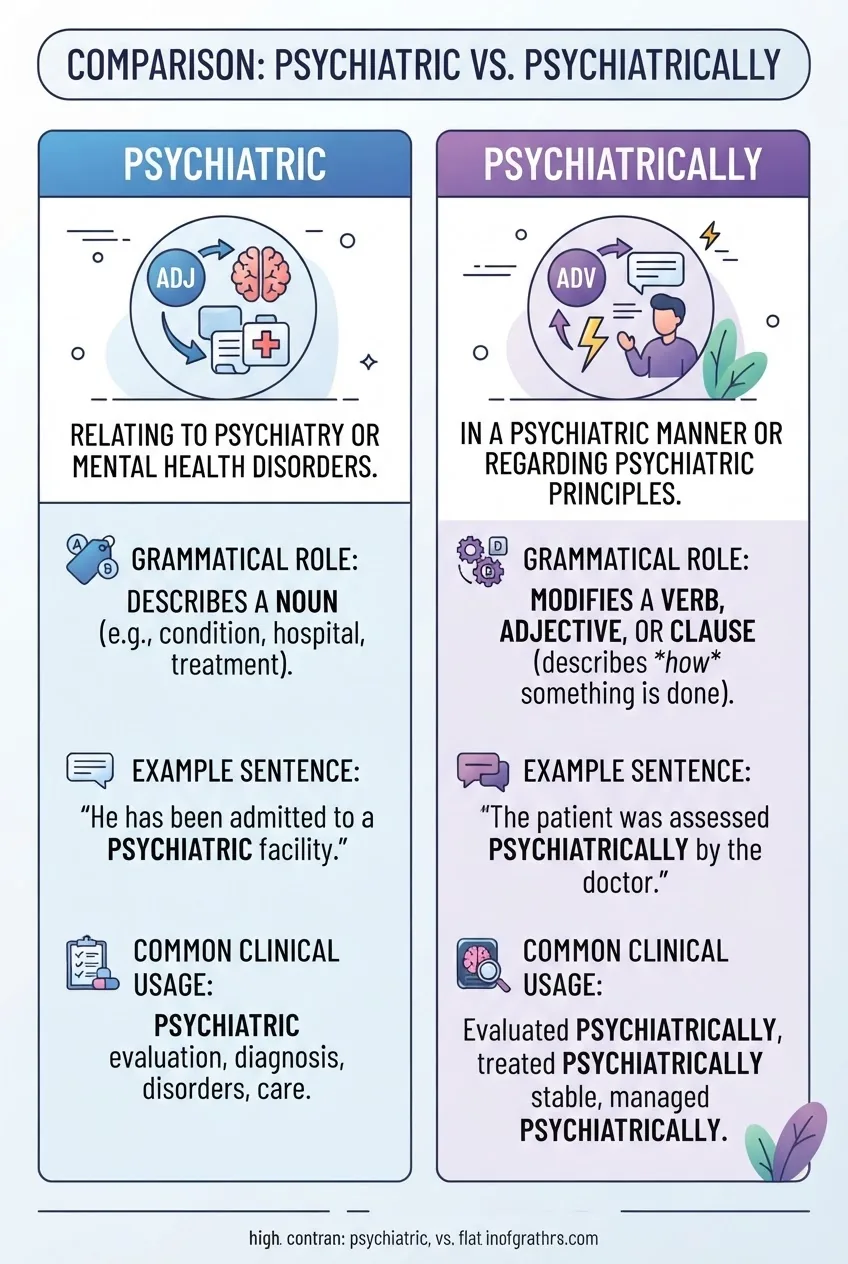
Answer: “Psychiatric” is an adjective that describes nouns (services, disorders, symptoms); “psychiatrically” is an adverb that modifies actions or statements to indicate they are made from a psychiatric perspective.
Term: DSM‑5 — the American Psychiatric Association’s manual for classifying psychiatric disorders; referenced here to illustrate how psychiatric language maps to diagnostic criteria.
| Feature | Psychiatric (adj.) | Psychiatrically (adv.) |
|---|---|---|
| Grammatical role | Modifies nouns | Modifies verbs/adjectives/adverbs |
| Example use | “psychiatric assessment” | “assessed psychiatrically” |
| Clinical implication | Denotes the type of service or condition | Denotes perspective or manner of observation |

Practical notes:
- Use “psychiatric” when naming a thing: psychiatric diagnosis, psychiatric symptom, psychiatric ward.
- Use “psychiatrically” when describing how something was done or judged: psychiatrically evaluated, psychiatrically relevant, psychiatrically stable.
- They are not interchangeable: replacing the adjective with the adverb will usually create grammatical errors or change meaning.
Transition: Having clarified grammar and usage, the next section shows step-by-step how “psychiatrically” appears in actual mental health assessments and documentation.
How “Psychiatrically” Is Used in Mental Health Assessments?
Answer: In assessments, “psychiatrically” qualifies observations, formulations and recommendations that stem from psychiatric evaluation — used in mental status examination, diagnostic formulation and clinical reporting to indicate psychiatric perspective.
Term: Mental status examination (MSE) — a structured clinical assessment of a person’s current mental state covering appearance, behaviour, mood, thought process, cognition and insight; a key place where psychiatrically may appear in notes.
Step-by-step: How a psychiatric-oriented assessment uses the term
- Referral and reason for assessment: The referral note states the presenting problem and may request a psychiatric opinion. Example: “Referral for psychiatrically informed assessment regarding mood instability.”
- Initial interview: Clinician captures history; statements like “Psychiatrically relevant family history includes bipolar disorder in a first-degree relative” appear to focus on psychiatric risk factors.
- Mental status examination (MSE): Observations are framed psychiatrically: “Speech coherent; psychiatrically, thought content lacks delusional themes.”
- Use of diagnostic criteria: Findings are compared to DSM‑5 or ICD‑11 criteria, with notes such as “Psychiatrically meets criteria for major depressive episode pending chronological history.”
- Formulation and differential diagnosis: Clinician writes psychiatrically informed formulation, weighing biological, psychological and social contributors.
- Risk assessment and safety planning: Notes specify psychiatrically determined risk levels and recommended steps (e.g., monitoring, medication adjustments, admission).
- Recommendations and follow-up: “Psychiatrically recommends trial of SSRI with follow-up in four weeks” is a typical phrasing that links the recommendation to psychiatric judgement.
Sample sentence examples drawn from typical assessment report language (hypothetical, anonymised):
- “Psychiatrically significant anergy and psychomotor retardation consistent with depressive episode.”
- “Psychiatrically, the risk profile is low-moderate; no intent or plan was identified.”
- “Cognitive complaints psychiatrically disproportionate to objective testing; consider neuropsychology referral.”
How to read a report where “psychiatrically” appears — practical tips:
- Identify the clause being qualified: is the clinician referring to observation, judgement, risk or treatment?
- Look for diagnostic anchors: DSM‑5 or ICD‑11 criteria cited after psychiatrically language signal formal diagnostic thinking.
- Ask your clinician for clarification if the term makes the report feel technical; clinicians can rephrase recommendations for consumers.
Resource link: For practical options to pursue structured testing and formal assessments, see our pillar guidance on assessment choices and testing.
psychological assessment guide and testing options online
Examples of conditions psychiatrically assessed (linking to sibling content where useful):
- Anxiety disorders are often psychiatrically screened using structured assessments — see more on anxiety test online quizzes and assessment.
- Depressive disorders are psychiatrically screened and monitored with validated scales — more in depression screening and assessment online.
- ADHD in adults is psychiatrically evaluated through history and tests; see ADHD diagnosis bulk billing options in Sydney for local pathways.
- Comprehensive mental wellness testing uses psychiatric language when clinicians interpret results — see mental wellness test online with assessment.
Additional assessment resources mentioned in clinical workflows:
- Structured MSE guides and examples in our mental status examination (MSE) guide and examples.
- Testing and diagnostic process overview at testing and diagnosis guide overview.
- Online screening tools and their interpretation in the anxiety test online quizzes and assessment and depression screening and assessment online guides.
Transition: Terminology matters for patient outcomes — the next section explains why precise psychiatric vocabulary improves care.
Importance of Correct Psychiatric Terminology in Patient Care
Answer: Correct psychiatric terminology ensures clarity in diagnosis, reduces misunderstanding, guides treatment planning and helps reduce stigma when used sensitively; it is essential for multidisciplinary coordination and safe care.
Term: DSM‑5 and ICD‑11 — authoritative classification systems used to standardise psychiatric terminology and diagnostic criteria internationally, referenced in clinical reports to justify diagnostic decisions.
How precise language impacts clinical accuracy and patient experience:
- Clarity for teams: Well-defined psychiatric terms let psychiatrists, GPs, psychologists and allied clinicians coordinate care effectively.
- Treatment planning: Terms tied to diagnostic criteria influence medication choices, psychological therapies and referral urgency.
- Reducing stigma: Clinicians who explain terms plainly and sensitively help patients understand conditions without shame.
- Legal and administrative accuracy: Precise wording affects eligibility for disability supports, work-integrated plans and referrals under Australian health systems.
Case example (clinical vignette): A 42‑year‑old patient receives a report stating “psychometrically inconclusive; psychiatrically leaning to an anxiety disorder.” The wording led to confusion; a follow-up clarified the provisional nature, DSM‑5 anchors and recommended intervention, improving adherence to the care plan.
Linking terminology to care pathways and affordability:
- Accurate psychiatric terms help patients navigate services such as mental health care plan example and template for Medicare-subsidised supports.
- Understanding these terms also aids people seeking cost-effective assessments like cost-effective ADHD diagnosis in Australia.
- For youth-focused language, terminology clarifies trends in mental health statistics in Australian youth.
Authority and standards: Psychiatric language is anchored to classification systems. For international classification and updates, clinicians refer to the World Health Organization’s ICD‑11 (ICD‑11), and for US-based definitions and terminology doctors reference DSM‑5 material from the American Psychiatric Association (DSM‑5). Australian clinical guidance is available from the Department of Health (Australian Government Department of Health).
Trust and sensitivity caveats:
- Language evolves: Diagnostic labels and terms change over time; clinicians should note the date and version of classifications used in reports (e.g., DSM‑5, ICD‑11).
- Ask for plain-language explanations: Patients should request clarification if a report feels technical or stigmatizing.
- Professional judgement: Terms like “provisional” or “suspected” indicate uncertainty and the need for further assessment — see provisional diagnosis meaning explained.
Transition: To support clinical literacy, the next section lists common psychiatric terms readers will encounter when “psychiatrically” appears in documentation.
Common Psychiatric Terms Related to “Psychiatrically”
Answer: Common related terms include “mental illness”, “psychiatric symptoms”, “diagnostic criteria”, “psychiatric therapy” and “medication management”; each term situates the psychiatric perspective in assessment and care.
Term: Mental illness — clinically significant behavioural or psychological syndromes associated with distress or disability; term used across DSM‑5 and ICD‑11 frameworks.
Glossary-style list (brief definitions):
- Mental illness: Conditions like depression, anxiety and psychosis that meet agreed diagnostic criteria and affect functioning.
- Psychiatric symptoms: Observable or reported signs such as hallucinations, low mood or panic attacks that clinicians evaluate psychiatrically.
- Diagnostic criteria: Standardised checklists (DSM‑5, ICD‑11) clinicians use to determine if symptom patterns constitute a disorder.
- Psychiatric therapy: Interventions often including medication, psychoeducation and referrals to psychological therapy delivered under psychiatric oversight.
- Psychological testing terminology: Terms describing scores, norms and psychometrics used when psychiatry integrates test data into formulations.
- Medication management: Prescribing and monitoring psychotropic medications, documented as psychiatrically indicated when linked to diagnosis.
- Multidisciplinary team terms: Words like “consultation-liaison”, “community mental health” and “case formulation” reflect coordinated psychiatric work.
Example cross-reference sentence for readers: “For more on specific psychiatric diagnoses and how they are assessed in NSW, see our guide on ADHD diagnosis bulk billing options in Sydney.”
Transition: The final explanatory section responds to common reader questions about using and understanding these terms in assessments and everyday healthcare interactions.
FAQs About Psychiatrically Definition and Psychiatric Meaning
Below are concise, featured‑snippet‑optimised answers to common questions about these terms and their clinical use.
What does psychiatrically mean in simple terms?
Psychiatrically means “from a psychiatric perspective”: it describes observations, judgements or actions that are grounded in psychiatry, such as diagnostic impressions, medication recommendations or risk assessments made by a psychiatrist.
How is psychiatric different from psychiatrically?
“Psychiatric” is an adjective that labels nouns (e.g., psychiatric disorder, psychiatric care); “psychiatrically” is an adverb that modifies actions or statements to indicate they were made from a psychiatric standpoint.
When is the term psychiatrically used in clinical settings?
Clinicians use “psychiatrically” in assessment notes, diagnostic formulations and recommendations to indicate the observation or decision is based on psychiatric evaluation, often aligned with DSM‑5 or ICD‑11 criteria.
Can I use psychiatric and psychiatrically interchangeably?
No; they serve different grammatical roles. Using one in place of the other will usually be grammatically incorrect and can change the meaning of clinical statements in reports.
How long does a psychiatric evaluation involving psychiatrically relevant terms take?
Typical outpatient psychiatric evaluations range from 30–90 minutes depending on complexity; extended assessments with collateral history or testing may take several hours across sessions, as noted in clinical scheduling guides.
What should I do if I don’t understand psychiatric terms in my assessment report?
Ask your clinician for a plain-language explanation, request a copy of the assessment with clarified terms, or seek a second opinion; clinicians are expected to explain diagnostic labels and treatment plans to patients.
How do psychiatrists ensure accuracy when using psychiatric language?
Psychiatrists rely on structured interviews, validated scales, collateral information and classification systems (DSM‑5, ICD‑11) to use precise terminology and to document diagnostic certainty or provisional status.
Are psychiatric terms consistent across different countries and healthcare systems?
Terminology is broadly harmonised through ICD‑11 internationally and DSM‑5 in many settings, but local clinical practice, coding and service models can vary; clinicians will usually state which system they used.
Transition: The article closes with core takeaways and steps readers can take next.
Key takeaway: Use “psychiatric” to describe nouns related to psychiatry and “psychiatrically” to describe how observations or decisions are made from a psychiatric view; ask clinicians to clarify terminology and consult structured guides when pursuing assessments.
If you want structured, practical options for assessment and testing, consult our psychological assessment guide and testing options online for local testing pathways and next steps.
Authority & sources: Definitions and usage above reference clinical practice norms and classification systems — see the World Health Organization’s ICD‑11 (ICD‑11) and American Psychiatric Association DSM‑5 resources (DSM‑5), plus Australian guidance from the Department of Health (Australian Government Department of Health).
Caveat: Psychiatric language and diagnostic systems evolve; reports may use provisional language. For personal concerns, seek direct clinical advice tailored to your history and local services.
Next step: Review your assessment report with your clinician, or follow the links above to explore assessment options and testing guidance in Sydney and Australia.