

This guide explains mental of health in Australia, describing common conditions, how to get assessed, and the practical support networks and government programs available nationwide, with clear steps for finding help in Sydney and other regions within the Australian system.
Understanding Mental Health in Australia
Answer: Mental health in Australia describes the state of psychological, emotional and social wellbeing; it covers mental wellness, mental illness and how people cope, recover and access support across communities and health services.
Term: mental health — a person’s psychological and emotional wellbeing, including capacity to manage stress, work productively and contribute to community.
Mental of health (the primary keyword used in this guide) covers both positive mental wellness and diagnosable mental disorders. Australians experience a spectrum from wellbeing to severe disorders; responses include primary care, specialist psychological assessment, Medicare‑supported services and community programs. Think of mental health as a balancing act that needs regular maintenance, early intervention when signs emerge, and coordinated support when problems arise.
This section outlines common disorders, why local context matters, and clarifies psychiatric terminology used later.
Term: psychiatric — relating to the medical specialty focused on diagnosing, treating and preventing mental disorders; clinicians called psychiatrists prescribe medication and coordinate complex care (see psychiatric definitions explained).
Common mental health disorders in Australia
- Depressive disorders — persistent low mood, loss of interest, functional impact.
- Anxiety disorders — generalized anxiety, panic disorder, social anxiety.
- Substance use disorders — harmful use of alcohol or drugs affecting function.
- Bipolar disorders — mood episodes with mania and depression.
- Psychotic disorders — such as schizophrenia, involving hallucinations or delusions.
- Neurodevelopmental conditions — including ADHD and autism spectrum presentations (assessment pathways differ by age).
These conditions are commonly discussed in Australian services and reflected in GP referrals, mental health care plans and specialist assessment processes. A formal psychological assessment or psychiatric opinion may be required for diagnosis, treatment planning and access to funded services.
Overview of Australian Mental Health Statistics and Trends
Answer: Mental health trends in Australia show high prevalence of anxiety and depression, rising service use, and concerning suicide statistics for specific age groups; data help target youth and regional responses.
Term: prevalence — the proportion of a population experiencing a condition at a given time.
According to a 2023 government report from the Australian Institute of Health and Welfare (AIHW), around one in five Australians reported having a mental or behavioural condition in the past 12 months, with anxiety and depressive disorders most common. According to a 2024 industry report from the AIHW, service utilisation rose following expanded telehealth and community programs.
| Measure | Statistic | Source / Year |
|---|---|---|
| 12‑month prevalence of any mental disorder | ~20% of adults | Australian Bureau of Statistics, 2021 survey |
| Youth (12–25) service contacts increase | Significant rise since 2019 | AIHW, 2023 mental health services report |
| Suicide rates (selected groups) | Higher in men, young people, and some regional areas | AIHW and state coronial data, 2023 |
Breakdowns by age, sex and remoteness show younger Australians often report higher psychological distress, and regional areas face workforce shortages. According to a 2024 industry report from the AIHW, the increased use of digital services partially addresses access gaps, but disparities persist for Aboriginal and Torres Strait Islander peoples and culturally and linguistically diverse communities.
For deeper youth figures see youth mental health statistics and insights.
Key Mental Health Support Resources Available in Australia
Answer: Australia offers a network of services: national crisis lines, government programs like Headspace and Beyond Blue, Medicare‑funded psychology sessions with referrals, community mental health centres, peer support groups and accredited telehealth providers.
Term: Headspace — an Australian government-funded national youth mental health foundation providing early intervention services for 12–25 year olds.

- Beyond Blue — National support for anxiety and depression: phone, online resources and referral pathways.
Contact: 1300 22 4636 — see Beyond Blue for programs and online tools.
- Headspace (youth services) — local centres offering counselling, GP liaison, vocational support and online chat for 12–25 year olds.
Find local Headspace centres through the Australian Government health portal: Department of Health and Aged Care.
- Lifeline — 24/7 crisis support and suicide prevention.
Phone: 13 11 14; online chat and resources at Lifeline.
- State and territory public mental health services — community teams handling acute assessment, inpatient care and community follow‑up; referral typically via GP, ED or direct contact in crisis.
- Medicare‑rebated mental health treatment — GPs can create Mental Health Care Plans to subsidise psychologist and allied mental health sessions; see later for steps.
- Private psychologists and psychiatrists — available with or without bulk billing; psychiatrists generally require a referral from a GP for Medicare rebate on a consultation.
- Community and peer support groups — NFP-run groups for carers, specific conditions and identity-based support (LGBTIQ+, culturally specific groups).
- Online assessment tools and self‑help resources — validated screening tools can guide next steps; try anxiety test and assessment resources, depression screening and assessment tools and mental wellness online test and assessment.
- Specialised services — Indigenous‑led services, refugee mental health services, perinatal mental health programs and eating disorder services operate regionally.
- Workplace and education supports — Employee Assistance Programs, university counselling and school-based services provide quick access to initial help.
Practical tip: start with your GP for a coordinated approach; GPs can provide urgent referrals, mental health care plans and advice on crisis escalation. For self-assessment and guided next steps see mental wellness online test and assessment and the linked condition screening pages.
Accessing Mental Health Assessment and Care in Australia
Answer: To access assessment and care, book a GP visit for symptom evaluation and a Mental Health Care Plan or referral; follow with psychological assessment, specialist referral or community program enrolment depending on need.
Term: Mental Health Care Plan — a GP-created plan that documents diagnosis, goals and enables Medicare rebates for allied mental health sessions.
Below are step-by-step practical steps and how to navigate referrals, Medicare processes and assessment types.
- Step 1 — Book a GP appointment
- Explain symptoms, duration and functional impact.
- Request a Mental Health Care Plan if appropriate.
- GP may provide an urgent referral for crisis services or a referral to a psychiatrist or psychologist.
- Step 2 — Obtain a Mental Health Care Plan (if eligible)
- Plan includes assessment summary, treatment goals and a referral to up to 10 Medicare‑rebated allied mental health sessions per calendar year.
- Bring the plan to your psychologist or allied health provider to claim Medicare rebates.
See examples at mental health care plan template and examples.
- Step 3 — Psychological assessment and testing
- Assessments include clinical interview, rating scales and psychometric testing for diagnosis or treatment planning.
- Different tests address cognition, mood, anxiety, attention and personality.
For full testing options see psychological assessment guide and testing options and mental health testing and diagnosis process.
- Step 4 — Specialist referral if needed
- Psychiatrist referral from GP is needed for medication management or complex diagnostic opinion; Medicare rebates apply with a referral.
- Child and adolescent specialists coordinate with schools and family services.
- Step 5 — Ongoing care and community support
- Follow-up via GP, psychologist sessions, peer-support or community mental health teams.
- Adjustments to care plans are routine and should be documented in updated Mental Health Care Plans.
Practical walkthrough: an anonymised scenario — “Anna, 28, saw her GP for persistent anxiety affecting work; the GP developed a Mental Health Care Plan, referred Anna to a psychologist for six Medicare-rebated sessions and to a headspace‑linked vocational support program; after assessment Anna began CBT and workplace adjustments.”
To understand clinical evaluation instruments used in assessments, refer to the mental status examination guide and examples, symptoms evaluation and diagnosis guide and the explanation of provisional outcomes at provisional mental health diagnosis meaning.
Navigating Costs and Bulk Billing Options for Mental Health Care in Sydney and Australia
Answer: Costs vary: public services are low‑cost or free, Medicare rebates reduce private psychologist fees with a Mental Health Care Plan, and some clinicians offer bulk billing; private psychiatry often incurs higher out‑of‑pocket costs.
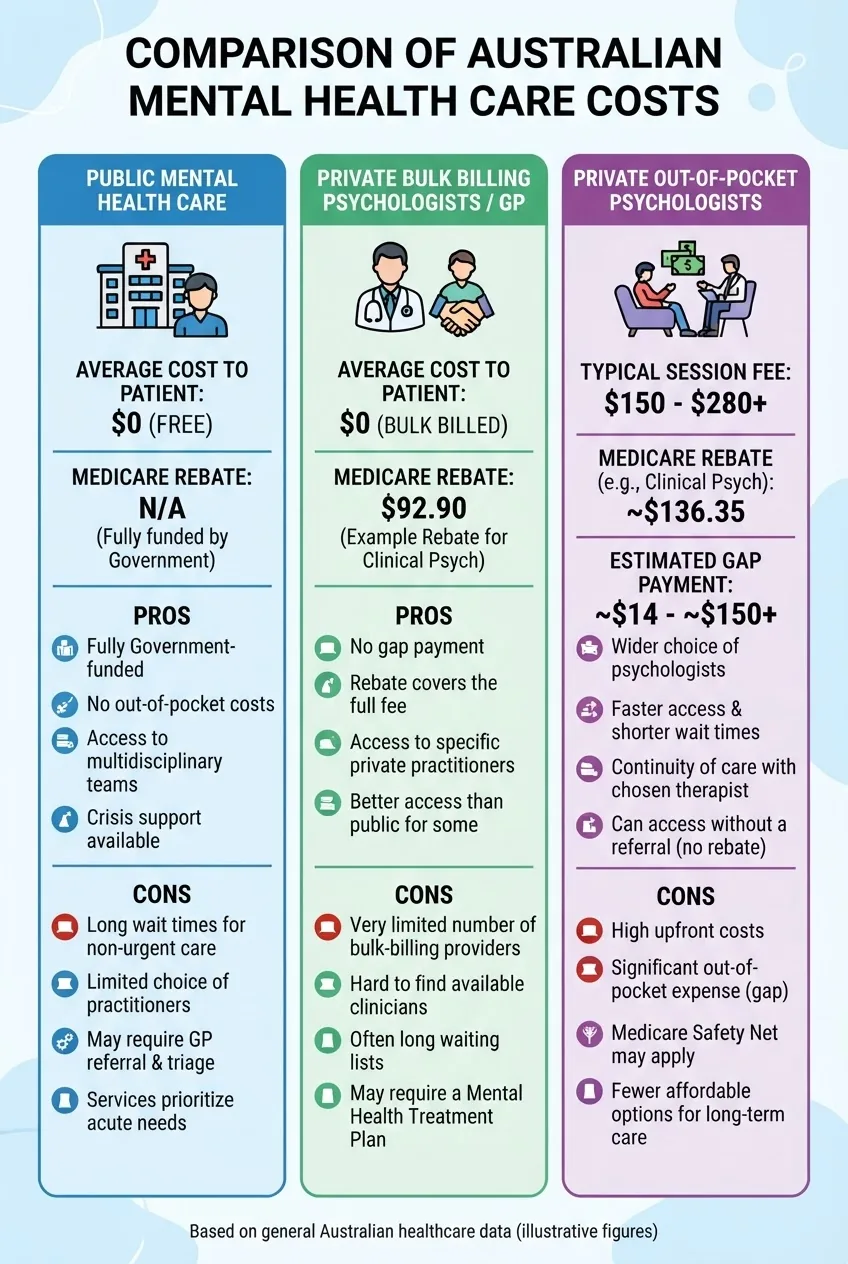
The table below summarises typical cost pathways and what to expect for Sydney and wider Australia.
| Option | Typical cost (AUD) | Medicare rebate / subsidy | Notes |
|---|---|---|---|
| Public community mental health | Free or low-cost | N/A (state funded) | Access via GP referral, ED or direct contact; waiting lists apply. |
| Private psychologist (standard) | $150–$260 per session | Medicare rebate ≈ $90–$130 with MHCP | Out-of-pocket varies; some practices offer reduced-fee slots. |
| Bulk‑billed private mental health | $0 at point of service | Provider bills Medicare directly | Limited availability, criteria apply; common for initial psychiatric consults in some clinics. |
| Private psychiatrist | $250–$600+ per consult | Partial Medicare rebate with GP referral | Higher out-of-pocket; complex care often requires psychiatry input. |
Real‑world tips for Sydney residents: some clinics offer bulk billing for initial assessments or for concession card holders; check local community mental health centres for no‑cost options. For ADHD assessment, consider targeted cost guides; see ADHD diagnosis bulk billing options in Sydney and national affordability strategies at affordable ADHD diagnosis options Australia.
Medicare navigation checklist:
- Obtain a Mental Health Care Plan from your GP to access allied mental health rebates.
- Ask providers whether they bulk bill or offer a concession rate.
- Check state programs for subsidised specialist clinics or youth services.
Telehealth and Online Mental Health Services in Australia
Answer: Telehealth and online services provide accessible psychology and psychiatry consultations, validated online screening tools and digital therapy programs, widely used since Medicare telehealth expansions.
Term: telehealth — delivery of clinical services via phone or videoconference to increase access, especially in remote areas.

Telehealth is supported by Medicare under specific conditions and many private practices offer video consultations. Online cognitive behavioural therapy (iCBT) programs, therapist‑guided modules and self‑help apps are evidence‑based options for mild to moderate conditions. According to a 2024 industry report from the Department of Health, telehealth uptake has improved continuity of care and reduced waiting times in many regions.
Examples and practical considerations:
- Video sessions with registered psychologists or psychiatrists — suitable for assessment, follow‑up and medication reviews.
- iCBT programs — structured modules with therapist support for depression and anxiety.
- Online triage and screening — validated tools can indicate severity but do not replace clinical assessment (limitations discussed below).
- Privacy and connectivity — ensure a private space and secure internet; check provider’s privacy policy and data handling.
Limitations: telehealth may be less suitable for acute crises, severe psychosis or when physical examination and in‑person observation are necessary. Use emergency services or Lifeline in acute situations.
Crisis Support and Emergency Mental Health Services
Answer: In a mental health crisis, contact Lifeline (13 11 14), Triple Zero (000) for immediate danger, or local psychiatric emergency teams; crisis services provide urgent assessment, short‑term stabilization and pathways to ongoing care.
Below are clear numbered steps to follow in escalating situations and contact details.
- If life is at risk or immediate danger: Call Triple Zero (000) and request ambulance and police assistance.
- For non‑immediate but urgent suicidal ideation or distress: Call Lifeline on 13 11 14 for 24/7 support and crisis planning; they can connect you to local services.
- For local acute mental health assessment: Present to the nearest hospital Emergency Department, or contact your state/territory mental health crisis line (search via state health sites).
- If a person is unwilling and at immediate risk: Emergency services can perform welfare checks and initiate involuntary assessment where legally authorised.
- After a crisis: Arrange follow‑up with a GP, community mental health team or an outpatient psychiatric service; ask for a documented safety plan and contacts for 24/7 support.
Practical note: if you’re supporting someone else, stay with them if safe, remove means of harm when possible, and get professional help promptly. Use national directories for local crisis teams and consider follow-up referral to community services for longer-term support.
Reducing Stigma and Promoting Mental Health Awareness in Australian Communities
Answer: Reducing stigma involves public education campaigns, peer support, workplace programs and culturally tailored services, which together increase help‑seeking and community acceptance of mental health conditions.
Examples of national and community initiatives:
- Beyond Blue campaigns promoting open conversations and practical help-seeking.
- Headspace school and youth engagement activities reducing stigma among young people.
- Workplace mental health programs that normalise reasonable adjustments and support return-to-work.
- Peer‑led groups and lived‑experience roles in services to model recovery narratives.
Cultural considerations: stigma varies across communities; targeted outreach (including Indigenous‑led services and multilingual resources) improves engagement. Community education that uses practical metaphors — mental health as a balancing act — helps explain fluctuations and the value of early support.
Anonymised case example: “Mark, in a regional NSW town, joined a peer support group run by a local NFP after seeing a community poster; peer support reduced his isolation and connected him to telehealth psychology, showing how destigmatisation and local programs work together.”
Limitations and next steps: stigma reduction requires sustained funding, community leadership and visible, accessible services. Individuals should be encouraged to seek help early, and communities can support by promoting trusted local resources.
Disclaimer: this guide provides general information; individual diagnosis and treatment require consultation with qualified health professionals.
Important information:
This article is general information only and is not medical advice. It was written from publicly available sources by a non-clinician, and this website is not a clinic. Please speak with your GP or another qualified health professional about your own situation. If you need urgent help, call 000, or contact Lifeline on 13 11 14 or Beyond Blue on 1300 22 4636.