

Answer: Drugs to treat OCD are primarily serotonin-based antidepressants—mainly SSRIs and clomipramine—prescribed alongside therapy to reduce obsessive thoughts and compulsive behaviours; choice, dose and duration follow Australian clinical guidelines with regular monitoring and shared decision-making between patient and prescriber.
Understanding OCD and the Role of Medication
Answer: Medication reduces the intensity and frequency of obsessive thoughts and compulsions, making therapy more effective; it is recommended when symptoms are moderate to severe, cause functional impairment, or when therapy alone is insufficient.
Term: OCD (obsessive–compulsive disorder) is a mental health condition marked by intrusive unwanted thoughts (obsessions) and repetitive behaviours or mental acts (compulsions) performed to reduce distress.
Medications target the neurochemical systems that maintain compulsive thinking and behavioural loops, primarily serotonin signalling. For many people, medication lowers baseline anxiety and obsessional arousal so exposure-based therapies have better engagement and retention.
Who typically needs medication?
- People with moderate-to-severe OCD causing work, study or relationship impairment.
- Those with severe distress or suicidal ideation where rapid symptom reduction is necessary.
- Individuals who have not responded to an adequate course of evidence-based therapy or cannot access therapy immediately.
Assessment and diagnosis should precede prescribing; refer to reliable screening tools and clinical interviews to confirm OCD and to exclude mimics (e.g., anxiety disorders, psychosis, substance-related problems).
For readers wanting subtype information (for example, contamination fears or intrusive sexual thoughts), medication effectiveness can vary by symptom profile; see specific resources for targeted symptom management.
OCD without compulsions – Pure O
Medication is one pillar of a treatment plan alongside psychological approaches and social supports. For a deeper look at therapy training and how evidence-based psychological treatments interact with meds, see specialised guidance.
For clearly understanding symptom cycles and why certain drugs target specific features of OCD, review the foundational cycle descriptions and types of OCD.
the cycle of OCD and its types
Distinguishing OCD from related presentations such as compulsive personality traits helps tailor medication and psychosocial interventions.
compulsive personality disorder treatment
Transition: With this context, the next section summarises the specific drug classes clinicians prescribe and how they compare in practice.
Overview of Drugs to Treat OCD
Answer: The main medications for OCD are selective serotonin reuptake inhibitors (SSRIs) and the tricyclic antidepressant clomipramine; other options include augmentation agents and off-label drugs when first-line agents are ineffective or intolerable.
Term: SSRI stands for selective serotonin reuptake inhibitor, a class of antidepressants that increase serotonin availability at synapses; they are first-line pharmacological treatment for OCD.

This section summarises drug categories, typical time-to-response, common side effects, and Australian availability. For a full comparative review and prescribing guidelines see the dedicated review of medications.
drugs to treat OCD – medication options and treatment guidelines
| Drug class | Examples (available in Australia) | Key benefits | Common side effects | Typical time to effect |
|---|---|---|---|---|
| SSRIs | Fluoxetine, sertraline, paroxetine, fluvoxamine, escitalopram | First-line, good tolerability, evidence for reducing obsessions | Nausea, sleep changes, sexual dysfunction, headaches | 4–12 weeks for initial response; longer for full effect |
| Clomipramine (TCA) | Clomipramine (Anafranil) | Strong anti-obsessional effects when SSRIs fail | Anticholinergic effects, sedation, cardiovascular risks | 4–12 weeks; often delayed by tolerability issues |
| Augmentation agents | Antipsychotics (risperidone, aripiprazole) — off-label | Helpful for partial responders, comorbid tics or psychotic features | Weight gain, metabolic changes, extrapyramidal symptoms | 2–8 weeks for short-term benefits |
| Other / off-label | Glutamate modulators, benzodiazepines (short-term), mirtazapine | Used when standard options fail; evidence varies | Drug-specific; often limited by side effects and evidence | Variable |
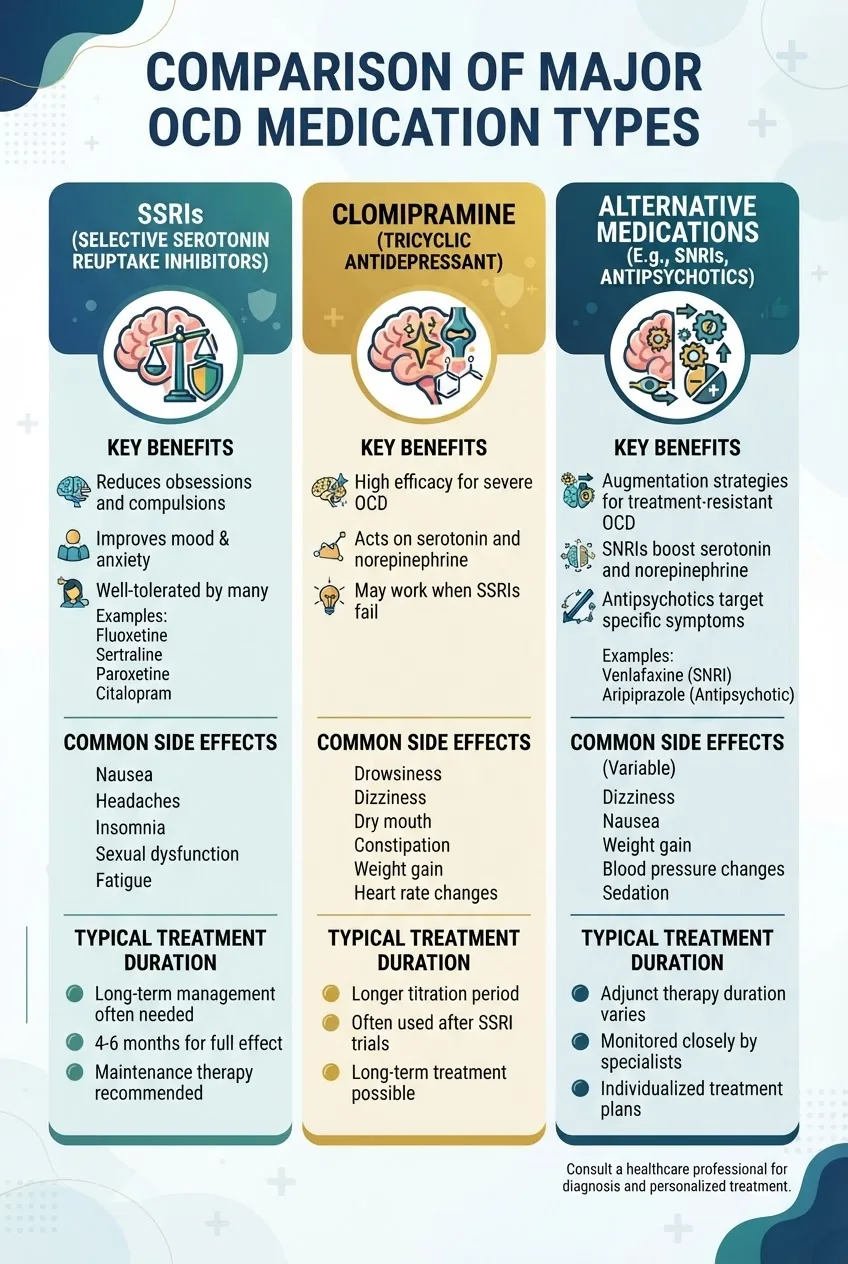
Selection factors include symptom severity, previous treatment response, side-effect profiles, comorbidities (depression, bipolar disorder, tics), drug interactions, pregnancy planning, and patient preference. The Royal Australian and New Zealand College of Psychiatrists and government guidance outline these decision points in clinical practice.
External clinical resources:
- Australian Government Department of Health
- National Institute of Mental Health (NIMH)
- Royal Australian and New Zealand College of Psychiatrists (RANZCP)
Transition: With a broad overview in hand, the next section examines SSRIs in detail—the most commonly used class for OCD.
Selective Serotonin Reuptake Inhibitors (SSRIs) for OCD
Answer: SSRIs are first-line medications for OCD; they reduce obsessive thoughts and compulsive behaviours by increasing serotonin signalling and are supported by multiple randomized controlled trials and meta-analyses.
Term: Selective serotonin reuptake inhibitor (SSRI) — a drug that blocks serotonin reabsorption into neurons, increasing available serotonin in the brain.
Mechanism explained simply: SSRIs raise serotonin levels at synapses, which helps reduce hyperactive circuits linked to repetitive intrusive thinking; think of serotonin as a volume control that reduces the intensity of obsessional alarms.
Evidence base: According to a 2021 meta-analysis of randomized trials, SSRIs produced significant symptom reductions versus placebo in adult OCD; symptom improvement is clinically meaningful for many patients (source type: meta-analysis, 2021).
Commonly used SSRIs in OCD (available and prescribed in Australia):
- Fluoxetine
- Sertraline
- Paroxetine
- Fluvoxamine
- Escitalopram
Dosing and duration principles (Australian clinical practice style):
- Start at a low-to-moderate dose to assess tolerability (examples: sertraline 25–50 mg/day, fluoxetine 20 mg/day), then titrate gradually based on response.
- Continue treatment at an effective dose for at least 12 months if there is a substantial response; many guidelines recommend 12 months to reduce relapse risk.
- If partial response after 8–12 weeks at therapeutic dose, consider dose increase (within licensing/safety limits) or augmentation strategies.
Side effects and management (summary):
- Gastrointestinal upset: take with food, dose adjust, or use anti-emetic short term.
- Sleep disturbances: change dosing time (morning vs night) or switch SSRI.
- Sexual dysfunction: discuss with prescriber; options include dose adjustment, drug switch or augmentation.
- Serotonin syndrome (rare): avoid harmful combinations (e.g., MAOIs, certain supplements); seek urgent care if agitation, fever or rigidity occur.
Special populations and considerations:
- Pregnancy and breastfeeding: choose agents with established safety records and consult obstetric psychiatry—risk/benefit decisions are personalised.
- Adolescents and children: some SSRIs (e.g., fluoxetine) have evidence and regulatory approval; monitor mood changes closely.
- Comorbid depression or anxiety: SSRIs can treat both conditions simultaneously.
Australian prescribing practices emphasise shared decision-making, documentation of informed consent, baseline medical screening (including ECG if cardiac risk), and monitoring plans for side effects—see the clinical checklist below.
Prescribing checklist (clinical tool):
- Confirm OCD diagnosis with standardised assessment tools.
- Screen for bipolar disorder and suicidal ideation.
- Review current medications and contraindicated combinations.
- Baseline physical exam, weight, blood pressure; ECG if indicated.
- Discuss expected benefits, timeline (4–12 weeks), and common side effects.
- Document follow-up plan within 2–4 weeks of initiation or dose change.
Transition: For people who cannot tolerate SSRIs or do not respond, clomipramine is a well-established alternative examined next.
Tricyclic Antidepressants (Clomipramine) in OCD Treatment
Answer: Clomipramine, a tricyclic antidepressant (TCA), is effective for OCD—sometimes superior for severe cases—but has a higher side-effect burden and requires closer medical monitoring and cardiovascular screening.
Term: Clomipramine is a tricyclic antidepressant that strongly inhibits serotonin reuptake and affects multiple neurotransmitter systems, often effective when SSRIs fail.
Efficacy: Clinical trials show clomipramine reduces OCD symptoms significantly, with some studies suggesting greater effect size than older antidepressants, but tolerability concerns limit its routine first-line use. According to a 2019 systematic review, clomipramine remains a key second-line agent (source type: systematic review, 2019).
Pharmacology and monitoring: clomipramine has anticholinergic effects (dry mouth, constipation), can cause orthostatic hypotension, sedation, and in rare cases prolong the QT interval. Baseline ECG, liver function and medication reconciliation are recommended before starting.
Typical initiation and titration (Australian clinical approach):
- Start at a low dose (e.g., 25 mg daily) and increase gradually every 3–7 days as tolerated.
- Target doses for OCD are often higher than for depression—many patients require 150–250 mg/day under careful monitoring.
- Monitor blood pressure, pulse, and ECG, especially in older adults or those with cardiac risk.
Case example (patient treatment scenario):
Michael, a 28-year-old with severe contamination OCD, started sertraline 50 mg with partial response at 12 weeks. After informed consent and medical clearance, his psychiatrist introduced clomipramine, initiating 25 mg nightly and titrating to 150 mg/day over six weeks with ECG monitoring. Michael reported marked reduction in intrusive thoughts by week 10 and manageable dry mouth treated with sips of water and sugar-free gum. He remained on combined medication and weekly ERP therapy, with planned review at 6 and 12 months.
This scenario illustrates real-world initiation, titration, side-effect management, and integration with therapy (ERP). Shared decision-making, documented monitoring, and clear follow-up intervals are key to safety and effectiveness.
Transition: After discussing clomipramine, the next section explains how medications are used together with therapy for optimal outcomes.
How Medication Works with OCD Therapy
Answer: Medication reduces symptom intensity to allow patients to engage more effectively in psychological treatments—especially Cognitive Behavioural Therapy with Exposure and Response Prevention (ERP)—and the optimal approach is coordinated, sequential or combined treatment tailored to patient response.
Medication alone often reduces symptoms but rarely achieves full functional recovery; combining medication with therapy typically yields superior long-term outcomes for many patients.
Step-by-step integrated treatment approach:
- Assessment and shared decision-making: Evaluate symptom severity, prior treatments, comorbidities and patient goals.
- Stabilisation phase: If safety or severe distress is present, start medication to stabilise acute symptoms and reduce suicidal risk.
- Concurrent therapy planning: Begin or continue CBT with ERP once medication has reduced anxiety enough for exposures (often 2–6 weeks after starting medication).
- Adjust medication based on therapy response: If therapy gains plateau, review adherence, dose adequacy, and consider augmentation or switching.
- Maintenance and discontinuation planning: After sustained response, discuss the duration of maintenance medication (commonly 12 months), taper strategies, and relapse prevention with therapist support.
Why combination often works better:
- Medication lowers baseline anxiety, improving ability to tolerate exposures.
- Therapy teaches strategies to prevent relapse when medication is reduced or stopped.
- Combined care addresses both biological and behavioural drivers of OCD.
Clinical coordination tools (practical):
- Shared care plan documenting medication, therapy sessions, emergency contacts, and relapse indicators.
- Regular interdisciplinary reviews every 4–12 weeks during initiation or change.
- Use of standardised outcome measures (Y-BOCS, OCI-R) to track symptom change objectively.
For practical therapy resources and ERP-specific cost and access guidance, consult the dedicated ERP guide which describes session structure, therapist training needs and expected outcomes.
exposure and response prevention therapy
If you want concrete education on intrusive thoughts and how combined treatments reduce them, see focused resources mapping intrusive thought management to medication and therapy steps.
how to stop obsessive compulsive thoughts
Transition: The next section details side effects, interactions and safety precautions clinicians and patients should manage actively.
Managing Side Effects and Risks of OCD Medications
Answer: Side effects are common but usually manageable; clinicians use baseline screening, patient education, dose adjustment, and monitoring checklists to reduce risk and support adherence.

Key caution points:
- Start low, go slow: Titrate doses to minimise nausea, dizziness and sleep disruption.
- Monitor interactions: Many SSRIs interact with other prescription drugs, over-the-counter medicines and supplements (e.g., St John’s wort) — always review medication lists.
- Cardiac risk: Clomipramine and some augmentation agents may affect heart rhythm; baseline ECG for at-risk patients is required in Australian practice.
- Suicide risk monitoring: Especially in adolescents and young adults, monitor mood and suicidal ideation closely after starting or changing doses.
- Withdrawal and discontinuation: Avoid abrupt cessation to reduce discontinuation symptoms; taper under medical supervision.
Management strategies and checklist:
- Provide a written medication information sheet and emergency contact numbers.
- Schedule a review within 2–4 weeks after initiation or dose change, then regularly (monthly to quarterly) while stabilised.
- Use a side-effect tracker for the first 12 weeks (headache, nausea, sexual side effects, sleep changes).
- Adjust dose or switch agent if side effects impair function; consider augmentation only after optimisation of a single agent.
- Document all discussions about risks and consent in the clinical record.
Interactions with natural remedies: Many people ask about supplements. Certain herbal agents (e.g., St John’s wort) can precipitate serotonin syndrome with SSRIs; others may alter drug metabolism. Always tell your prescriber about supplements.
OCD alternative medicine and natural remedies
Transition: The final substantive section answers common patient questions in a concise FAQ format to support decision-making.
Frequently Asked Questions About Drugs for OCD
Answer: The following concise expert answers address the most common questions patients raise about medication effectiveness, timelines, safety, and accessing care in Australia.
Transition: After the FAQs, the conclusion provides local Sydney resources and next steps.