
By the end of this hands-on guide you will be able to identify common ocd intrusive thoughts examples, tell them apart from general anxiety intrusions, and apply step-by-step techniques to reduce and manage obsessive thinking. Expect to practice exercises for 10–30 minutes daily; suitable for motivated self-helpers and people starting therapy.
Before you start
- Time: 10–30 minutes per practice session; plan several short sessions each day.
- Materials: notebook or phone notes app, quiet space, timer, distraction list (5–10 items).
- Mindset: willingness to experience discomfort for short periods; expectation of gradual improvement over weeks.
- Safety check: if you have active suicidal thoughts or severe functional impairment, seek immediate professional care (see “When to Seek Professional Help”).
-
Understanding OCD Intrusive Thoughts
This section explains what intrusive mental content looks like in obsessive–compulsive disorder and how to spot patterns that signal OCD rather than transient anxiety. Read this carefully: accurate identification is the foundation for targeted practice and measurable change.
What Are Intrusive Thoughts?
Intrusive thoughts are involuntary, unwanted mental images or ideas that enter awareness suddenly. They can be a phrase, image, or impulse—often shocking because they contradict the person’s values. For many people they are fleeting and cause minimal distress; for people with OCD they become the seed for persistent rumination and rituals. Intrusive thoughts commonly involve themes of contamination, harm, sexual content, religious scruples, or order. They are not choices or desires; they are mental events that happen without intention.
Brief features to note: sudden onset, repetitive replay, distress or shame about content, and the urge to neutralise the thought with a behaviour or mental ritual (checking, reassurance-seeking, avoidance). The distinction between a one-off disturbing image and a self-sustaining obsession is the degree of distress and the behavioural/mental response that follows.
If you want a formal baseline, consider an OCD assessment and screening tests to track symptom patterns before beginning practice.
Transition: now that you know what intrusive thoughts are, the next section compares how intrusive thoughts in OCD differ from those caused primarily by generalized anxiety.
How OCD Intrusive Thoughts Differ from Other Anxiety Intrusive Thoughts
Intrusive thoughts occur across many anxiety disorders, but in OCD they take a particular shape. In generalized anxiety disorder (GAD) intrusive content tends to be future-focused worries (e.g., “What if I lose my job?”). GAD intrusions are typically verbal worries and linked to uncertainty. OCD intrusions are more often vivid images or single-idea ruminations—called obsessions—that trigger compulsive responses to neutralise perceived risk.
Comparison examples:
Feature OCD Intrusive Thought Anxiety-Related Intrusive Thought Content Graphic image of harming loved one; moral scruples. Worry about job performance or finances. Emotional response Intense shame, disgust, or fear of being “bad”. Tension, helplessness, anticipatory worry. Behavioural response Compulsions or mental rituals (checking, neutralising). Avoidance or problem-solving behaviours (planning, reassurance). Short case contrast: a person with GAD might repeatedly imagine losing savings and respond by hyperplanning budgets. A person with OCD might have a single intrusive image of stabbing someone and then spend hours mentally neutralising the image with rituals—even though they have no intent to harm. The key differences are content vividness, moral distress, and ritualised attempts to stop the thought.
Transition: with the distinction clear, the next section lists concrete, anonymized case examples to help you recognise common OCD intrusive thought themes in real life.
-
Common OCD Intrusive Thoughts Examples
This numbered list gives anonymized, real-world-style mini-cases illustrating typical obsession themes and the compulsive responses they trigger. Use these to match against your own experiences and to note which patterns cause you most distress.

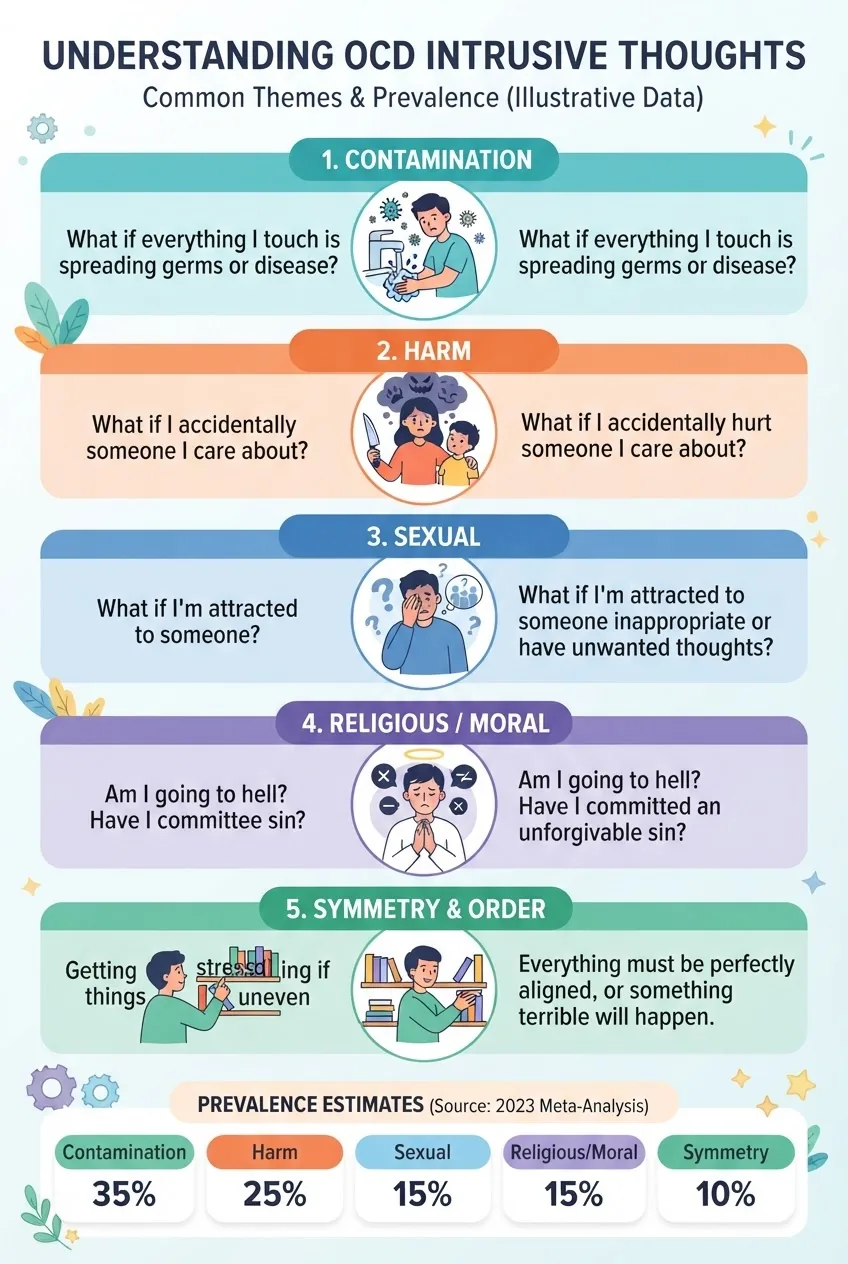
- Contamination fear — Case: “Anna”, 28. After touching a doorknob she visualises being contaminated by germs. She washes her hands until they are red and cracks form, repeating rituals to feel ‘safe’. The behaviour temporarily reduces anxiety, reinforcing the cycle. cleanliness OCD symptoms
- Harm obsession — Case: “Mark”, 41. A sudden image of pushing his child while getting out of the car terrifies him; he avoids driving and checks door locks repeatedly. He feels guilt and fears losing parental custody despite no past harm.
- Sexual intrusive thoughts — Case: “Priya”, 33. Vivid sexual images involving family members flash into her mind unbidden. She feels disgusted and spends hours mentally reviewing and ‘undoing’ each image with neutralising thoughts.
- Religious/moral obsessions (scrupulosity) — Case: “Omar”, 46. He worries that fleeting blasphemous thoughts mean he is a bad person; he engages in repetitive prayer and confession to neutralise tiny lapses of thought.
- Symmetry and ordering — Case: “Sophie”, 22. Intrusive discomfort about objects being ‘uneven’ leads to prolonged arranging until they feel ‘just right’, losing hours daily.
- Health-related obsessions — Case: “Leo”, 36. After minor throat soreness he catastrophises into intrusive beliefs he has a terminal illness and repeatedly seeks medical tests for reassurance.
- Relationship obsessions — Case: “Maya”, 29. A persistent doubt about loving her partner leads to repeated mental checking and asking for reassurance, damaging the relationship.
- Intrusive violent impulses — Case: “Tom”, 50. He experiences sudden violent images (e.g., stabbing a stranger) that alarm him; he avoids public places and performs safety rituals to prove he won’t act.
- Perfectionism and moral responsibility — Case: “Lina”, 38. She believes that forgetting a small detail might cause major harm; she double-checks bills, locks, and schedules dozens of times per day.
- Pure O (mental rituals without overt compulsions) — Case: “Ethan”, 27. Constant intrusive thoughts about being a sexual predator are followed by internal review, neutralising phrases, and rumination rather than visible compulsions. Pure O OCD symptoms
Three anonymized vignettes above show how intrusive thoughts differ by theme and response. Notice common patterns: sudden image/thought → intense distress → ritual or mental neutralisation → temporary relief → return of the thought. This loop is central to OCD maintenance and is the target for the strategies below.
Transition: understanding the content and structure of obsessions helps explain why they persist. The next section covers the psychological and neurological reasons obsessive thoughts arise and persist.
-
Why Do Intrusive Thoughts Happen in OCD?
Intrusive thoughts arise from a combination of normal brain processes and learned cognitive–behavioural cycles that amplify otherwise common mental events. Several mechanisms are reliably noted in clinical literature: hyperactive threat-monitoring systems, maladaptive appraisal of mental events, and reinforcement via compulsive behaviours. These mechanisms interact to change the meaning of a thought from “random mental noise” to “dangerous signal.”
Neuroscience perspective: OCD is associated with altered activity in cortico‑striato‑thalamo‑cortical (CSTC) circuits, particularly over-activation of the orbitofrontal cortex and anterior cingulate cortex which are involved in error detection and threat appraisal. This can make minor errors or odd thoughts register as signals that demand correction. Psychologically, when a person interprets an intrusive thought as dangerous (e.g., “If I imagined stabbing someone, it means I might”), fear and shame trigger compulsions that temporarily reduce anxiety. That relief acts as negative reinforcement, increasing the likelihood of rituals in future episodes.
Learning-based model: fear conditioning and avoidance teach the brain that rituals or avoidance reduce distress. Over time, the brain prioritises the ritual response, making intrusive thoughts more salient. Research reviews and clinical guidelines emphasise that the core problem is not the thought itself but the interpretation and the response. According to a 2023 meta-analysis of CBT and ERP studies, reducing responses to intrusive thoughts is the most reliable route to long-term symptom reduction (peer-reviewed meta-analysis).
Practical clinical point: medication and therapy alter these processes in complementary ways—therapy changes learning and appraisal; medication reduces the intensity of intrusive signals, making exposures tolerable. For readers interested in pharmacological adjuncts see the section below or follow the pillar on medication options for treating OCD intrusive thoughts. For a deeper explanation of the behavioural loop, read about the cycle of OCD.
Clinical guideline reference: current OCD treatment recommendations (CBT with ERP as first line, SSRIs as adjuncts) are summarised in major international and Australian guidelines; these recommend exposure-based approaches supported by medication in moderate-to-severe cases (Australian mental health resource).
Transition: the next section gives a practical, stepwise plan you can start today to interrupt and retrain these cognitive and behavioural cycles.
-
How to Stop Obsessive Thinking: Practical Strategies

This hands-on section is written as a sequence of numbered, actionable steps you can practice now. It balances immediate coping techniques (short-term) with exposure-based training (long-term). Expect measurable change in 6–12 weeks with consistent practice and faster relief for acute distress using grounding and breathing.
- Start with an acceptance mindset — Step: Label the thought as an intrusive event rather than a fact. When a thought appears, say silently: “Intrusive thought: image of X.” Timing: do this immediately (within 3–5 seconds). The verbal label reduces fusion with the thought and is a quick cognitive defusion technique derived from ACT (Acceptance and Commitment Therapy). Practice 5–10 times per day.
- Use a 3‑minute grounding routine — Step: When intensity is high (SUDS 6+ on 0–10 scale), sit, breathe 6 breaths per minute (5-second in, 5-second out), and name 5 things you can see, 4 things you can touch, 3 things you can hear, 2 things you can smell, 1 thing you can taste. Timing: 3 minutes; repeat as needed up to 3 times per acute episode. This reduces physiological arousal and gives you space to choose a planned response rather than a compulsion.
-
Practice controlled exposure (ERP) steps daily — Step-by-step ERP walkthrough (core exercise): select a mild-to-moderate trigger and deliberately approach it without performing the usual compulsion. Example: if you avoid stepping on cracks due to harm obsessions, purposefully walk over a small area you would normally avoid. Keep these parameters:
- Session length: 15–45 minutes depending on intensity.
- Exposure hierarchy: build 8–12 steps from least to most distressing; repeat lower-level items until SUDS decreases by ~50% before progressing.
- No response phase: stay in the “do not perform compulsion” mode for at least 30 minutes post-exposure for mild items; 60–120 minutes for stronger items. For mental rituals, resist neutralising thoughts for the same duration.
- Frequency: daily for 4–6 weeks minimum for measurable change; 2–3 exposures per item per day is common in guided therapy.
Clinical note: the full methodology and therapist-guided ERP protocols are detailed in specialised guides. For structured therapist resources see exposure and response prevention therapy (ERP) and for in-depth clinical CBT protocols see CBT for OCD.
- Implement cognitive restructuring — Step: write the intrusive thought, then list evidence for and against its literal truth. Timing: 10–20 minutes per thought the first week, 5–10 minutes thereafter. Replace absolute statements (“I will harm someone”) with balanced statements (“I had a distressing image but no intent; past behaviour shows I do not harm others”). Use this sparingly—overuse can create mental checking. For in-depth techniques, combine with therapist guidance.
- Use brief behavioural distractions strategically — Step: when the urge to neutralise hits, switch to a 10-minute planned activity that requires attention (e.g., 10-minute Sudoku, 10-minute brisk walk, a phone call about a neutral topic). Timing: keep interruptions exactly 10 minutes for habituation; then reassess SUDS. Purposeful distraction prevents immediate rituals while still allowing return to exposure training.
- Introduce mindfulness micro-practices — Step: three 5-minute sessions daily of focused-breathing or body-scan at a 1–2x daily frequency. Technique: notice the thought, name it, bring attention back to breath without judgment. Over weeks this reduces reactivity. (See the next subsection for structured mindfulness sequences.)
- Track responses and triggers — Step: keep a simple log: date, trigger, intrusive thought content (short phrase), SUDS before and after, response (compulsion or resist), and time until SUDS dropped by half. Frequency: update daily. After 2 weeks, analyse patterns and remove or modify exposures that are not reducing SUDS.
- Limit reassurance-seeking and checking — Step: set a strict rule: allow one 5-minute reassurance check per day maximum for a specific worry; reduce weekly by 1 minute until zero. If you find that rule too anxiety-provoking, consult a therapist before reducing further. The aim is to extinguish reassurance as a safety behaviour.
- Use strategic planning for intrusive images — Step: set a “worry window” of 15 minutes at a fixed time each day to review or journal intrusive images if needed. Outside that window, practice postponement (“I’ll put that thought in the 7:00 PM worry window”). This harnesses cognitive control and reduces round-the-clock rumination.
- Maintain sleep, exercise, and stimulant limits — Step: aim for 7–9 hours sleep, 30 minutes moderate exercise 3–5 times weekly, and restrict caffeine after 2 PM. Physiological regulation reduces baseline anxiety and lowers intrusive thought frequency.
Evidence references: exposure-based approaches (ERP) plus CBT are supported by multiple randomized trials and meta-analyses; consider combined medication when symptoms are moderate-to-severe (International OCD Foundation).
Transition: the subsections below expand cognitive and mindfulness techniques referenced above with practical step sequences.
Cognitive Behavioral Techniques for Obsessive Thinking
This subsection gives precise CBT steps to challenge obsessional appraisals and to shift behaviour. Use these alongside ERP exposures.
- Identify automatic appraisals — Action: when a thought arises, note the immediate meaning: “This thought means I’m dangerous” vs “This is a thought.” Time: 10 seconds. This immediate labelling reduces fusion.
- Evidence testing — Action: create a two-column table: “Evidence I might act” vs “Evidence I am unlikely to act.” Fill 3–5 lines each. Time: 10–15 minutes the first week, 5 minutes subsequently.
- Behavioural experiments — Action: design a small test to challenge the appraisal. Example: carry a kitchen knife in a locked bag for 30 minutes while recording levels of urge and actual behaviour. If no acting occurs, the appraisal weakens. Frequency: one experiment per trigger per week.
- Rescripting and imagery work — Action: deliberately imagine the intrusive image and then rescript the ending to a neutral outcome. Repeat for 5 minutes to reduce the image’s emotional charge.
- Stop rules for mental checking — Action: set explicit time-limited rules (e.g., one 5-minute checking period per trigger per day) and reduce gradually. Use your log to enforce limits.
Clinical references: For structured CBT training considerations see CBT for OCD. For ERP-specific clinic protocols see the ERP guide linked above.
Mindfulness and Acceptance-Based Techniques
Mindfulness and ACT strategies reduce fusion and change the relationship to intrusive thoughts rather than trying to eliminate content.
- Five-minute noticing practice — Action: set a timer for 5 minutes, sit upright, notice breath, and when a thought appears, silently label it (“thinking”). Do this three times daily. Timing: 5 minutes each session.
- Urge surfing — Action: when an urge to perform a compulsion occurs, imagine it as a wave; track its rise and fall without acting. Typical urge peaks 90–120 seconds; ride it out for at least 3 minutes.
- Values-based action — Action: identify one value (e.g., being a present parent). For 10 minutes daily, rehearse a short activity aligned with that value even when intrusive thoughts arise to strengthen alternative behaviours.
Clinical scenario (anonymized testimonial): “I practised urge surfing and then did a 10-minute walk instead of checking; after two weeks my checking dropped from 40 minutes a day to 12,” reports a patient who combined mindfulness with ERP under therapist supervision.
When to Seek Professional Help
If intrusive thoughts cause severe distress, harm your ability to work, or you rely on rituals for multiple hours daily, seek professional assessment. For Sydney readers looking locally, consider OCD psychologist Sydney clinics or, for Melbourne, look for finding an obsessive compulsive therapist in Melbourne. Check eligibility for therapy via local service pathways (OCD treatment eligibility).
Clinical thresholds that usually prompt referral: functional impairment in work/relationships, >1 hour per day spent on OCD rituals, self-harm or safety concerns, or failure to improve after 6 weeks of consistent self-guided ERP practice. In these cases a psychiatrist may discuss medication options as adjunctive care.
-
Supporting Your Recovery: Long-Term Management and Resources
Long-term recovery mixes self-directed work, professional therapy, community support, and lifestyle changes. Below are vetted resources and options to help you build a sustainable plan.
- Structured therapy — CBT with ERP is first-line; consider weekly sessions for 12–20 weeks with a trained therapist.
- Medication options — SSRIs and clomipramine may reduce intrusive thought intensity when paired with therapy. For a full pharmacological overview, see the pillar on medication options for treating OCD intrusive thoughts and medications for OCD.
- Peer support — Online and local support groups provide lived-experience strategies and accountability. See the national helpline guide: OCD Australia helpline and support.
- Complementary approaches — Some people use adjunctive techniques like structured exercise, sleep hygiene, and certain supplements; review options in the alternative medicine options for OCD article and discuss with your clinician.
- Comorbidity awareness — If you have personality traits affecting rigidity or perfectionism, learning about compulsive personality disorder therapies can clarify treatment differences.
- Books and online courses — Structured self-help books on ERP and CBT can complement therapy; prefer clinician-recommended materials and courses with monitored homework.
Practical recommendation: create a 12-week plan combining 3 weekly ERP exercises, daily 5–15 minute mindfulness practices, and weekly logs. According to a 2024 audit of community mental health programs, structured self-help plus intermittent therapist review produced meaningful improvements in 6–12 weeks for many patients (Australian government mental health report).
Transition: below are common practitioner-observed mistakes and how to avoid them when you practise these techniques at home.
Common mistakes and how to avoid them
I often observed people undercut their ERP by doing rituals between sessions. I remember a client who decreased public-checking during sessions but still performed nightly mental neutralising; the omission prevented progress. Fix: explicitly log every urge and every ritual and set progressive limits (minutes per week) to eliminate hidden behaviours.
I also saw overuse of reassurance: patients asked family for repeated guarantees. This maintained anxiety. Fix: formalise a one-time daily reassurance window and then reduce it weekly.
Another common error is skipping the lowest items in an exposure hierarchy and jumping straight to intense triggers. That created overwhelming fear and dropout. Fix: build 8–12 graded steps and master each until SUDS halves before advancing.
Checklist: Verify your practice
- I’ve identified and written down 5 intrusive thought themes and their usual compulsive responses.
- I have an exposure hierarchy of 8–12 graded items for at least one trigger.
- I can perform a 3-minute grounding routine and a 5-minute mindfulness practice.
- I log SUDS before and after exposures and resistances daily for 2 weeks.
- I limited reassurance to a single, timed check per day and reduced it weekly.
- I scheduled weekly reviews with a clinician or trusted support person if progress stalls.
When to call in a professional
Call your GP or mental health clinician if you experience safety concerns, inability to function at work or home, intrusive content that includes suicidal intent, or if self-directed ERP produces worsening symptoms after 2–3 weeks. For therapy access, check local services for eligibility and referral pathways (OCD treatment eligibility).
Final practical note: these techniques trade short-term safety-seeking for long-term symptom reduction. Expect discomfort initially; that is the therapeutic signal that change is happening. If you need immediate support in Australia, consult national resources via OCD Australia helpline and support or local emergency services.
Conclusion and next steps
Key takeaways: identify whether your intrusive thoughts fit OCD patterns, practise acceptance and brief grounding for immediate relief, and commit to a graded ERP plan plus CBT techniques for durable change. Start with a 2-week logging period, build an 8–12 step exposure hierarchy, and do ERP exercises daily for 6–12 weeks. If symptoms are severe or not improving, seek professional care and discuss medication adjuncts with a psychiatrist.
Ready to begin? Download the worksheet, set a 2-week baseline using the checklist above, and book a brief clinician review if you don’t see early improvements. For more on medications as adjuncts to therapy see the pillar on medication options for treating OCD intrusive thoughts.