
ocd test: An OCD test is a structured clinical or self-report assessment used to identify obsessions and compulsions, measure symptom severity, and guide decisions about diagnosis or referral; it screens for obsessive compulsive disorder symptoms but does not itself provide definitive treatment.
What is an OCD Test?
Answer: An OCD test is a clinical or self-report screening tool designed to identify obsessive and compulsive symptoms, quantify severity, and flag cases that need a full diagnostic assessment.
Term: Obsessions are recurrent intrusive thoughts, images or urges that cause distress; compulsions are repetitive behaviours or mental acts performed to reduce that distress.
OCD tests, or obsessive compulsive disorder tests, come in two main forms: quick screening questionnaires for initial identification and clinician-administered instruments for in-depth symptom measurement. Clinicians use them as checklists to structure interviews and to track symptom severity over time; they do not replace a formal diagnostic interview.
Common purposes of an OCD test include:
- Screening for likely OCD in primary care or community settings.
- Measuring baseline symptom severity before treatment.
- Monitoring response to treatment during follow-up.
- Supporting differential diagnosis by documenting symptom content and function.
Tests vary in length and administration: self-administered questionnaires (useful for initial screening) versus professional tools (used in clinics to map directly to diagnostic criteria). For background on how OCD can present across presentations, see different types of OCD and for how intrusive thoughts show up in screening, see intrusive thoughts as OCD symptoms.
Transition: Next we list the common assessment tools you’ll encounter in clinics and online.

Common Types of OCD Assessment and Screening Tests
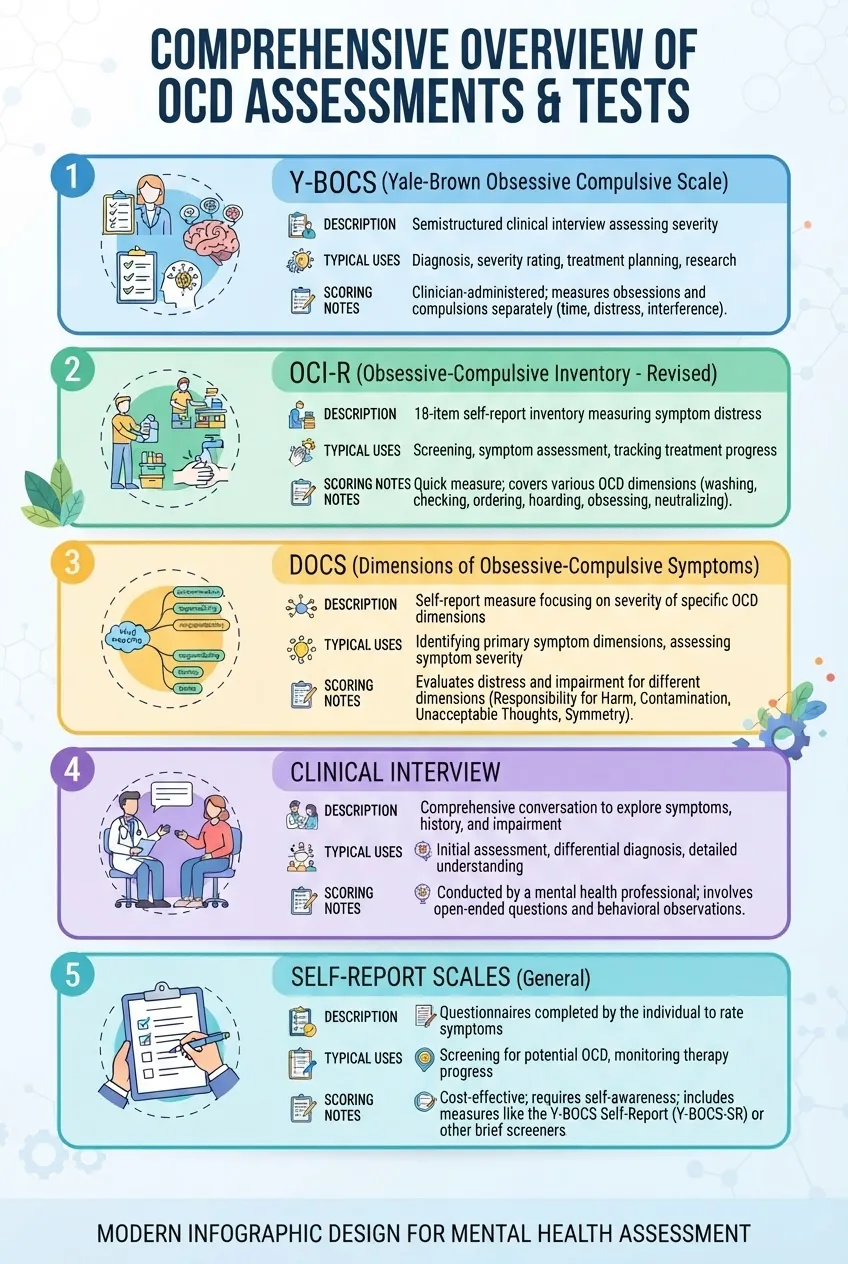
Answer: Common OCD assessment tools include clinician-rated scales (e.g., Y-BOCS), self-report questionnaires (OCI‑R, DOCS), dimensional measures and structured clinical interviews used in clinics and research.
Term: Screening questionnaires are brief self-report forms that flag possible cases; clinician-rated scales are structured interviews or observer-rated tools used by trained professionals.
- Yale-Brown Obsessive Compulsive Scale (Y-BOCS) — clinician-administered 10-item scale measuring obsession and compulsion severity; gold-standard for symptom severity in clinics and trials. Often used at intake and for tracking change.
- Obsessive-Compulsive Inventory — Revised (OCI‑R) — 18-item self-report checklist measuring symptom domains (washing, checking, obsessing, etc.); quick screening and subscale detail.
- Dimensional Obsessive-Compulsive Scale (DOCS) — self-report assessing four OCD symptom dimensions with emphasis on distress and avoidance; useful for phenotyping and treatment planning.
- Structured Clinical Interview (e.g., SCID) — a diagnostic interview that maps directly to DSM-5 criteria; administered by trained clinicians to confirm diagnosis and identify comorbidities.
- Self-report symptom checklists and severity ratings — brief questionnaires used in GP clinics, online screens, or intake forms; fast but higher risk of false positives if used alone.
- Pure O symptom screening — targeted questionnaires or interview probes to detect OCD presentations dominated by intrusive thoughts without obvious compulsions; requires clinician assessment to clarify mental rituals.
| Test | Format | Typical Use | Scoring/Time |
|---|---|---|---|
| Y-BOCS | Clinician-rated interview | Severity measurement in clinics | 0–40 scale; 15–25 mins |
| OCI‑R | Self-report | Quick screening, subscales | 18 items; 5–10 mins |
| DOCS | Self-report | Dimensional assessment | 16–20 items; 10–15 mins |
| Structured interview (SCID) | Clinician interview | Diagnostic confirmation | 30–60 mins |
Clinics in Australia commonly follow national guidance when choosing assessment tools; for formal recommendations see the Australian Government mental health guidelines.
Australian Government mental health guidelines
Transition: Read on for step-by-step preparation advice to make your OCD assessment accurate and useful.
How to Prepare for an OCD Assessment?
Answer: Prepare by tracking your symptoms, journaling triggers and rituals, listing medical and mental health history, collecting medication information, and noting how symptoms affect daily life to make assessments reliable.
Term: Symptom journaling means recording occurrences, triggers, frequency, intensity and time spent on obsessions or compulsions to provide objective evidence for clinicians.
- Record symptoms for 2–4 weeks: note time of day, trigger, intrusive thought content, compulsion performed, duration and distress level (0–10).
- Track frequency and severity: quantify how many times per day/week and how much time and distress each episode causes.
- Gather personal and family mental health history: list any diagnoses, hospitalisations, or psychiatric medications.
- Prepare a medication and substance use list: include over-the-counter, prescription, herbal supplements, alcohol and recreational drug use.
- Note functional impact: work, study, social, and safety concerns—clinicians use this to assess clinical significance.
- Bring previous test results or reports, if any, and be ready to complete self-report scales in the waiting room.
Anonymised clinic case example (experience signal): A patient attending a Sydney clinic documented two weeks of repeated checking behaviour that occupied one hour daily. The intake OCI‑R flagged high checking scores; a clinician-administered Y‑BOCS confirmed moderate severity and led to a referral for specialist assessment. Details are de-identified for confidentiality.
Tips for accuracy: answer questions honestly rather than minimising symptoms; note mental rituals (e.g., counting silently) as compulsions; and ask the clinician to clarify any questionnaire items you find confusing.
Transition: Next, find out exactly what happens during a diagnostic test at a clinic so you know what to expect.
What to Expect During an OCD Diagnosis Test?
Answer: A clinic diagnosis test typically involves a clinical interview mapping symptoms to DSM-5 diagnostic criteria, completion of standardised scales (e.g., Y‑BOCS), differential diagnosis checks, and documentation for referral or treatment planning.
Term: DSM-5 is the Diagnostic and Statistical Manual of Mental Disorders, Fifth Edition, used by clinicians to define diagnostic criteria for OCD and other mental disorders.
Core steps during a clinical diagnostic assessment:
- Clinical interview: clinician asks about symptom content, onset, duration and functional impact; this maps to DSM-5 criteria — American Psychiatric Association guidance outlines these criteria and assessment expectations.
- Standardised measures: a clinician may administer the Y‑BOCS or ask you to complete OCI‑R or DOCS to quantify severity and symptom dimensions.
- Differential diagnosis: the clinician will rule out conditions with overlapping features (e.g., major depression, tic disorders, or substance effects).
- Risk and safety assessment: the assessor will check for suicidality, severe avoidance, or behaviours that present imminent danger.
- Feedback and next steps: results are discussed, and referrals or follow-up assessments are arranged if needed.
For formal DSM-5 diagnostic criteria and clinician resources see the American Psychiatric Association.
American Psychiatric Association — DSM-5 resources
Practical notes on administration:
- Appointments typically last 30–60 minutes for an initial diagnostic interview; extended assessments for complex cases may take longer.
- Expect specific probes about the intrusive nature of thoughts, the intention behind rituals, and whether rituals relieve distress.
- Bring collaterals if helpful: a partner or family member’s observations can clarify severity and safety issues.
Transition: After testing, clinicians interpret scores and combine them with clinical judgment — the next section explains how results are interpreted.

Interpreting Your OCD Test Results
Answer: Test results are interpreted by combining numerical scores (symptom severity) with clinical interview findings to determine clinical significance, diagnosis confirmation, and next steps like referral or monitoring.
Term: Symptom severity refers to the intensity, frequency and functional impact of obsessions and compulsions measured by scales such as the Y‑BOCS.
How clinicians use results in practice:
- Score thresholds: self-report tools have cut-offs indicating probable OCD; clinician-rated scales provide severity bands (mild, moderate, severe).
- Clinical corroboration: scores are interpreted alongside the diagnostic interview; high scores with minimal functional impairment may need different management than moderate scores with marked impairment.
- Examples of scenarios:
Scenario A — Mild scores on OCI‑R but no functional impairment: clinician may monitor symptoms and provide psychoeducation or brief GP follow-up.
Scenario B — High Y‑BOCS score with daily impairment: likely confirmation of OCD, referral to specialist services for therapy and medication assessment.
Scenario C — High intrusive thoughts without overt rituals: clinician examines for mental rituals (Pure O) and may use targeted interview probes or refer to a specialist.
Y-BOCS scoring walkthrough
Answer: The Y‑BOCS scores obsession and compulsion severity on two 0–20 subscales summed to 0–40; clinicians score frequency, interference, distress, resistance and control for each domain, then map totals to severity bands.
- Administration: clinician asks standardised questions about obsessions and compulsions; each of 10 items is scored 0 (none) to 4 (extreme).
- Subscales: five items evaluate obsessions (time, interference, distress, resistance, control); five items evaluate compulsions using same metrics.
- Scoring: sum obsession items (0–20) and compulsion items (0–20); total score 0–40.
- Interpretation bands (typical): 0–7 (subclinical), 8–15 (mild), 16–23 (moderate), 24–31 (severe), 32–40 (extreme).
- Clinical use: clinicians combine Y‑BOCS totals with diagnostic interview to confirm severity and monitor treatment response over time.
Transition: Understanding limitations of screening tools helps prevent misdiagnosis — the next section outlines key caveats and reliability concerns.
Limitations and Reliability of OCD Screening Tests
Answer: OCD screening tests are useful but have limitations: false positives and negatives, variability in self-report accuracy, and inability to replace a full professional diagnostic assessment.
Term: False positives occur when a screening tool suggests OCD but a diagnostic interview does not confirm it; false negatives are the opposite.
Key limitations and cautionary advice:
- Self-assessments can overestimate prevalence because they rely on subjective reporting and lack clinical context.
- Comorbid conditions (depression, anxiety, tic disorders) can inflate scores or mask OCD; clinician assessment is needed to disentangle causes.
- Screening tools differ in sensitivity and specificity; no single test is definitive — they are part of a broader assessment process.
- Cross-cultural validity: some questionnaires may not translate perfectly across cultural contexts; clinicians interpret results with cultural competence.
WHO classification perspective: The World Health Organization’s ICD-11 provides a diagnostic framework that complements DSM-5 and underscores the importance of clinician judgment beyond screening scores.
WHO ICD-11 classification of mental disorders
Differential diagnosis warning: compulsive personality disorder can be mistaken for OCD because both involve rigid behaviour patterns; a clinician will assess motives, flexibility and distress to differentiate.
For readers interested in non-conventional options, screening limitations are relevant when considering alternative medicine approaches—these should complement, not replace, evidence-based diagnostic processes.
Transition: If testing suggests OCD or you remain concerned, here’s how to seek and navigate professional care in Sydney.
When and How to Seek Professional Help After Testing?
Answer: Seek professional help when screening indicates moderate-to-severe symptoms, functional impairment, safety concerns, or diagnostic uncertainty; referrals can be made to GPs, psychiatrists, psychologists, or specialised clinics for follow-up and treatment planning.
Referral steps and practical guidance:
- Discuss results with your GP for initial triage and to arrange referrals; your GP can provide a mental health treatment plan and Medicare rebates where eligible.
- If tests indicate significant impairment or risk, request referral to a psychiatrist for medication review and a psychologist experienced in OCD for therapy.
- When considering therapy options, explore CBT as a treatment option for OCD and specialised protocols such as exposure and response prevention therapy.
- For medication options following diagnosis, clinicians often consult pharmacological guidelines—see Drugs to Treat OCD: Medication Options and Treatment Guidelines and complementary summaries like medication options for OCD.
- Find local clinicians: search for OCD psychologists in Sydney or consider nearby options such as find OCD therapists in Melbourne if local capacity is limited.
- Confirm treatment eligibility and next steps after diagnosis by reviewing treatment eligibility and symptom evaluation.
If you need urgent help (self-harm, inability to care for yourself), contact emergency services or crisis lines immediately and inform your clinician at the earliest opportunity.
Transition: The final section lists practical resources available in Sydney and Australia for testing and ongoing support.
Resources for OCD Testing and Support in Sydney
Answer: Sydney residents can access public and private mental health clinics, specialist OCD services, helplines, and support groups; below are key contacts and options for testing, referral and peer support.
- Human Health Clinics — OCD assessment services: Local clinics offering Y‑BOCS assessments and referral pathways for therapy and psychiatry (contact via clinic intake numbers and websites).
- Head to Health (NSW) centres: walk-in or appointment-based mental health assessment and navigation for community referrals.
- Clinical psychologists specialising in OCD: private practitioners offering comprehensive assessment and evidence-based therapy — search via clinic directories.
- OCD helpline and support in Australia — national resources and helplines for immediate support and referrals.
- Local support groups: peer-led OCD groups in Sydney meet online and in person; clinicians can provide referral contacts.
- Online validated tests: some clinics offer vetted online OCI‑R or DOCS forms for preliminary screening — use these only as an initial step.
According to a 2024 Australian Government Department of Health report, approximately 1–2% of Australians experience OCD symptoms consistent with clinical thresholds during their lifetime; screening and early assessment improve access to evidence-based care (source: government mental health report).
Transition: Below is a concise wrap-up and recommended next steps.
Conclusion: An ocd test is a structured, useful first step to identify symptoms and severity but requires clinical interpretation. Prepare with symptom logs, expect a combined interview and scale-based assessment, and follow up with a GP or specialist for diagnosis and treatment planning. If concerned, seek help promptly.
CTA: Book an assessment with a local clinic or speak to your GP to arrange follow-up testing and referrals.