

This guide maps the main types of therapy, the training pathways therapists take, and how each approach produces measurable treatment benefits—helping you choose an approach or understand professional training in Sydney and beyond. It covers modalities, professional credentials, practical techniques, expected outcomes and how training supports effective care.
Introduction to Different Types of Therapy
Answer: Different types of therapy are organised approaches—such as cognitive, behavioural, relational and acceptance-based methods—designed to reduce symptoms, teach coping skills and support long‑term recovery; many are evidence‑based and combine into flexible treatment plans tailored to the person’s condition and goals.
Term: Therapy — a planned set of psychological interventions or counselling techniques delivered by a trained practitioner to reduce distress, change behaviour or improve functioning.
Therapy approaches range from structured, manualised treatments like Cognitive Behavioural Therapy (CBT) to relational or insight-oriented therapies. Some target specific symptoms (for example, behavioural activation for depression) while others focus on skills and values (for example, Acceptance and Commitment Therapy). Treatments occur in multiple modalities (individual, group, online) and are selected according to evidence, clinician training and client preference.
Therapy is often described along three axes: theoretical orientation (cognitive, behavioural, psychodynamic, humanistic), delivery format (individual, group, online), and purpose (symptom reduction, skills training, rehabilitation). This guide emphasises how those types relate to therapist training and practical benefits so readers can make informed choices—whether seeking care or planning a career in psychotherapy.
For practical guidance on how sessions are structured and clinical services are set up, see psychology session and therapy setup.
Disclaimer: Therapy is not one-size-fits-all; effectiveness varies by person, condition severity and therapist competence—seek an accredited clinician for assessment and tailored care.
Transition: The next section outlines the common therapy types used specifically in depression psychotherapy and highlights core features and typical benefits of each approach.
Overview of Common Types of Therapy Used in Depression Psychotherapy
Answer: Common therapies for depression include Cognitive Behavioural Therapy (CBT), Dialectical Behaviour Therapy (DBT), Acceptance and Commitment Therapy (ACT), psychodynamic therapy, humanistic approaches, interpersonal therapy (IPT) and behavioural activation; each uses distinct methods to reduce depressive symptoms and restore functioning.
Term: Cognitive Behavioural Therapy (CBT) — a structured, time-limited therapy that identifies and modifies unhelpful thoughts and behaviours to reduce symptoms.

-
Cognitive Behavioural Therapy (CBT)
CBT combines cognitive restructuring (challenging negative thoughts) with behavioural experiments and activity scheduling to reduce depressive symptoms and prevent relapse. Evidence: CBT has robust meta-analytic support for mild–moderate depression; outcomes improve with 8–20 sessions when delivered by trained therapists. According to a 2023 clinical review, CBT consistently shows moderate-to-large effects on depressive symptoms (source type: clinical review).
See also CBT for PTSD and training for trauma‑adapted CBT approaches.
-
Dialectical Behaviour Therapy (DBT)
DBT is a cognitive‑behavioural model emphasising emotion regulation, distress tolerance, interpersonal effectiveness and mindfulness; originally developed for borderline personality disorder, DBT modules are used for chronic suicidal ideation, self-harm and severe emotional dysregulation co-occurring with depression. It combines individual therapy, group skills training and phone coaching.
Training and local resources: Dialectical Behaviour Therapy (DBT).
-
Acceptance and Commitment Therapy (ACT)
ACT is an evidence-based behavioural therapy that teaches acceptance of private experiences and committed action aligned with personal values; it reduces experiential avoidance and increases psychological flexibility, effective for persistent depressive symptoms and relapse prevention.
For detailed training and exercises, see Acceptance and Commitment Therapy (ACT).
-
Psychodynamic Therapy
Psychodynamic therapy focuses on unconscious patterns, early relational experiences and meaning-making; it is often longer term and helps people understand recurring mood patterns and interpersonal factors maintaining depression. Evidence supports its effectiveness for complex and recurrent depression when delivered by trained psychotherapists.
-
Humanistic and Person-Centred Therapies
Humanistic approaches emphasise empathy, unconditional positive regard and personal growth; useful for clients seeking supportive, non-directive work to rebuild self‑esteem and agency alongside symptom-focused care.
-
Interpersonal Therapy (IPT)
IPT targets current interpersonal problems (role transitions, disputes, grief) that trigger or maintain depression; typically brief (12–16 sessions) and effective for major depressive episodes.
-
Behavioural Activation (BA)
BA is a focused behavioural treatment encouraging activity scheduling to increase positive reinforcement and reduce avoidance—efficient for moderate–severe depression and often implemented within CBT frameworks.
-
Trauma‑Focused Therapies
For depression with comorbid trauma, trauma-focused CBT and EMDR (Eye Movement Desensitisation and Reprocessing) are commonly used; these require specialist training and supervision to ensure safety and effectiveness.
-
Brief and Structured Therapies
Short-term, evidence-based protocols (6–12 sessions) such as problem-solving therapy or structured CBT are suitable for mild–moderate depression and can be delivered online or in primary care settings.
Each therapy includes specific techniques—thought records and behavioural experiments in CBT; mindfulness and values exercises in ACT; skills coaching in DBT; free association and interpretation in psychodynamic work. The choice depends on symptom profile, comorbidity, patient preference and therapist competencies.
Transition: After reviewing common depression therapies, the next section explains how therapists gain the training and credentials necessary to deliver these treatments safely and effectively.
Understanding Therapy Training: How Therapists Become Qualified
Answer: Therapists become qualified through a mix of university degrees (psychology, social work, counselling), accredited clinical placements, postgraduate professional training, supervised clinical hours and certification or registration with professional bodies; ongoing professional development and supervision maintain clinical competence.
Term: Therapist certification — formal credentials or registration indicating completion of required education, supervised practice and exam/assessment standards set by professional organisations or regulators.

Typical training pathways (Australia-focused example relevant to Sydney):
-
Undergraduate degree
A Bachelor of Psychology or related degree provides foundational knowledge in psychological science; in Australia this is often the first step toward registration or further postgraduate training.
-
Honours or equivalent
An Honours year or research component is commonly required for progression to accredited clinical training and demonstrates competency in research methods and assessment.
-
Postgraduate professional training
Clinically oriented master’s or doctoral programs (e.g., Master of Clinical Psychology, Doctor of Psychology) include supervised practicum and meet standards for registration with the Psychology Board of Australia or other regulators.
-
Registration and certification
After completing accredited training and supervised hours, practitioners may register with regulatory boards (e.g., the Psychology Board) and pursue membership or endorsements with the Australian Psychological Society (APS) or specialty bodies for CBT, DBT or ACT.
For specifics on CBT accreditation and practitioner fees in Victoria, see CBT therapist training and certification.
-
Supervised practice and continuing professional development (CPD)
Ongoing supervision, peer consultation and CPD workshops are required to maintain registration and ensure adherence to evidence-based practice—commonly a set number of CPD hours per year mandated by professional bodies.
-
Specialist certifications
After initial registration, clinicians often pursue specialty certification (e.g., DBT training, ACT workshops, trauma-focused CBT diplomas) that require coursework, case supervision and sometimes competency assessment.
Comparing roles and credential types:
- Psychologist — typically requires an accredited sequence of study (four+ years plus supervised experience or an accredited postgraduate program) and registration with the Psychology Board of Australia.
- Counsellor/Counsellor (Australia) — may hold diplomas or degrees in counselling; registration and accreditation vary by state and organisation; see counselor certification processes in Australia.
- Registered clinical psychologist vs counsellor — differences and training pathways are explained in psychologist vs counselor certification.
- Other therapists — social workers, occupational therapists and psychotherapists may deliver therapies after role-specific training; details on scope are in therapist roles and certifications.
Practical components of training that directly affect treatment quality:
- Structured clinical placements with supervised cases.
- Competency-based assessments (observed sessions, case reports).
- Specific training in therapy methods (e.g., CBT manuals, DBT skills, ACT experiential training).
- Training in risk assessment, cultural competence and measurement-based care.
Sydney/Australia pathway example (composite):
- Bachelor of Psychology (3 years) → Honours year (1 year).
- Master of Clinical Psychology (2 years) with 1,000+ supervised clinical hours.
- Registration with Psychology Board of Australia and APS membership; additional specialist training (e.g., accredited CBT diploma).
Case note: Many clinicians combine general registration with short-course certifications (e.g., two-day ACT workshops) then seek supervised practice to achieve competency before delivering the intervention independently—training depth correlates with measurable outcomes.
Transition: Understanding training explains how clinicians achieve competence; next we examine the measurable treatment benefits different therapies offer for depression and related conditions.
Treatment Benefits of Different Types of Therapy
Answer: Different therapies deliver symptom relief, coping skills and improved functioning; benefits vary by approach but commonly include reduced depressive symptoms, improved emotion regulation, better interpersonal functioning and relapse prevention when therapy is evidence‑based and delivered by trained clinicians.
Term: Evidence-based therapies — interventions supported by systematic research demonstrating efficacy for specific conditions.
Key, evidence-based benefits across therapy types:
- Symptom reduction — most evidence-based therapies (CBT, IPT, BA) produce clinically meaningful reductions in depressive symptoms within 8–20 sessions for many patients.
- Improved coping skills — DBT and ACT teach emotion regulation, distress tolerance and acceptance strategies that help manage crises and reduce maladaptive behaviours.
- Behavioural activation and activity increase — BA increases engagement in rewarding activities reducing social withdrawal and anhedonia.
- Interpersonal functioning — IPT targets relationship issues that maintain depression, improving communication and social support.
- Relapse prevention — ACT and CBT both include relapse prevention elements (values work, cognitive restructuring) that lower recurrence risk.
- Functional recovery — therapy often improves work, relationships and daily functioning beyond symptom change, especially when combined with occupational or rehabilitation support.
- Comorbidity management — trauma-focused CBT and integrated approaches treat coexisting PTSD, anxiety and substance use disorders.
Specific benefits by therapy type (concise):
- CBT: Rapid symptom reduction, clearly measurable goals, strong relapse-prevention strategies and a wealth of outcome data from randomized controlled trials.
- DBT: Effective for severe emotional dysregulation, reduces self-harm and improves crisis management through skills practice.
- ACT: Increases psychological flexibility, reducing experiential avoidance and supporting values-based living as a means of reducing depressive relapse.
- Psychodynamic therapy: Provides depth-oriented change addressing developmental patterns behind chronic depression.
Composite case example (de-identified, composite):
A 32-year-old with recurrent depression engaged in 16 sessions of CBT with a clinician who had completed an accredited CBT diploma and supervised practice; by session 12 they reported a 60% reduction in symptom scores, resumed part-time work, and continued monthly maintenance sessions to prevent relapse.
Evidence and authoritative guidance: According to a 2024 APS report, structured therapies such as CBT and IPT are recommended first-line treatments for many depressive disorders when delivered by accredited clinicians (source type: professional association report). The NIMH also summarises that psychotherapy is an effective treatment option for depression, often comparable to medication for mild–moderate cases when patient preference and access are considered (source type: government research institute).
For disorder-specific outcomes, including mood stability and psychosocial interventions tailored to bipolar-spectrum depression, see therapy benefits for bipolar depression.
How benefits are usually measured:
- Symptom scales (e.g., PHQ-9, BDI) administered baseline→progress→end-of-treatment.
- Functional measures (work attendance, social activity logs).
- Process measures (therapeutic alliance ratings, skills acquisition checks).
Limitations and variability:
- Individual response varies—severity, comorbidities, readiness for change and access to trained therapists influence outcomes.
- Therapist competence and treatment fidelity matter; poor implementation can reduce effectiveness.
- Some therapies require longer courses for full benefit (psychodynamic therapy, complex trauma therapies).
Transition: Understanding benefits clarifies why training quality matters—next we show how therapist training directly enhances treatment effectiveness and patient outcomes.
How Therapy Training Enhances Treatment Effectiveness
Answer: High-quality training improves therapist competence, adherence to evidence-based protocols, ability to form a strong therapeutic alliance and to apply measurement-based care, all of which increase treatment success rates and reduce harm.
Term: Therapeutic alliance — the collaborative, trusting relationship between therapist and client that predicts treatment engagement and outcomes.
Mechanisms by which training improves outcomes:
- Skill acquisition: Formal training teaches specific techniques (e.g., thought records, exposure tasks, DBT skills training) that produce therapeutic change when correctly applied.
- Fidelity to evidence-based protocols: Accredited training emphasises manualised approaches and treatment integrity; higher fidelity correlates with better outcomes.
- Risk assessment and safety planning: Training covers suicide risk assessment, mandatory reporting and safety planning—critical for depression care.
- Supervision and feedback: Ongoing supervision provides corrective feedback, reduces drift from protocol and supports complex case management.
- Measurement-based care: Training often includes routine outcome monitoring (e.g., session-by-session PHQ‑9) enabling early detection of non-response and treatment adjustment.
How-to elements clinicians use (examples):
- CBT: use of structured thought records, behavioural experiments, graded exposure and relapse prevention worksheets to change thinking and behaviour.
- DBT: skills coaching (mindfulness, distress tolerance), chain-analysis for problem behaviours and behavioural contracts to reduce self-harm.
- ACT: experiential exercises such as defusion techniques, values clarification worksheets and committed action planning.
Examples of training impact:
- Measurement practice: A clinician trained in routine outcome monitoring detects stagnation by session 6 and switches to a blended CBT+BA plan, improving response by session 12.
- Supervision case: A trainee learns to apply DBT distress tolerance in acute crises under supervisor oversight, reducing emergency presentations.
Evidence linking training to outcomes: According to a 2022 systematic review, therapists who complete formal training and receive regular supervision demonstrate higher fidelity and produce better patient outcomes than untrained practitioners (source type: systematic review).
Practical tips for patients looking for well-trained clinicians:
- Ask about specific training in the therapy you want (e.g., CBT certification, DBT skills training).
- Inquire about supervised hours and ongoing CPD activities.
- Look for membership or endorsements from recognised bodies such as the Australian Psychological Society.
Transition: Different formats deliver therapy in different contexts—below is a detailed comparison of individual, group and online modalities to help weigh pros and cons.
Comparing Different Kinds of Therapy: Modalities and Approaches
Answer: Individual, group and online therapies differ in focus, cost, accessibility, confidentiality and typical outcomes; choice depends on clinical needs, learning style, cost and convenience.
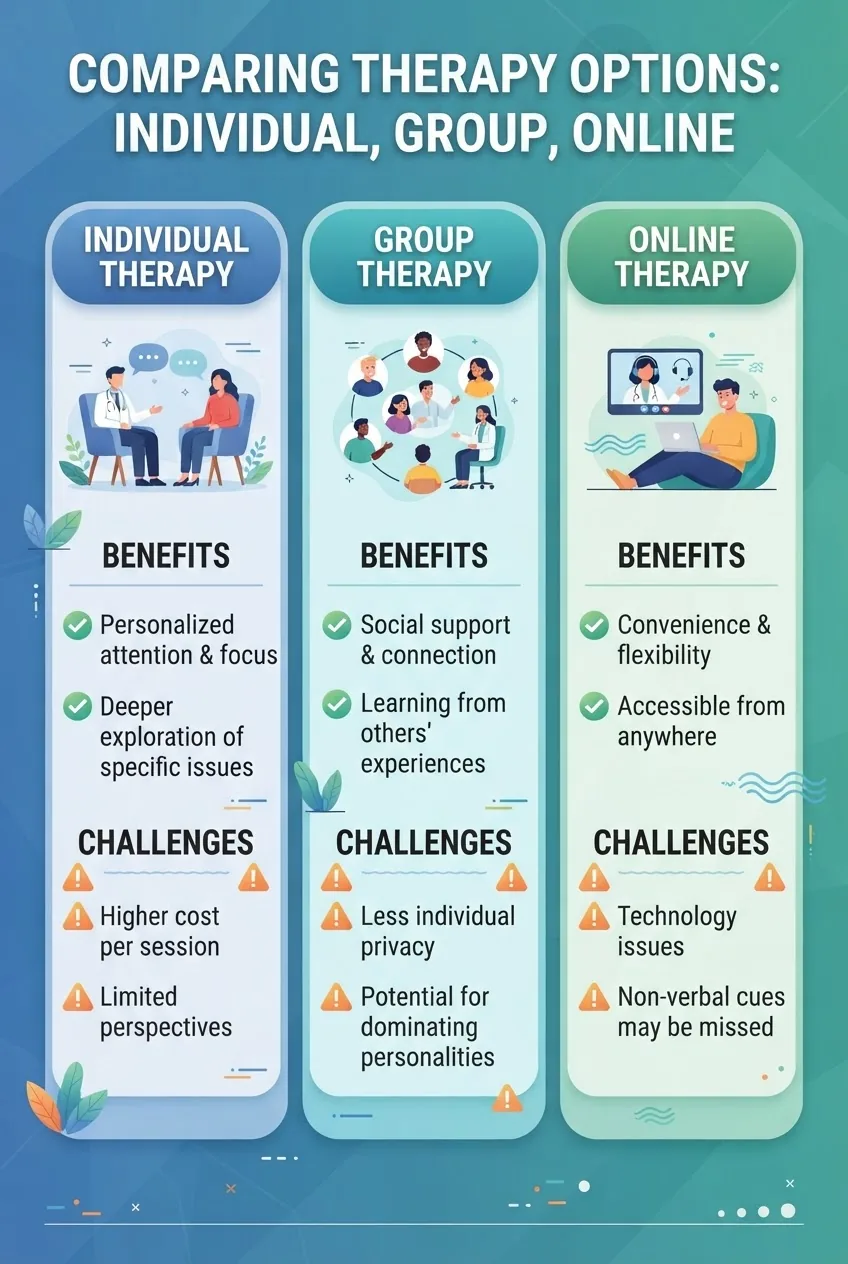
Below is a practical comparison table highlighting core differences and common use-cases.
| Modality | Typical benefits | Common challenges | Best suited for | Session format & practical notes |
|---|---|---|---|---|
| Individual therapy | Tailored treatment, strong therapeutic alliance, privacy | Cost per session higher; limited peer learning | Complex presentations, high-risk cases | 50–60 min sessions; in-person or video; ideal for manualised therapies like CBT |
| Group therapy | Peer support, social skills practice, lower cost per person | Less individual focus; confidentiality concerns | Social anxiety, DBT skills groups, relapse prevention | 90–120 min weekly sessions; leadership by 1–2 facilitators; good for skills training |
| Online therapy | Accessible, flexible, often lower cost, scalable | Technology barriers, privacy/security concerns, suitability limits for high risk | Mild–moderate depression, busy clients, rural access | Video or text-based; consider verified platforms and clinician credentials; measurement-based care feasible |
Additional contrasts:
- Cost: Group and online options are typically less expensive per session than individual therapy.
- Outcomes: Individual therapy may produce stronger alliance-driven gains; group interventions excel at behavioural rehearsal and peer feedback.
- Accessibility: Online therapy expands access; ensure secure platforms and clinician licensure for cross‑jurisdictional practice.
If you are interested in remote learning or remote delivery of CBT, explore CBT online course options.
Transition: With modality differences clarified, the next section offers a step-by-step approach to choosing the right therapy for your needs.
Choosing the Right Type of Therapy for You
Answer: Choose a therapy by matching your diagnosis, treatment goals and personal preferences to evidence-based options, confirming the therapist’s training and availability, and using short trials with outcome monitoring to evaluate fit and effectiveness.
Term: Therapy matching — the process of selecting a therapy approach based on clinical presentation, empirical evidence and client preference.
Step-by-step selection process:
- Clarify goals: Identify whether you prioritise symptom reduction, skills training, relationship work or insight; goals guide modality selection.
- Assess diagnosis and comorbidity: For primary depression with anxiety, CBT or ACT may be ideal; for complex trauma, trauma-focused CBT or EMDR with an experienced clinician is preferable.
- Check therapist training: Ask about formal training, supervised hours and CPD in the chosen modality; credentialed providers have better adherence to protocols.
- Consider modality and logistics: Decide between individual, group or online formats considering cost, access and comfort level.
- Trial period with outcome measures: Commit to 6–8 sessions with routine outcome monitoring (PHQ‑9) to assess initial response and adjust treatment as needed.
- Evaluate therapeutic fit: Adequate progress and a strong alliance indicate good fit; lack of progress should prompt a discussion about treatment change or referral.
Tips for specific scenarios:
- Mild depression: Brief CBT or guided self-help (online) often effective.
- Severe or recurrent depression: Consider specialist-trained clinicians, combination of psychotherapy and medication, and measurement-based care.
- Anxiety with depression: Look for transdiagnostic CBT or ACT approaches that address both—see anxiety vs depression treatment considerations for condition-specific differences.
What to do if progress is slow:
- Ask your therapist for a progress review using outcome measures.
- Discuss alternative or adjunctive approaches (medication, group therapy, specialist referral).
- Request supervision notes or a second opinion if you suspect insufficient training or fit.
Access and equity considerations in Sydney and Australia:
- Public services may offer lower-cost options but longer waitlists; private services offer shorter wait times at higher cost.
- Telehealth can bridge geographic gaps—confirm clinician registration covers interstate practice if needed.
Transition: The final section underlines the combined value of high-quality therapy and professional training for sustained mental health improvement.
Conclusion: The Value of Therapy and Qualified Training for Mental Health
Answer: Therapy delivers measurable benefits for depression when matched to clinical needs and delivered by trained professionals; strong training systems, supervision and evidence-based practice together increase treatment effectiveness, safety and long-term recovery prospects.
High-quality therapy and rigorous therapist training form a feedback loop: training produces clinician competence and adherence to evidence-based methods, which improves outcomes and informs future training standards. According to a 2024 APS report, investing in accredited training and supervised practice improves patient outcomes and reduces treatment variability (source type: professional association report).
Key takeaways:
- Understand therapy types and their methods to match treatment to your needs.
- Confirm therapist qualifications and specific training in the therapy you want.
- Use short trials and measurement-based care to assess effectiveness; be ready to switch approaches if progress stalls.
- Training, supervision and therapist competence are central to safe, effective treatment.
If you are seeking help in Sydney, start by clarifying treatment goals and asking potential providers about their accreditation and specific training; for training pathways, consult accredited university and professional organisation guidance to plan supervised practice and credentialing steps.
Call to action: If you want tailored help locating an accredited clinician or exploring training options in a specific therapy, contact a local clinic or training provider and request details of clinician credentials and supervised training pathways.