

By the end of this guide you will understand what a therapist for panic attacks does, which treatments work, and a clear, step-by-step plan to start therapy; it typically takes 4–12 weeks to notice meaningful change and assumes no prior clinical training.
Therapist for panic attacks — this hands-on guide walks you through assessment, choosing a therapist, therapy types, medication basics, what happens in sessions, and practical tools to manage and prevent attacks. Read the numbered steps, follow the checklist, and use the patient scenarios to set realistic expectations.
Before you start
- A list of your recent panic attack dates, durations, and triggers (note at least 2–4 incidents)
- A summary of current medications and dosages (if any) and GP/psychiatrist contact
- Insurance or Medicare details and referral letters if required
- A quiet 60–90 minute block for an initial intake session
- Openness to track symptoms weekly for at least 8–12 weeks
Core steps: start-to-finish process
- Clarify your experience — document what you felt physically and mentally during recent attacks, noting heart rate changes, breathlessness, dizziness, or chest sensations, and rate severity 1–10. This intake log speeds clinical assessment.
- Get a medical check — arrange a GP visit to rule out cardiac, respiratory or thyroid causes and to review medications that may provoke panic; bring your symptom log.
- Choose your therapist type — decide whether you want a clinical psychologist, psychiatrist, or accredited mental health social worker; check credentials and experience with panic disorder.
- Start evidence-based therapy — begin a structured program such as CBT with weekly sessions for 8–16 weeks; combine with targeted exposure work if recommended.
- Review medication options — if symptoms are frequent or severe, discuss SSRIs or short-term benzodiazepines with a psychiatrist or GP, and set timelines for review.
- Practice skills between sessions — commit to daily breathing practice (4–6 minutes), weekly exposure exercises, and a sleep and exercise routine for 12 weeks.
- Measure progress — use a simple scale (0–10) of attack frequency and severity each week; expect a 30–50% improvement by 8–12 weeks in most structured programmes.
- Plan maintenance — after core therapy, move to fortnightly or monthly review sessions for 3–6 months and keep a relapse prevention plan.
Transition: With these practical steps in mind, the sections below expand each step into clinical detail, patient scenarios and what to expect at each phase.
Understanding Panic Attacks and Panic Disorder
First, understand the experience so you can explain it clearly to a clinician and get focused help. A panic attack is a sudden surge of intense fear or discomfort with physical symptoms that peak within minutes. Panic disorder is when attacks are recurrent and followed by persistent worry or behaviour change.

What Is a Panic Attack?
A panic attack is an abrupt episode of intense anxiety accompanied by physical signs: racing heart, shortness of breath, shaking, sweating, chest discomfort, nausea, dizziness, numbness or a fear of losing control. Attacks typically peak within 10 minutes and can last 20–30 minutes; residual anxiety may persist longer.
Signs and Symptoms of a Panic Attack
Common symptoms include:
- Heart palpitations or accelerated heart rate in panic attack
- Shortness of breath, choking or smothering sensations
- Trembling, shaking or sweating
- Dizziness, lightheadedness, or near-fainting
- Nausea or abdominal distress
- Feelings of unreality (derealisation) or detachment (depersonalisation)
- Fear of losing control or “going crazy”
- Fear of dying (common, but medically unlikely)
Differences Between Panic Attacks and Anxiety Attacks
Many people ask about “anxiety attack vs panic attack.” A panic attack is sudden and intense, often with strong physical symptoms. An anxiety attack (a non-clinical term) typically builds more gradually and is linked to a specific worry or stressor. For diagnostic clarity, clinicians look at onset speed, frequency, and behavioural changes.
Transition: Now that you recognise symptoms and differences, learn what causes and triggers to look for so you can personalise treatment.
Causes and Triggers of Panic Attacks
Understanding triggers helps design targeted exposure and avoidance-reduction strategies. Panic attacks arise from an interaction of biological vulnerability and learned responses to internal or external cues.
- Biological factors: family history of panic disorder, heightened autonomic reactivity, and certain medical conditions.
- Life stressors: bereavement, major life transitions, or acute trauma.
- Substances: caffeine, nicotine, stimulants, some asthma medications, and illicit drugs can precipitate attacks.
- Learned responses: catastrophic misinterpretation of normal bodily sensations (e.g., interpreting heart rate increase as danger).
- Situational triggers: crowded spaces, driving, or places where escape feels difficult.
Examples from practice: a patient who developed nightly attacks after a hospital stay had a conditioned hypervigilance to heartbeats; another’s attacks were closely tied to excessive caffeine intake and irregular sleep.
For questions about fainting or serious syncopal events, see passing out from panic attacks.
Transition: With likely causes identified, the next section explains when and why to engage a therapist and what good therapy produces.
When and Why to See a Therapist for Panic Attacks
See a therapist when attacks are frequent (e.g., weekly or more), when you avoid activities because of fear, or when worry about future attacks lasts a month or longer. Therapy reduces attack frequency, improves coping, and restores functioning.
Case scenario A — Immediate impairment: Emma, 32, had daily attacks lasting 10–20 minutes, avoiding work meetings. After 6 weeks of CBT at Human Health Clinics with weekly exposure tasks, she regained confidence and returned to work part-time. Case scenario B — Medication-supported entry: Daniel, 48, had severe nocturnal attacks and benefited from a short SSRI initiation alongside therapy to stabilise sleep and reduce intensity.
Therapy benefits include skill acquisition (breathing, cognitive restructuring), graded exposure to feared situations, and relapse prevention. If symptoms are severe, a combined approach with medication often speeds symptom reduction.
Transition: The next section compares therapies side-by-side and links to broader treatment resources.
Types of Therapy for Panic Attacks
Below is a practical comparison table of common therapy types used by practitioners treating panic attacks. Use it to discuss options with a therapist and pick a plan with defined session counts and measurable goals. For broader treatment pathways see panic disorder treatment.

| Therapy Type | Description | Benefits | Usual Duration |
|---|---|---|---|
| Cognitive Behavioural Therapy (CBT) | A structured, time-limited talking therapy that modifies thinking patterns and behavioural responses. | Rapid symptom reduction, teachable skills, measurable outcomes. | 8–16 weekly sessions. |
| Exposure Therapy | Graduated exposure to feared sensations and situations to extinguish conditioned fear responses. | Reduces avoidance, durable relapse prevention. | 4–12 sessions plus homework. |
| Acceptance and Commitment Therapy (ACT) | Builds psychological flexibility and value-driven action despite anxiety. | Improves quality of life and coping with residual symptoms. | 8–12 sessions. |
| Psychodynamic/Insight-oriented therapy | Explores underlying emotional conflicts that may maintain panic responses. | Helps with comorbid issues and long-term personality patterns. | Often longer-term (3+ months). |
Short prose: CBT focuses on testing and changing thoughts (cognitive restructuring) and using behavioural experiments. Exposure therapy deliberately and safely triggers feared sensations in a controlled way, teaching the nervous system it can tolerate them. Human Health Clinics protocols typically pair CBT with interoceptive exposure (practicing induced physical sensations) in 8–12 sessions for measurable gains.
For reassurance about medical risk see can you die from a panic attack.
Transition: Therapy often works best when combined with appropriate medical care; below explains medication choices and trade-offs.
Medication and Other Medical Treatments for Panic Attacks
Medication can reduce frequency and severity of panic attacks and is often used alongside therapy. Use careful, documented trials with review dates and clear exit plans—there is no single “panic attack cure” for everyone.
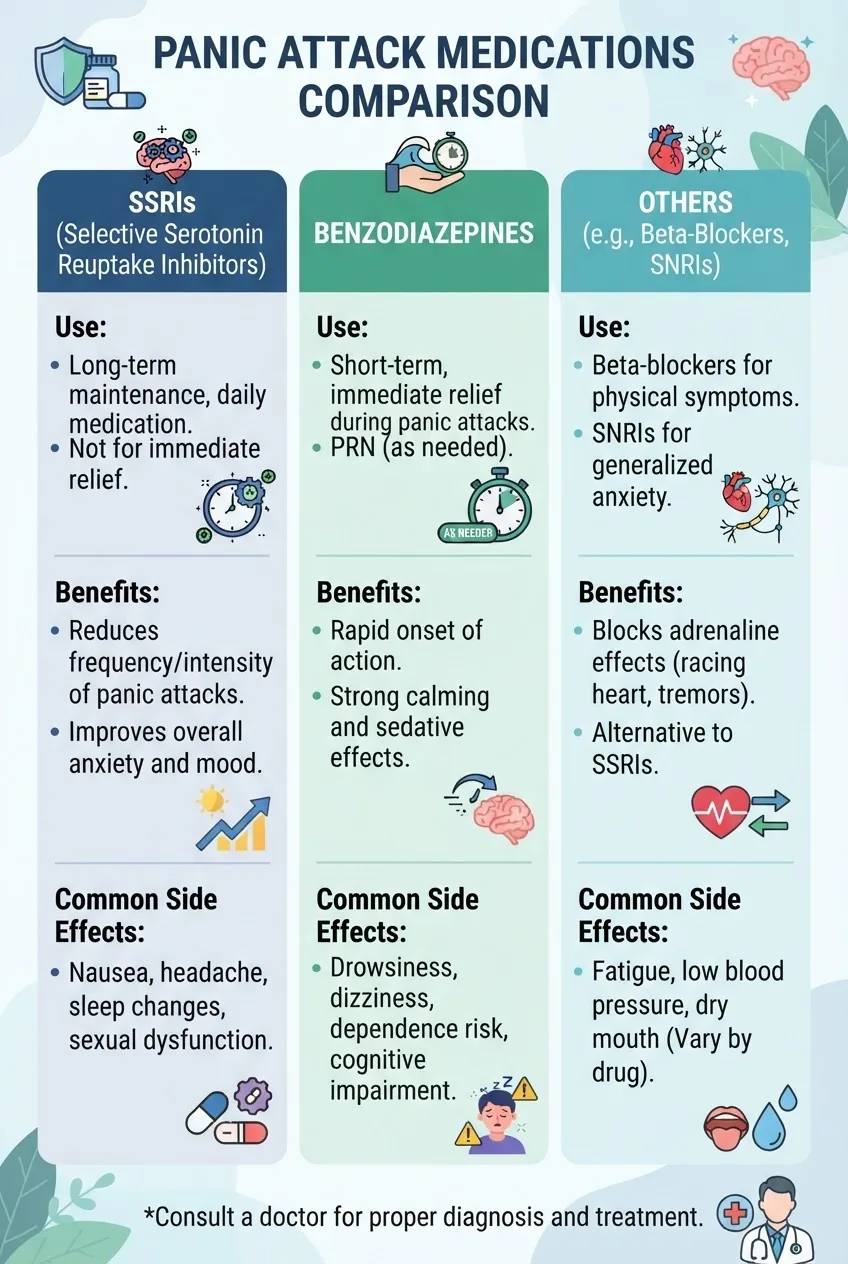
Selective Serotonin Reuptake Inhibitors (SSRIs)
SSRIs (e.g., sertraline, fluoxetine) are first-line medications for panic disorder. They reduce baseline anxiety and the likelihood of attacks when taken at therapeutic doses for at least 6–12 weeks. Pros: good evidence base, low overdose risk. Cons: initial side effects (nausea, sleep disturbance), delayed onset of benefit.
Benzodiazepines
Benzodiazepines (e.g., diazepam, lorazepam) act quickly to reduce acute anxiety. They are effective for short-term relief but carry risks of sedation, dependence, cognitive slowing, and withdrawal. Clinical guidance recommends limiting use to short periods (e.g., under 2–4 weeks) while longer-term strategies start.
Other Medications
Other agents include SNRIs, beta-blockers for situational triggers (e.g., performance anxiety), and, in some cases, antipsychotics for refractory cases. Each requires tailored risk–benefit discussion and monitoring.
Medication guidance: always set a review plan at 6–12 weeks after initiation, track side effects weekly, and coordinate with a psychiatrist if doses near maximum therapeutic ranges are contemplated. According to a 2023 Australian Government mental health guidance report, combined therapy and medication produce faster symptom control for severe cases; follow local protocols for dose adjustments (Australian Government Department of Health).
For meta-analytic evidence on psychotherapy and pharmacotherapy effectiveness, consult peer-reviewed sources such as the Journal of Anxiety Disorders and clinical guidelines summarised by NIMH.
Transition: With treatment options clarified, learn what a therapy pathway looks like from intake through maintenance so expectations match reality.
What to Expect During Therapy for Panic Attacks
This section is a step-by-step walkthrough of a typical therapy course at a clinic such as Human Health Clinics, from intake to maintenance.
- Intake assessment (60–90 minutes) — clinician documents history, attack timeline, medical review, and functional impact. You will complete standardised measures (e.g., panic symptom scales) and set 2–3 treatment goals with measurable targets (reduce weekly attacks by X%, return to Y activity).
- Initial formulation (1 session) — therapist explains a working model pinpointing triggers, maintaining factors, and a short-term plan (e.g., 12 sessions of CBT with interoceptive exposure twice weekly homework).
- Skill building (weeks 1–4) — learn breathing control (box breathing 4s in, 4s hold, 4s out, 4s hold; 4 repetitions twice daily), grounding techniques, and cognitive restructuring exercises practiced in 10–15 minute daily blocks.
- Exposure and practice (weeks 4–12) — structured interoceptive exposure (e.g., spinning, breath-holding, aerobic elevation) and situational exposure graded from 10–20 minute tasks up to full real-world challenges; homework logged and reviewed weekly.
- Consolidation (weeks 12–16) — reduce session frequency, build relapse prevention plan, and rehearse coping strategies under mild stressors.
- Maintenance and review (3–6 months) — schedule fortnightly or monthly check-ins, update the plan if new triggers emerge, and transfer skills to daily living and work.
Patient narrative: “In my first session I felt heard. My therapist gave a clear plan: four weeks of skills, then exposure. By week 8 my attacks dropped from 3 per week to one mild episode.” These realistic scenarios reflect typical outcomes when patients complete core sessions and homework.
Transition: While therapy is central, you can apply immediate techniques to stop and prevent attacks outside sessions.
How to Manage and Prevent Panic Attacks Outside Therapy
Use these concrete, timed strategies when an attack starts or to reduce future risk.
- Stop and orient (0–60 seconds) — sit if possible; name five things you can see, four you can touch, three you can hear, two you can smell, one you can taste (5-4-3-2-1 grounding). This anchors attention away from catastrophic thoughts.
- Breathe with structure (1–5 minutes) — do box breathing: inhale 4s, hold 4s, exhale 4s, hold 4s; repeat 6 cycles (about 4–6 minutes) to reduce hyperventilation and heart rate spike.
- Allow sensation (5–15 minutes) — remind yourself sensations peak and pass within 10–20 minutes; practise self-talk: “This is an attack, not a medical emergency.”
- Use emergency coping items — a small bottle of peppermint oil, a cold towel on the face, or a 5-minute walk can interrupt rumination.
- Prevention routine (daily) — limit caffeine to <200 mg/day, sleep 7–8 hours, do 30 minutes of moderate exercise 5 times/week, and practice 4–6 minutes of breathing daily.
Transition: Below are practitioner-observed common mistakes and how to avoid them.
Common mistakes and how to avoid them
I often saw patients stop medication without a taper — that led to rebound anxiety and return of attacks. To avoid this, always plan medication changes with your prescriber with a 2–4 week taper schedule for SSRIs where indicated. I also observed avoidance behaviours worsen when exposure homework was skipped; do the short daily tasks—10–20 minutes—to get durable gains.
Checklist: Verify your therapy plan
- Have you documented at least 2 weeks of symptom logs with times and triggers?
- Did you obtain a medical review to exclude cardiac or medical causes?
- Does your therapist use a structured approach (CBT or exposure) and measurable goals?
- Is there a medication review plan with specific review dates (6–12 weeks)?
- Do you have a written relapse prevention plan and maintenance session schedule?
When to call in a professional
Contact emergency services or your GP immediately if chest pain is severe, fainting occurs, or you suspect a medical emergency. Seek an urgent psychiatric or GP review if panic attacks increase in frequency to daily or if suicidal thoughts emerge. Otherwise, call your therapist if attacks worsen despite 4 weeks of structured therapy or if side effects from medication are severe.