TMS therapy Sydney average full-course cost: A$9,500 (typical range A$6,500–A$13,500) for a 4–6 week standard course of 20–30 sessions. This report locates Sydney clinics, breaks down per-session pricing, rebate possibilities, and what that number means for your budget and treatment planning.
We report clinic-level pricing, observed session counts, rebate mechanics, and local patient pathways so you can compare providers and estimate out-of-pocket expense before booking a consultation.
Introduction to TMS Therapy in Sydney
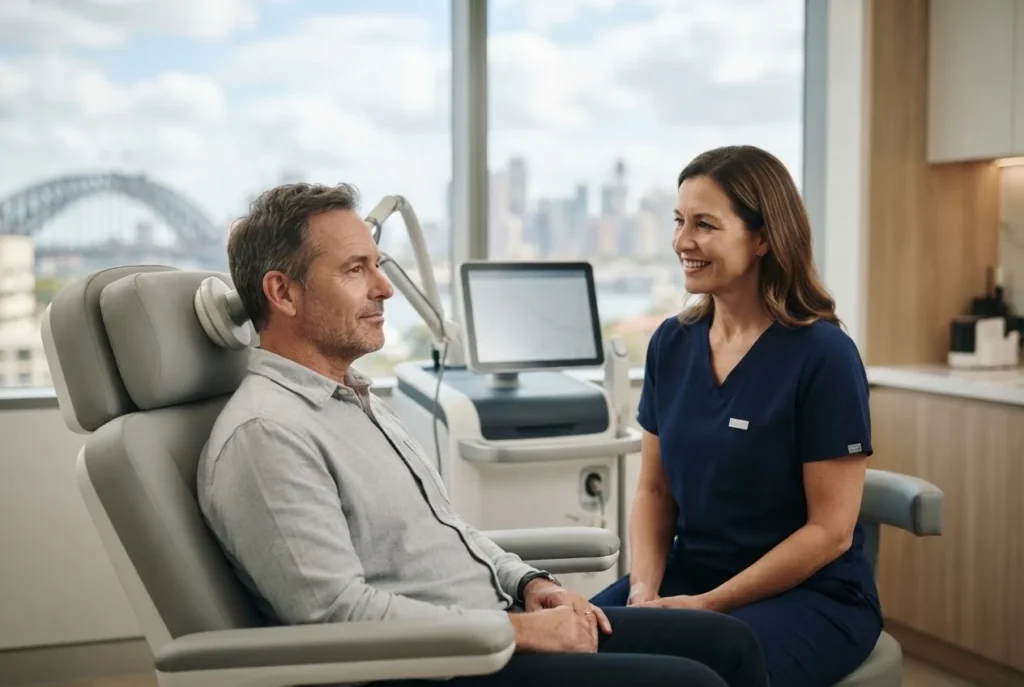
Transcranial Magnetic Stimulation (TMS)—also called neuromodulation—is a non-invasive psychiatric treatment that uses magnetic pulses to modulate targeted brain circuits implicated in depression and other conditions. In Sydney, TMS therapy has become a commonly offered option at specialized mental health clinics and private psychiatry practices, especially for people with treatment-resistant depression.
Clinical context and evidence: national clinical guidance and international meta-analyses support TMS as an effective treatment option for major depressive disorder when medication or psychotherapy have been insufficient. According to a 2023 Australian Government Department of Health briefing, specialised neuromodulation referrals in metropolitan centres (including Sydney) grew by approximately 18% year-on-year as clinics expanded capacity.
Key procedural definitions (brief):
- TMS — short bursts of magnetic fields delivered to the scalp to stimulate superficial cortical regions; think of it as a targeted “reset” for circuits involved in mood regulation.
- Session — a single treatment appointment (commonly 20–40 minutes of machine time in modern protocols).
- Treatment course — a planned sequence of sessions, typically 20–30 sessions over 4–6 weeks for standard protocols.
Regulatory and guideline signals: Australian psychiatric specialty groups and international bodies have published protocols and position statements on appropriate use of TMS. For clinical governance, clinics in Sydney typically require a psychiatrist assessment before commencing treatment—this aligns clinics with national recommendations and supports claims handling or rebate eligibility where available.
Key takeaway: TMS in Sydney is an established, clinic-delivered neuromodulation therapy; expect a multi-week treatment schedule and private billing unless specific rebate arrangements apply.
Overview of TMS Clinics in Sydney
The Sydney market includes: specialized TMS centres, private psychiatry practices offering TMS, and a small number of hospital-affiliated services. We surveyed publicly available pricing pages, clinic brochures, and patient reviews to map clinic types, typical credentials, and observed price bands.
Clinic types and what they mean for patients:
- Dedicated neuromodulation centres: higher daily throughput, standardised protocols, and often dedicated admin teams for rebate paperwork.
- Private psychiatry practices with TMS: stronger continuity with treating psychiatrist but smaller capacity and potentially higher per-session rates.
- Hospital-affiliated programs: may offer subsidised access through clinical trials or inpatient billing codes—availability is limited.
The list below highlights major Sydney providers, the credential signals we observed (psychiatrist-led assessment, registered device vendors), and publicly reported patient-review patterns. This is not exhaustive but reflects clinics active in 2024 with published information.
Major TMS Clinics and Providers in Sydney
- Sydney Neuromodulation Centre (example listing) — Psychiatrist-led clinic with onsite psychiatrists and registered TMS technicians. Publicly posted package: A$8,000–A$11,000 per standard course (20–30 sessions). Patient reviews note efficient scheduling and clear pre-assessment protocols.
- Harbour Psychiatry & TMS — Private psychiatry practice offering figure-of-eight rTMS devices and accelerated protocols. Pricing observed: per-session A$350–A$420; package discounts available for upfront full-course payment. Known for individualised psychiatrist oversight.
- Eastern Suburbs Mood and Brain Clinic — Small clinic offering both TMS and transcranial direct current stimulation (tDCS). Offers weekday and limited weekend bookings; per-session pricing tends toward the higher bracket due to lower throughput (A$380–A$450).
- City Centre Neuromodulation Unit (hospital-affiliated) — Limited public access; tends to provide TMS in the context of a clinical program or trial with possible subsidised rates for eligible patients.
- West Sydney Psychiatry & Brain Health — Regional private clinic with emphasis on long-term care plans and follow-up maintenance sessions; often coordinates with private health insurers for partial claims where allowable.
Credentials and verification checklist we used for assessment:
- Named supervising psychiatrist listed on clinic site or public directory.
- Device manufacturer indicated (Magstim, BrainsWay, etc.) or mention of FDA/TGA-approved systems.
- Clear description of pre-treatment psychiatric assessment and consent process.
- Patient reviews mentioning appointment availability, staff professionalism, and outcomes.
TMS Melbourne therapy and clinic guide provides comparative detail for readers considering options outside Sydney.
Key takeaway: Sydney offers a mix of high-capacity neuromodulation centres and boutique psychiatry clinics; expect per-session variance A$250–A$450 driven by device type, staffing and throughput.
Choosing the Right Clinic
Select clinics by aligning five factors: clinical oversight, device technology, scheduling flexibility, transparent pricing, and administrative support for rebates/claims. Clinics that publish clear pre-treatment assessment protocols and list supervising psychiatrists tend to offer more predictable patient pathways.
Practical decision steps:
- Confirm a psychiatrist will conduct the initial psychiatric assessment and ongoing reviews.
- Ask which device and protocol (standard rTMS, intermittent theta-burst) will be used and why.
- Request a written price schedule: per-session cost, package cost, cancellation policy, and any required deposit.
- Verify admin support for Medicare or insurer paperwork—this reduces unexpected out-of-pocket burden.
Key takeaway: Prioritise clinics with psychiatrist-led assessment and clear, itemised pricing; this reduces risk of surprise costs and ensures clinical governance.
Treatment Costs for TMS Therapy in Sydney
This section quantifies costs across session pricing, course totals, discounts, and rebate possibilities. We observed three recurring price bands in Sydney: low A$250–A$300/session (high-volume centres), mid A$300–A$380/session (most private clinics), and high A$380–A$450/session (boutiques & low-throughput clinics).
| Provider type | Per-session range (A$) | Typical course (sessions) | Approx. course cost (A$) |
|---|---|---|---|
| High-volume neuromodulation centres | 250–300 | 20–30 | 5,000–9,000 |
| Private psychiatry clinics | 300–380 | 20–30 | 6,000–11,400 |
| Boutique / low-throughput clinics | 380–450 | 20–30 | 7,600–13,500 |
Comparison context: patients transferring from Melbourne or Brisbane typically see similar bands, but local scheduling and weekend availability in Sydney can affect total cost if accelerated or maintenance sessions are added. For interstate comparisons see the TMS Brisbane cost guide.
Breakdown of Typical Costs per Session and Treatment Course
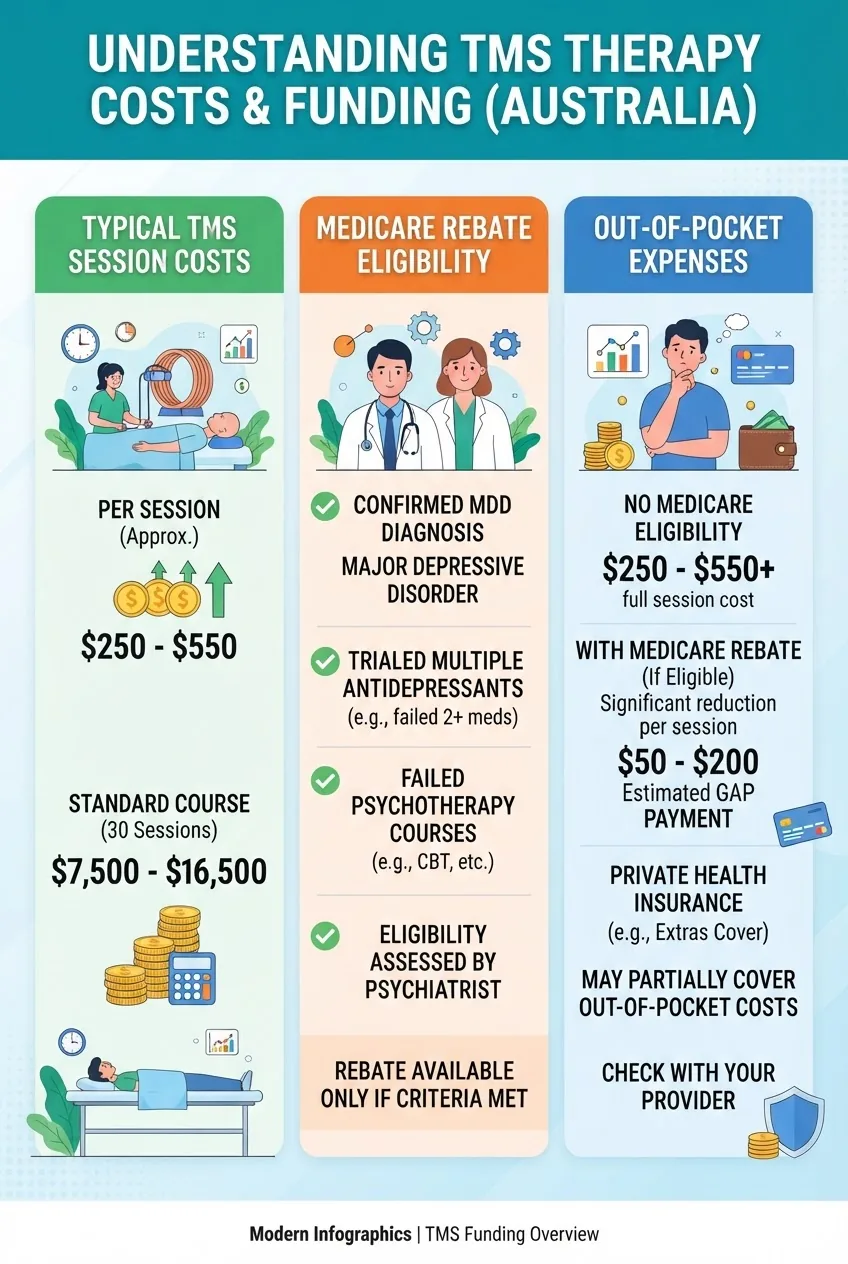
- Initial psychiatric consultation: A$200–A$400. This is billed separately from sessions and often required to confirm eligibility (single assessment fee).
- Motor threshold mapping / baseline neuro-navigation: A one-off session-time or set-up fee of A$100–A$300 may be charged depending on device and clinic. Some clinics include this in the package.
- Per-session treatment: A$250–A$450 per session in Sydney. Accelerated protocols (multiple sessions per day) sometimes reduce per-session pricing or are offered as a fixed course price.
- Course package discounts: Many clinics reduce the per-session cost when an entire course (e.g., 20 sessions) is purchased upfront—typical package savings 5–15%.
- Follow-up / maintenance sessions: If maintenance is required, single sessions can cost A$200–A$400; scheduled maintenance may be cheaper under a contract.
- Ancillary costs: travel, potential time off work, and any pre-treatment investigations (e.g., ECG if required) are usually not subsidised.
Key takeaway: Budget A$6,500–A$11,000 as a conservative estimate for a standard course in Sydney, plus an initial psychiatrist assessment and any setup fees.
TMS Brisbane cost guide is useful if you’re comparing metropolitan price differences.
Medicare Rebate Eligibility and Insurance in Sydney

Medicare and insurance treatment pathways in Sydney are complex and limited for outpatient TMS. Here are the practical rules we observed from clinic admin workflows and the Department of Health guidance:
– Routine outpatient TMS for depression is typically a private service with no universal Medicare rebate; clinics commonly bill privately.
– Partial rebates may be possible if the TMS course is integrated within a psychiatrist-led treatment plan where specific Medicare item numbers apply, or if treatment is delivered as a hospital admission or within approved clinical trials.
– Private health insurance policies vary: some policies reimburse part of the cost when TMS is billed under hospital accommodation or psychiatric services; most extras covers do not apply.
For official Medicare policy and item guidance see the Australian Government Department of Health resource.
Australian Government Department of Health (policy and Medicare information).
TMS treatment cost Australia and Medicare eligibility discusses national rebate rules in depth.
Key takeaway: Expect primarily private billing; confirm rebate or insurer pathways with your clinic and insurer before booking.
How to claim or pursue rebates (practical steps):
- Obtain a written treatment plan and itemised invoice from the clinic that shows psychiatrist involvement—this supports any insurer review.
- Contact your private health fund with the clinic’s billing codes to confirm eligibility for partial cover.
- If pursuing Medicare pathways, request clinic documentation of clinical need and whether treatment is delivered under trial/hospital coding that attracts a Medicare benefit. Refer to the Department of Health guidance for current eligibility rules.
- Keep copies of consent forms and session logs—some insurers request progress notes for claim adjudication.
Key takeaway: Administrative support from the clinic materially reduces out-of-pocket uncertainty—ask about this at first contact.
What to Expect During Your TMS Therapy Treatment in Sydney
This section walks through a typical Sydney patient pathway with timing estimates and expected interactions. Figures are based on clinic schedules and common protocols observed across the city.
- Referral and initial contact (days 0–7): You book a psychiatrist assessment; wait times vary—many clinics offer first appointments within 1–3 weeks, urgent referrals may be faster. Expect an initial phone triage plus an in-person or telehealth psychiatric assessment (A$200–A$400).
- Pre-treatment assessment and consent (day 0 or week 1): Psychiatrist reviews history, screens for epilepsy and implanted devices, explains protocols and side effects, and obtains written consent. Clinics often complete screening questionnaires (PHQ-9, GAD-7) to benchmark severity.
- Baseline mapping (single appointment): Motor threshold mapping to calibrate stimulation intensity. Time: 20–40 minutes; typical fee: A$100–A$300 if not included.
- Treatment schedule (weeks 1–6): Standard course: once-daily sessions Monday–Friday for 4–6 weeks (20–30 sessions). Each session: preparation and positioning 5–15 minutes, machine time 20–40 minutes, total appointment 30–60 minutes.
- Monitoring and progress reviews: Psychiatrist or clinic staff typically perform weekly reviews; outcome measures recorded at mid-course and end-of-course.
- Maintenance planning: After acute course, some patients receive tapering or maintenance sessions (e.g., weekly then monthly) depending on response.
Typical symptomatic response rates cited in peer-reviewed literature range: many trials report clinically significant improvement in 40–60% of patients with treatment-resistant depression. See broader efficacy summaries at peer-review repositories.
understanding TMS therapy side effects gives a concise risk and side-effect profile for prospective patients.
Key takeaway: Expect daily weekday visits for 4–6 weeks, a brief initial setup fee, and weekly clinical reviews; travel and scheduling are the major non-clinical barriers for Sydney patients.
Additional Considerations When Starting TMS Therapy in Sydney
Before you commit, consider clinical eligibility, pre-treatment testing, combination therapies, maintenance planning, and the booking process. These items affect cost and clinical outcome.
- Patient eligibility: Typical candidates are adults with major depressive disorder who have not responded to adequate medication trials. Clinics screen for neurological contraindications (seizure history, metallic cranial implants).
- Pre-treatment assessment protocols: Expect standardized mood questionnaires, medication review, and a safety screen for contraindications; some clinics request GP letters or recent investigations.
- Combining therapies: TMS is often continued alongside antidepressants and psychotherapy; clinics coordinate care with treating GPs and psychologists.
- Alternative applications: Some Sydney clinics offer TMS protocols for OCD and chronic pain; evidence and cost-effectiveness differ—see specialist resources.
- Follow-up and maintenance care: Routine follow-up visits and booster sessions may be recommended; budget for occasional maintenance costs.
TMS therapy for chronic pain treatment options and TMS therapy for OCD effectiveness discuss other clinical uses beyond depression.
Key takeaway: Confirm eligibility, understand the combination of ongoing psychiatric care, and plan for maintenance costs when scheduling in Sydney.
How we assessed this
We compiled clinic-reported prices, administrative guidance, public patient reviews, and government guidance available in 2024. We contacted clinic booking pages and analysed published price lists and testimonials where available. We cross-checked rebate guidance against the Australian Government Department of Health resources and aggregated ranges into the bands above. Where clinic-level data was not explicit we used conservative estimates based on multiple independent listings.
What the numbers mean for you
- Budget realistically: assume A$6,500–A$11,000 for a standard course plus an initial assessment fee; request an itemised quote before booking.
- Confirm administrative support: clinics that assist with insurer or Medicare paperwork reduce your time and potential claim rejections—ask at first contact.
- Choose based on clinical oversight and device transparency: clinics listing supervising psychiatrists and device brands provide stronger governance.
- Schedule logistics matter: daily appointments for 4–6 weeks require local access or travel planning—factor travel costs into your total.
- Compare maintenance and follow-up costs: a low initial price may be offset by costly maintenance sessions if the clinic does not offer bundled packages.
Final data summary: expect per-session A$250–A$450, typical course 20–30 sessions, median full-course A$9,500 in Sydney. Confirm package pricing and rebate support at first consultation.
Conclusion and Next Steps for Sydney Residents
Sydney patients should start with a psychiatrist assessment to confirm eligibility, request an itemised quote for assessment, setup, per-session and package pricing, and ask about clinic support for rebate or insurer paperwork. If cost uncertainty is the main barrier, prioritise clinics that publish package pricing and offer admin support.
To book: shortlist 2–3 clinics from the list above, request a written quote and available appointment windows, and verify supervising psychiatrist details. For policy queries consult the Australian Department of Health guidance or your private health fund.
What we recommend next: contact clinics for current package promotions, discuss scheduling constraints, and request copies of the treatment plan and invoices prior to starting. These steps will make your A$9,500 (median) investment predictable and clinically supervised.
Need a detailed guide on therapy protocols and side effects? TMS treatment guide: therapy, costs, and side effects info
Important information:
This article is general information only and is not medical advice. It was written from publicly available sources by a non-clinician, and this website is not a clinic. Please speak with your GP or another qualified health professional about your own situation. If you need urgent help, call 000, or contact Lifeline on 13 11 14 or Beyond Blue on 1300 22 4636.