

The cheapest way to get ADHD diagnosis Australia-wide is typically: see a bulk-billing GP for an initial consult and referral, access public mental health services or community clinics for assessment, or use a Medicare-rebated psychologist/psychiatrist; private assessments and specialist testing are faster but cost more out-of-pocket. This balances speed, rebates and expense.
What Is ADHD Diagnosis and Why Is It Important?
Answer: An ADHD diagnosis is a clinical assessment confirming attention-deficit/hyperactivity disorder; it guides treatment, access to funded services, workplace adjustments and education supports, and helps manage risks linked to unrecognised ADHD.
Term: ADHD stands for attention-deficit/hyperactivity disorder, a neurodevelopmental condition characterised by inattention, hyperactivity and/or impulsivity present across settings.
A confirmed ADHD diagnosis provides a diagnostic label clinicians use to develop treatment plans (medication, psychological therapies, adjustments at work/school) and enables access to Medicare-subsidised care and some state-funded supports. According to a 2024 industry report, timely diagnosis improves adult workplace outcomes and educational attainment.
ADHD symptoms overlap with anxiety, depression and learning disorders; screening for co-occurring conditions is routine during assessment and essential for accurate treatment choice. For prevalence and age-specific impact data, see mental health in Australian youth statistics.
Understanding provisional diagnoses helps when immediate full assessments aren’t available; learn more at provisional diagnosis definition and meaning.
Transition: Next, the practical steps to secure a diagnosis in Australia—who to see, referrals and testing options—are laid out below.
How do I get an ADHD diagnosis in Australia (Overview of the ADHD Diagnosis Process in Australia)?
Answer: Start with a GP for an assessment and referral, then follow structured diagnostic steps that may involve a psychiatrist, psychologist or clinical neuropsychologist, and use validated rating scales and history-taking to confirm DSM-5 criteria.
The usual pathway varies by state and service type. Below are numbered steps used across Australia, with links to further resources explaining tests and clinical roles.
- GP appointment and screening — Your GP documents symptoms, functional impairment and history, rules out medical causes, and provides referrals.
Term: Referral — a GP’s formal recommendation for specialist assessment or allied health care.
- Referral to appropriate clinician — Depending on complexity: psychiatrist (medical management and diagnosis), psychologist (psychological assessment), or clinical neuropsychologist (detailed cognitive testing). For descriptions of psychiatric roles, see psychiatrically definition and psychiatric meaning explained.
- Structured diagnostic interview — Clinicians use clinical interviews mapped to DSM-5 criteria, collect developmental history and collateral reports (school/employer).
Term: DSM-5 — the Diagnostic and Statistical Manual, 5th edition; clinicians use its ADHD criteria to determine diagnosis.
- Standardised rating scales and questionnaires — Tools commonly used include Conners Rating Scales, ADHD Rating Scale, and strength/weakness inventories; clinicians compare scores against norms.
- Cognitive and learning assessment if required — Clinical neuropsychological testing (IQ, working memory, executive function) is used when the presentation is complex or diagnostic clarity is needed.
- Medical review and laboratory checks — GPs or psychiatrists may order basic blood tests to exclude medical contributors to concentration problems.
- Feedback and report — Clinician provides a diagnostic formulation, recommendations (medication, therapy, adjustments) and a written report for schools, employers or Medicare claims.
- Follow-up and care plan — If eligible, a GP can create a Mental Health Care Plan and arrange subsidised sessions; see practical templates at mental health care plan example and assessment template.
Assessment tools and testing often referenced in Australian assessments include Conners scales, Adult ADHD Self-Report Scale (ASRS), neuropsychological batteries and structured DSM-5-based interviews. For methods used across medicine, see diagnosis in medicine guide for symptoms evaluation and MSE mental status examination assessment.
Medicare and reporting: clinicians typically code consultations under Medicare Benefits Schedule (MBS) items when eligible; psychiatrists’ assessments attract different MBS items and rebates than psychology sessions. According to 2024 Medicare data, average rebates for standard psychology visits remain limited, making choice of clinician a cost factor.
Transition: Understanding who does what and the steps clarifies cost and timing trade-offs, explained next.
What are the costs involved in getting an ADHD diagnosis (Understanding the Costs Involved in Getting an ADHD Diagnosis)?
Answer: Costs range from zero (public services/bulk-billed GP) to $1,200–$3,500+ for comprehensive private neuropsychological assessments; Medicare rebates reduce some psychology/psychiatry fees but do not fully cover detailed testing.
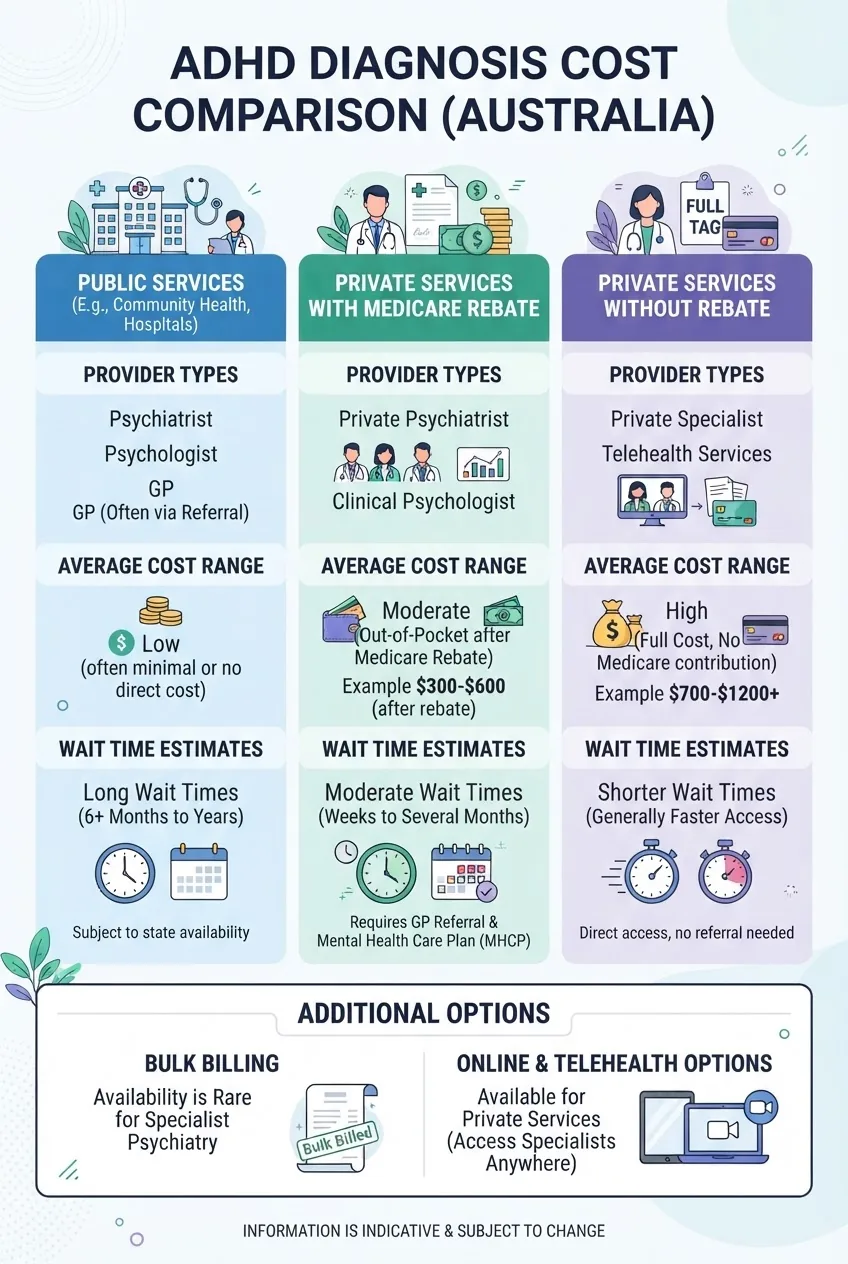
| Provider / Pathway | Typical Out-of-Pocket (2024) | Medicare Rebate Possible | Typical Wait Time |
|---|---|---|---|
| Bulk-billing GP consult (referral) | $0 if bulk-billed | N/A for GP visit (Medicare covers item partly if gap exists) | Same-day to 2 weeks |
| Public/community mental health assessment | $0 (public) or low-cost | N/A | 2–26+ weeks (varies by state) |
| Private psychologist assessment (brief) | $200–$600 total | Partial rebate via MBS with Mental Health Care Plan (limited) | 2–8 weeks |
| Private psychiatrist consult | $250–$800 (initial) | Medicare rebate applies to specific MBS items | 1–12+ weeks |
| Clinical neuropsychological testing (private) | $1,200–$3,500+ | Limited rebate or none | 4–16 weeks |
| Online assessment services (clinician-led) | $150–$900 | Some services offer Medicare-rebatable telehealth items | Same-day to 2 weeks |
Explanation: Private neuropsychology involves multi-hour testing and formal reports, hence higher costs. Private psychiatrists can provide diagnostic clarity and authority for medication prescriptions; their initial consults are typically more expensive than psychologist sessions but attract larger MBS rebates for medical services.
Medicare rebates: Medicare provides rebates for GP, psychiatric and some psychologist services via the MBS and the Better Access initiative when a Mental Health Care Plan exists. For up-to-date item details and rebate amounts, consult Australian Government Department of Health. According to a 2024 Medicare summary, rebates reduce but do not eliminate cost for multi-hour assessments.
Insurance: Private health insurance rarely covers diagnostic assessments fully; it may cover inpatient or psychiatry if admitted or specific allied health under extras; check your policy. Employers and NDIS (for eligible participants) can subsidise supports after diagnosis.
Transition: With costs clearly mapped, next are the cheapest realistic pathways nationwide and case examples to illustrate choices.
What are the cheapest ways to get an ADHD diagnosis in Australia?
Answer: The cheapest routes are bulk-billed GP referrals to public/community mental health or bulk-billed clinics, sliding-scale community psychology services, and some online clinician-led assessments that offer Medicare-rebatable telehealth items.

Below are low-cost options, practical steps to access them, and a short scenario showing how to minimise cost while retaining clinical value.
- Bulk-billing GP + public service referral
Find a GP who bulk-bills (no gap) for an initial consult and referral to public child/youth mental health or adult community mental health teams; public services are free. Search local community health centres or hospital outpatient clinics for assessment clinics.
- Community health clinics and sliding-scale psychology
State-funded community mental health teams and university psychology clinics offer low-cost or free assessments. University clinics often provide supervised assessments at reduced fees.
- Mental Health Care Plan then Medicare-rebated psychology
With a GP mental health care plan, you can access up to 10 subsidised psychology sessions (Medicare rebates apply) for assessment and therapy. Use subsidised sessions for diagnostic interviews—note complex neuropsychology may not be fully covered.
- Telehealth / online clinician-led assessments
Some telehealth providers offer shorter wait times and lower fees; if run by a registered psychologist or psychiatrist they may attract Medicare telehealth rebates when criteria are met.
- Bulk-billing psychiatric outreach programs
In some regions public hospitals run psychiatric clinics that bulk-bill or are free for residents; these are often triaged for severity and functional impairment.
- Student and NGO services
Non-profits and university training clinics can perform assessments at low cost; wait times vary but cost is minimal.
Case scenario: A 24-year-old requires diagnosis fast and affordably. Step 1: book a bulk-billing GP (no gap) for a referral and Mental Health Care Plan. Step 2: book a Medicare-rebated telehealth psychology assessment (using initial subsidised sessions) while awaiting public clinic triage. Total out-of-pocket: potentially $0–$150 depending on private session gaps.
How to find bulk-billing and low-cost clinics:
- Local Health District websites and community health centre listings.
- University psychology/medical school clinics (search for practicum clinics).
- State health waitlist for public mental health services.
- Telehealth platforms advertising Medicare-rebatable clinician services.
For Sydney-specific bulk billing options see ADHD diagnosis Sydney bulk bill options.
Limitations: Public and low-cost routes often have longer waits and variable scope of testing (may omit full neuropsychological batteries). Always confirm what the assessment includes (diagnostic interview, collateral history, rating scales, formal report) before booking.
Transition: If speed matters more than absolute cheapest cost, consider the faster pathways next.
What is the fastest way to get your ADHD diagnosis?
Answer: The fastest route is to book a private psychiatrist or a private psychologist offering expedited or telehealth assessments; many private services can deliver a diagnosis in days to a couple of weeks at higher cost.

Steps and tips to speed up diagnosis:
- Call multiple private clinics — Ask for earliest cancellations and express that you need an assessment within two weeks; many clinics maintain cancellations lists.
- Use telehealth — Telehealth often has more appointment slots; check whether the provider offers full diagnostic assessments remotely and whether Medicare rebates apply.
- Request an initial psychiatric review — Psychiatrists can provide provisional diagnosis and medication management faster than longer psychology testing pathways.
- Prepare collateral documents — Bring school or employment reports, prior assessments, and symptom logs to reduce appointment time spent on history-taking.
- Pay for an assessment package — Some private clinics offer an expedited paid package (assessment + report) with faster turnaround; weigh costs vs. speed.
- Ask your GP for an urgent referral — If functional impairment is severe, GPs can flag referrals as urgent to public services.
Timing expectations: private psychiatrist initial consults can be within 1–14 days; private psychologists offering focused ADHD assessments often provide results within 1–3 weeks; full neuropsychological batteries typically require multiple sessions over several weeks.
Trade-offs: Faster private routes cost more and may provide less comprehensive testing than a multi-session neuropsychological assessment. If medication is likely, a psychiatrist delivers both diagnosis and prescriptive authority quickly, while a psychologist cannot prescribe medication.
Transition: Below is a direct comparison of online, public and private services to help choose by cost, speed and accuracy.
How do online, public, and private ADHD diagnosis services compare?
Answer: Public services are cheapest or free but slower and variable in scope; private services are fastest and more comprehensive but costlier; online clinician-led assessments can be a middle ground—faster and often cheaper than face-to-face private testing but variable in depth.
| Service Type | Cost Range | Speed | Assessment Depth | Ideal For |
|---|---|---|---|---|
| Public / community mental health | Free | Slow (weeks–months) | Variable; often interview + basic scales | Those who can’t afford private care |
| Private psychiatrist | $250–$800 initial | Fast (days–weeks) | Clinical interview; medical assessment; may not include full cognitive testing | Need quick diagnosis and medication |
| Private psychologist | $200–$1,200 | Moderate (1–4 weeks) | Interview + standardised questionnaires; more psychotherapeutic focus | Behavioural interventions and diagnosis without immediate medication |
| Clinical neuropsychology | $1,200–$3,500+ | Slower (weeks–months) | Very comprehensive cognitive testing and report | Complex presentations or medico-legal needs |
| Online clinician-led services | $150–$900 | Fast (same-day–2 weeks) | Interview + digital scales; variable cognitive testing | Those seeking faster, lower-cost options |
Accuracy considerations: Face-to-face detailed neuropsychology remains gold standard for complex cases; however, trained clinicians using validated scales and collateral information via telehealth can reliably diagnose typical ADHD presentations. For assessment standards in Australia, see the Australian Psychological Society guidance at Australian Psychological Society and NHMRC clinical guidance at National Health and Medical Research Council.
Transition: Preparing well for appointments reduces repeated costs and speeds the diagnostic process—next is a practical checklist for preparation.
How should I prepare for my ADHD diagnosis appointment?
Answer: Prepare by tracking symptoms, collating history and documents, listing medications and questions, and completing screening tools or a mental wellness test to save clinician time and improve diagnostic accuracy.
Before the appointment, complete structured symptom logs covering two or more settings, collect school or workplace reports, and ask caregivers/partners to provide collateral statements if possible. Consider completing an online baseline self-report.
- Bring identification, Medicare card and a list of current medications and dosages.
- Document onset and persistence of symptoms (childhood examples help confirm developmental history).
- List functional impacts across work, home and relationships with concrete examples.
- Prepare a short timeline of previous mental health treatments and responses.
- Complete screening tests such as Adult ADHD Self-Report Scale (ASRS) if available; consider a mental wellness test online ahead of time.
- Prepare questions: diagnostic methods, expected timeline, cost estimate, written report turnaround, and next steps if diagnosis confirmed or ruled out.
Bringing well-organised documentation can reduce the number of sessions required and therefore total cost. If attending on a low budget, ask whether the provider can prioritise diagnosis and written recommendations over extended testing to limit expenses.
Transition: After diagnosis, there are subsidised and practical support options—read on for treatment options, care plans and resources.
What happens after the diagnosis and what support options are available?
Answer: After diagnosis, clinicians recommend treatment (psychological therapy, medication), a Mental Health Care Plan for subsidised therapy sessions, workplace or school adjustments, and referrals to support groups or NDIS where eligible.
Treatment pathways depend on age, severity and comorbidities. Typical options include stimulant or non-stimulant medication prescribed by a psychiatrist or GP under shared care; cognitive-behaviour therapy (CBT) or ADHD coaching by psychologists; and occupational therapy for executive function support.
- Mental Health Care Plan: GPs can prepare a plan allowing access to Medicare-rebated psychology sessions; for details and templates see mental health care plan example and assessment template.
- Medication management: Psychiatrists or GPs (with training) manage prescriptions; ongoing monitoring is required for efficacy and side effects.
- Therapy and coaching: Psychologists provide CBT and behavioural strategies; ADHD coaches support practical organisation and planning.
- Workplace and education supports: Formal diagnostic reports assist in obtaining reasonable adjustments at work or school.
- Peer and community supports: Local support groups, online forums and employer assistance programs offer practical strategies.
- NDIS eligibility: Some individuals with significant functional impairment may qualify; seek assessment and referral through local NDIS pathways.
Many people with ADHD also have anxiety or depression; complementary screening is recommended—see the online anxiety test guide and depression test online guide.
For broader definitions of recovery and wellbeing, explore mental healthiness meaning and mental wellness definition, and for national support listings see mental of health in Australia guide and support resources.
Transition: Below are common FAQs about diagnosis timing, cost and online reliability, answered succinctly for quick reference.
Important information:
This article is general information only and is not medical advice. It was written from publicly available sources by a non-clinician, and this website is not a clinic. Please speak with your GP or another qualified health professional about your own situation. If you need urgent help, call 000, or contact Lifeline on 13 11 14 or Beyond Blue on 1300 22 4636.