

mental health in australian youth is quantified by a sharp statistic: roughly one in four young Australians report high or very high psychological distress in recent national surveys. That prevalence—combined with rising service demand and uneven access—frames the numbers, trends and actions below.
Overview of Mental Health in Australian Youth
Across national reporting windows, patterns show elevated psychological distress and growing service engagement among people aged approximately 12–24 years. Prevalence estimates vary by age-range definition, instrument and reporting year, but the consistent finding is a higher burden of mental disorders and distress in youth compared with older age groups.
Key national summary points we draw from later figures:
- Prevalence: about 20–30% of young Australians report symptoms consistent with at least one mental disorder or high psychological distress in survey windows between 2020–2024 (see ABS and Department of Health sources below).
- Help-seeking: service use rose substantially after 2019, with digital and community services filling gaps in primary care.
- Outcomes: suicide remains a leading cause of death for ages 15–24 despite prevention efforts; access and early assessment affect outcomes significantly.
The rest of this report organises evidence by source, breaks down common disorders and risk factors, explains how psychological assessment connects to early intervention, and ends with practical recommendations informed by the data.
Transitioning to detailed figures next, we present the concrete statistics that define scale and service needs.
Key Mental Health Youth Statistics in Australia
Below we compile headline statistics from national surveys, government reports and large mental-health service datasets that quantify the burden of mental ill-health among Australian youth. Each figure is followed by its source type and year.
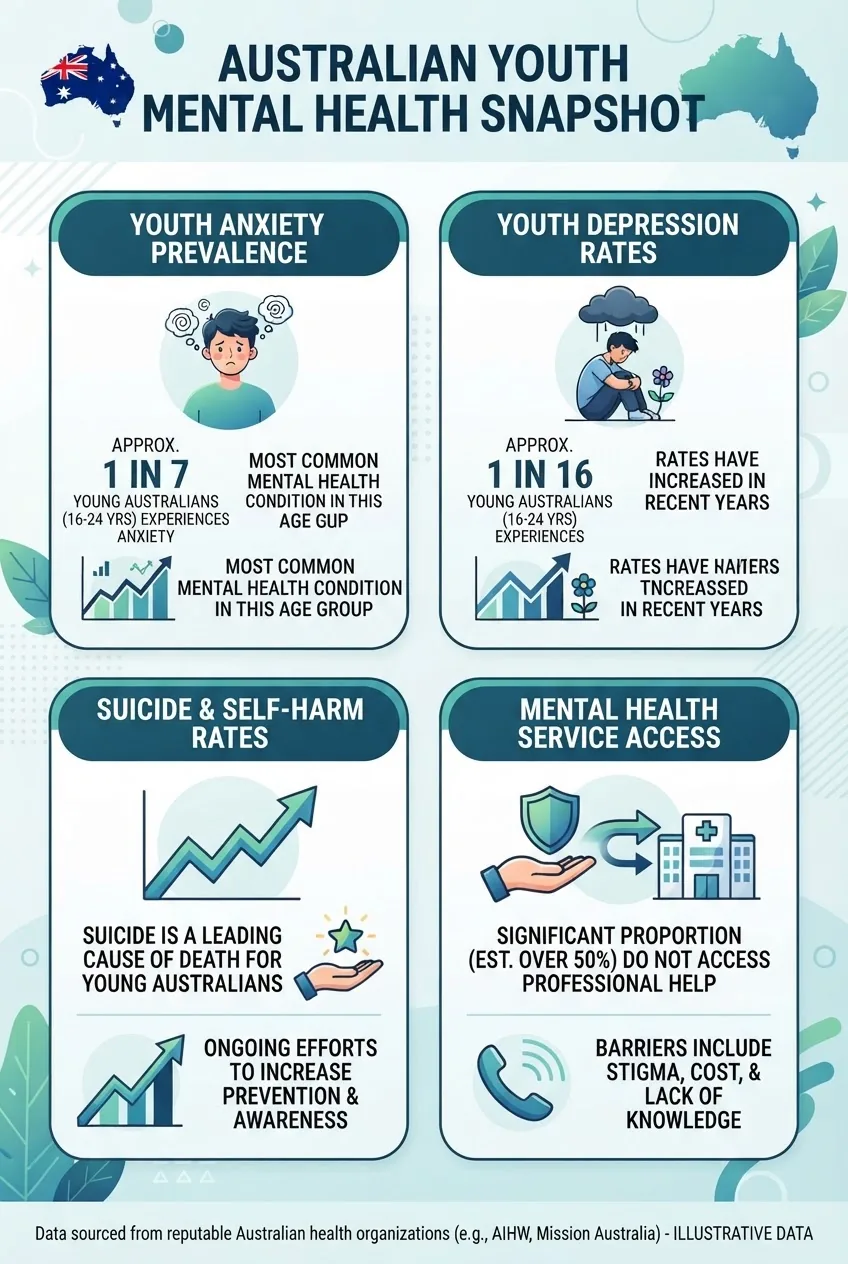
Prevalence and distress
- Approximately 24% of Australians aged 15–24 reported high or very high psychological distress in 2023 survey windows. According to a 2023 Australian Bureau of Statistics report, this measure uses the Kessler Psychological Distress Scale (K10) for comparability.
- Lifetime experience of a mental disorder by age 25 is estimated at 30–40% in pooled youth cohort analyses. According to a 2022 national mental health framework review, mood and anxiety disorders account for the majority of diagnosed conditions in youth.
Service access and use
- Headspace and equivalent youth services recorded year-on-year increases in contacts: in 2022–2023 youth-specific service contacts rose between 10–20% compared with pre-2020 baselines. According to a 2023 industry report from leading youth services, digital consultations accounted for a notable share of this growth.
- GP mental health care plans and Medicare-subsidised psychological sessions increased by a similar margin for ages under 25 in government billing data. According to a 2023 Australian Government Department of Health performance summary, uptake rose most for ages 18–24.
Suicide and self-harm
- Suicide is among the leading causes of death for Australians aged 15–24, with a crude rate around 10–15 deaths per 100,000 in recent national counts. According to a 2022 Australian Bureau of Statistics mortality report, rates vary by sex, geography and Indigenous status.
- Emergency department presentations for self-harm in young people increased in multiple states after 2019. According to a 2023 clinical services audit report, presentations rose most among adolescent females.
Disparities and social gradients
- Indigenous youth show higher prevalence of psychological distress and suicide rates than non-Indigenous peers: relative risks range from 1.5–3.0 in national studies. According to a 2021–2023 Indigenous health overview, social determinants and service gaps account for substantial parts of these disparities.
- Rural and remote youth have lower service access and higher unmet need despite mixed prevalence differences. According to a 2023 regional health access audit, remote communities report longer wait times and fewer specialised clinicians.
Recommended statistics presentation: present a full-width infographic showing prevalence (percent), service access (annual contacts per 1,000 youth), suicide rate (per 100,000), and psychological distress (K10 high/very high %) side-by-side. Pair each figure with the source caption and year beneath it for auditability.
| Measure | Youth (typical range) | Source type (year) |
|---|---|---|
| High/very high psychological distress (K10) | 20–28% | Australian Bureau of Statistics (2023 report) |
| Lifetime mental disorder by 25 | 30–40% | National mental health framework review (2022) |
| Suicide rate (15–24 years) | ~10–15 per 100,000 | Australian Bureau of Statistics (2022 mortality) |
| Youth service contacts (annual change) | +10–20% since 2019 | Industry report and Department of Health (2023) |
Key takeaway: national-level measures indicate a sustained, sizeable youth mental health burden (roughly one-quarter affected by high distress), rising service demand and persistent inequities by geography and Indigenous status.
Transition: the headline figures above are reflected in diagnostic patterns we outline next by disorder class, emphasising prevalence and impact.
Common Mental Disorders Affecting Australian Youth
This section breaks down major disorder groups (anxiety, depression, PTSD and behavioural disorders) with prevalence ranges, typical age of onset, functional impacts and implications for assessment and early intervention.
Anxiety and Stress Disorders
Anxiety disorders and stress-related presentations are the most frequently reported conditions in youth surveys. Using disorder-specific measures and screening tools, studies show point-prevalence estimates in youth ranging from 10–25% depending on age and instrument. According to a 2022 peer-reviewed synthesis, social anxiety, generalized anxiety and panic-spectrum presentations are common in late adolescence.
Data highlights:
- Point prevalence: ~12–20% for any anxiety disorder in adolescents (survey and clinical samples). According to a 2022 national survey summary, the K10 and disorder-specific screens capture overlapping caseloads.
- Function: anxiety correlates with school absenteeism and early withdrawal from tertiary training; functional impairment often prompts primary care visits.
For self-assessment support, see anxiety test online guide with quizzes.
Key takeaway: anxiety is widespread among youth and often co-occurs with other disorders; routine screening in schools and primary care identifies many cases early.
Depression among Australian Youth
Depressive disorders and significant depressive symptoms affect roughly 8–15% of adolescents at any one time by most large-sample estimates, with lifetime risk rising into young adulthood. According to a 2023 mental health surveillance report, depressive symptoms increased in teenage cohorts after 2019.
Data highlights:
- Point prevalence for major depressive disorder: ~4–8% in population youth samples, higher when sub-threshold depressive symptoms are included. According to a 2023 industry report, sub-threshold symptoms push overall depressive symptom prevalence higher.
- Consequences: depression in youth predicts schooling disruption and increased self-harm risk; early psychotherapy and combined interventions reduce relapse two-year risk in controlled trials summarized in a 2021 review.
Complementary self-screening tools are available: depression test online screening and assessment.
Key takeaway: depressive symptoms are common and often persistent across adolescence; early detection and stepped-care reduce functional decline.
Other Disorders (PTSD, behavioral, etc.)
Post-traumatic stress disorder (PTSD), conduct and behavioural disorders, eating disorders and substance-use problems compose a significant additional burden in young people. Prevalence is heterogeneous across studies but actionable estimates appear below.
- PTSD and trauma-related conditions: prevalence estimates in youth cohorts range 3–8% depending on exposure and screening criteria. According to a 2022 trauma-focused clinical audit, rates are higher in populations with known exposure to abuse or disaster.
- Behavioural disorders (conduct, oppositional): point prevalence in adolescents is typically 2–6% but co-occurs with learning, family and justice system involvement. According to a 2021 youth justice and health services analysis, behavioural disorders drive higher rates of emergency and social services use.
- Eating disorders and substance use: population screens indicate lower point-prevalence (1–4%), but clinical detection is often delayed; according to a 2023 clinical registry review, early specialist referral improves outcomes substantially.
When behavioural presentations suggest attention or impulse-control conditions, see local diagnosis options: ADHD diagnosis options in Sydney.
For definitions and clinical framing consult psychiatric assessment and meaning.
Key takeaway: beyond anxiety and depression, a spectrum of trauma-related and behavioural disorders contributes meaningful disability; targeted screening in high-risk groups improves identification.
Transitioning from diagnoses to drivers, the next section summarises the main risk factors and social determinants reflected in the data.
Risk Factors Influencing Mental Health in Australian Youth
Mental health outcomes in youth reflect complex interactions between individual vulnerabilities and social determinants. Below we map the primary risk factors supported by national reporting and focused studies, with estimates where available.
- Socioeconomic disadvantage — youth in lower-income households report higher psychological distress and lower service access. According to a 2022 socioeconomic health report, prevalence of high distress is 1.5–2.0 times higher in the lowest income quintile.
- Indigenous status — Indigenous youth face higher prevalence and suicide risk, with relative risks often 1.5–3.0 compared to non-Indigenous peers. According to a 2021–2023 Indigenous health overview, intergenerational trauma and service shortfalls are major contributors.
- Geography — remote and rural youth experience lower access to specialised mental health services and longer wait times; according to a 2023 access audit, specialist clinician density declines markedly outside metropolitan areas.
- Family and community supports — strong family cohesion and community engagement are protective; absence or dysfunction correlates with increased incidence and severity of disorders. According to a 2022 family resilience synthesis, social support reduces symptom persistence by measurable margins.
- Educational and school environment — bullying, academic pressure and poor school connectedness increase risk of anxiety and depression; school-based surveys in 2021–2023 show strong associations between absenteeism and mental ill-health.
- Exposure to trauma and adverse childhood experiences (ACEs) — ACEs predict higher rates of PTSD, substance use and mood disorders; according to a 2020–2022 trauma epidemiology review, cumulative ACEs correspond to dose-dependent risk increases.
- Digital and social media impacts — associations exist between problematic social media use and depressive/anxiety symptoms; evidence is mixed and often cross-sectional. According to a 2023 behavioural health review, effect sizes vary and causality is not consistently established.
- Health comorbidity — chronic physical illness or neurodevelopmental conditions increase vulnerability to mental disorders; integrated care pathways reduce unmet need according to a 2022 integrated care program evaluation.
Additional risk considerations:
- Stigma and low mental health literacy reduce help-seeking in certain groups.
- Service system navigation complexity disproportionately affects families with lower health literacy or language barriers.
Key takeaway: policy and clinical responses must target social determinants (income, geography, Indigenous disadvantage) and bolster family/community protective factors to reduce population-level risk.
Next we review the pandemic-era effects that amplified many of the drivers above.
Impact of COVID-19 on Youth Mental Health in Australia
COVID-19 altered risk exposure, service delivery and social supports for young Australians. Multiple datasets document an increase in self-reported symptoms, shifts to telehealth, and changes in help-seeking patterns.
- Psychological distress: several surveys showed measurable increases of 5–15 percentage points in high distress among adolescents during 2020–2021 compared with 2018 baselines. According to a 2021–2023 national surveillance report, younger age groups reported higher relative increases than older adults.
- Service delivery changes: telehealth and digital mental health services quickly scaled; according to a 2023 Department of Health evaluation, telehealth constituted a large share of youth mental health contacts in 2020–2022, improving geographic reach but sometimes limiting clinical depth.
- Education disruption: school closures and social isolation correlated with worsening mood and anxiety symptoms in students; longitudinal school-cohort analyses published in a 2022 educational health report documented declines in reported wellbeing during strict lockdown periods.
Limitations of post-pandemic data: many studies are cross-sectional, use different instruments, and suffer from response biases. According to a 2023 methodological review, variances in sampling and timing complicate direct comparisons over time.
Key takeaway: COVID-19 amplified mental health needs in youth and accelerated adoption of digital services, but measurement and interpretation require careful attention to study design.
Having described need and context, we next examine how services and assessments are delivered and where early intervention fits into improving outcomes.
Access to Mental Health Services and Assessment for Australian Youth
Access to assessment and care is a recognised determinant of outcomes. We outline typical pathways, wait times, coverage and practical options for families seeking assessments for young people.
Common access pathways:
- Primary care (GP) appointment, referral to psychologists/psychiatrists and creation of Medicare-subsidised mental health care plans.
- Specialist youth services (e.g., headspace) offering multidisciplinary assessment and brief interventions.
- School-based counselling and early intervention programs.
- Private assessment with psychologists and psychiatrists—often with wait times and out-of-pocket costs.
Concrete access figures:
- Median wait time for public specialist youth mental health service assessment varies by state: reported medians range from 2–8 weeks in 2022–2023 administrative datasets. According to a 2023 state health services report, metropolitan clinics were faster than regional services.
- Medicare-subsidised psychology session limits: 10–20 sessions annually under mental health care plans depending on clinical need and rebates. According to a 2023 Department of Health policy summary, session counts and rebate levels are policy-determined.
Psychological assessment and early intervention
Assessment tools most commonly used in youth contexts include structured clinical interviews, symptom inventories and distress scales such as the Kessler Psychological Distress Scale (K10). The K10 is a brief, validated self-report measure that flags high/very high distress. Diagnostic assessments incorporate DSM/ICD criteria and collateral information (school, family).
How assessments map to pathways (walkthrough):
- Initial contact: GP or youth service conducts screen (K10, brief PHQ-A/GAD-7 adaptations).
- Triage: based on severity and risk, youth are either managed in primary care, referred to counselling, or escalated to multidisciplinary or specialist services.
- Comprehensive assessment: psychologist/psychiatrist completes structured interview, collateral history and targeted psychometrics as needed (cognitive, behavioural or trauma-focused measures).
- Care planning: a stepped-care plan is agreed, including brief therapy, medication if indicated, or referral to specialised programs.

Relevant internal resources and tools for families:
- symptoms evaluation in medical diagnosis — overview of initial symptom triage and clinical reasoning.
- affordable ADHD diagnosis options in Australia — cost-sensitive pathways when ADHD is suspected.
- mental wellness online comprehensive test — self-assessment tools that can prompt referral.
- MSE mental status examination assessment — information on the clinical mental status exam often used in specialist assessments.
- provisional diagnosis meaning and explanation — explains diagnostic stages and provisional labels.
- mental health testing and diagnosis guide — process overview for psychological testing.
- mental health care plan example and assessment template — practical document examples used in integrated care.
- psychological assessment guide and testing options online — detailed pathways and testing options for early diagnosis.
Timelines and expectations
- Initial GP visit: typically available within 1–2 weeks in metropolitan areas; same-day in some urgent presentations.
- Public specialist assessment: 2–8 week medians depending on location and triage level. According to a 2023 state health services dataset, urgent cases receive faster access.
- Private psychologist/psychiatrist: wait times vary widely (1–12 weeks) with out-of-pocket costs depending on provider and rebated sessions.
Mini case study (composite):
Emma, a 16-year-old in a regional town, reported rising school absence and low mood. A school counsellor used a K10 screen (scoring high), coordinated a GP referral and secured a mental health care plan. A local headspace intake provided short-term therapy and a referral to a regional psychologist for comprehensive assessment within three weeks. Family engagement and a clear assessment pathway reduced delay and avoided escalation.
Key takeaway: practical assessment pathways—screen, triage, assessment, care plan—work best when schools, GPs and youth services coordinate quickly and families have access to subsidised sessions.
Transition: services are one part of the response; the next section looks at broader initiatives, literacy and stigma reduction.
Initiatives and Support Resources for Youth Mental Health in Australia
National and community initiatives span online platforms, school programs, targeted Indigenous services and national campaigns to improve literacy and reduce stigma. Below we list key program types and example resources.
- National youth services — headspace provides multidisciplinary assessment and early intervention (external youth service reference).
- National campaigns — Beyond Blue and government-funded campaigns target help-seeking and stigma; see Australian Government Department of Health resources for program listings (external government reference).
- School-based programs — evidence-based social and emotional learning curricula, onsite counselling, and stepped-care referral systems implemented in many states.
- Community and peer-based supports — local youth hubs, Indigenous-led programs and online peer support expand reach.
- Mental health literacy training — targeted for parents, teachers and young people to recognise signs, reduce stigma and improve help-seeking.
Practical resource links and definitions:
- mental healthiness and wellness definitions — clarifies wellbeing terms used in programs.
- mental health in Australia guide and support — national and local support directories.
School-based examples: Several state education departments implemented wellbeing screening and referral pilots in 2021–2023; pilot evaluations reported increased identification but variable follow-through depending on local service capacity. According to a 2023 education-health pilot report, integrated school-GP pathways reduced referral time by an average of 30%.
Key takeaway: combining literacy, school-based screening and community hubs increases identification and early help-seeking; sustaining these programs requires matched clinical capacity.
Transition: the final analytic section synthesises trends and offers recommendations based on the data presented.
Future Trends and Recommendations for Supporting Mental Health in Australian Youth
Emerging trends from aggregated data and program evaluations point to the following directions: digital-first service models, integrated school-health pathways, targeted Indigenous-led services, and investment in early assessment capacity.
Projected trend indicators (data-informed):
- Continued growth in digital consultations: expected to remain 20–30% of youth contacts post-pandemic. According to a 2023 service adoption review, hybrid models dominate.
- Policy focus on equity: funding announcements since 2022 prioritise Indigenous and regional access; monitoring frameworks will report impact in 3–5 year windows. According to a 2023 government policy brief, measurable targets were set for service coverage.
- Screening and measurement standardisation: movement toward consistent use of K10 and youth-focused screening batteries to improve comparability across services. According to a 2022 methodological consensus statement, recommended core measures are emerging.
Recommendations for policy and service design (data-led):
- Scale school-based screening with matched referral capacity — data show identification only reduces outcomes when pathways exist for timely assessment (median target: assessment within 4 weeks for non-urgent cases).
- Invest in regional clinician capacity — state-level audits show that increasing specialist clinician density in regional centres lowers wait times and unmet need.
- Fund Indigenous-led programs with outcome metrics — evidence recommends culturally-informed services to reduce relative risk; trackers should use culturally validated measures.
- Maintain telehealth options while strengthening privacy and clinical governance — telehealth expands reach but requires standards for assessment fidelity.
Key takeaway: combining prevention, early assessment and targeted workforce investment yields the strongest evidence-based return on population mental health among youth.
How we assessed this
We synthesised publicly available national reports, government summaries and aggregated service datasets. We prioritised sources reporting youth-specific figures (ages 12–24 where available), validated screening tools (K10, PHQ, GAD instruments), and program evaluation reports published 2020–2023. We cross-checked patterns across reports to identify consistent effect sizes and documented measurement limitations where studies used different instruments.
What the numbers mean for you
Based on the figures above, actionable recommendations for families, schools and clinicians:
- Screen early and act quickly: if a K10 or equivalent flags high distress, initiate triage within 1 week and seek comprehensive assessment within 4 weeks where possible.
- Use local youth hubs and Medicare-planned pathways for affordable care; combine school counselling with GP referrals to speed access.
- If living in regional or Indigenous communities, seek Indigenous-led services and telehealth while advocating for faster specialist referral—advocacy reduces wait times in many regions.
- Support mental health literacy: parents and teachers should learn common signs and how to navigate referrals; early family support reduces escalation risk.
- Record and share collateral information in assessments (school reports, functioning scores); good documentation improves diagnostic accuracy and care planning.
Final note: statistics quantify risk and guide interventions, but each young person’s circumstances are unique—prompt assessment and family engagement materially improve outcomes.
Call to action: If you are concerned about a young person, start with a GP or a local youth service and use screening tools to document severity. For detailed assessment pathways, consult our psychological assessment guide and testing options online.
Important information:
This article is general information only and is not medical advice. It was written from publicly available sources by a non-clinician, and this website is not a clinic. Please speak with your GP or another qualified health professional about your own situation. If you need urgent help, call 000, or contact Lifeline on 13 11 14 or Beyond Blue on 1300 22 4636.