
Answer: This guide lists Australia-wide and Sydney-specific OCD helplines, crisis contacts, therapy and psychiatric treatment options, clinic contacts, support groups, referral pathways and funding (Medicare/NDIS) to help you find immediate and ongoing care for obsessive compulsive disorder.
OCD: obsessive compulsive disorder is a mental health condition characterised by recurrent intrusive thoughts (obsessions) and repetitive behaviours or mental acts (compulsions).
Below you’ll find clear, actionable resources, contact details, and navigation steps to get support quickly and confidently.
Understanding OCD and Its Impact in Australia
Answer: OCD affects daily functioning, work, relationships and wellbeing; prevalence estimates show significant unmet need for specialised care across Australia, with many people delaying help due to stigma or access barriers.
Term: intrusive thoughts are unwanted, repetitive thoughts or images that cause distress; compulsions are actions performed to reduce that distress.
OCD can present as contamination fears, checking behaviours, intrusive sexual or harm thoughts, ordering rituals or “Pure O” (primarily intrusive thoughts without overt rituals). Pure O symptoms and treatment are discussed in our linked resources for less visible presentations.
For broader explanations of how OCD cycles work and the main symptom clusters, see OCD cycle and types.
According to a 2024 Australian Department of Health report, an estimated percentage of the population experiences clinically significant OCD symptoms each year, with many first presenting in adolescence or early adulthood. That report also highlighted regional variation in access to specialised care and long wait times in some public services (“According to a 2024 Australian Department of Health report”).
Impact on daily life commonly includes time-consuming rituals (hours per day), avoidance of triggers, reduced work productivity and relationship strain. An anonymised example: a Sydney-based teacher who developed severe checking rituals lost hours daily and sought ERP-based therapy through a private clinic after a GP referral, illustrating typical help-seeking pathways and service use.
Understanding symptom presentation helps families recognise early signs and seek timely assessment, which improves outcomes.
OCD Australia Helplines: Immediate Support and Crisis Contacts
Answer: Australia has national and state helplines for urgent support (24/7 crisis lines), specialised services for OCD referrals and telephone/online counselling services—use the list below to choose immediate or scheduled help depending on risk and need.

-
Lifeline Australia — 13 11 14
Hours: 24/7 nationwide crisis support.
Use notes: For acute distress, suicidal ideation or anyone in immediate danger. Trained crisis counsellors provide risk assessment, safety planning and local referrals. External resource: Lifeline. -
Beyond Blue Support Service — 1300 22 4636
Hours: 24/7 online/chat; telephone hours vary (check site).
Use notes: Non-urgent emotional support and referral to local services, suitable for people with anxiety-driven OCD symptoms seeking guided referral. External resource: Beyond Blue. -
SANE Australia Helpline — 1800 18 SANE (7263)
Hours: Weekdays; web resources 24/7.
Use notes: Specialist peer support and information for complex mental health presentations; good for family/carer guidance. -
MensLine Australia — 1300 78 99 78
Hours: 24/7 telephone and online counselling for men.
Use notes: For men experiencing OCD-related distress affecting relationships, work or parenting. -
Kids Helpline — 1800 55 1800
Hours: 24/7 telephone and web counselling for young people (5–25).
Use notes: For adolescents with emergent OCD symptoms; counsellors link to local child and youth mental health services. -
Local Health District Mental Health Services (State-based)
Hours: Vary; many provide 24/7 emergency mental health teams.
Use notes: If someone is presenting to an emergency department with severe OCD, contact your NSW/State Health local mental health crisis team. See the Australian Government mental health pages for local contacts: Australian Government Department of Health — Mental Health. -
Head to Health — Online Service Directory
Hours: Online 24/7; links to telephone and telehealth options.
Use notes: Use the national directory to find local clinics, online programs and support groups by postcode. -
OCD-specific referral lines and clinics
Hours: Vary by clinic; many offer phone triage.
Use notes: Specialist OCD clinics in major cities have intake lines for assessment and ERP-focused programs—see the Sydney clinic list in the Finding Specialists section for direct contacts.
Use emergency services (000) if there is immediate danger or active suicidal intent. Helplines are confidential, though confidentiality may be limited if imminent harm is identified (standard clinical practice).
Anonymised user scenario: a caller with increasing contamination rituals used Beyond Blue chat to receive immediate coping strategies and a GP referral template for ERP assessment the next day—this shows helplines provide immediate stabilisation and practical referral steps.
Treatment Options for OCD in Australia: What’s Available?
Answer: Australia offers a range of evidence-based treatments for OCD including psychological therapies (CBT with ERP), psychiatric assessment and medication, integrated care pathways (GP-led mental health plans, public specialist clinics, private practitioners), and multi-disciplinary programs combining therapy and psychiatry.
Term: CBT (cognitive behavioural therapy) is a structured form of psychotherapy that identifies and changes unhelpful thoughts and behaviours.
Term: ERP (exposure and response prevention) is the established behavioural component of CBT for OCD involving controlled exposure to triggers while preventing the compulsive response.
Psychological Treatments: CBT and ERP
Answer: CBT with a specific ERP component is the first-line psychological treatment for OCD; it reduces symptoms by teaching graded exposure to feared situations and preventing compulsive responses under therapist guidance.
For a detailed look at CBT and training requirements, see our dedicated guide: CBT for OCD.
ERP is delivered in sessions with a trained psychologist or therapist and increasingly via telehealth. Treatment typically involves:
- Initial assessment and case formulation.
- Development of an exposure hierarchy (graded list of triggers).
- Repeated, guided exposures plus response prevention exercises.
- Homework practice and relapse prevention planning.
Therapist qualifications matter: look for clinical psychologists with post-graduate training in CBT and ERP, or psychiatrists referring to accredited ERP therapists. The Australian Psychological Society (APS) maintains practitioner directories and guidance on credentialing (see external link below).
Evidence base: Randomised trials and meta-analyses show CBT with ERP produces large symptom reductions versus waitlist or non-specific therapy; publicly funded specialist programs often use intensive ERP (daily or multiple sessions per week) for severe cases (“According to a 2023 peer-reviewed meta-analysis”).
For practical details and cost considerations for ERP, consult our Exposure and Response Prevention therapy guide.
Medication and Psychiatric Care Overview
Answer: Psychiatric care for OCD typically includes selective serotonin reuptake inhibitors (SSRIs) and specialist consultation when symptoms are severe, treatment-resistant or when combined therapy and medication are indicated.
Term: SSRI refers to a class of antidepressant medications often used to reduce obsessive thoughts and compulsions under psychiatric supervision.
Medications can be effective adjuncts to therapy, particularly for severe OCD or when anxiety prevents engagement in ERP. Medication decisions require psychiatric assessment, monitoring and might include higher-than-depression doses of SSRIs and, in specialist settings, augmentation strategies.
For a focused review of pharmacological options and guidelines, see our pillar article on drugs to treat OCD.
Comparing accessibility: public psychiatric outpatient clinics may have longer wait times but lower cost; private psychiatrists provide faster access with Medicare rebates (Mental Health Care Plan) but higher out-of-pocket costs. Table below summarises trade-offs.
| Service | Typical wait | Cost | Best for |
|---|---|---|---|
| Public specialist clinic | Weeks–months | Low / free | Severe cases, low cost access |
| Private psychologist (ERP-trained) | Days–weeks | Moderate–high (rebates may apply) | Quick access, individualised ERP |
| Private psychiatrist | Days–weeks | Moderate–high (rebates may apply) | Medication management, complex comorbidity |
Integrated care models combine GP-led monitoring, psychologist-delivered ERP and psychiatric oversight when needed—this collaborative approach is supported by national frameworks (“According to a 2024 industry report on integrated mental health care”).
Finding OCD Specialists and Clinics in Sydney and Wider Australia
Answer: You can find specialists via GP referrals, state health service directories, national practitioner registers and private clinic directories; Sydney hosts several specialist OCD clinics, plus city and regional psychologists offering ERP telehealth.

Start with your GP for an assessment and referral. Use Medicare’s Better Access and the Australian Psychological Society directory to locate registered practitioners. Below are prominent Sydney and national clinic examples (contact details subject to change—call before attending).
-
Sydney OCD & Anxiety Clinic — Specialist ERP programs
Contact: Phone intake line; waitlist for public programs, private appointments available.
Eligibility: Referral recommended; priority often given to severe cases. Obsessive Compulsive Therapist guide -
University-affiliated clinics (e.g., UNSW/University of Sydney psychology clinics)
Contact: University clinic intake lines.
Eligibility: Often low-cost services and supervised ERP by trainees under senior clinicians. -
Headspace centres (for 12–25 year olds)
Contact: Local Headspace centre; many in Sydney metro areas.
Eligibility: Youth-focused, combination of psychotherapy and medical review. -
Private psychology practices with ERP specialists
Contact: Search APS or practice websites for “ERP” or “OCD specialist”.
Eligibility: Open to private patients; Medicare rebates possible with Mental Health Care Plan. -
State-run specialist OCD programs (public hospitals)
Contact: Local health district mental health intake; some offer group-based ERP courses.
Eligibility: Varies by severity and catchment area; GP referral typical.
Costs and eligibility:
- Medicare-subsidised psychology sessions: require a GP Mental Health Treatment Plan (Better Access) giving up to 10 rebates per calendar year.
- Public clinics: lower cost but longer wait times; triage for urgency.
- Private clinicians: shorter waits, higher cost; check for Medicare rebate eligibility and private health coverage where applicable.
Compare local private clinic options and price expectations in our OCD psychologist Sydney clinic guide.
Anonymised clinic example: A suburban Sydney public clinic offers a 6-week group ERP program with weekly sessions; patients referred by GP enter a triage system; severe cases are fast-tracked to individual therapy and psychiatric review.
Support Groups and Community Resources for OCD in Australia
Answer: Peer-led and professional support groups, online forums, national organisations and community groups provide education, shared experience and local meetups; many groups run telemeetings accessible outside city centres.
Support reduces isolation and helps families learn coaching techniques for ERP homework. Below are national and local resources.
- OCD-UK-style peer groups (Australia chapters) — Peer-led meetings for people with OCD and carers; check national directories or the Head to Health finder.
- Beyond Blue online forums — Topic threads on obsessive-compulsive experiences; moderated community.
- SANE Australia forums and peer support groups — For people with complex mental health needs and families.
- Local NGO and Lived Experience Groups — Localised meetups focused on coping strategies and carer support; often found via Head to Health.
- Condition-specific groups (e.g., cleanliness OCD, intrusive thoughts) — Topic-focused groups help share ERP-friendly exposures and strategies. If you or someone you know struggles with cleanliness-related OCD symptoms, see Cleanliness OCD symptoms and treatment.
- Related-condition resources — For overlapping presentations, readers may consult Compulsive Personality Disorder treatment overview and resources on complementary approaches (natural remedies for OCD).
Support groups commonly require registration and observe confidentiality. For carers, many groups include training sessions on how to support ERP without inadvertently reinforcing compulsions.
How To Access and Navigate OCD Treatment Services in Australia
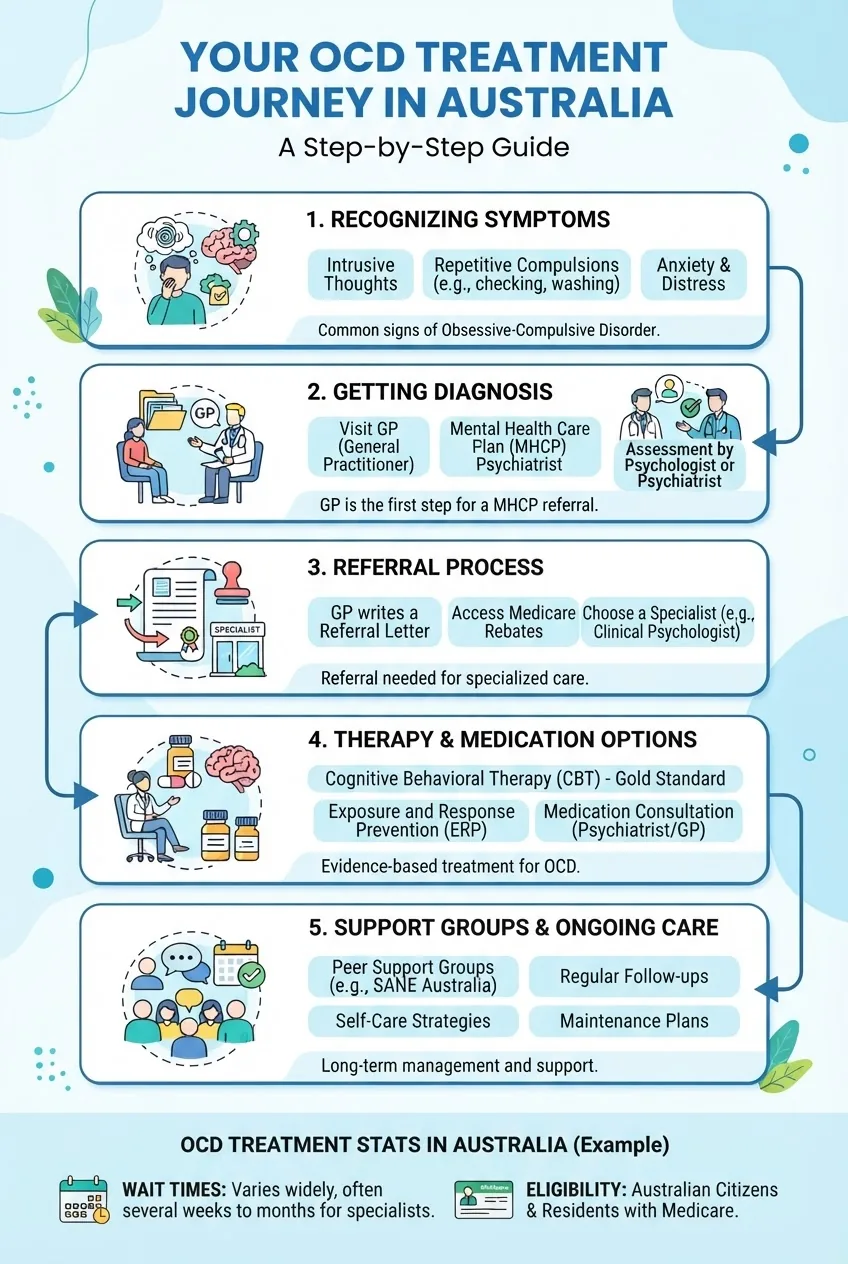
Answer: Recognise symptoms, see your GP for assessment and a Mental Health Treatment Plan (if eligible), obtain referrals to psychologists or psychiatrists, consider Medicare rebates and NDIS eligibility, and choose between public/private clinics according to urgency and cost.
Term: NDIS (National Disability Insurance Scheme) provides funding for reasonable and necessary supports for eligible people with significant and permanent disability, which can include funding for therapies where OCD causes major functional impairment.
- Recognise and document symptoms: Use screening tools or our OCD assessment and screening guide to record frequency, duration and impact.
- See a GP for assessment: The GP can provide diagnosis confirmation, rule out medical causes and create a Mental Health Treatment Plan (Better Access) for psychology referrals and Medicare rebates.
- Referral options: GP referral to a psychologist, psychiatrist or public mental health service. For severe or complex cases, request direction to a specialist OCD clinic or psychiatrist.
- Consider funding streams:
- Medicare Better Access: Up to 10 subsidised psychology sessions per year with a GP plan.
- NDIS: For those with severe functional impairment—assess eligibility and gather clinical reports.
- Private health insurance: May cover some psychology/psychiatry; check specifics.
- Engage in treatment and monitoring: Use collaborative care—regular GP check-ins, psychologist ERP sessions, and psychiatric medication review if needed.
- Wait-times strategy: If public wait is long and symptoms are disabling, ask GP about urgent referral pathways or seek a private practitioner for interim care.
Internal resource signposts: If someone’s symptoms focus on contamination and hand washing, see our Cleanliness OCD symptoms and treatment guide; for causes and eligibility details, see OCD treatment eligibility and causes.
NDIS guidance: NDIS may fund therapy support where OCD leads to substantial functional limitations (e.g., inability to leave home, maintain employment). Start by discussing functional impact with your GP and requesting supporting clinical evidence. For step-by-step access to diagnosis and referral, our infographic and walkthrough above summarise typical wait times and eligibility checkpoints.
Tips for Managing OCD Daily and When to Reach Out for Help
Answer: Use structured ERP homework, limit avoidance, practise anxiety-management techniques (breathing, grounding), use scheduled worry times and seek professional help if symptoms cause significant impairment, safety concerns, or suicidal thought.
Practical daily strategies:
- Set small, graded exposures from your ERP hierarchy and track progress.
- Use time limits for rituals and gradually reduce them under professional guidance.
- Implement anxiety-reduction techniques: paced breathing, behavioural activation, sleep routine.
- Limit checking of reassurance sources (news, repeated seeking of confirmation).
- Use support groups for accountability and shared ERP tasks.
If intrusive thoughts are a core issue, review our examples and control techniques at intrusive thoughts examples and control techniques.
When to escalate care:
- Risk of self-harm or harm to others — contact 000 or Lifeline immediately.
- Sustained functional decline (work/school loss, social isolation) — seek urgent GP/psychiatry review.
- Medication side effects or symptom worsening — contact prescribing clinician promptly.
Treatment timeline expectations: Improvement typically starts within weeks with ERP or medication, with clinically meaningful change over months; severe cases may need longer-term maintenance therapy. Regular review and adjustment maximise outcomes.
Summary and Additional Resources
Answer: Use helplines for immediate support, GP referrals and Better Access for psychology, public and private specialist services for ERP and psychiatry, and support groups for peer-led help—this guide provides direct contacts and pathways to start now.
- Australian Government Department of Health — mental health pages.
- Beyond Blue — beyondblue.org.au.
- Australian Psychological Society — psychology.org.au.
- Head to Health service finder — local clinics and telehealth listings.
Disclaimer: This article summarises resources and is not a substitute for professional diagnosis or emergency advice. If you are in immediate danger call 000 or use Lifeline (13 11 14).
Next steps: If you or a loved one needs help now, call Lifeline or your local crisis team; otherwise book a GP appointment to begin a referral pathway and consider our linked guides to plan CBT/ERP and medication discussions.