

By the end of this hands-on guide you will understand the clinical signs of cleanliness OCD (compulsive hand washing), know step-by-step evidence-based treatment options, and be able to start practical urge-management routines you can use immediately; expect 6–16 weeks to see measurable change with therapy, and this assumes no prior specialist training—only willingness to practice daily techniques.
- Before you start — prerequisites:
- Ability to commit 30–60 minutes daily for exercises and homework.
- Journal or smartphone notes app to track urges, durations and exposures.
- Access to a qualified mental health clinician if symptoms cause severe distress.
- Comfortable, private space for in-session ERP practice and mindfulness.
Understanding Cleanliness OCD and Hand Washing Compulsions
Cleanliness OCD is a subtype of obsessive–compulsive disorder characterised mainly by contamination obsessions (intrusive fears of germs, contamination, or moral/psychic “dirt”) and repetitive cleaning rituals—most commonly compulsive hand washing. A compulsion is a repetitive action performed to neutralise or reduce anxiety from an intrusive thought; an obsession is the intrusive thought itself. Together they form an obsession-compulsion cycle that maintains symptoms through behavioural reinforcement.

Example scenario: a person touches a doorknob (trigger), experiences an intrusive image of contamination, feels acute anxiety, then washes hands repeatedly until anxiety temporarily falls. That short-term relief reinforces the hand washing, making the behaviour habitual and progressively time-consuming.
- Define the trigger and obsession: Identify common external triggers (public surfaces, animals, bodily fluids) and internal triggers (intrusive images or doubts). Write triggers in a log immediately after they occur.
- Map the ritual: Note how long washing takes, the steps (soap amount, temperature, drying rituals), and the subjective anxiety reduction on a 0–10 scale before and after each wash.
- Distinguish safety from compulsion: Label each wash as ‘functional hygiene’ or ‘compulsive’ based on frequency (more than 5 minutes per episode or >20 times/day suggests compulsion) and distress level (anxiety-driven vs. habit).
Understanding intrusive thoughts and the emotional chain that follows is essential to later applying structured therapies. For more clinical descriptions of intrusive thoughts, see the section on intrusive thoughts linked to OCD.
Transition: With foundational understanding in place, the next section lists clear observable symptoms and signs that differentiate routine hygiene from clinically significant cleanliness OCD.
Symptoms and Signs of Cleanliness OCD
The presence of excessive hand washing and related behaviours is core to cleanliness OCD. Clinical severity is judged by frequency, time lost, distress, and impact on functioning. Below is a detailed, numbered checklist with examples clinicians use during assessment.
- Excessive hand washing frequency — Repetitive washing episodes that total more than 30 minutes per day or occur more than 10–20 times daily. Example: washing hands for 2–5 minutes after touching mail or every 10 minutes at home.
- Ritualised procedure — Fixed steps (e.g., three lather cycles, exact drying method). These rituals cause distress if interrupted. Example: a patient insisted on using warm water exactly for 45 seconds, or anxiety rose to 8/10 when another family member changed the towel.
- Distress and impairment — Avoidance of social situations, leaving work, or skin damage from washing (dermatitis). Example: missed work deadlines because of washing episodes that monopolised mornings.
- Repeated checking for “clean” feeling — A subjective sense of “not clean enough” despite clear cleanliness; checking often involves re-washing or inspecting hands under light. Example: inspecting hands in mirrors repeatedly even after multiple washes.
- Time-consuming compulsions — Activities that interfere with daily routines (e.g., taking >1 hour total daily). Clinically significant impairment usually begins at 1+ hours/day spent on rituals.
- Anxiety symptoms — Palpitations, sweating, inability to focus, intrusive images following contact with perceived contaminants. Example: immediate panic symptoms when a hand touches public transport rails.
- Avoidance behaviour — Avoiding outings or touching shared objects to prevent the urge to wash. Example: refusing to hold grandchildren without gloves for fear of contamination.
- Insight variability — Patients may recognise thoughts as irrational (good insight) or be convinced they are necessary (poor insight). Both presentations occur in cleanliness OCD.
- Skin and physical consequences — Cracked skin, infections from over-washing, or eczema from repeated soap exposure; these are objective signs pointing to compulsive behaviour rather than normal hygiene.
- Secondary safety behaviours — Carrying sanitiser constantly, wearing gloves indoors, or excessive laundering of clothes following perceived exposure.
Use the OCD screening and assessment tools when symptoms match several items above. OCD screening and assessment
Transition: Knowing the symptom profile leads naturally into an explanation of why these patterns form — the psychological and neurobiological mechanisms that sustain cleanliness OCD.
Causes and Psychological Mechanisms Behind Cleanliness OCD
Cleanliness OCD arises from interactions between anxiety triggers, learning mechanisms, and altered brain circuitry. The core process is the obsession-compulsion cycle: intrusive thought → anxiety → compulsive behaviour to reduce anxiety → temporary relief → reinforcement of the compulsion.
- Biological vulnerability: Genetic predisposition and neurotransmitter differences, particularly in serotonin systems, increase risk. According to a 2024 Australian Government mental health report, OCD prevalence and service utilisation patterns indicate biological and social contributors to help-seeking behaviour (government report, 2024).
- Learning and reinforcement: Behavioural reinforcement occurs when hand washing reduces anxiety; that relief is negative reinforcement that strengthens the ritual. Clinicians use this principle when designing exposure-based therapies.
- Cognitive distortions: Overestimation of threat, inflated responsibility, and intolerance of uncertainty drive contamination obsessions. For example, someone may believe a single touch will lead to serious illness, despite low objective risk.
- Intrusive thought misinterpretation: Individuals often misattribute meaning to intrusive images (e.g., “If I don’t wash, I’m dangerous”), amplifying distress. See related guide on the broader OCD cycle and types for context.
- Environmental and developmental factors: Trauma, early parental models of excessive cleanliness, or health anxiety can create patterns that evolve into full-blown OCD in adolescence or adulthood.
Clinically, treatment targets both the cognitive distortions and the behavioural reinforcement (see treatment section). For further eligibility and causal detail, consult OCD treatment eligibility and causes.
Transition: With causes and mechanisms clear, clinicians then assess whether cleaning falls within normal hygiene or is OCD-driven — the next section provides a direct comparison.
Differentiating Normal Hygiene from OCD-Driven Cleaning
| Feature | Healthy Hygiene | Compulsive Cleaning (Cleanliness OCD) |
|---|---|---|
| Reason for action | Routine, social norms, infection prevention | Driven by intrusive thoughts and anxiety reduction |
| Flexibility | Flexible; skips if inconvenient | Rigid rituals; distress if interrupted |
| Time spent | Minutes daily | Often >30 minutes to several hours daily |
| Purpose | Hygiene/health | To neutralise obsessional anxiety |
| Physical harm risk | Low | High (dermatitis, infections from over-washing) |
| Functional impairment | None or minimal | Significant—work, relationships, social life affected |
For readers interested in personality-based compulsiveness, compare with compulsive personality disorder to understand trait-based behaviours versus obsessional compulsion.
Transition: Clear diagnostic distinctions allow clinicians to recommend tailored evidence-based treatments covered in the next, detailed section.
Evidence-Based Treatment Options for Cleanliness OCD
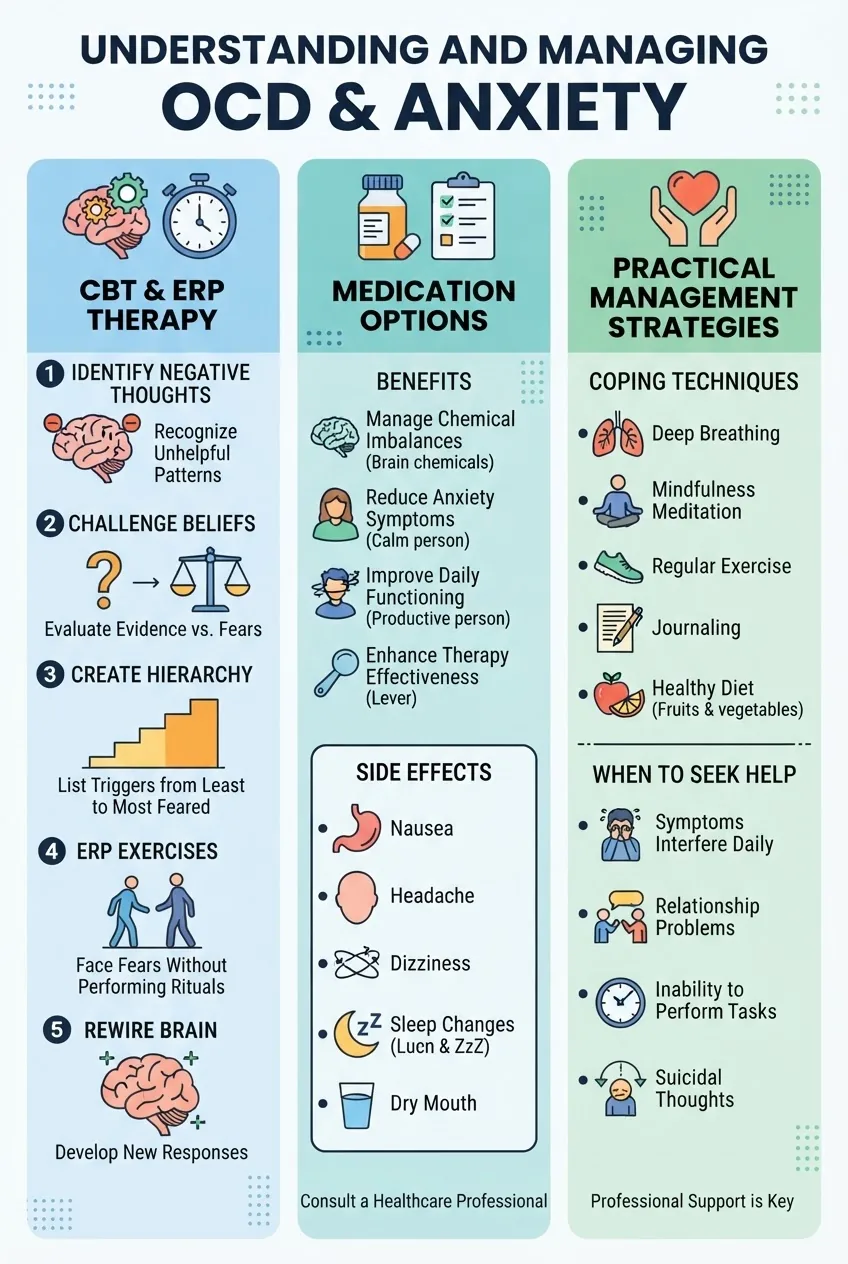
This section summarises clinical best practices: psychological therapies, medication, and combined approaches. Standards align with Australian Government mental health guidance and international bodies such as the International OCD Foundation (IOCDF) and the NIMH resources. Below are actionable steps and core protocols.
-
Start cognitive assessment and psychoeducation — 1–2 sessions
Action: record symptom diary (3× daily), baseline Y-BOCS if available, and severity rating (0–40). Time: 30–60 minutes per session.
-
Implement Cognitive Behavioral Therapy (CBT) with an ERP focus — primary treatment
CBT for OCD emphasises cognitive restructuring and behavioural experiments; the active ingredient for cleanliness OCD is Exposure and Response Prevention (ERP), which systematically exposes the patient to contamination triggers while preventing the hand washing response.
Typical course: 12–20 weekly sessions (45–60 minutes), plus daily graded exposures (20–30 minutes). For those wanting training specifics, see Cognitive Behavioral Therapy (CBT) for OCD.
Clinical ERP walkthrough (example):
- List triggers and rate anxiety: e.g., touching door handle (SUDS 7/10).
- Design graded exposure: Step 1: touch personal doorknob for 5 seconds (SUDS expected 4–6); Step 2: touch a public rail (SUDS 8–9).
- Prevent response: do not wash hands for a preset window (start 10 minutes, extend by 48 hours of practice to 60–90 minutes and beyond as tolerance builds).
- Record SUDS trajectory: note anxiety at 0, 5, 15, 30, 60 minutes. Anxiety should naturally decline (habituation) without washing.
Duration to benefit: clinicians often see 30–50% symptom reduction within 8–12 weeks of committed ERP; full remission may take months. For a therapy cost and delivery guide, see Exposure and Response Prevention (ERP) therapy.
-
Consider medication when indicated — adjunctive or primary in severe cases
SSRIs (selective serotonin reuptake inhibitors) at OCD-level doses are first-line medications for OCD; options include fluoxetine, sertraline, fluvoxamine and higher-dose sertraline or escitalopram in some protocols. Response typically requires 8–12 weeks at therapeutic doses. Discuss trade-offs: sexual dysfunction, GI upset, initial anxiety increase, and withdrawal risks.
For a full pharmacological overview, consult the main medication guide: medication options for OCD and the comparative medicines guide medicines to treat OCD.
-
Combine therapy and medication for moderate–severe cases
Evidence supports combined CBT/ERP and SSRI medication when severity limits therapy response alone. Typical approach: begin or optimise SSRI, then initiate ERP once medication side effects are stabilised (usually 4–8 weeks after dose target). According to a 2024 Australian Government clinical guideline, combined care increases the probability of significant response in moderate–severe cases (clinical guideline, 2024).
-
Specialised adjuncts and clinical best practices
- Use of augmentation (antipsychotic) only when SSRI+ERP fail—short-term and under specialist supervision.
- Therapist-delivered in vivo ERP is preferred; telephone or telehealth ERP is effective when delivered by trained clinicians.
- Monitor skin health: integrate dermatology input when washing causes dermatitis.
-
Maintenance and relapse prevention
After improvement, gradually reduce session frequency to fortnightly, then monthly, with ongoing exposure homework: 3× weekly “booster” exposures of 15–30 minutes. Track relapse warning signs—rising SUDS, increased avoidance, time spent on rituals—and restart intensive ERP early.
When considering options, the Australian Government Department of Health provides treatment guidance consistent with these recommendations. Australian Government Department of Health (government resource, 2024) offers referral pathways and service criteria.
For training-intensive CBT certification and clinician requirements, readers may consult the specialist guide on Cognitive Behavioral Therapy (CBT) for OCD.
Transition: With an evidence-based plan established, apply practical, day-to-day coping strategies described next to support ERP and reduce urges between sessions.
Managing Compulsive Hand Washing: Practical Strategies and Coping Techniques

These hands-on techniques are designed for daily use to reduce urge intensity and support ERP practice. They complement therapy rather than replace it.
- Delay and extend — Practice delaying washing after a trigger by defined increments: start with 10 minutes, then 30, then 60, then 24 hours. Use a timer and log SUDS at 0, 10, 30, 60 minutes. Aim for at least a 40–60 minute no-wash window on most exposures within 4–6 weeks.
- Urge surfing — When an urge arises, sit quietly for 5–10 minutes and practise noticing bodily sensations without acting. Label sensations (e.g., “heat in palms”) and breathe 4-4-8 for three cycles. This reduces the immediate compulsion intensity by 30–50% within sessions.
- Behavioural substitution (temporary) — Replace immediate washing with a micro-task (washing hands with water-only for 10 seconds and then stopping is therapy only under clinician direction). Preferable: use sensory grounding (hold a cold object for 60 seconds) to interrupt the automatic ritual loop.
- Mindfulness and cognitive defusion — Practice 10–15 minutes daily of mindfulness to reduce fusion with intrusive thoughts; note thought content and let it pass. Mindfulness reduces reactivity and supports ERP tolerance.
- Habit reversal elements — Identify automatic triggers and introduce competing responses (e.g., fold hands for 60 seconds instead of washing). Track success: aim for 50% fewer washes per week after 3 weeks.
- Skin care and safe limits — Use pH-balanced soap, moisturise after washing, and set a maximum wash duration (e.g., 30 seconds for typical hygiene needs). This prevents dermatologic injury while therapy reduces compulsion frequency.
- Social and environmental strategies — Inform close contacts of planned ERP practice so they can support non-interference. Reduce access to alcohol gels for a few hours following exposures as a deliberate limit to immediate relief-seeking.
- Record and review — Weekly review of the washing log with a therapist or support person. Targets: reduce time spent by 10–20% each week until below 30 minutes/day.
- Complementary supports — Integrate exercise (30 minutes moderate activity 4× weekly), sleep hygiene (7–8 hours), and stress management to lower baseline anxiety and urge frequency. For natural adjuncts, consult natural remedies for OCD.
Transition: Practical strategies reduce daily interference, but when symptoms persist or worsen, local professional help in Sydney can provide structured ERP and medication management — see next section for how to find and engage services.
When and How to Seek Professional Help in Sydney
If hand washing causes daily impairment, skin injury, inability to work or social withdraw, seek clinical assessment. A specialist assessment includes psychiatric history, Y-BOCS severity scoring, and formulation of an ERP plan. Typical referral criteria include >1 hour/day spent on rituals, or severe avoidance.
- Book a clinical assessment — Expect a 60-minute intake that includes history, past treatments, and baseline scales. Bring your wash log and SUDS ratings for the assessor.
- Find qualified clinicians: Search for local specialist services and trained ERP therapists. For options and clinic contacts, explore OCD psychologists in Sydney and for broader therapist listings see obsessive compulsive therapists.
- Discuss funding and costs — In Australia, Medicare rebates may apply for a limited number of sessions under a GP Mental Health Treatment Plan; private health rebates depend on the fund and coverage. Expect private session costs in Sydney to range widely—check clinic pages before booking.
- Emergency indicators — Contact emergency services if compulsions place you at immediate physical risk or if suicidal ideation occurs. For national support, use OCD support resources in Australia.
- Prepare for therapy — Bring detailed logs, a support person if available, and a willingness to begin graded exposures. Initial ERP homework typically requires 20–30 minutes daily outside sessions.
For help finding clinicians or understanding eligibility, see national and international resources such as the IOCDF and the NIMH (clinical resources, 2023–2024).
Transition: Many people recover significant function with therapy; read the next section for real-world experiences and realistic recovery pathways.
Living with Cleanliness OCD: Patient Experiences and Hope for Recovery
Below are brief anonymised case summaries illustrating typical progress and relapse prevention strategies. These draw on clinician-observed cases in Sydney clinics.
- Case A — Gradual exposure success: A 28-year-old reduced washing from 90 to 20 minutes/day over 12 weeks of ERP plus weekly CBT. Key steps: graded exposures, delaying washes by 30→90 minutes, and skin care. Outcome: 60% self-reported symptom reduction and return to full-time work.
- Case B — Medication augments therapy: A 42-year-old with severe contamination fears began an SSRI and started ERP at week 6; within 16 weeks combined therapy produced a 50–70% symptom reduction. Side effects were monitored and dose adjusted by a psychiatrist.
- Case C — Relapse and booster strategy: A patient experienced relapse during high stress; rapid re-introduction of twice-weekly ERP sessions for 6 weeks restored gains. This illustrates why booster plans are essential.
“Recovery is a staged process—small reductions in ritualised time compound into major functional gains when maintained with structured homework.” — Senior clinician, Sydney clinic
Relapse prevention: maintain weekly exposure homework, monitor early warning signs, and access booster therapy early. Recovery timelines vary—many patients see clear functional improvement in 2–4 months with committed ERP.
Transition: Next are the practical common mistakes I’ve observed in clinical practice and how I avoid them.
Step-by-step practitioner checklist and final actions
- Step 1 — Record baseline: 7-day log of washing times, triggers and SUDS (time: 10 minutes daily).
- Step 2 — Engage a clinician: Book 60-minute intake within 2 weeks if impairment is clear.
- Step 3 — Start graded ERP: 12 weekly sessions + daily 20–30 minute homework exposures.
- Step 4 — Review medication need: If Y-BOCS >24 or limited ERP response at week 8, discuss SSRI options with prescriber.
- Step 5 — Maintain skin care & booster exposures: Moisturise twice daily and schedule maintenance exposures 3× weekly.
Common mistakes and how to avoid them
I often see patients immediately jump to high-intensity exposures and then drop out because anxiety spikes felt intolerable. I learned to start with very small, time-limited steps (10–15 minutes) and increase only after habituation. I also observed over-reliance on medication without concurrent ERP; mixing treatments without a coordinated plan delayed progress. Finally, many tried to self-manage without logging behaviours; without objective tracking you can’t measure change.
Practical checklist
- Have a 7-day baseline wash & SUDS log completed.
- Booked an initial clinical assessment (or telehealth) if >1 hour/day on rituals.
- Started daily 20–30 minute graded exposures within two weeks of assessment.
- Implemented skin care routine: gentle soap, moisturiser twice daily.
- Set a maintenance plan: 3× weekly booster exposures after improvement.
When to call in a professional
Contact a clinician immediately if: rituals consume >2 hours/day, cause job loss or relationship breakdown, you experience suicidal thoughts, or skin damage/infection occurs. For immediate national support use OCD support resources in Australia.