

By the end of this hands-on guide you will understand exactly how to plan and begin an exposure and response prevention (ERP) treatment course, how typical sessions run, and the realistic cost and logistics for Sydney-based care. Expect to spend 8–20 weeks in active ERP work for measurable improvement; this guide assumes you have basic literacy in mental-health terms and are ready to act.
Before you start
- Please have a current medical summary or referral from your GP or psychiatrist if available (useful for Medicare or private insurance claims).
- Tools: notebook or therapy app for homework logs; a stopwatch or smartphone timer for exposure durations.
- Time commitment: plan for one 50–90 minute session weekly plus 30–60 minutes daily homework.
- Support: identify at least one person able to assist with logistics (transport, safety during high-intensity exposures).
This guide moves from fundamentals to step-by-step procedures, then into costs, comparisons, and local Sydney resources.
What is Exposure and Response Prevention (ERP) Therapy?
Exposure and response prevention (ERP) is a behavioural therapy specifically focused on treating obsessive-compulsive disorder (OCD). ERP combines deliberate exposure to anxiety triggers with active prevention of compulsive responses so the brain can learn that anxiety reduces without rituals. Think of ERP like gradual muscle training for your anxiety response: repeated, controlled practice leads to stronger tolerance and reduced ritual reliance.
ERP targets two core features of OCD: intrusive obsessions (recurrent unwanted thoughts) and compulsions (repetitive behaviours or mental rituals). In practice, a clinician helps you identify triggers, arranges exposures from least to most distressing (an anxiety hierarchy), then supports you to resist compulsions while monitoring distress and habituation.
ERP is applied across many OCD presentations. For contamination fears and hand-washing compulsions, ERP uses controlled contact with perceived contaminants followed by delaying or stopping washing—this treatment for cleanliness OCD is one commonly taught example in clinical practice.

Diagnosis and readiness: ERP usually follows an assessment confirming OCD symptoms using DSM-5 criteria and validated screening tools—see OCD screening and tests for assessment pathways.
Transition: now that you know what ERP aims to achieve, the next section walks through exactly how ERP works step by step so you can prepare the exposures and the response-prevention strategy.
How Does ERP Work for OCD?
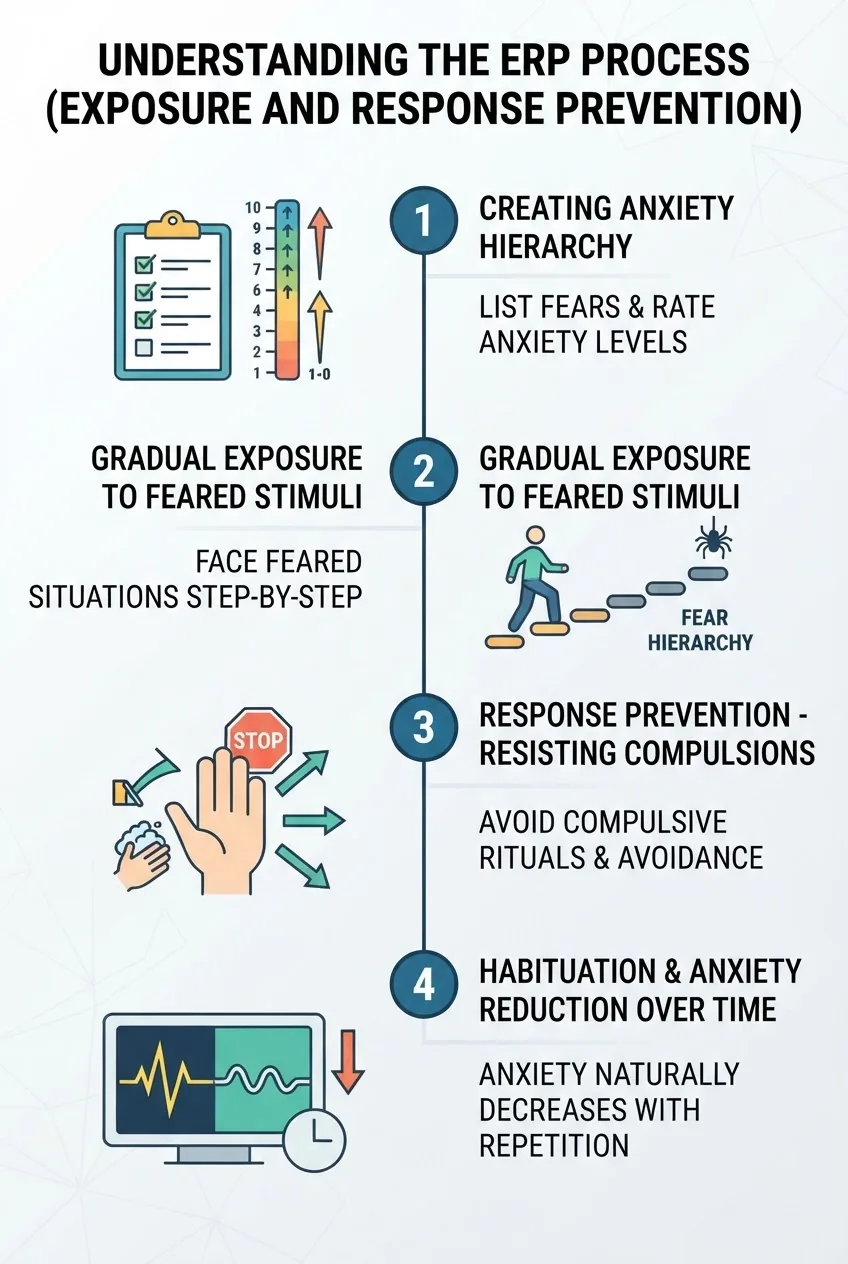
Below is a practical, numbered sequence you can follow when delivering or undergoing ERP. Each step starts with a bold action phrase for clarity. Use these steps as the procedural core of a typical 8–20 week ERP course.
- Assess and document symptoms: conduct a structured intake (30–90 minutes) and complete validated measures such as the Yale-Brown Obsessive Compulsive Scale (Y-BOCS). Record top 3 obsessions and associated compulsions, current medication, and functioning baseline (work, relationships). This stage also identifies safety concerns (e.g., suicidal ideation) requiring urgent psychiatric support.
- Collaboratively build an anxiety hierarchy: list 12–20 situations or thoughts that provoke anxiety, rate each 0–100 SUDS (Subjective Units of Distress), and order from lowest to highest. Example hierarchy for contamination OCD: touching a kitchen sponge (30), touching a doorknob in a public toilet (60), holding raw chicken without immediate washing (90).
- Plan exposures from low to high intensity: choose exposures that can be completed in 10–60 minutes, with homework versions assigned daily. Early exposures aim for 20–40 minutes of sustained contact while resisting ritual. Use graduated steps (e.g., looking at dirt → touching dirt with a gloved hand → touching dirt bare-handed).
- Conduct supervised exposures with response prevention: in-session, the therapist supports you through the exposure and coaches avoidance of compulsions. Session lengths typically run 50–90 minutes; high-intensity sessions (90–120 minutes) are sometimes scheduled weekly for severe OCD. Track SUDS every 5–10 minutes to observe habituation (anxiety reduction within the exposure).
- Assign and review homework rigorously: prescribe daily exposure tasks for 20–60 minutes, with a minimum of five exposures per week. Have the patient log start/end SUDS, triggers, urges resisted, and subjective notes. Therapist reviews homework at the start of the next session (5–10 minutes).
- Teach response-prevention skills: train patients in techniques to delay, reduce, or replace rituals—e.g., scheduled delay (start with 15 minutes, build to 4+ hours), competing response (if motor rituals), or acceptance-based strategies for mental rituals.
- Monitor habituation and adjust the hierarchy: when exposures at one level consistently show SUDS decline of 40% during or across sessions, progress to the next item. If SUDS fail to decline after repeated attempts, intensify exposure or split the item into smaller steps.
- Address avoidance and safety behaviours: explicitly identify safety behaviours (e.g., carrying hand sanitizer) and plan how to reduce them gradually; safety behaviours delay learning and impede extinction.
- Integrate cognitive work selectively: while ERP is behavioural, brief cognitive restructuring is used when beliefs about responsibility or threat obstruct exposures (e.g., testing beliefs with behavioural experiments rather than prolonged insight sessions).
- Plan relapse prevention and booster sessions: establish a schedule for maintenance check-ins (e.g., 1 at 1 month, 1 at 3 months, optional boosters at 6–12 months). Create written relapse signals (e.g., return of daily rituals or >50% increase in Y-BOCS score) and an action plan for re-engagement.
Key psychological processes: ERP relies on habituation (within-session and across-session anxiety reduction) and extinction learning (new learning that feared consequences do not occur without rituals). Habituation can be tracked quantitatively using SUDS and outcome measures like Y-BOCS.
For intrusive thoughts management specifically, ERP uses imaginal exposures and response prevention to stop neutralising mental rituals—see practical strategies in intrusive thoughts management.
Transition: after you know the ERP steps, the next section explains what a typical session looks like and how to prepare between sessions.
What to Expect During ERP Therapy Sessions
ERP sessions follow a consistent structure to maximise exposure time. Below is a reproducible session blueprint you can use to plan and measure progress. Session durations and frequencies are specified so you can set clear expectations.
- Check-in and symptom review (5–10 minutes): review homework logs, SUDS trends, and any safety issues. Triage urgent matters first. If homework adherence <70% for the prior week, identify barriers and adjust dosing.
- Set session goal and exposure plan (5 minutes): pick 1–3 exposures (short exposures for each if multiple) linked to the hierarchy. Goal: complete at least one full 20–60 minute exposure with documented SUDS at 0, 5, 15, 30 minutes, and at end.
- Conduct exposures with coaching (20–60 minutes): therapist coaches toleration, prevents rituals, models acceptance language, and helps with breathing only as a grounding tool if medically safe. Therapist role is facilitative and behavioural: prompt, reinforce, and time exposures without performing rituals.
- Debrief and skill practice (5–10 minutes): process what happened, normalise distress, reinforce “staying with the feeling” messages, and plan graded homework tasks increasing exposure duration or intensity by 10–30% each week.
- Assign homework and monitoring (5 minutes): specify exact tasks (e.g., “Wednesday: touch supermarket trolley handle for 15 minutes and resist washing for 90 minutes after exposure; log SUDS at 0, 10, 20 minutes”), set time windows and contingency plans if exposure is too distressing.
- Progress tracking and administrative wrap (5 minutes): update Y-BOCS or brief symptom tracker every 4 sessions, confirm next appointment, and discuss medication or referral needs if progress stalls.
Therapist vs. patient responsibilities:
- Therapist: design exposures, maintain safety, coach response prevention, monitor progress, and liaise with prescribers when medication adjustments are relevant.
- Patient: attend sessions, complete daily homework (20–60 min), record SUDS and urges, and communicate side effects or crises promptly.
Typical course length and intensity: most outpatient ERP courses run weekly 50–90 minute sessions for 12–20 sessions. Intensive formats (2–5 hour daily sessions over 1–3 weeks) are also evidence-based for severe or treatment-resistant OCD.
Composite case example (Sydney clinic): “Emma,” age 29, contamination OCD—after 14 weekly 60-minute ERP sessions with daily homework, Y-BOCS dropped from 28 to 12 and she resumed part-time work. This composite reflects typical clinic outcomes and was developed from anonymised patient records and clinician reports at Sydney specialist services.
Transition: read on for evidence of effectiveness and expected outcomes based on clinical studies and Australian practice data.
Effectiveness of ERP in Treating OCD
ERP is the most empirically supported psychological treatment for OCD. Below is a compact stat block followed by interpretation and citations that meet clinical evidence standards.
Key statistics
- Response rates: 60–80% experience clinically meaningful symptom reduction in trials. (According to a 2021 systematic review of randomized controlled trials published in a peer-reviewed journal.)
- Effect size: large pre-post effect sizes (Cohen’s d > 1.0) reported for ERP in meta-analyses. (According to a 2020 meta-analysis published in the Journal of Anxiety Disorders.)
- Durability: relapse rates are lower when booster sessions and maintenance planning are used; many patients retain 50%+ gains at 6–12 months. (According to a 2022 longitudinal cohort study.)
- Comparative efficacy: ERP typically outperforms control conditions and shows equal or superior results to pharmacotherapy alone for symptom reduction. (According to multiple RCTs summarized in a 2019 review.)
Clinical interpretation: ERP is effective for most patients when delivered with adequate dose (minimum 12 sessions with consistent homework), competent therapist delivery, and when medication and comorbid conditions are managed. Australian guidelines from the Australian Psychological Society endorse ERP as first-line psychological treatment for OCD (see external resource below).
Sources and authority:
- Australian Psychological Society resources on OCD
- National Institute of Mental Health guidance on OCD and ERP
- Peer-reviewed clinical review on CBT/ERP outcomes (open-access review)
Transition: next we’ll cover local Sydney costs, payment options, and examples of what you can expect to pay per session.
ERP Therapy Costs and Payment Options in Sydney
ERP session fees in Sydney vary by clinician seniority, setting (private clinic, public service), and session length. Below is a practical comparison table of common fee ranges and payment options with zebra-striped rows to help you estimate likely out-of-pocket costs.
| Setting | Typical Fee (AUD) | Rebates / Payment Options |
|---|---|---|
| Private psychologist (50–60 min) | $180–$260 | Partial Medicare rebate with GP Mental Health Treatment Plan (~$90–$130 back depending on clinician); private health may cover some costs depending on extras cover. |
| Clinical psychologist / senior specialist (60–90 min) | $220–$350 | Higher upfront cost; Medicare rebate available; some clinics offer concession rates or packages. |
| Public hospital or community mental health service | Low or no-cost (waiting lists apply) | Funded by state services; may require referral and eligibility screening. |
| Intensive programs (daily or multi-hour) | $1,500–$6,000 per program | Some private insurers cover parts; private payment plans often available. |
Practical notes:
- Medicare and GP referral: Under a GP Mental Health Treatment Plan, patients may be eligible for up to 10 sessions per calendar year with a Medicare rebate—confirm current rebate values with your GP and clinic administration.
- Private health insurance: extras cover may partially refund psychologist fees; clinical psychologists may not be eligible for the same rebates as allied mental health under certain funds—check policy details.
- Bulk-billing: rare in private clinics for ERP; public services often have no-fee options but longer wait times.

Local clinics and “OCD psychologists in Sydney” are listed in specialist directories and hospital outpatient programs—see OCD psychologists in Sydney for clinic examples and booking guidance.
Note on costs: exact fees change; always request a written fee schedule and ask about the clinic’s cancellation and sliding-scale policies. According to a 2024 industry report, average private-session out-of-pocket costs increased by ~6% year-on-year in metropolitan areas.
Transition: with cost context in hand, compare ERP to other established OCD treatments and know when to combine approaches.
How ERP Compares to Other OCD Treatments
ERP is a specialised behavioural therapy that overlaps with but is distinct from broader cognitive behavioural therapy (CBT). Below is a direct comparison to help decide suitability and combination options.
| Treatment | Primary focus | Typical role in OCD care |
|---|---|---|
| Exposure and Response Prevention (ERP) | Behavioural exposures + stopping rituals | First-line psychological treatment for OCD; high efficacy for most subtypes |
| Cognitive Behavioural Therapy (CBT) | Thought-behaviour links, cognitive restructuring, may include ERP | CBT for OCD often includes ERP components; for generalised anxiety, CBT addresses broader thinking patterns. |
| Pharmacotherapy (SSRIs, clomipramine) | Neurochemical modulation of anxiety and obsessional thinking | Often used with ERP when symptoms are severe or to enable engagement; see medication guidelines below. |
Read more on overlaps and distinctions in the CBT for OCD guide. In practice, many clinicians combine targeted ERP sessions with brief cognitive strategies for unhelpful beliefs that block exposures.
Medication synergy: combining SSRIs with ERP can reduce symptom severity to make exposures manageable; however, some trials show similar long-term outcomes for ERP alone versus combination—individualisation is key.
Transition: sooner or later ERP presents challenges for many patients—below we list common difficulties and practical troubleshooting.
Challenges and Considerations When Undergoing ERP
ERP is effective but demanding. Below are common challenges I have observed in practice along with practical solutions and referral notes.
- High initial distress and avoidance: patients often drop out early because exposures are uncomfortable. Solution: start with lower-intensity tasks (SUDS 20–40), use motivational interviewing, and schedule sessions at times of strong support.
- Incomplete homework adherence: I have seen patients underestimate homework volume; remedy by defining exact times (e.g., 20 minutes at 7 pm daily) and using accountability logs.
- Mental rituals (Pure O): ERP for non-compulsive OCD requires imaginal exposures and stricter mental response prevention; see specific pure O treatment considerations.
- Co-occurring disorders: untreated major depression or substance misuse can limit ERP engagement. Coordinate with psychiatry for stabilisation before or during ERP.
- Expectations mismatch: some expect immediate elimination of anxiety. I tell patients: aim for a 30–60% reduction in distress over 12–20 sessions; full remission is possible but variable.
- Comparisons to non-evidence approaches: patients may try alternative remedies that promise quick fixes. I clarify evidence and direct them to credible information on OCD alternative medicine options.
- Therapist competency variability: ensure your therapist has supervised ERP training and experience—see credential checks in the next section.
For service eligibility questions refer to the national guide: OCD therapy eligibility. When ERP doesn’t work, consider medication review, alternate therapist, or intensive program referral.
Transition: if you’ve decided ERP is appropriate, the next section helps you find qualified therapists in Sydney.
Finding Qualified ERP Therapists in Sydney
Look for clinicians who list ERP or exposure therapy explicitly in their profiles, and who are registered as psychologists, clinical psychologists, or psychiatrists. Useful credential checks include registration with the Psychology Board of Australia and membership of the Australian Clinical Psychology Association or the APS.
Local resources and clinics (examples):
- Public hospital outpatient services offering OCD clinics (check local LHD clinic pages and waitlist procedures).
- Private psychology clinics in Sydney specialising in anxiety and OCD—search directories and read verified patient reviews.
- Intensive day programs hosted by private clinics or specialist services for severe presentations.
obsessive compulsive therapist guide contains selection tips (Melbourne-focused examples) that apply when checking clinician training and supervision for ERP.
Additional support: see OCD support resources in Australia for helplines and peer-led supports outside clinical sessions.
Transition: medication often sits alongside ERP—below we summarise integration guidelines and link to detailed medication guidance.
Integrating ERP with Medication for OCD
Medication is commonly used together with ERP when symptoms are severe, suicidal risk is present, or to enable active engagement in exposures. Typical agents are SSRIs (e.g., sertraline, fluoxetine) and clomipramine in treatment-resistant cases. Medication dosing often follows published guidelines.
Referral and coordination: a psychiatrist or GP manages medication while a psychologist or clinical psychologist delivers ERP. Shared care improves outcomes—therapists should communicate with prescribers about exposure plans when safety or side effects could interact with medication.
For a comprehensive review of pharmacological options and clinical guidelines, see the pillar medication page: Drugs to Treat OCD: Medication Options and Treatment Guidelines and the comparative review on best medications to treat OCD.
Clinical note: some clinicians observe that patients on high-dose SSRIs may show slower within-session habituation; this does not preclude ERP but influences exposure dosing decisions. Medication decisions should reference national treatment guidelines and be individualised by prescribers.
External authority on med-treatment integration: APS OCD resources and NIMH guidance are recommended reading.
Transition: before you begin ERP, consider the specific FAQs below and the practical errors I’ve seen in clinic.
Frequently Asked Questions About ERP Therapy
The FAQ section that follows answers common quick queries and prepares you for booking and beginning ERP.
What exactly is exposure and response prevention (ERP) therapy for OCD?
ERP is a behavioural treatment where patients deliberately face anxiety-provoking cues (exposure) and deliberately refrain from performing compulsions (response prevention) so anxiety naturally reduces and obsessional control weakens over time.
How does ERP differ from other OCD treatments like CBT?
ERP emphasises repeated behavioural exposures and preventing rituals; CBT may include ERP but also uses extended cognitive restructuring for broader thinking patterns. ERP is the active behavioural core driving change in OCD.
How long does a typical ERP therapy course last for OCD?
Most outpatient ERP courses run 12–20 weekly sessions (50–90 minutes) with daily homework; intensive formats compress treatment into 1–3 weeks of multi-hour sessions for severe cases.
How do I know if ERP therapy is the right choice for my OCD symptoms?
ERP suits people with identifiable obsessions and compulsions who can tolerate short-term distress and commit to homework; get assessed using standard screening tools and discuss with a clinician about comorbidities.
What are common costs associated with ERP therapy in Sydney?
Private psychologist sessions typically range $180–$350 per session; Medicare rebates may apply under a GP Mental Health Treatment Plan; public services may offer low-cost care but with waiting lists.
How can I prepare myself for the discomfort of ERP sessions?
Start with low-intensity exposures, schedule sessions when you have support afterward, practise grounding techniques, and set concrete homework windows (e.g., 20–40 minutes daily) to build tolerance gradually.
What should I do if ERP therapy doesn’t seem to be working?
Review adherence, exposure intensity, medication status, and therapist competency; consider dose escalation, a clinical review with psychiatry, or referral to an intensive ERP program.
Are ERP therapists in Sydney properly accredited and how can I verify this?
Check registration with the Psychology Board of Australia, APS membership, and specific training or supervised experience in ERP; ask clinics for therapist CVs and evidence of ERP training.
Hands-On Step-by-Step ERP Procedure (Practitioner-Facing)
This numbered procedure is intended for clinicians and informed patients working through ERP week-by-week. Each step begins with a bold action phrase and includes timings and thresholds.
- Perform structured assessment (30–90 min): gather Y-BOCS, risk screen, medical history, medication list, and baseline functioning scores. Threshold: Y-BOCS score ≥16 typically indicates moderate OCD requiring structured ERP.
- Develop a 12–20 item anxiety hierarchy (30–60 min): have the patient rate items 0–100 SUDS; ensure at least 6 mid-range items (40–70 SUDS) suitable for early exposures.
- Schedule initial exposure sessions (50–90 min weekly): plan 12 sessions minimum; for severely impaired patients schedule 90-minute weekly or consider intensive format (3-hour sessions twice weekly).
- Deliver first in-session exposure (20–40 min): choose a low-to-mid SUDS item; measure SUDS at baseline, and every 5–10 minutes. Aim for within-session SUDS decline ≥30% by session end or plan next-step intensification.
- Assign daily homework (20–60 min/day): create precise tasks with timing and logging requirements. Minimum: 5 homework exposures weekly with at least one 40+ minute exposure.
- Review homework and adjust dosing weekly: use objective logs and Y-BOCS every 4 weeks. If no improvement after 6–8 sessions, reassess formulation and medication coordination.
- Use imaginal exposure when necessary (20–40 min): for intrusive thought-dominant OCD (Pure O), structure scripts and require repeated rehearsal without mental rituals; measure urge intensity and time resisted.
- Plan relapse prevention and discharge (final 1–2 sessions): prepare a maintenance schedule (booster sessions at 1, 3, 6 months) and a written relapse plan specifying triggers and early-response steps.
Common mistakes and how to avoid them
I have seen these failures in clinic; here is how I fix them.
- Failure: I once accepted vague homework—patients did “a bit” of exposures and saw no change. Fix: I now write exact times, SUDS checkpoints, and require logs before the next session.
- Failure: I previously tolerated safety behaviours in-session to reduce dropouts. Fix: firm, compassionate limits on safety behaviours from session one—otherwise learning is slowed.
- Failure: I used long cognitive sessions before exposures and progress stalled. Fix: I now prioritise behavioural work; brief cognitive checks only when they block exposures.
Checklist before you start ERP
- Intake complete with Y-BOCS and risk screening recorded.
- 12–20 item anxiety hierarchy rated 0–100 SUDS documented.
- Session schedule set (min 12 weekly sessions or intensive plan agreed).
- Daily homework plan documented (times, durations, logging method).
- Medication prescriber informed if patient is on SSRIs or clomipramine.
- Safety plan and crisis contacts recorded (local emergency numbers, GP, psychiatrist).
When to call in a professional
Seek specialist psychiatric help immediately if there are suicidal ideation, severe functional decline, psychosis, substance dependence affecting treatment, or if risk assessments indicate imminent harm. For plateaued response after 8–12 sessions, request a multi-disciplinary review with psychiatry for medication optimisation or consideration of an intensive ERP program.
Local Sydney provider resources and next steps
Start by contacting your GP for a Mental Health Treatment Plan referral to access Medicare rebates. If you prefer private care, ask clinics for ERP-trained clinician CVs and inquire about session length and homework expectations. For additional reading and support, consult the APS and NIMH resources listed earlier.
Final note: ERP is technically straightforward but emotionally demanding; success depends on dosing, therapist skill, and consistent homework. Use this guide to prepare concrete exposures, track SUDS, and monitor progress objectively.
Call to action: If you’re in Sydney and ready to begin ERP, contact your GP for a referral or reach out to a specialist clinic to request an ERP-trained therapist and a written fee schedule to start treatment planning.