

Answer: The cycle of OCD is a repeating pattern where intrusive thoughts (obsessions) trigger intense anxiety, prompting rituals or mental acts (compulsions) that temporarily reduce distress and thereby reinforce the loop; disrupting this feedback loop through targeted therapies and sometimes medication breaks the cycle and reduces symptoms.
Introduction to the Cycle of OCD — What is the cycle of OCD?
Answer: The cycle of OCD is a self-reinforcing loop of intrusive ideas, rising anxiety, ritualised responses, and short-lived relief that strengthens the association between thought and behaviour, making obsessions return more quickly and compulsions more automatic.
Obsessions: unwanted, recurrent intrusive thoughts, images or urges that cause distress.
Compulsions: repetitive behaviours or mental acts performed to reduce anxiety or prevent feared outcomes.
The obsessive compulsive cycle, also called the obsessive compulsive loop or repetitive thoughts loop, is a clinical model for how OCD symptoms persist and intensify over time. It begins when an intrusive thought or image appears — for example, a sudden thought that hands are contaminated or that a loved one might be harmed. That thought produces emotional and physical anxiety symptoms (racing heart, sweating, intrusive mental rehearsal). To reduce that anxiety, the person performs a specific act — a compulsion — such as washing hands, checking locks, counting, or performing a mental ritual.
Relief follows the compulsion, but because the relief is temporary, the brain learns that the compulsion is the way to reduce threat-related feelings. This negative reinforcement strengthens both the frequency of intrusive thoughts and the rigidity of the response, creating an anxiety reinforcement loop or feedback loop that maintains the disorder.
Early screening and clear assessment help identify where someone sits in this cycle and which interventions will interrupt it; for structured screening tools and assessment guidance see OCD screening and assessment.
Clinical case snapshot (anonymised): “M,” a 28‑year‑old office worker, experienced sudden intrusive contamination fears and began washing hands repeatedly. Initial relief lasted minutes; rituals escalated to interfere with work. A focused assessment revealed an intact insight and marked functional impairment; treatment was planned to target the avoidance-compulsion link directly with exposure and response prevention and adjunct SSRI medication.
According to a 2023 Australian mental health survey, many people wait years before treatment; early recognition of the obsessive compulsive cycle reduces time to care and improves outcomes, especially in integrated clinic settings that combine assessment, psychotherapy and medication when indicated.
Breaking Down the Obsessive Compulsive Cycle — How does each stage of the OCD cycle work?
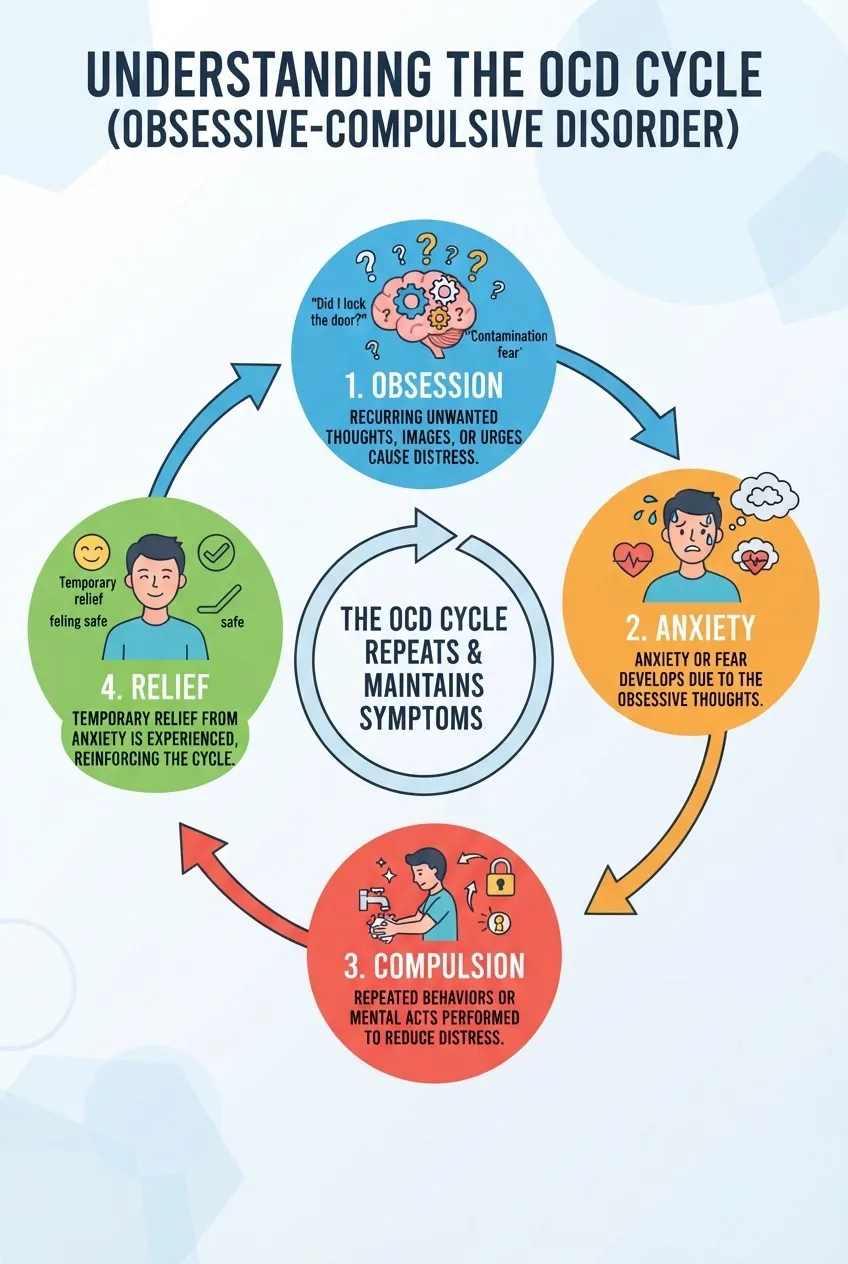
Answer: The cycle of OCD typically follows four stages — obsession, anxiety, compulsion, and relief — each reinforcing the next; identifying and intervening at any stage can interrupt the loop and reduce symptom persistence.
-
1. Triggering intrusive thought or stimulus (Obsession)
Answer: An obsession is an intrusive, unwanted idea, image or urge that appears without intent and causes distress; it is not a voluntary worry but a sudden, recurrent mental event that captures attention.
Obsession phase details:
- Content varies: contamination, harm, sexual, religious/moral, symmetry, or doubt-related themes.
- Intrusive thoughts often contradict the person’s values, increasing shame and secrecy: these are classic intrusive thoughts rather than indications of intent.
- Physiological response often begins immediately (heart rate, cortisol surge, fight-or-flight activation).
Clinical note: Therapeutic assessment distinguishes normal worry from obsessional intrusions by intensity, ego-dystonia (distress about the thought), and resistance attempts.
For examples that clarify the content and range of obsessional thinking, see intrusive thoughts examples.
-
2. Anxiety escalation and emotional arousal
Answer: The obsessive cue triggers an anxiety response that escalates proportionally to perceived threat; this emotional arousal motivates an action to reduce distress and regain a sense of control.
Mechanisms:
- Neurologically, the amygdala and threat-detection networks engage; cortisol and adrenaline support vigilance.
- Behaviorally, increased attention narrows to threat-related stimuli, raising compulsion probability.
- Emotionally, shame or disgust frequently accompany obsessions, which strengthens avoidance patterns.
Clinical observation: Patients may attempt neutralisation — mental reviewing, reassurance seeking, or avoidance — which function like safety behaviours and maintain the anxiety reinforcement loop.
-
3. Compulsive response or mental neutralisation (Compulsion)
Answer: A compulsion is any overt behaviour or mental ritual performed to reduce obsession-triggered anxiety; performing the compulsion produces immediate, short-term relief but reinforces the cycle long-term.
Compulsion types:
- Overt behaviours: washing, checking, counting, ordering.
- Mental rituals: silent prayers, repeating phrases, mental reviewing, neutralising images.
- Avoidance and reassurance-seeking are functional compulsions that prevent exposure to anxiety cues.
Case vignette detail: A patient engaging primarily in mental rituals may have covert compulsions that appear like normal rumination; careful assessment and behavioural experiments reveal the neutralising function.
-
4. Temporary relief and reinforcement (Relief)
Answer: Compulsions reduce anxiety briefly, creating negative reinforcement: the brain learns the compulsion successfully removes distress, increasing the chance the pattern repeats when obsessions return.
Dynamics:
- Relief is often immediate but short-lived — minutes to hours — which encourages more frequent rituals.
- Over time, the threshold for obsession-triggered anxiety lowers, and intrusive thoughts become more persistent and intrusive.
- Compulsions generalise and may proliferate into multiple contexts, raising functional impairment.
Therapeutic implication: Breaking the link between compulsion and relief — through prevented response to exposure — weakens the learned association and decreases obsessive frequency.
Additional cycle drivers and modifiers:
- Safety behaviours (reassurance seeking, checking with family) maintain the loop by preventing disconfirmation of feared outcomes.
- Mood disorders and stress increase cycle intensity; trauma can shape obsession content.
- Subtypes differ in the balance of overt versus covert compulsions and in the sensory or cognitive triggers involved.
Different Types of OCD and How They Relate to the Cycle — What are the main OCD subtypes and how does each affect the cycle?
Answer: Major OCD subtypes—contamination, symmetry/ordering, hoarding, Pure O (obsessions without overt compulsions), checking, sexual/religious taboo obsessions—each present distinct obsession-compulsion pairings that alter how the cycle shows up clinically and which treatments are most effective.
Contamination and related cleanliness-related concerns
Answer: Contamination OCD features intrusive fears of germs, illness or contamination that trigger cleaning and avoidance compulsions; the relief from washing reinforces future contamination obsessions and often leads to avoidance of triggering environments.
Cycle specifics:
- Obsessions: vivid contamination images or fears of illness.
- Anxiety: heightened disgust and hypervigilance to perceived contaminants.
- Compulsions: washing, sanitising, avoiding perceived contaminants, ritualised cleaning sequences.
- Relief: temporary reduction in disgust/anxiety reinforcing avoidance.
For a focused symptom and hygiene treatment guide see cleanliness OCD subtype.
Symmetry, ordering and ‘just right’ feelings
Answer: Symmetry OCD centres on an internal discomfort when things feel misaligned; compulsions aim to restore a subjective sense of “rightness,” reinforcing sensory checking and repetitive arranging rituals that maintain the cycle.
Cycle specifics:
- Obsessions: perceptions of asymmetry or incompleteness, or internal “not-just-right” sensations.
- Anxiety: mounting tension, irritability or inner unease until order is restored.
- Compulsions: arranging, aligning, repeating actions until the sensation subsides.
Clinical note: These compulsions may be time-consuming and socially impairing even without fear-based content; therapy targets tolerance of imperfect sensations via response prevention.
Checking and doubt-based OCD
Answer: Checking OCD involves intrusive doubt (Did I lock the door? Did I harm someone?) that produces checking rituals; each check reduces doubt briefly, strengthening the need to check when similar doubts recur.
Cycle specifics:
- Obsessions: doubt about safety, memory reliability, or moral culpability.
- Compulsions: repeated checks, seeking reassurance, mental review.
- Clinics often use behavioural experiments to test beliefs and reduce checking frequency.
Hoarding disorder and acquisition-related difficulties
Answer: Hoarding features persistent difficulty discarding possessions due to perceived need or distress, forming a different maintenance loop where avoidance of decision-making and distress over loss sustain accumulation rather than ritual relief.
Cycle specifics:
- Obsessions: fears of losing important items or making wrong decisions.
- Anxiety: intense distress at the idea of discarding objects; indecision.
- Behaviours: excessive acquiring, saving, and avoidance of discarding; relief is subtle and tied to perceived safety rather than immediate anxiety reduction.
Distinction: Hoarding is now a separate diagnosis but overlaps functionally with OCD; treatment often needs home-based behavioural work and decision-making skills training.
Pure O (obsessive thoughts without visible compulsions)
Answer: The Pure O subtype involves predominantly intrusive, often taboo thoughts and internal rituals (mental checking, neutralising) rather than visible behaviours; the cycle is preserved via covert compulsions that are harder to detect and treat without careful assessment.
Cycle specifics:
- Obsessions: violent, sexual, blasphemous or morally distressing thoughts.
- Compulsions: mental neutralising, rumination, reassurance-seeking internally or from others.
- Treatment focus: targeting the mental response patterns and preventing internal rituals via adapted ERP techniques.
For a focused overview on this presentation see Pure O subtype.
Sexual, religious, and taboo obsessions
Answer: Taboo obsessions provoke intense shame and secrecy, often leading to covert mental rituals and high distress; relief through mental or behavioural neutralisation reinforces the underlying anxiety-driven loop.
Clinical caution: These obsessions often carry severe distress and guilt; clinicians emphasise normalising intrusive thought content and clarifying difference between thought and action.
When OCD overlaps with personality or other disorders
Answer: Symptoms can look like compulsive personality traits, anxiety disorders or obsessive-compulsive personality disorder (OCPD); differential diagnosis matters because treatment strategies and targets differ.
Comparative point: For a formal guide distinguishing these presentations see compulsive personality disorder.
Across subtypes, the obsessive compulsive cycle retains the same mechanism (intrusive cue → anxiety → response → relief) but varies in:
- Compulsion modality (behavioural vs. mental).
- Visibility and detectability of symptoms.
- Types of avoidance and safety behaviours enacted.
The Role of Anxiety in Maintaining the OCD Cycle — How does anxiety keep the OCD cycle running?
Answer: Anxiety is the engine of the OCD cycle: obsession-induced anxiety motivates compulsions that temporarily reduce distress; through negative reinforcement the anxiety-compulsion link becomes stronger, maintaining the disorder over time.
Term: Negative reinforcement: a behavioural process where removing an aversive state (anxiety) increases the likelihood of the behaviour that removed it (compulsion).
Neuroscientific and psychological mechanisms:
- Anxiety triggers the sympathetic stress response (fight or flight) with cortisol and adrenaline release; acute stress sharpens attention to threat cues and narrows cognitive flexibility.
- Repeated relief after a compulsion strengthens associative learning pathways; the cortico‑striatal‑thalamo‑cortical (CSTC) circuit implicated in OCD shows hyperconnectivity associated with intrusive thought salience and action-selection bias.
- Emotion regulation deficits — including intolerance of uncertainty and high need for certainty — magnify anxiety responses and shorten the interval between obsession and compulsion.
Clinical observations:
- Patients with higher baseline anxiety often experience faster cycle escalation and broader generalisation of compulsions across contexts.
- Stressful life events or comorbid depression can reduce coping capacity and increase reliance on compulsions for short-term relief.
- Therapeutic work that reduces anxious reactivity (through exposure, cognitive restructuring, or medications that lower baseline arousal) reduces compulsion frequency and weakens learned associations.
According to a 2022 meta-analysis in the Journal of Anxiety Disorders, interventions that lower anxiety reactivity — particularly ERP and targeted SSRIs — yield the largest reductions in compulsive behaviours and recurrence rates; combined approaches often outperform single modalities in moderate-to-severe presentations. For clinical practice in Australia, national guidance encourages integrating psychotherapy and pharmacotherapy where clinically indicated; see Australian Government Department of Health for national mental health resources.
OCD Treatment Overview: Interrupting the Cycle Effectively — What treatments break the OCD cycle and how do they target it?
Answer: The most effective treatments interrupt the obsession → anxiety → compulsion → relief loop by either reducing anxiety sensitivity or preventing compulsion-driven relief: frontline therapies are CBT with Exposure and Response Prevention (ERP), SSRIs when needed, and adjunctive approaches tailored to subtype and severity.
Core treatment targets:
- Reduce anxiety reactivity to obsessional cues.
- Prevent compulsions to remove the negative reinforcement.
- Modify catastrophic beliefs and intolerance of uncertainty that fuel obsessions.
Evidence summary and approach:
- CBT with Exposure and Response Prevention (ERP) — Directly targets the cycle by exposing the patient to obsessional cues without permitting the compulsion, allowing habituation and disconfirmation of feared outcomes. ERP is the gold standard psychological treatment with robust effect sizes across OCD subtypes. For treatment training and structured protocols see CBT for OCD and for in-depth ERP resources see exposure and response prevention (ERP).
- Medication — Selective serotonin reuptake inhibitors (SSRIs) and some other agents reduce obsessive intensity and baseline anxiety, making ERP more tolerable and effective; medication is commonly used for moderate-to-severe OCD or when psychotherapy alone is insufficient. For a detailed medication review see medication options and treatment guidelines and see further comparative summaries at medications for OCD.
- Combined treatment — Combining ERP with SSRIs often produces greater symptom reduction and faster functional gains than either alone, especially in more severe cases; clinical decisions depend on patient preference, symptom severity, and comorbidity.
- Adjunctive and alternative approaches — Mindfulness-based strategies, acceptance and commitment therapy (ACT), and some neuromodulation techniques (e.g., rTMS) can be useful when standard treatments are incomplete; discuss these with a specialist. Additional complementary options are summarised in alternative treatments for OCD.
- Specialised formats — Intensive outpatient or day programmes, group ERP, or residential programmes may be indicated for severe, treatment-resistant cases.
How treatments map to the cycle:
- ERP directly interrupts the compulsion → relief link by preventing the ritual, promoting extinction learning and tolerance of anxiety.
- CBT cognitive work targets maladaptive appraisals that make obsessions look threatening, reducing initial anxiety amplitude.
- SSRIs lower baseline anxiety and obsession strength, making it easier to engage with exposures and reduce relapse risk.
Therapy eligibility and practical guidelines are outlined in clinical resources; for full criteria and stepwise recommendations see treatment eligibility and guidelines.
Clinical trade-offs and monitoring:
- ERP requires repeated, sometimes intense anxiety exposures; clinician support and stepped pacing reduce dropout and adverse events.
- SSRIs require weeks to take effect and have side effects (gastrointestinal upset, sexual dysfunction, sleep changes); monitoring and dose adjustments are routine.
- Combined care in clinics often yields better adherence and faster functional gains by coordinating medication management with ERP delivery.
Service and cost comparisons (summary table):
| Treatment | How it breaks the cycle | Typical duration / notes |
|---|---|---|
| ERP (CBT) | Prevents ritual → reduces negative reinforcement | 8–20 sessions; intensive options available |
| SSRI medication | Reduces obsession intensity and anxiety reactivity | 6–12 weeks to response; monitor side effects |
| Combined ERP + SSRI | Improves tolerability and response rates | Individualised; commonly recommended for moderate-severe OCD |
Authorities and evidence:
- Meta-analyses in peer-reviewed journals show ERP has large effect sizes for reducing compulsions and obsessions; for direct evidence consult peer-reviewed sources such as the Journal of Anxiety Disorders (Journal of Anxiety Disorders).
- Clinical guidelines from Australian mental health bodies and international organisations support ERP as first-line psychological treatment and SSRIs for pharmacotherapy augmentation; see the International OCD Foundation at International OCD Foundation.
Practical therapy walkthrough (ERP monitoring tool example):
- Identify three high‑impact obsessional cues and rate anxiety 0–100 for each.
- Create a graded exposure hierarchy from least to most distressing cue.
- Plan exposures with prevented response (no ritual allowed) for set durations, recording anxiety levels across time to document habituation.
- Review progress weekly; escalate exposure intensity as tolerance grows.
According to a 2021 Cochrane-style review in major clinical journals, guided ERP with a trained clinician produces sustained improvements in quality of life and functional outcomes, and combined approaches reduce relapse; clinic-based monitoring is recommended for safety and adherence.
Local Sydney Clinic Insights: Treatment Resources and Next Steps — Where can I get treatment in Sydney and what should I expect?
Answer: Sydney clinics provide integrated OCD care—assessment, ERP-trained psychologists, psychiatrist-led medication management, and stepped care programs—so local residents should seek clinics offering combined services, clear care pathways and measurable outcome tracking to interrupt the OCD cycle efficiently.
What to expect from a quality Sydney clinic:
- Comprehensive diagnostic assessment using DSM-5 criteria and standardised scales (Y-BOCS or similar).
- Individualised care plans combining ERP, CBT, and medication if indicated.
- Access to psychiatrists for medication management and to multidisciplinary teams for comorbidities.
- Outcome monitoring and relapse-prevention planning.
Referral and eligibility:
- Primary care referral or self-referral is accepted by many specialist clinics; eligibility depends on severity, safety concerns, and comorbid conditions.
- Public mental health services may offer stepped care with triage for acute risk; private clinics offer faster access to specialist ERP-trained therapists.
Local and regional resources:
- OCD psychologists in Sydney — clinic directories and cost guides.
- OCD therapists in Melbourne — for geographic comparison and options.
- OCD Australia helpline and support — national helplines and peer support services.
Clinic feature checklist (brief):
- ERP-trained clinicians and access to psychiatrist review.
- Outcome measurement and documented treatment plans.
- Options for intensive therapy blocks if required.
- Clear communication about therapy risks, medication side effects and expected timelines.
Next steps to access care in Sydney:
- Start with a structured assessment via a qualified clinic or GP referral; consider clinics offering same‑week triage for moderate-to-severe cases.
- Request an ERP-trained therapist and, if needed, psychiatric review for medication discussion.
- Check public and private coverage options, and look for clinics that document outcomes and provide relapse-prevention planning.
Conclusion and Encouragement for Seeking Treatment — Why should I seek help and what can I expect from treatment?
Answer: Seek help because OCD’s cycle is learned and reversible; with evidence-based interventions like ERP and appropriate medication most people achieve substantial symptom reduction, improved functioning and regained control over intrusive thoughts.
Key takeaways:
- The cycle of OCD is predictable: obsessions trigger anxiety, compulsions relieve it briefly, and relief reinforces the loop.
- Treatments work by breaking the compulsion‑relief link and reducing anxiety reactivity; ERP plus medication when needed is most effective for many.
- Local Sydney clinics offer integrated, evidence-based care; early assessment shortens the path to recovery.
Clinical reassurance and CTA: If intrusive thoughts or compulsive behaviours are reducing your quality of life, contact a trained clinician for assessment and an individualised plan; early, specialist-led intervention increases chances of durable improvement.