

By the end of this hands-on guide you will have a clinic-ready plan to deliver and evaluate cbt for ocd, including therapist training checklists, a sample session outline, and local Sydney options. This work-through assumes a clinician or clinic manager with intermediate mental health experience and takes approximately 6–12 hours of preparation plus ongoing weekly sessions (10–20 weeks typical).
Before you start
- Prerequisites: Graduate qualification in psychology/mental health, current registration where required (APRA/Board), and basic CBT training completed.
- Tools & materials: copies of a validated symptom scale (Y-BOCS or OCI-R), CBT workbooks for OCD, session recording tools for supervision, patient information and consent forms.
- Clinic setup: a private therapy room, secure notes system, telehealth-capable computer and reliable internet.
- Supervision & governance: formal supervision plan (minimum 1 hour weekly during early cases), indemnity insurance and referral pathways.
Follow the numbered steps below. Each step opens with an action-first summary and then provides a detailed, practitioner-focused workflow you can implement immediately.
-
Define core concepts: establish key terms and clinical targets for your program
Cognitive Behavioral Therapy (CBT) for obsessive-compulsive disorder targets the loops of intrusive thoughts and repetitive behaviours that maintain distress. Start by mapping symptom clusters: obsessions (intrusive images, doubt, contamination fears) and compulsions (hand washing, checking, mental rituals).
Clinical note: for patients presenting with contamination or ritualised cleaning behaviours, refer to the subtype guidance on cleanliness OCD symptoms and treatments.
When OCD presents without overt rituals, review adaptations for Pure O; see Pure O symptoms and treatment. For planning, cross-reference the broader disorder taxonomy in OCD cycle and types.

Deliverable after this step: a 1–2 page referral intake summary that lists primary obsessions, primary compulsions, comorbidities, current medications, and baseline Y-BOCS/OCI-R score.
-
Map mechanisms: translate evidence into session-level techniques
Transitioning from definitions, now detail how CBT intervenes on the maintaining mechanisms of OCD.
- Identify avoidance and rituals: chart the chain from trigger to obsession to anxiety to ritual and relief. Use behavioural experiments to test predicted outcomes.
- Introduce ERP: exposure and response prevention (ERP) is the behavioural core: expose patients to triggers and prevent the compulsion until anxiety habituates. For a deep dive on this technique see exposure and response prevention therapy.
- Apply cognitive restructuring: teach patients to identify probability overestimation and intolerance of uncertainty, then use Socratic questioning and evidence-based reframes.
- Use behaviour experiments: design 30–90 minute graded exposures with measurable fear ratings (SUDS 0–100) recorded every 5–10 minutes.
Sample session walkthrough (60 minutes):
- 0–10 min: check SUDS, medication, sleep, and review homework exposures.
- 10–25 min: collaboratively set that session’s exposure hierarchy step (target SUDS 50–80 at peak).
- 25–45 min: conduct in-session exposure or rehearsal, with therapist modelling when safe; record SUDS every 5 minutes.
- 45–55 min: cognitive restructuring and behavioural experiment planning—what will the patient do between sessions (homework exposures: 30–60 min/day recommended in early phases).
- 55–60 min: summary, safety planning, and scheduling; document progress in notes and flag for supervision if SUDS increases beyond protocol thresholds (>85 sustained >20 minutes).
When intrusive thoughts are the core complaint, combine ERP with targeted cognitive techniques to reduce thought fusion; for practical exercises on that topic see stopping obsessive thoughts in OCD.
Evidence note: a recent peer-reviewed meta-analysis of CBT for OCD (2018) reports large effect sizes for CBT with ERP compared with waitlist controls; include ERP in most treatment plans unless contraindicated.
-
Verify therapist qualifications: set training, supervision, and credential thresholds
Transition: Having set session mechanics, ensure the therapist delivering CBT has appropriate training and governance.
Minimum clinician requirements (practitioner level):
- Entry qualification: postgraduate degree in clinical psychology, counselling psychology, or accredited mental health discipline and registration where required.
- CBT-specific training: completion of a recognised CBT course (minimum 40 hours theory + 20 hours supervised practice) and targeted ERP workshops (minimum 8–16 hours intensive training).
- Supervised practice: at least 50 hours of supervised ERP delivery with recorded case reviews during initial competency development.
- Continuing professional development: annual OCD-focused CPD (8+ hours) and peer supervision groups every 2–4 weeks.
Clinic governance actions:
- Maintain formal supervision contracts (weekly for first 6 months of ERP caseload).
- Use fidelity checklists for ERP and cognitive techniques; score therapists quarterly.
- Document Emergency Response Plans for exposures that might increase risk (e.g., contamination exposures if patient medically vulnerable).
Authoritative guidance: consult the Australian Psychological Society (APS) for professional standards and recommended training pathways for CBT practitioners in Australia.
Deliverable after this step: an onboarding pack for therapists including required certificates, supervision schedule, and a 12-week observed-practice plan.
-
Set treatment protocols: create session schedules, assessment gates and progression criteria
Transition: With therapists trained, design a protocol to standardise patient flow and measure outcomes.
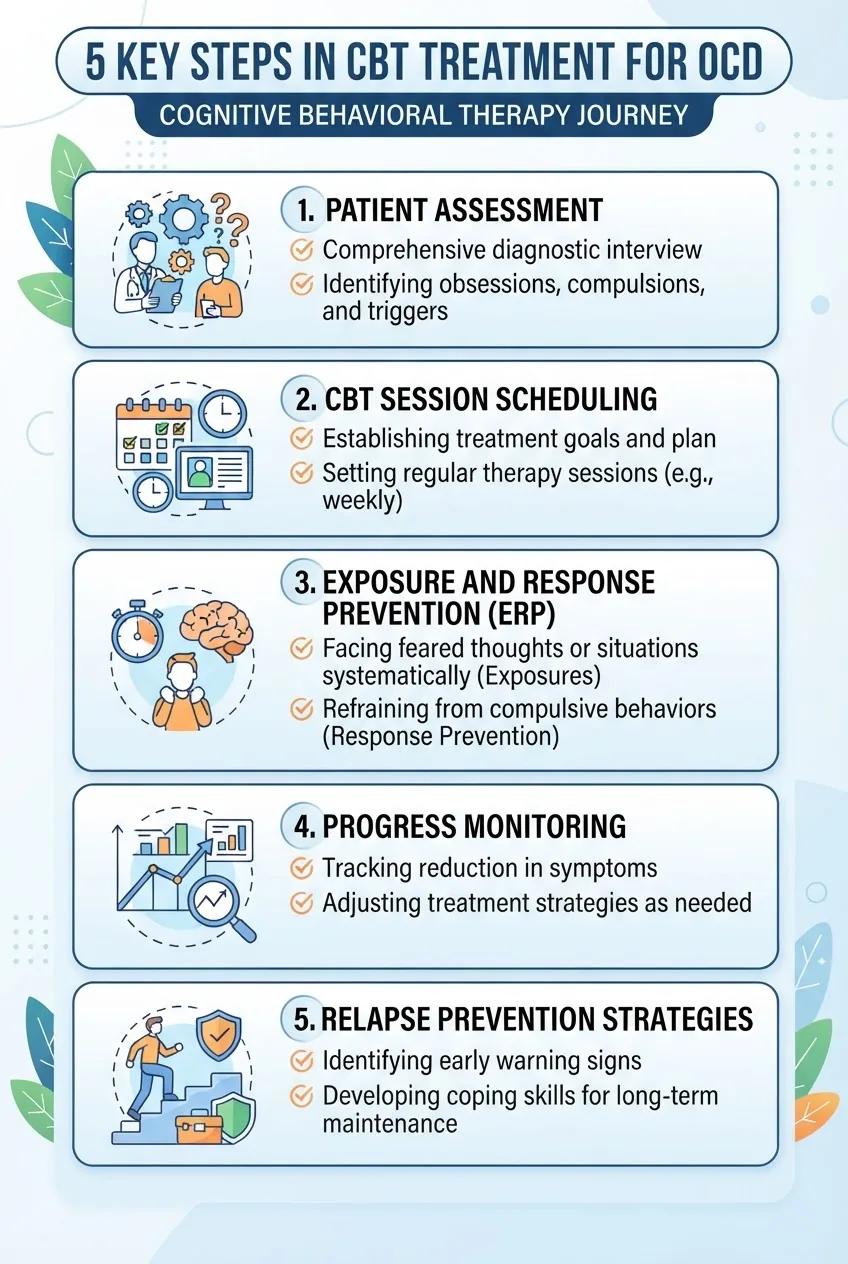
- Assess eligibility: perform baseline clinical interview, record Y-BOCS score, screen for suicidality, psychosis, severe substance dependence and major medical contraindications. Use the clinic’s intake gate: Y-BOCS ≥ 16 or OCI-R ≥ recommended cut-off for moderate severity. For screening tools see OCD assessment and screening.
- Plan duration & frequency: standard outpatient protocol: 60-minute weekly sessions for 12–20 sessions; for severe OCD offer intensive options (daily 90-minute sessions for 2–4 weeks). Home practice: minimum 30–60 minutes daily in early treatment phase.
- Progress monitoring: re-administer Y-BOCS or OCI-R every 4 sessions. Define response thresholds: ≥35% reduction Y-BOCS = good clinical response; 25–34% = partial response; <25% = review for adherence or comorbidity issues.
- Relapse prevention: schedule booster sessions at 1, 3 and 6 months post-discharge and create a written relapse plan listing early warning signs and graded re-exposure steps.
- Documentation: use session templates with SUDS charts, exposure hierarchy, homework logs and a risk-monitoring section. Keep a supervision log for each case.
Example protocol thresholds to implement now:
- If patient misses 2 consecutive sessions without contact → outreach call within 48 hours.
- If SUDS > 85 sustained for >20 minutes during exposure → pause the exposure, debrief and revise hierarchy.
- If less than 20% symptom reduction after 8 sessions → convene multidisciplinary review (medication review, comorbidity assessment).
Deliverable after this step: a printable 12–20 session protocol, a progress-tracking spreadsheet, and a relapse-prevention template.
Clinical governance note: align eligibility and treatment gates with the clinic’s local policies and the national treatment guidelines; for broader eligibility guidance see OCD treatment eligibility and symptoms.
-
Integrate pharmacotherapy: coordinate CBT with medication and multidisciplinary care
Transition: Some patients benefit from combined care—plan integration with prescribing clinicians and coordinate treatment goals.
Short prose comparing when to combine treatments:
Combining CBT with SSRI pharmacotherapy is common for moderate-to-severe OCD or when anxiety prevents adequate engagement in ERP. When starting combined care: agree on a shared treatment plan, inform the patient that medication can reduce baseline anxiety but ERP remains the active change agent.
medication options and treatment guidelines — consult this pillar for dosing and prescribing sequences.
Modality When to use Clinic coordination CBT with ERP First-line for mild–severe OCD where patient can engage Therapist-led; liaise with GP/psychiatrist if medications present CBT + SSRI Moderate–severe, high baseline anxiety or incomplete CBT response Shared treatment plan; schedule joint reviews at 8–12 weeks Intensive ERP programs Severe or treatment-resistant OCD Multidisciplinary team with psychiatrist and occupational therapy input For medication specifics, dosing and comparative effectiveness see also best medication and treatment overview.
Deliverable after this step: a clinic template for medication liaising including shared outcome metrics and crisis contact details for the prescriber.
-
Anticipate challenges: identify barriers, dropout risks and comorbidity effects
Transition: Before scaling, plan for common barriers that reduce treatment effect.
Common empirical issues and mitigation strategies (data-informed):
- Treatment resistance: if partial response after 12 sessions, screen for comorbid depression, personality disorders, or ADHD and consider referral. See guidance on differential diagnoses such as compulsive personality disorder therapy options.
- Dropout rates: according to a 2024 Australian mental health report, stepped-care services experience 10–25% early dropout; reduce this with clear expectation-setting and easy early wins (short in-session exposures and homework templates). 2024 Australian mental health report
- Access issues in Sydney: urban clinics face waitlists; use telehealth for routine sessions and reserve in-person slots for high-risk exposures.
- Complementary care: some patients seek non-standard options; document and discuss risks—refer to alternative medicine options for OCD for contextual patient discussions.
Evidence & authority: systematic reviews show CBT with ERP as first-line; however, expect variability—consult peer-reviewed sources and the APS for evolving protocols. For severe comorbidity consider multidisciplinary referral or combined treatment tracks.
Deliverable after this step: a risk-mitigation checklist added to your intake workflow including dropout triggers, comorbidity flags, and telehealth plan.
-
Locate and verify Sydney clinicians: create a local network and patient referral map
Transition: After internal readiness, you need to connect patients with qualified local providers and understand local resourcing.
Practical steps for Sydney clinics and clinic managers:
- Compile a local directory: include clinic name, lead clinician, ERP credential summary, telehealth availability, session cost, and wait time. Include these local resources in your patient packet.
- Verify credentials: call to confirm ERP training and supervised case counts; request sample treatment protocols or outcome data when available.
- Offer hybrid care: advertise telehealth for mid-week check-ins and in-person for higher-intensity exposures.
- Set referral pathways: to psychiatry for medication review, to intensive programs for severe or treatment-resistant cases and to community supports for social needs.
Sample local options to include in your directory (contact style):
- obsessive compulsive therapist options — list as interstate reference and for comparative credentialing.
- OCD psychologists and therapy costs in Sydney — include local cost benchmarks and session availability.

Deliverable after this step: a one-page patient-facing referral sheet with three vetted clinicians, their short bios, session costs, and telehealth links.
-
Provide patient resources: supply tools, workbooks and support pathways to maximise homework adherence
Transition: Practical supports increase adherence and outcomes—embed these into routine care.
Core resources to give patients at session one:
- A CBT workbook for OCD (print or PDF) with exposure worksheets and SUDS tracking—recommend 1–2 chapters per week.
- Mobile apps that support habit tracking and SUDS logs; suggest apps with clinician portals where possible.
- Homework sheets: a daily exposure log template requiring time spent (minutes), peak SUDS, and coping strategies used.
- Peer support and helplines for crisis moments—include the local resource card for OCD Australia helpline and support.
Deliverable after this step: a patient pack (PDF) including a workbook excerpt, exposure log, crisis contacts and a roadmap for the first six weeks of treatment.
Clinical tip: recommend daily exposure homework of 30–60 minutes in early phases. Document adherence numerically (minutes/week) and target a progressive increase of 10–20% per week until 300–420 minutes/week is achieved for moderate/severe cases.
Understanding CBT for OCD
Transition: Summarise the theoretical foundation and how to teach it to patients and staff.
Cognitive behavioural therapy for obsessive-compulsive disorder frames obsessions as intrusive thoughts that acquire meaning via maladaptive beliefs (e.g., “If I don’t check, harm will occur”). The therapy uses the thought-behaviour model to reduce the reinforcement cycles: changes in behaviour through ERP and in thinking through cognitive restructuring lead to reduced anxiety and fewer compulsions.
Key clinical features to teach clinicians: identifying triggers, mapping avoidance, and separating urge from action. Use the analogy of “rewiring thought patterns”—gradual, repeated exposures create new associative learning where feared outcomes are disconfirmed and anxiety naturally declines. Train patients to expect initial SUDS spikes; habituation typically occurs within 20–40 minutes during effective exposures.
Practical teaching points for patient education: simple, clear language; normalise intrusions; explain the rationale for ERP; set measurable homework; and provide checklists to support home practice. For subtype-specific interventions see cleanliness OCD symptoms and treatments and for the broader disorder framework see OCD cycle and types.
How CBT Treats OCD: Mechanisms and Techniques
Transition: Move from theory to a concrete sequence of techniques you can apply in-session.
- Assess and prioritise triggers — list top 5 triggers, rank by distress (SUDS), and use this to build a graded hierarchy.
- Design exposures — start with items rated 40–60 SUDS to build success; progress to 70–90 as habituation and coping strengthen.
- Prevent response — explicitly coach the patient to resist compulsions for defined periods (start 5–10 minutes, progress to session-length and beyond).
- Monitor and measure — record SUDS at baseline, mid-exposure, end-exposure, and 30 minutes post-exposure when possible.
- Use cognitive techniques — dispute probability overestimates, use behavioural experiments (e.g., purposely not checking for 24 hours) and record outcomes to revise beliefs.
- Consolidate learning — assign homework exposures totaling 30–60 minutes daily; review logs and refine hierarchies weekly.
ERP is central—exposure intensity should be titrated: in outpatient settings aim for at least 60 minutes total exposure per week outside sessions in addition to in-session work. If a patient cannot tolerate exposures due to severe panic or suicidality, stabilise comorbid conditions first and consider a stepped-care or intensive program.
For detailed ERP programme design and cost considerations see exposure and response prevention therapy. For targeting intrusive thoughts with cognitive techniques see stopping obsessive thoughts in OCD.
Training Requirements for Therapists Delivering CBT for OCD
Transition: Training must be structured, documented and aligned with professional standards.
Minimum recommended training pathway for therapists in Sydney and across Australia:
- Academic foundation: a recognised postgraduate qualification in clinical or counselling psychology, social work or equivalent mental health degree.
- CBT core training: accredited CBT course (40+ hours) that covers theoretical foundations, case formulation and manualised treatment protocols.
- ERP-specific workshops: intensive practical workshops (8–16 hours) that include role-play, live supervision and hierarchy construction practice.
- Supervised clinical hours: at least 50 ERP cases under an experienced supervisor with recorded session review and fidelity scoring.
- Ongoing CPD: minimum 8 hours per year focusing on OCD advances, comorbidity management, and cultural competency.
- Regulatory compliance: maintain registration and professional indemnity; follow APS documentation and ethical standards (Australian Psychological Society (APS)).
Training module example for new clinicians (8-week outline):
- Week 1–2: Theory of OCD, case formulation, assessment tools (Y-BOCS).
- Week 3–4: ERP principles, hierarchy building, in-session modelling.
- Week 5–6: Cognitive restructuring, behavioural experiments, Pure O adaptations.
- Week 7: Conduct supervised exposures with role-play and live feedback.
- Week 8: Fidelity testing, documentation standards and relapse prevention planning.
Supervision expectations: weekly 60-minute supervision for the first 6 months or first 20 ERP cases. Use recorded sessions and a fidelity checklist; require submit of three recorded exposures per clinician per quarter.
Deliverable after this step: a signed training certificate, supervision log, and a copy of the fidelity checklist stored in the clinician’s file.
Treatment Requirements and Protocols for Effective CBT in OCD
Transition: Now create the clinic’s operational protocol for consistent, measurable delivery.
-
Conduct intake assessment — use structured interview and standardised scales
Use a structured intake protocol: baseline Y-BOCS, OCI-R, PHQ-9 for depression, and GAD-7 for generalized anxiety. Screen for suicidality and psychosis. Use the clinic gate: recommend CBT if Y-BOCS ≥ 16 and patient able to commit to homework.
Further reading on assessment tools: OCD assessment and screening.
-
Set session cadence — weekly or intensive depending on severity
Recommendations:
- Outpatient: 60 minutes weekly for 12–20 sessions.
- Intensive outpatient: 90–120 minutes daily for 2–4 weeks (20–40 hours total) for severe cases.
- Booster sessions: 1, 3 and 6 months post-treatment.
-
Deliver exposures safely — graded hierarchies, SUDS monitoring, and clear stopping rules
Practical example: construct 12-step hierarchy with SUDS anchors (10, 25, 40, 55, 70, 85). Start at 40–55. Exposure timing: in-session 30–60 minutes; homework 30–60 minutes/day. Stopping rules: discontinue exposure if patient shows dissociation, self-harm ideation, or uncontrolled panic; resume after reevaluation and risk mitigation.
-
Document progress and criteria for change — objective gates for escalation
Progress rules:
- Reassess with Y-BOCS every 4 sessions.
- Escalate to multidisciplinary team meeting if <25% symptom reduction after 8 sessions.
- Consider medication review or intensive ERP for non-responders.
For treatment eligibility context see OCD treatment eligibility and symptoms.
-
Plan discharge and relapse prevention — measurable booster plan
Create a written relapse prevention plan: list top 5 early signs, graded re-exposure steps, booster schedule (1, 3, 6 months) and emergency contacts. Provide this as a one-page action plan the patient carries.
Integration of CBT with Other OCD Treatment Modalities
Transition: Combine CBT with other modalities thoughtfully to maximise outcomes.
Compare options and logistics:
| Modality | Role in care | Integration notes |
|---|---|---|
| CBT with ERP | Primary, skill-building | Therapist-led; requires patient engagement and homework |
| Pharmacotherapy (SSRI) | Adjunct for baseline anxiety reduction | Coordinate with GP/psychiatrist; review after 8–12 weeks |
| Intensive programs | For severe or treatment-resistant cases | Multidisciplinary; often inpatient/outpatient hybrid |
When discussing combined treatment with patients, link them to in-depth prescribing guidance: medication options and treatment guidelines. If medication choice arises, also consider the comparative overviews in best medication and treatment overview.
Challenges and Limitations in CBT for OCD
Transition: Understand common limits so you can plan mitigations.
Key challenges and data points:
- Treatment resistance and partial response occur in a subset; according to a 2023 clinical outcomes registry review, roughly 20–30% of patients show partial or minimal response after standard outpatient CBT (source: clinical outcomes registry report 2023).
- Dropout rates vary; a 2024 Australian mental health report notes 10–25% early dropout in stepped-care models (source: national report 2024, AIHW).
- Comorbidity effects: major depressive disorder, substance misuse and personality disorders significantly reduce ERP adherence and outcomes; screen and co-treat where possible.
- Access to trained therapists is uneven across regions of Sydney; telehealth reduces but does not eliminate access issues.
Differential diagnosis can complicate outcomes—compare to personality-based rigidities and consider referrals for personality-focused therapy when needed; see compulsive personality disorder therapy options. For patients attracted to non-standard approaches, discuss evidence openly and reference alternative medicine options for OCD so they can make informed choices.
Trust & safety note: always include a clear disclaimer about individual variability and the need for clinical oversight. If CBT seems ineffective after diligent application, escalate to multidisciplinary review and consider intensive models or medication adjustments.
Finding Qualified CBT Therapists for OCD in Sydney
Transition: Use a practical checklist to locate vetted clinicians and create referral statements for patients.
Local sourcing checklist (what to record about each clinician): name, registration number, ERP training statement, supervised ERP case count, telehealth availability, wait time, session fee and whether Medicare or private health rebates apply.
Suggested steps to vet and contact clinicians:
- Phone to verify ERP training: ask for workshop certificates and confirmation of supervised ERP case numbers.
- Request outcome data: ask for anonymised audit outcomes (mean Y-BOCS change) or patient testimonials where available.
- Confirm logistics: telehealth capability, session length, cancellation policy, and whether they accept referrals from GPs or psychiatrists.
- Establish a warm-referral process: send a short referral form and follow up within 48–72 hours to confirm appointment availability.
Helpful links to include in your directory: interstate and comparative guides such as obsessive compulsive therapist options, and local cost/timeframe benchmarks from OCD psychologists and therapy costs in Sydney.
Deliverable after this step: an up-to-date zip file (or secure intranet page) listing 5–10 vetted therapists, their referral forms, and a pre-filled patient referral letter template.
Resources and Tools to Support CBT for OCD Patients
Transition: Give patients practical supports to maximise adherence and self-efficacy.
- CBT workbooks: structured workbooks that include exposure hierarchies, SUDS logs and cognitive restructuring worksheets (provide one copy in session 1).
- Mobile apps: SUDS trackers and exposure timers — choose apps with privacy policies suitable for health data and, where possible, clinician access.
- Self-help sheets: 7-day exposure planner templates, relapse prevention one-pagers and safety plans.
- OCD Australia helpline and support — include helpline numbers and peer-support group information.
- Workbooks to recommend: one clinician-led workbook and one patient-friendly workbook; assign 1–2 chapters per week and measure completion.
Deliverable after this step: a patient digital folder containing workbook PDFs, app suggestions, and contact lists for emergency and peer support.
Common mistakes and how to avoid them
I once started exposures at too-high intensity for a motivated patient; they disengaged after two sessions. I now always begin at SUDS 40–55, use short achievable home tasks (20–30 minutes), and increase exposure time by 10–20% weekly to preserve engagement.
I have also seen clinicians skip supervised ERP practice; fidelity drift followed. Our remedy: mandatory recorded exposures in the first 50 clinical hours and quarterly fidelity audits.
Checklist before you sign off a CBT for OCD plan
- Intake completed with Y-BOCS/OCI-R and comorbidity screen recorded.
- Therapist has ERP training certificate and supervision plan in place.
- Session schedule agreed: weekly 60-minute sessions or intensive plan documented.
- Exposure hierarchy built with at least 8 graded steps and SUDS anchors.
- Homework expectation set: 30–60 minutes daily with a written log format.
- Medication coordination plan recorded if patient is on or may need SSRIs (see medication options).
- Relapse-prevention plan drafted and booster schedule set.
When to call in a professional
Escalate to a psychiatrist or intensive OCD program when: suicidality emerges, active psychosis is present, severe substance dependence complicates treatment, or there is <25% symptom reduction after 8 sessions despite good adherence. Also consult psychiatry for medication management where indicated.
Final notes and disclaimer
This guide summarises evidence-based procedures for Cognitive Behavioral Therapy (CBT) with a focus on practical implementation. Individual outcomes vary; consult registered clinicians for personalised care. The guidance references national standards and peer-reviewed evidence but does not replace direct clinical training or supervisory oversight.