

What you’ll achieve: By the end of this hands-on guide you will have a clear, workplace-tested plan to identify triggers, apply practical anxiety tools during the workday, and communicate needs to managers or HR. Realistic timeline: immediate relief techniques (5–15 minutes), practical routine changes (1–4 weeks), measurable improvement in workplace functioning (6–12 weeks). Skill level: beginner to intermediate — no prior clinical training required.
Before you start
- Tools: a quiet 5–15 minute space, a smartphone with a timer, a notepad or digital task manager, water bottle, comfortable shoes for short walks.
- Materials: wearable watch or phone for reminders, noise-cancelling headphones (optional), a short list of three trusted colleagues or HR contacts.
- Prerequisites: permission to take short breaks (check local workplace policy), a willingness to try structured steps for at least four weeks.
Follow the numbered steps below. Each step opens with the action first and then delivers detailed, evidence-informed techniques that you can apply on the job.
-
Define and learn: Understanding Anxiety at Work
Understanding Anxiety at Work
Anxiety at work is a pattern of persistent worry, heightened arousal and avoidance behaviours that specifically interfere with job tasks, interactions and decision-making. Over the next ~800 words you’ll get a practical breakdown of what workplace anxiety looks like, why it behaves differently from everyday stress, and small tests you can run today to measure its impact on your work.
Workplace stress and anxiety overlap, but there are key differences. Stress is often situational and resolves after the stressor is removed (for example, meeting a tight deadline). Anxiety at work tends to be anticipatory, excessive, and present even when immediate danger is low — it reduces concentration, triggers avoidance of key tasks and can produce emotional distress that colours work relationships and performance.
Real-world example: Sarah, a project coordinator in a Sydney marketing firm, started feeling shortness of breath and intrusive thoughts before weekly client calls. Her worry escalated to avoiding volunteering for calls, which resulted in missed opportunities and increased workload for colleagues. That avoidance fed more worry — a classic anxiety cycle, amplified in the workplace where stakes and visibility are higher.
How workplace environment changes symptom presentation:
- Visibility and evaluation: being observed by colleagues or managers magnifies performance anxiety.
- Routine disruption: unpredictable schedules, last-minute deadlines and frequent interruptions trigger anticipatory worry.
- Interpersonal dynamics: poor workplace culture or unresolved conflict converts ordinary stress into chronic anxiety.
Functional checks you can perform right now (5–10 minutes each):
- Workday audit: For two workdays, note when anxiety increases on a simple scale of 0–10 and record the task, time and physical sensations. This identifies patterns like “start-of-day emails” or “mid-afternoon meetings.”
- Task avoidance log: When you delay or avoid a work task, write down the reason and how long you delayed. If avoidance exceeds 10–15 minutes and repeats across tasks, anxiety may be driving behaviour.
- Short cognitive check: After an anxiety spike, list three facts that contradict the worry (e.g., “I have completed similar tasks before,” “my manager has given positive feedback”). This simple cognitive test helps separate realistic risks from catastrophic thinking.
Why workplace anxiety can feel worse than other anxiety: it often impacts income, reputation and future career prospects, creating chronic cognitive load. Physiological symptoms (elevated heart rate, breathlessness) feed into cognitive symptoms (rumination, impaired decision-making), which then affect emotional regulation — a loop we interrupt later in the coping tools section.
Measurement and outcome goals you should set: reduce peak anxiety scores by 30% in four weeks (as measured by your daily audit), complete previously avoided tasks at least twice per week, and introduce at least two regular micro-breaks (5–10 minutes) daily for physical movement or grounding.
Transition: Now that you can spot anxiety and have a simple measurement plan, the next step is to identify common workplace triggers so you can target your interventions.
-
List the causes: Common Causes and Triggers of Anxiety at Work
Common Causes and Triggers of Anxiety at Work
Below are the most common workplace triggers. For each, I describe how it presents, the short test you can run to confirm it, and an immediate 1–3 minute action to reduce a spike.
- Workload pressure — Presentation: chronic long hours, overflowing inbox, multitasking without completion. Test: track tasks and hours for three days; if average daily work time exceeds contracted hours by >20%, workload pressure is present. Immediate action: apply the 5/25 rule — do the top 5-minute task now, defer the rest to a scheduled block today.
- Deadlines and unpredictability — Presentation: frequent last-minute changes or unrealistic delivery times. Test: count the number of tasks given with <48-hour deadlines in a week; more than two indicates high unpredictability. Immediate action: confirm delivery windows with a brief email template that sets expectations.
- Job insecurity — Presentation: worry about performance reviews, restructuring or redundancy. Test: list objective indicators (e.g., paused hiring, re-org announcements). Immediate action: document recent positive achievements and share them in the next one-on-one or performance update.
- Interpersonal conflict — Presentation: avoidance of certain colleagues, tense meetings, passive-aggressive emails. Test: map interactions for a week; note frequency of meetings that trigger anxiety. Immediate action: use a neutral email template to clarify responsibilities or request a short face-to-face to align expectations.
- Poor workplace culture — Presentation: lack of psychological safety, ridicule, or unrealistic norms (e.g., “always-on” expectation). Test: anonymously compare your experience to an organisational values statement or ask HR about equivalent reports. Immediate action: locate an ally (trusted colleague) and schedule a 10-minute check-in to share perceptions.
- Micromanagement — Presentation: frequent corrections, lack of autonomy, constant status checks. Test: measure times you need approval for small decisions; more than five times per day suggests micromanagement. Immediate action: proactively present a brief plan with checkpoints to reduce ad-hoc interventions.
- Performance anxiety — Presentation: fear of speaking up in meetings, presenting work or being judged. Test: monitor physiological arousal (heart rate, sweating) during presentations. Immediate action: rehearse the first 60 seconds and use the “prepare, pause, deliver” method to reduce anticipatory fear.
- Unclear role or expectations — Presentation: confusion about responsibilities leading to repeated clarifications. Test: request role responsibilities in writing; ambiguity signals a trigger. Immediate action: draft a one-page role summary and propose it in your next meeting for sign-off.
- Commute and external pressures — Presentation: exhaustion from long commutes or home-life stress that reduces coping capacity. Test: track commute times and note correlations with mood. Immediate action: try one day of adjusted start time or a remote day (if available) and measure impact on anxiety scores.
- Technology overload — Presentation: constant notifications and multitasking between tools. Test: turn off non-essential notifications for a work block and see if focus improves. Immediate action: set 25–50 minute focus blocks with “Do Not Disturb” enabled on devices.
Each trigger can coexist. For example, workload pressure plus micromanagement often multiplies anxiety because reduced autonomy prevents effective workload negotiation. Your best tactic is to identify the two highest-impact triggers from your workday audit and prioritise interventions for those first.
Transition: With triggers identified, you need to reliably recognise the signs that anxiety is affecting your work. The next section helps you label and respond to symptoms swiftly.
-
Catalog symptoms: Recognizing the Symptoms of Anxiety at Work
Recognizing the Symptoms of Anxiety at Work
Recognising symptoms early prevents escalation. Below are common physical, cognitive and emotional symptoms with quick workplace checks and examples.
-
Physical symptoms
- Chest tightness, palpitations, breathlessness — often mistaken for exertion. Check: measure resting heart rate after a spike; if >15 bpm above baseline, use paced breathing for 3–5 minutes.
- Muscle tension (neck, shoulders), headaches, digestive upset. Check: brief progressive muscle relaxation at your desk for 5 minutes.
- Fatigue despite sleeping — central nervous system drain from chronic worry. See more on anxiety fatigue symptoms.
-
Cognitive symptoms
- Racing thoughts, difficulty concentrating, memory slips — common during complex tasks.
- Catastrophic predictions about outcomes (e.g., “I’ll get fired”) — these distort task appraisal.
- Indecision and avoidance that slow productivity.
-
Emotional symptoms
- Heightened irritability, tearfulness, or emotional numbness.
- Sense of dread or persistent worry about future work events — more than routine concern.
- Occasional panic attacks: intense fear with physiological symptoms peaking within 10 minutes. If you experience panic attacks at work, follow the breathing and grounding steps in the coping section and seek additional support.
-
Behavioural symptoms
- Procrastination, calling in sick more often, frequent bathroom escapes from meetings.
- Increased use of stimulants (coffee) or avoidance of social interactions at work.
- Severity indicators — Use this quick scoring rule: if symptoms (physical, cognitive or emotional) occur more days than not for two weeks and reduce work functioning (missed deadlines, reduced hours), consider professional assessment. For self-monitoring, set a threshold: 4/10 average daily anxiety for 7 days or more should trigger escalation plans.
Case note: I once observed a team lead who repeatedly missed simple deadlines because of cognitive overload and perfectionism. By tracking the time spent on tasks and gradually limiting revision time to one additional pass, the lead reduced revision time by 40% and reported less anticipatory worry.
Transition: Recognising symptoms is necessary, but the most valuable part is learning precise coping tools you can use during the workday. The next section gives step-by-step workplace-ready techniques.
-
Physical symptoms
-
Apply techniques: Practical Coping Tools and Techniques for Anxiety at Work
Practical Coping Tools and Techniques for Anxiety at Work
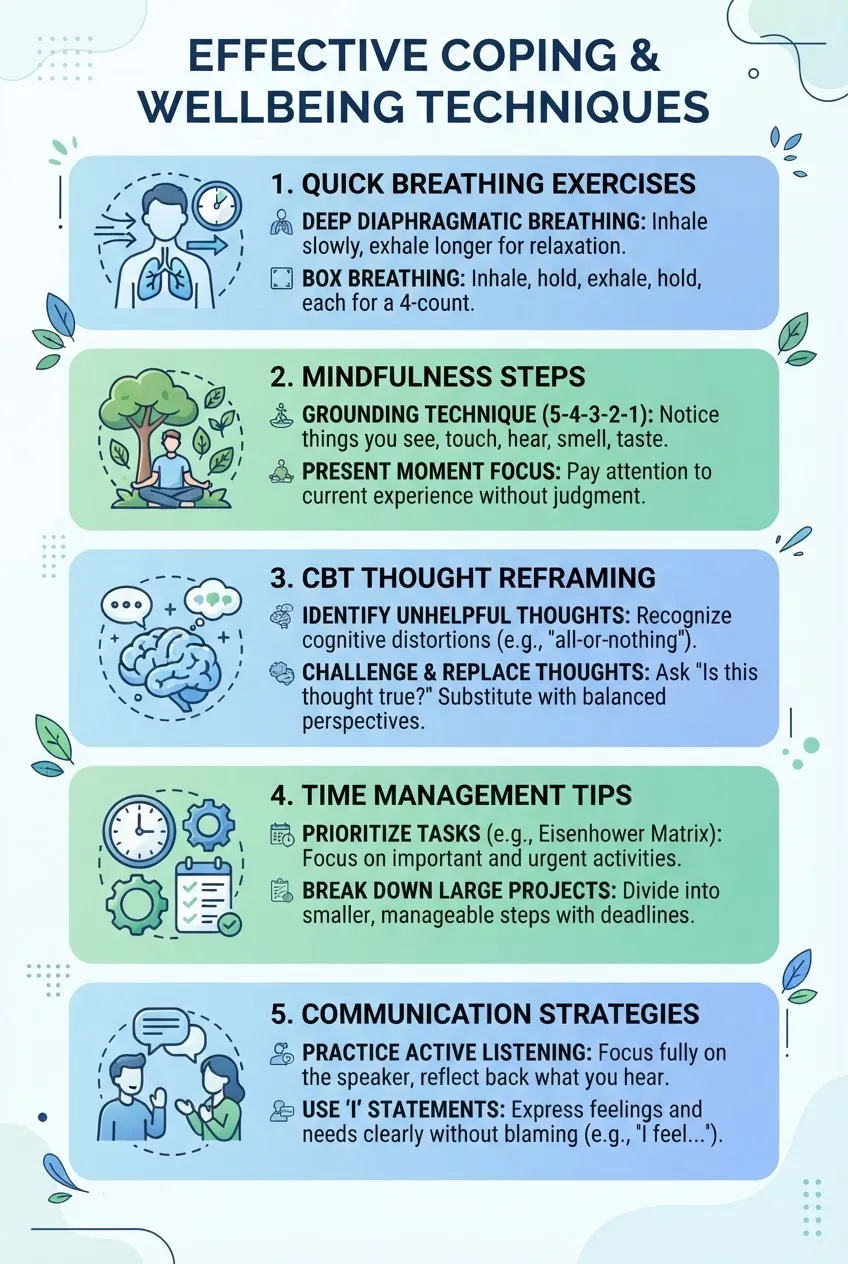
This 1,200-word section gives step-by-step techniques you can use immediately: breathing, grounding, quick CBT exercises, time-boxing, movement breaks and workplace-adapted mindfulness. Where evidence exists I reference peer-reviewed sources. Use these techniques in short, repeatable doses (3–20 minutes) and build a weekly habit (daily micro-practices + 1 longer practice per week).

-
Practice paced breathing (5–10 minutes)
How-to: Sit upright, feet flat. Breathe in for 4 seconds, hold 1–2 seconds, breathe out for 6 seconds. Repeat for 5 minutes. Use a smartphone timer or an app. Goal: reduce heart rate and interrupt the fight-or-flight loop.
Evidence: Meta-analyses show slow diaphragmatic breathing reduces physiological arousal (see a 2019 review in Frontiers in Psychology). Frontiers in Psychology (2019).
When to use: before a meeting, after a panic spike, during a commute pause. If you have respiratory conditions, modify timing and consult a clinician.
Internal tools: link to detailed exercises: breathing techniques for panic relief.
-
Use grounding techniques (2–5 minutes)
How-to: 5-4-3-2-1 grounding — identify 5 things you can see, 4 you can touch, 3 you can hear, 2 you can smell, 1 you can taste or a positive memory. Do this slowly in the office seat or standing. Goal: shift attention to sensory input and away from catastrophic thoughts.
When to use: instant interruption for escalating panic, pre-presentation stabilization. Grounding is safe and immediate; no professional oversight required.
-
Implement a micro-mindfulness routine (5–10 minutes)
How-to: choose a recurring trigger (e.g., first email check). Before opening email, close eyes for 30 seconds, take three paced breaths, and set a specific objective for the email session (e.g., “clear urgent messages only, 25 minutes”). Repeat daily for two weeks.
Evidence: Mindfulness-based interventions reduce workplace stress in multiple trials (see a 2020 systematic review in Journal of Occupational Health Psychology). Journal of Occupational Health Psychology (2020).
Practical tweak: use a neutral cue (placing a small plant on your desk) to remind you to mindfully pause.
-
Simple CBT reframing steps (10–20 minutes)
Definition: Cognitive Behavioural Therapy (CBT) is a structured, time-limited approach that identifies unhelpful thoughts and replaces them with balanced alternatives.
How-to (workplace-adapted 3-step method for immediate use):
- Label the thought: write the automatic thought in one sentence (e.g., “If I speak up, I’ll be judged”).
- Find the evidence: list two objective facts that support the thought and two that contradict it (e.g., “I have presented five times this quarter with positive feedback”).
- Reframe and plan: write a balanced statement and a small behaviour to test it (e.g., “I can offer one comment in the meeting and observe reactions; if feedback is neutral or positive, note it”).
Case walkthrough: At 10am, before a team meeting, practice the three steps (10 minutes). After the meeting, record outcome: did the test disconfirm the catastrophic thought? Repeat weekly to retrain expectation patterns.
Evidence: CBT is first-line for anxiety disorders in numerous trials (see a 2017 meta-analysis in Clinical Psychology Review). Clinical Psychology Review (2017).
For more structured clinical options beyond workplace CBT techniques, see clinical interventions for anxiety treatment without medication.
-
Time-blocking and prioritisation (15–60 minutes weekly, 25–50 minute work blocks)
How-to: Reserve two 25–50 minute focus blocks per day for deep work, with 5–10 minute breaks. At the start of each week, create a “Top 3” deliverables list; break each into 3–4 micro-tasks with time estimates (in minutes). Example: “Weekly report — write 300 words (30 min), create figures (45 min), proofread (20 min).” Schedule these blocks and communicate them to your manager to protect focus time.
Analogy: Just like scheduling meetings organises your calendar, time blocking organises your mental energy. Start with one protected block per day and increase to two blocks within two weeks.
Tools: digital calendars (set busy), timers (Pomodoro), and task managers that show estimated durations.
Further reading on broader time strategies is available in anxiety management techniques.
-
Movement and stretch breaks (5–15 minutes)
How-to: Every 60 minutes, stand, do a 3-minute mobility routine (neck rolls, shoulder circles, calf raises) and take a 10-minute outdoor walk when possible. Aim for at least two 10-minute movement breaks daily. Evidence shows short walks reduce anxiety and clear cognitive fog.
Practical rule: If your concentration drops by 20% (measured by error rate or time-on-task), take a movement break; otherwise schedule regular breaks every 60–90 minutes.
-
Use anxiety support apps for on-the-go management
How-to: Choose apps that offer guided breathing, short CBT exercises and mood tracking. Keep one app accessible on your phone and set a 3-minute guided breathing shortcut. For app recommendations see the Best Anxiety Apps Guide. anxiety support apps.
-
Short behavioural experiments (15–60 minutes)
How-to: Convert avoidance into experiments. If you avoid speaking in meetings, set a very small test: make one supportive statement or ask one clarifying question. Measure outcome and record it. Repeat weekly and increase the challenge by one increment.
Evidence: Behavioural experiments form part of CBT and are effective for reducing avoidance (see exposure therapy literature and clinical trials). For more on exposure-related strategies see our exposure therapy guide at exposure therapy guide.
-
Consider adjuncts cautiously (supplements and workplace-safe options)
Note: Supplements can be adjunctive but require informed use. If you’re exploring herbal or nutraceutical options, review evidence and discuss with a health professional. For evidence and options see our supplements guide: natural anxiety relief supplements.
Important: supplements are not a substitute for workplace adjustments or structured therapy. Consult a clinician if you have medical conditions or take medications.
-
Track changes and iterate weekly (10–20 minutes)
How-to: Use the workday audit you started earlier. Each Sunday, review your daily scores and actions. If average peak anxiety drops less than 10% after two weeks, adjust techniques (e.g., increase breathing practice to twice daily or introduce a longer 20-minute mindfulness session once per week).
Evidence summary: CBT and mindfulness-based approaches consistently show benefit for workplace anxiety in controlled trials (examples include randomized and meta-analytic data in Clinical Psychology Review and Journal of Occupational Health Psychology, 2017–2020). Practical workplace interventions like time-blocking and micro-breaks are supported by occupational health literature (see Australian Government resources below).
Transition: Having practical tools is crucial, but using them effectively depends on clear communication and workplace support; next we cover how to discuss anxiety with managers and colleagues.
-
Practice paced breathing (5–10 minutes)
-
Talk and negotiate: Communication and Workplace Support Strategies
Communication and Workplace Support Strategies
This section gives scripts, negotiation steps and policy points to get manager and HR buy-in for practical adjustments. It references Australian workplace policy frameworks and shows a mini case-study of an HR conversation.
Framework for disclosure and negotiation (3-step approach):
- Prepare the facts (10–20 minutes): Document tasks impacted, objective examples (dates/times), and the specific adjustments you seek (e.g., one protected focus block per day, a weekly 15-minute check-in). Keep the email or conversation factual and focused on performance outcomes.
- Request a short meeting (5 minutes): Use a neutral opener: “Can we book a 15-minute meeting to discuss ways I can improve my productivity?” Share your prepared facts and the proposed adjustments. Emphasise outcome: “This will help me meet deadlines and reduce errors.”
- Agree on a trial (2–4 weeks): Propose a trial period after which you’ll both review measurable outcomes (task completion, quality). Agree on reporting frequency and decision points.
Example dialogue with a manager (mini case-study):
Employee: “Thanks for taking 15 minutes. I’ve noticed I struggle most with concentrated tasks between 9–11am. I’d like to propose one protected focus block 9–10am and a short daily update by 4pm so you can see progress. Can we trial this for two weeks and review?”
Manager: “That sounds reasonable — let’s try it. If it helps your output, we can formalise it in your weekly schedule.”
When disclosing, you don’t need clinical labels; focus on functional impact and proposed solutions. If you feel safer disclosing to HR rather than a manager, prepare the same facts and request confidentiality. The Australian Psychological Society offers guidance on workplace mental health and reasonable adjustments — see their resources for managers and employees. Australian Psychological Society.
Employee Assistance Programs (EAPs): Many Australian workplaces provide an EAP offering confidential counselling. Ask HR about access, number of sessions, and confidentiality rules. If you use an EAP, document any agreed outcomes in your personal notes, not in formal performance files, unless you choose to share them.
Mini case study — negotiating with HR:
I coached an employee who asked HR for a “work-from-home one day per week” trial to reduce commute-related anxiety. HR requested a two-week trial with measurable outcomes (on-time delivery, communication availability). After the trial, the employee maintained performance and secured the arrangement.
Legal and policy context: The Australian Government Department of Health and workplace guidelines outline employer responsibilities for mental health support and reasonable adjustments. Australian Government Department of Health: Mental Health.
Practical tips for managers receiving a disclosure:
- Listen and ask clarifying questions about functional impact, not diagnosis.
- Agree on a time-limited trial and measurable outcomes.
- Keep adjustments documented and review at agreed checkpoints.
Transition: Communication and workplace adjustments reduce anxiety risk, but workload and time management are the day-to-day levers you can control — read on for concrete time strategies.
-
Organise tasks: Managing Workload and Time to Reduce Anxiety
Managing Workload and Time to Reduce Anxiety
Below are prioritized time management strategies you can apply immediately. Each item includes a short “how-to” and a measurable threshold.
- Prioritise with a Top 3 rule (5–10 minutes weekly): Each Friday or Monday morning list your Top 3 deliverables for the coming week. If more than three high-priority items exist, delegate or renegotiate scope. Threshold: if you have more than three high-priority items two weeks in a row, request workload review with your manager.
- Time blocking (daily, 25–50 minute sessions): Block two focus sessions daily. Use “Do Not Disturb” and set calendar visibility to “Busy.” Threshold: expect to protect at least 50–100 minutes daily within two weeks.
- Set meeting rules (immediate): Propose 25 or 50-minute meetings instead of full hours; add clear agendas and decide on required attendees only. Threshold: if meetings occupy >40% of your calendar, reduce attendance or set “report-only” attendees.
- Delegate or batch tasks (weekly): Identify three tasks you can delegate or batch. Batch similar tasks (emails, approvals) into two scheduled blocks. Threshold: delegation should free at least 30 minutes/day within two weeks.
- Use the “two-minute” rule (instant): If a task takes <2 minutes, do it now. If >2 minutes, add to a priority block or delegate. Threshold: reduces small-task backlog by 20–30% in one week.
- Schedule short breaks (every 60–90 minutes): Use active breaks: short walks, mobility or breathing. Threshold: two 10-minute outdoor or movement breaks daily.
- Limit email checks (daily): Default to checking email at the start of the day, mid-afternoon, and before end-of-day — three times max unless role requires higher frequency. Threshold: aim to reduce email-checking to three times per day in two weeks.
- Plan end-of-day shutdown (5–10 minutes): Create a “tomorrow start” list and set a firm computer close time to signal the end of the workday and reduce ruminative evening anxiety. Threshold: reduce evening work by 50% in three weeks.
- Use digital tools to visualise workload (weekly): Use a Kanban board that shows “To Do — Doing — Done.” Move three tasks to “Done” daily where possible to reinforce progress and counter catastrophising.
- Establish a weekly review (20–30 minutes): Review the week’s Top 3 outcomes, blocked time, and energy dips. Adjust next week’s Top 3 and make small scheduling changes. Threshold: weekly review maintained for four consecutive weeks predicts ongoing improvements.
Small experiments: commit to one new time-management strategy for two weeks and measure impact using your anxiety audit. If anxiety reduces by at least 15% and task completion increases, maintain the change; if not, iterate with a different strategy.
Transition: If symptoms persist despite these workplace strategies, or if anxiety significantly impairs function, it’s time to consider professional help. The next section provides Sydney-specific next steps and resources.
-
Escalate appropriately: When to Seek Professional Help and Therapy Options in Sydney
When to Seek Professional Help and Therapy Options in Sydney
This ~800-word section guides you through deciding when to seek professional support, how to access Sydney-based services, and links to local clinics and counselling resources. It references Australian guidelines and includes a clear next-steps checklist.
When to seek professional help — red flags:
- Persistent daily anxiety at or above 4/10 for more than two weeks that reduces work functioning (missed deadlines, significant avoidance).
- Frequent panic attacks that occur unexpectedly and interfere with workplace safety or duties.
- Increased substance use to manage symptoms, suicidal thoughts, or behaviours requiring immediate attention.
Initial steps in Sydney:
- Primary care assessment: Book an appointment with your GP to conduct a medical check (rule out physical causes), discuss symptoms and obtain a Mental Health Treatment Plan if appropriate. GPs in Australia can refer patients to subsidised psychological services under Medicare.
- Access evidence-based therapy: Cognitive Behavioural Therapy (CBT) is recommended as a first-line intervention for anxiety disorders. Consider a registered clinical psychologist or a behavioural therapist specialising in workplace-related anxiety. See the Behavioural Therapist and CBT Therapy Guide for therapist selection tips: behavioural therapist and CBT therapy guide.
- Clinics and targeted services in Sydney: For specialised support, see local listings and referral options at anxiety disorders clinics in Sydney.
- Short-term counselling: If immediate confidential support is needed, consider Employee Assistance Programs (EAP) or private counsellors who offer short-term therapy.
- Community and peer supports: Look for workplace mental health initiatives, peer support groups, and workshops on resilience. The Australian Psychological Society and Department of Health provide workplace mental health frameworks and resources. Australian Psychological Society and Australian Government Department of Health: Mental Health.
Local referral examples (how to prioritise):
Situation Best next step (Sydney) Mild-to-moderate workplace anxiety, functional with adjustments Contact a psychologist for CBT (short course) or use EAP for six sessions Repeated panic attacks or severe avoidance Prioritise referral to a clinical psychologist or anxiety disorders clinic in Sydney Safety concerns or suicidal ideation Seek immediate medical help or call emergency services; consider crisis counselling services Local directories and clinic options: Search for clinicians who list workplace anxiety, CBT or occupational mental health in their profiles. For a broad starting point, review our clinic guide: anxiety disorders clinics in Sydney.
Cross-regional reference: If you are exploring counselling options more broadly, see resources such as anxiety counselling for how to evaluate counselling services even if based in a different state.
Evidence and staging: For persistent or complex anxiety, multidisciplinary approaches that include CBT, workplace adjustments and occupational therapy often provide the best outcomes. Peer-reviewed evidence supports CBT as first-line; for specific clinical pathways consult clinical guidelines or your treating clinician.
Disclaimer: This guide is not a substitute for professional medical advice. If you are in immediate danger or have suicidal thoughts, contact emergency services or crisis lines immediately.
Transition: To wrap up this hands-on guide, I share common mistakes I see and a concise checklist you can use right now.
Common mistakes and how to avoid them
– I used to skip documenting triggers and assumed mood swings would resolve; instead, tracking two days quickly revealed a pattern tied to a specific meeting, which made targeted change possible.
– I once tried too many techniques at once; outcome: nothing stuck. I recommend starting with one breathing routine and one time-blocking habit for two weeks.
– I used informal self-talk to cope and delayed seeking help; when I finally consulted a GP and got a short CBT referral, progress accelerated.
Checklist: verify your work
- Have you completed a two-day workday audit and identified top two triggers?
- Can you perform paced breathing for 5 minutes and grounding for 2–3 minutes?
- Have you set at least one daily protected focus block and two movement breaks per day?
- Have you prepared a concise, factual request for a manager or HR meeting (Top 3, measurable outcomes, two-week trial)?
- Do you know how to access an EAP or a local Sydney clinic if symptoms persist?
When to call in a professional
Call or see a professional when your average daily anxiety is ≥4/10 for two weeks and affects task completion, you experience frequent panic attacks, increased substance use to cope, or any suicidal ideation. If in Sydney, consider referral to an anxiety disorders clinic; for immediate concerns contact emergency services.
Final note: Keep interventions small, measurable and repeatable. Building a manageable routine — a 5-minute breathing practice, one protected focus block, and a short weekly review — yields measurable improvements within 4–8 weeks when consistently practised.
This guide draws on occupational mental health frameworks and peer-reviewed evidence to help you act now and iterate. For clinical treatment paths without medication, visit our pillar resource: clinical interventions for anxiety treatment without medication.
If you found this useful, take one immediate action: schedule a 10-minute audit session on your calendar today.