

By the end of this hands-on guide you will be able to design, run and monitor a structured exposure therapy treatment plan for anxiety disorders. Expect to learn practical session scripts, a full exposure hierarchy walkthrough, and progress measurement tools; realistic completion time to a basic, deliverable plan is 4–6 hours of clinician-guided preparation plus ongoing weekly sessions. This guide assumes basic clinical training in CBT or equivalent allied mental health experience.
Before you start
- Prerequisites: accredited training in CBT or behavioural therapy, knowledge of risk assessment, and local clinical supervision arrangement.
- Tools and materials: SUDS (Subjective Units of Distress) 0–100 scale sheets, GAD-7 or disorder-specific measures, pen and notepad, stopwatch/timer, smartphone with recording capability for imaginal work.
- Environment: access to an adjustable therapy room and a plan for safe in vivo exposure locations (public transport, cafés, clinics).
- Administrative: informed consent form, emergency contact and safety plan, ethics/clinic documentation for routine outcome monitoring.
What is Exposure Therapy?
Exposure therapy is a behavioral intervention that helps people with anxiety disorders reduce avoidance and fear by systematically and safely confronting feared stimuli or situations. The goal is to change the fear response — not by arguing with thoughts, but by training the nervous system to learn new, less threatening associations.

Core features: controlled, repeated contact with triggers; measurable anxiety monitoring; therapist-guided pacing; and a clearly defined exposure hierarchy. Common anxiety symptoms encountered in exposure therapy include rapid heartbeat, sweating, intrusive thoughts, avoidance behaviour and hypervigilance — all of which are addressed through planned behavioural interventions to interrupt the fear response cycle.
Exposure therapy applies to a range of anxiety disorders: specific phobias, panic disorder (with interoceptive exposure), social anxiety disorder, post-traumatic stress disorder (PTSD) using prolonged exposure protocols, and obsessive-compulsive disorder (OCD) using exposure and response prevention (ERP). For cases of emotional dysregulation or acute breakdown, exposure forms one part of broader emotional anxiety treatment approaches and is tailored to current capacity.
Evidence base: exposure is one of the most empirically supported treatments for anxiety. According to a 2023 APS clinical guideline, exposure-based protocols show consistent, moderate-to-large effect sizes across disorders when delivered with clear goals and therapist collaboration (source: clinical guideline document, Australian Psychological Society).
Terminology defined briefly:
- Habituation — reduction in physiological and emotional responses with repeated exposure.
- Extinction — learning that a previously feared stimulus is safe, reducing conditioned fear responses.
- In vivo — real-world exposure to the feared stimulus or situation.
- Imaginal — guided, vivid recall of feared content when in vivo exposure is impractical or unsafe.
How exposure differs from general anxiety management: it focuses on behavioural change through sustained confrontation and learning, not primarily on relaxation, supplements, or apps — though these can be adjunctive supports. Transitioning to the mechanism-level explanation helps plan stepwise treatment safely.
How Exposure Therapy Works for Anxiety
Exposure therapy reduces anxiety through three interacting mechanisms: habituation, extinction learning, and cognitive re-appraisal driven by behavioural evidence. Below I explain these processes, the brain mechanisms involved, and how they inform a structured treatment plan.
1. Habituation and decreased physiological reactivity. Repeated, non-reinforced exposure to a feared cue leads to reduced autonomic activation. Practically, this is the observable drop in SUDS scores during a 30–60 minute exposure trial.
2. Extinction learning. Extinction is not erasure of fear memory but formation of a new safety memory that competes with the old fear memory. This learning involves the prefrontal cortex inhibiting amygdala-driven fear responses. Clinical implication: spacing and retrieval practice (re-exposure) matter; single long exposures are less reliable than repeated, distributed practice.
3. Cognitive change by behavioural evidence. Patients update beliefs when feared outcomes do not occur; this is faster when exposure includes detailed prediction and review steps (pre-exposure prediction, in-session observation, post-exposure debrief).
How these mechanisms translate into practice:
- Assessment-driven exposure. Use structured interviews and measures (GAD-7, Panic Disorder Severity Scale, Fear Questionnaire) to identify target triggers and baseline severity.
- Hierarchical dosing. Build an exposure hierarchy from 0–100 SUDS with at least 10 graded steps. Each step should be repeatable for 20–60 minutes depending on disorder and patient stamina.
- Active engagement. Patients must stay in the exposure long enough to reach and pass peak anxiety (usually 20–40 minutes) so habituation and extinction can begin.
- Variation and generalisation. Introduce varied contexts and stimuli (different people, locations, times) to promote retrieval cues for the new safety memory and prevent context-specific relapse.
Practical timing guidelines: initial sessions (assessment + psychoeducation) 60–90 minutes; typical exposure sessions 45–90 minutes; frequency weekly or twice-weekly for severe cases. Expect initial symptom fluctuation; according to a 2022 peer-reviewed meta-analysis, most patients show measurable improvement by session 5–8 (source: peer-reviewed studies summary).
When exposure is paired with cognitive restructuring — the standard CBT integration — outcomes improve because unhelpful beliefs are addressed along with behavioural learning. For a full clinical framework, see the guideline from the Australian Psychological Society: Australian Psychological Society (APS) for recommended protocols and safety checks.
For discussion of CBT integration specifically, refer to cognitive behavioural therapy and exposure.
Types of Exposure Therapy Used in Anxiety Treatment
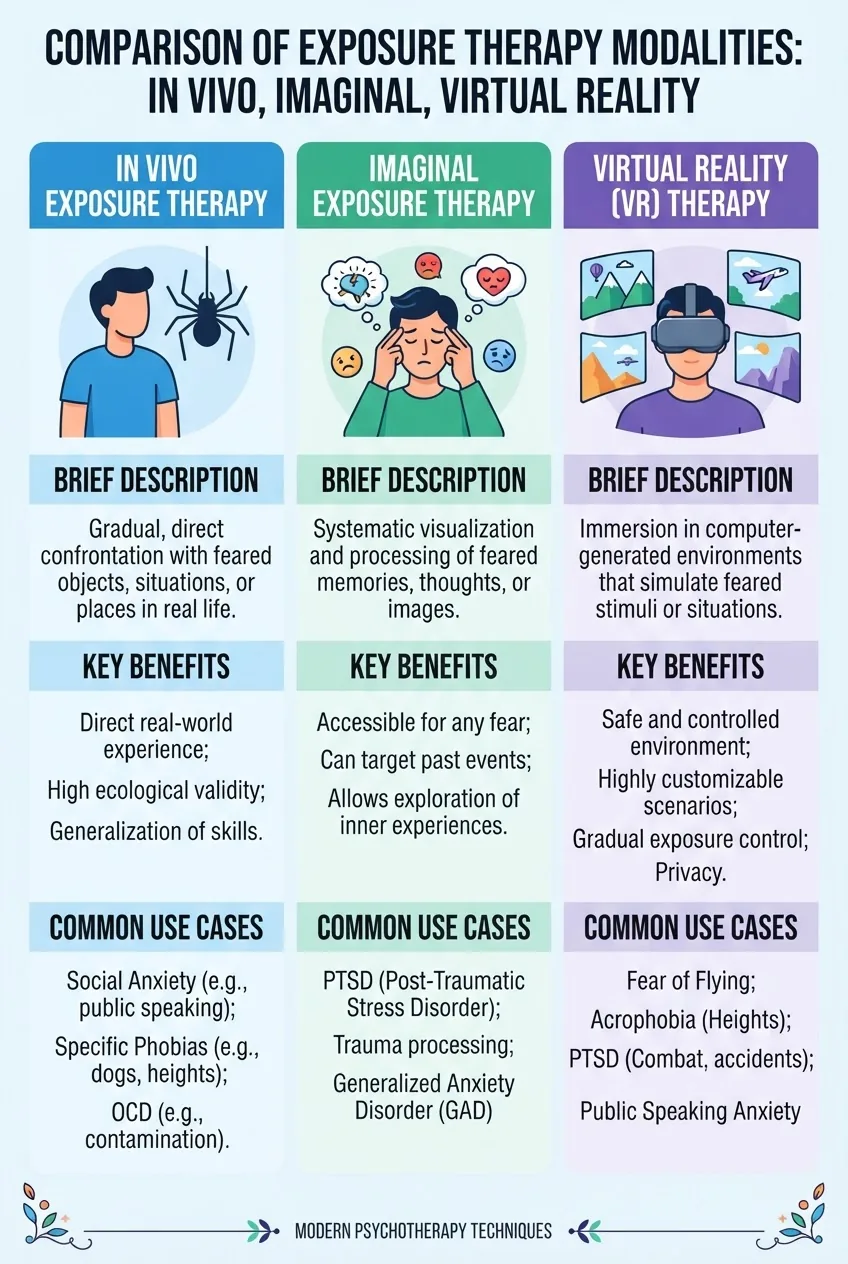
This table compares commonly used exposure modalities: methodology, typical pros and cons, and primary clinical use cases. Rows are zebra-striped to aid scanning.
| Type | Methodology | Pros | Cons / Use cases |
|---|---|---|---|
| In vivo exposure | Direct, real-world confrontation with feared objects/situations (e.g., public speaking, transport). | High ecological validity; rapid generalisation when varied contexts are used. | Can be logistically complex; requires safety planning for severe panic or risk. |
| Imaginal exposure | Guided, relived imagery of feared events or outcomes (used in PTSD, health anxiety). | Useful when in vivo is unsafe or impossible; controlled clinic setting reduces risk. | Relies on vivid imagination; may produce strong transient distress; needs careful pacing. |
| Virtual reality exposure therapy (VRET) | Computer-generated immersive scenarios that approximate feared environments (e.g., flying, heights). | Controlled, repeatable, and scalable; good for public speaking, flying, social scenarios. | Requires hardware/software; efficacy varies by realism and therapist skill. |
| Prolonged exposure | Extended imaginal and in vivo sessions used for PTSD, with written narratives and processing. | Strong evidence in PTSD; structured manualised approach. | Intensive; patient must be stable enough for repeated trauma recounting. |
| Interoceptive exposure | Purposely inducing bodily sensations (e.g., dizziness, breathlessness) to treat panic disorder. | Targets feared somatic cues; reduces panic-triggered avoidance. | Needs medical clearance in some populations; requires careful monitoring. |
Choosing a modality depends on diagnosis, patient preference, safety and resources. Virtual reality is expanding availability where in vivo practice is impractical; imaginal exposure remains indispensable for trauma memories that cannot be re-created safely.
Developing an Effective Exposure Therapy Treatment Plan
Transitioning from theory to practice, below is a clinician-level, step-by-step plan to create a robust exposure program. This section links exposure to wider clinical options and documents how to prepare and iterate a treatment plan.
- Conduct a thorough diagnostic assessment (60–90 minutes). Administer disorder-specific measures (GAD-7; Panic Disorder Severity Scale; Social Phobia Inventory) and record baseline SUDS ratings for identified triggers. Screen for suicidality, psychosis, substance misuse and severe PTSD dissociation. According to a 2024 APS clinical guideline, this step must include suicide and risk assessment documentation (source: clinical guideline document).
- Obtain informed consent with explicit exposure rationale (30 minutes). Explain the purpose, typical course (6–12 weekly sessions for moderate cases), potential transient worsening of symptoms, and safety plan. Document consent for in vivo contacts, and agreement about homework and recordings.
- Co-create a measurable treatment goal list (30–60 minutes). Write 2–4 SMART goals (Specific, Measurable, Achievable, Relevant, Time-bound). Example: “Attend a 30-minute networking event without leaving early for three separate events within 12 weeks.” Attach target SUDS reductions (e.g., baseline SUDS 85 → target 25 by week 12).
- Build an exposure hierarchy collaboratively (60–120 minutes across sessions). Use patient reports to generate at least 10 graded items rated 0–100 SUDS. Include exact situation descriptions, duration targets (20–60 minutes), and objective behaviour (e.g., “stand in the queue for 10 minutes without checking phone more than once”). Provide a worked example and rehearsal in session.
- Plan session-by-session dosing and modality. For each hierarchy item, set session number, planned duration, safety behaviours to eliminate, and planned outcome metrics (peak SUDS, time to peak, distress drop percentage). For severe panic, plan interoceptive exercises of 2–3 minutes with immediate recovery.
- Set monitoring and measurement tools. Use SUDS pre/during/post every exposure, weekly GAD-7 (or disorder-specific scale), and session notes with behavioural markers (time in exposure, avoidance incidents). Record audio or video of imaginal exposures when appropriate for fidelity checks.
- Layer skills training where needed (15–30 minutes per session). Teach brief grounding or paced breathing for use between exposures (not to be used as avoidance). Reinforce cognitive framing: prediction, experience, evidence-based review. Link to outpatient resources if adjunctive supports are needed, and to broader non-medication options: clinical interventions for anxiety treatment without medication.
- Schedule homework and generalisation tasks. Assign 3–5 short exposures per week, each 15–30 minutes, documenting SUDS pre/post and context. Plan at least one exposure per week that challenges contextual generalisation (different location or social group).
- Plan safety and contra-indicators checks. Reassess suicidality and medical risk every 2–4 weeks. For comorbidities like severe depression or active substance use, consider adjunctive supports or stabilisation before intensive exposure.
- Review outcomes and adapt every 4 sessions. If no progress (less than 20% reduction in target SUDS across four exposures), modify pacing, re-evaluate avoidance, or consider alternative modalities (VRET, imaginal work). Document decisions and seek supervision as needed.

Case vignette (anonymised): A 34-year-old with social anxiety rated eye-contact scenarios at SUDS 90. Over 10 weekly exposures with graded public interactions (5→10→20→40 minutes) and explicit prediction review, peak SUDS decreased to 30 and avoidance dropped by 80% at 12-week follow-up. This exemplifies gradual dosing, repeated practice, and varied contexts producing durable gains.
Clinical documentation standards recommended by the APS suggest explicit recording of hierarchy items, SUDS logs and behavioural targets; review those guidelines when building clinic templates. For APS resources, see Australian Psychological Society.
Role of the Therapist and Patient in Exposure Therapy
The therapeutic alliance is the active ingredient enabling exposure: the therapist provides structure, safety monitoring and technical scaffolding; the patient provides engagement, honest reporting and homework completion. Below are practical role descriptions and examples.
Therapist responsibilities: accurate assessment, risk screening, clear psychoeducation, collaboratively building the hierarchy, modelling exposures when helpful, and monitoring physiological responses. The therapist must track fidelity to the plan, adjust dosing, and provide compassionate debriefing after difficult sessions.
Patient responsibilities: accurate SUDS reporting, committing to in-session and homework exposures, avoiding safety behaviours during exposures (e.g., avoidance moves, constant checking), and logging outcomes. Effective collaboration requires candid feedback about coping capacity and life stressors.
Example interaction: After a 30-minute in vivo exposure to a crowded café, the therapist asks the patient to report peak SUDS, time to peak, and any safety behaviours used. The therapist then leads a 10-minute review: “What did you predict would happen? What actually happened? What evidence updates do you notice?” This concrete review anchors extinction learning.
Complementary techniques: teach breathing techniques for anxiety as stabilising tools between exposures (not during exposures where they prevent learning). Combine behavioural experiments with cognitive challenges where rigid beliefs persist.
Therapist skills that improve outcomes include precise dosing decisions, timing (keeping exposures for 20–60 minutes depending on disorder), and clear homework instructions. I have observed that when I let a patient leave an exposure before reaching peak anxiety, progress stalls; insist on staying for at least 20 minutes or until peak and early decline are observed.
Therapeutic troubleshooting: if a patient repeatedly uses safety behaviours, explicitly list them, set a reduction target (e.g., reduce checking from 5 to 1 per exposure), and rehearse exposures with the safety behaviour removed in session.
What to Expect During Exposure Therapy Sessions
This section is written directly to patients and clinicians preparing for sessions: what the session looks like, concrete timings, and tips to reduce avoidable setbacks.
- Session start: check-in and SUDS baseline (5–10 minutes). Clinician confirms safety, medication changes, and records pre-exposure SUDS (0–100 scale).
- Psychoeducation or brief skills refresher (5–10 minutes). Remind patient of hierarchy item, prediction task, and what counts as success (objective behaviour + SUDS tracking).
- Exposure implementation (20–60 minutes). The therapist initiates the exposure, times it (use a stopwatch), and records SUDS at predetermined intervals (0, 5, 10, 20 minutes, end). For in vivo tasks, move through concrete steps (enter café → sit → order → stay 20 minutes).
- Debrief and evidence review (10–15 minutes). Compare predictions to actual outcomes, note behaviour changes, and assign homework with explicit time/duration targets (e.g., “Three self-directed exposures this week: 15 minutes each, document SUDS pre/post and context”).
- Documentation and scheduling (5 minutes). Record exposure fidelity: duration, peak SUDS, whether safety behaviours occurred, and next session’s target.
Patients commonly ask how to prepare: wear comfortable clothing, bring a SUDS log, and ensure at least 30 minutes free after the session for grounding. Use of adjunct technology such as a voice recorder for imaginal exposure homework is useful; many patients use brief audio playback to replicate session cues.
Apps can support homework tracking and breathing practice; see guidance on integrating anxiety apps for support alongside exposure tasks.
Managing fatigue: expect exposure sessions to be physically and mentally tiring. Adopt a 10–20 minute recovery protocol (low-effort grounding, hydration, short walk). For specific techniques to manage fatigue encountered during treatment, review stress relief techniques during anxiety treatment.
Measuring Progress and Success of Exposure Therapy
Objective outcome measurement ensures treatment fidelity and informs adjustments. Use both session-level and program-level indicators.
Session-level measures: pre/during/post SUDS (0–100), session duration, and presence/absence of safety behaviours. Track these every exposure to chart within-session habituation (peak SUDS and time to peak).
Program-level measures: weekly administration of standardised instruments such as GAD-7 for generalized anxiety, Social Phobia Inventory, Panic Disorder Severity Scale, or disorder-appropriate scales. For functional outcomes, measure behavioural change (e.g., number of social events attended) and avoidance frequency.
Evidence thresholds clinicians can use: a 30% or greater reduction in disorder-specific scale scores over 8–12 weeks is considered clinically meaningful in many trials (source: peer-reviewed meta-analyses, 2022–2023). Use routine outcome monitoring every 2–4 weeks to detect non-response early.
Concrete tracking example: for social anxiety, record weekly the number of minutes spent in public speaking or social exposure, peak SUDS each time, and the GAD-7 score. If after four exposures there is <20% reduction in peak SUDS and no increase in behavioural approach, escalate: revise hierarchy, remove safety behaviours, or add interoceptive work.
Use validated tools and patient-centred outcome measures; many clinics use digital outcome systems to graph trends. Link therapy progress to daily functioning resources such as coping strategies for anxiety at work when return-to-work or occupational performance is a goal.
External clinical resources for measurement and benchmarking: National Institute of Mental Health and Anxiety and Depression Association of America provide summaries of measurement tools and treatment-effect expectations.
Potential Risks, Setbacks and When Exposure Therapy May Not Be Suitable
Exposure therapy is effective but not universally suitable. Clinicians must weigh benefits against contraindications and manage potential adverse reactions.
Common temporary effects: transient increases in anxiety, sleep disturbance, and fatigue. These are expected in the early dosing phase and usually resolve with consistent practice. According to a 2023 APS clinical guideline, transient increases in symptom intensity occur in a minority but do not predict treatment failure (source: clinical guideline document).
Contraindications and cautionary flags include:
- Unstable suicidality, active psychosis, severe dissociation — stabilise these first.
- Severe substance dependence without concurrent management.
- Medical risk during interoceptive exposure (e.g., cardiac conditions) — require GP clearance.
- Insufficient therapeutic alliance or lack of informed consent.
When exposure therapy may not be the first-line: in severe, acute safety concerns or when a patient cannot tolerate protocols due to cognitive impairment; consider alternative or adjunct treatments including medication. For comparisons and guidance about pharmacological options, see prescription anxiety medications.
Complementary and alternative supports: some patients prefer combining behavioural treatment with natural anxiety relief supplements or lifestyle changes. These can be adjunctive but should not replace exposure when avoidance is the primary maintaining factor.
Red flags during treatment that prompt modification or pause:
- Progress plateau of <20% improvement in key measures after four targeted exposures.
- Escalation of self-harm ideation or new-onset psychosis.
- Repeated non-adherence to homework and persistent use of safety behaviours undermining exposures.
When to consider medication alongside or instead of exposure: if functional impairment is severe and immediate symptom relief is necessary to engage in therapy, or where comorbid conditions substantially impede behavioural work. For details on medication options, consult the clinic’s prescribing guidelines and prescription anxiety medications.
Exposure Therapy in the Sydney Context: Accessing Treatment
Sydney-based patients seeking exposure therapy have several access pathways: private psychologists with CBT training, specialist anxiety clinics, and some university clinics offering supervised interventions. Wait times and costs vary; private sessions commonly range from AUD $160–260 per session depending on clinician experience.
Practical steps to access treatment in Sydney:
- Check clinician accreditation. Look for endorsement in CBT or accredited psychology registration. Local directories list clinicians by speciality.
- Ask about exposure experience. Request examples of exposure work the clinician routinely does, and whether they use VRET or interoceptive protocols.
- Confirm session length and frequency. Most local clinics offer 50–60 minute weekly sessions; intensive programs (twice-weekly) are available in specialist centres.
- Explore subsidised options. Medicare Chronic Disease Management Plans or private health rebates may reduce out-of-pocket cost for eligible patients.
Local resources and clinics: for a list of specialist providers, see the directory of Sydney anxiety disorders clinics. For parallel resources in other regions, compare with local anxiety counselling options as a model of available services.
Be proactive: ask about routine outcome measurement, risk management plans, and the therapist’s supervision arrangements. These are markers of clinic quality and patient safety.
Hands-On Steps: Run an Initial 12-Week Exposure Program
The following numbered steps are the practical core: use them to turn the plan into clinical action. Each step begins with a bold action phrase and contains exact timings and measurable targets.
- Assess and baseline (60–90 minutes). Administer GAD-7 and a disorder-specific scale, complete risk assessment, and collect baseline SUDS for 10 potential triggers (0–100). Record these electronically and save as session 0.
- Consent and psychoeducation (30 minutes). Explain mechanism of exposure (habituation/extinction), expected timeline (6–12 weeks), and common short-term effects. Obtain signed consent including permission for homework exposures and any in vivo public tasks.
- Create hierarchy (1–2 sessions, 60–120 minutes total). Generate 10 graded items, each with explicit behavioural targets and planned durations (20, 30, 45 minutes). Assign SUDS for each item and identify expected coping resources; rehearse the first low-intensity item in session.
- Deliver weekly exposures (45–90 minutes each). For each session: 5–10 minute check-in, 5–10 minute briefing, 20–60 minute exposure (stopwatch used), 10–15 minute debrief, 5 minute documentation and homework set. Target 1–2 in-session exposures per week plus 3 homework exposures for generalisation.
- Measure and adapt (every 4 sessions). Review GAD-7 and SUDS trends; if <20% improvement on the primary goal, revise dosing (increase exposure length by 10–20 minutes or add contextual variation) or consult supervisor.
- Consolidate gains and relapse plan (final two sessions). Practice maintenance exposures, set a 3-month booster schedule, and create a written relapse prevention plan with coping steps and emergency contacts.
Common mistakes and how to avoid them
I have observed several recurring failures in exposure delivery:
- I once accepted homework reports without SUDS logs; that made progress invisible. Now I require SUDS entries for every exposure.
- I previously allowed sessions to end before peak anxiety was reached; learning stalled. I now set a minimum 20-minute exposure length or until peak plus early decline.
- I underestimated the harm of unchallenged safety behaviours. If a patient uses them, I list them explicitly and set stepwise removal targets.
Checklist: Verify your Exposure Therapy Plan
- Assessment completed with baseline GAD-7 or disorder scale and risk screen.
- Informed consent signed and documented.
- Exposure hierarchy with at least 10 items, each rated 0–100 SUDS and duration set (20–60 minutes).
- Session schedule with homework assignments (3 short exposures/week) and measurement plan (SUDS + weekly scale).
- Safety plan, medical clearance for interoceptive work where relevant, and supervisor contact documented.
- Relapse prevention and booster session plan noted.
When to call in a professional
Refer immediately to specialist services or psychiatric input when you encounter any of the following: suicidality, active psychosis, severe dissociation, or medical risk during somatic exposure. If standard exposure dosing yields no measurable improvement after 8–12 sessions, consult a senior clinician for alternative formulations or adjunctive treatments (medication, intensive day programs).
Summary: exposure therapy is a structured, evidence-based process requiring careful assessment, collaborative hierarchy construction, measured dosing, and routine outcome tracking. With consistent practice and clinician oversight, many patients achieve large reductions in avoidance and distress. If you’re in Sydney and ready to begin, contact a qualified provider to discuss a tailored plan and next steps.
Call to action: Book an initial assessment with a trained exposure therapist to create your first hierarchy and get supervised practice planned.