

testing and diagnosis answer: Testing and diagnosis in mental health are structured procedures clinicians use to gather information, match symptoms to recognised criteria, and produce a working diagnosis that guides treatment; the process combines interviews, rating scales, standardised tests and clinical judgement to reach provisional or definitive conclusions.
What is Testing and Diagnosis? Defining Key Concepts
Answer: Testing and diagnosis refers to the combined set of assessment activities—clinical interviews, psychological tests, and diagnostic formulation—used to identify mental health conditions and inform care planning.
Term: testing and diagnosis — a coordinated process of assessment activities and clinical reasoning to identify mental health conditions.
Testing and diagnosis meaning in practice: clinicians collect symptom reports, behavioural observations and test scores, then compare these to formal diagnostic criteria (DSM-5 or ICD-10/11) to make a clinical determination. For a comparison of medical and symptom-focused evaluation frameworks see the diagnosis in medicine guide for symptoms evaluation.
Example: a psychologist conducts a clinical interview, administers a depression screening and cognitive tasks, then synthesises findings to formulate a diagnosis or a provisional diagnosis pending further information.
Why is Testing and Diagnosis Important in Mental Health?
Answer: Testing and diagnosis improve treatment accuracy, enable early intervention, and help clinicians tailor care to the individual’s needs and risks.
Term: clinical diagnosis — the clinician’s determination about the presence and nature of a mental disorder based on assessment data and diagnostic criteria.
Accurate mental health diagnosis is the foundation for effective treatment planning and risk management. Diagnostic clarity reduces trial-and-error treatments, allows access to specific care pathways (psychotherapy types, medication, support services), and supports applications for funded services. According to a 2024 Australian Government report, timely diagnosis increases access to evidence-based care and reduces acute presentations to emergency services (Australian Government Department of Health, 2024 report).
Clinical examples: in youth mental health the right diagnosis informs school adjustments and family interventions; in adult services it determines medication vs psychotherapy pathways. For youth prevalence and service needs see mental health in Australian youth statistics and insights.
What Is the Step-by-Step Process of Testing and Diagnosis?
Answer: The testing and diagnosis process follows sequential stages—referral and intake, clinical interview and history, psychological testing, evaluation and differential diagnosis, then feedback with next steps.
Term: diagnostic process — the sequence of assessment steps clinicians use to gather, analyse and interpret data to reach a diagnostic formulation.
Below is an ordered walkthrough clinicians commonly follow; each numbered step includes practical actions, clinician roles (psychologist, psychiatrist), and local Sydney service navigation where relevant.

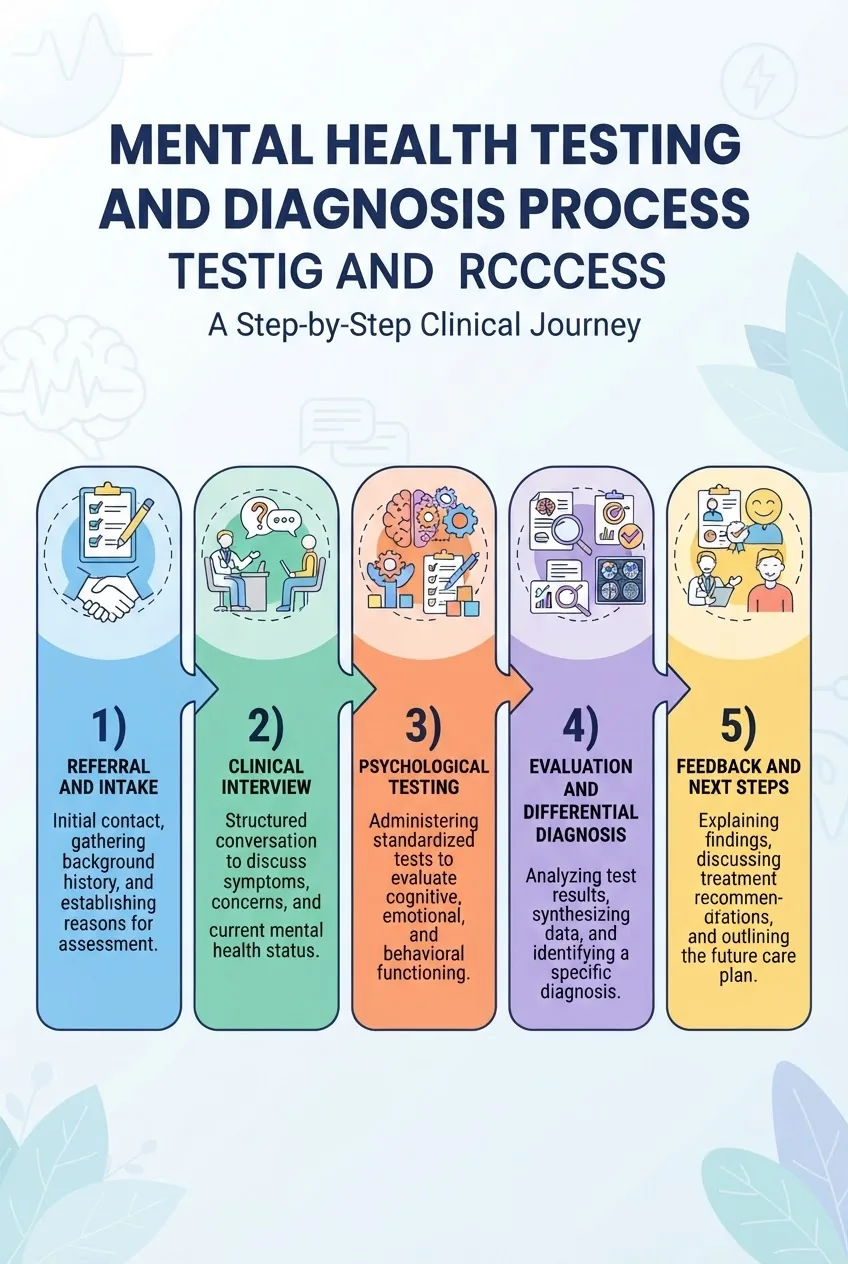
- Initial referral and intake — see sub-section below.
- Clinical interview and history taking — see sub-section below.
- Administration of psychological tests and tools — see sub-section below.
- Evaluation and differential diagnosis — see sub-section below.
- Communication of diagnosis and next steps — see sub-section below.
Initial Referral and Intake
Answer: Initial referral and intake establish reason for assessment, urgency, and who will lead the diagnostic process.
Term: referral — the request from a GP, organisation or self-referral that initiates an assessment pathway.
Referrals in Sydney can come from GPs, schools, employers, or individuals. Intake typically includes a brief triage call or form to collect presenting concerns, current risks (self-harm, psychosis), medical history, medications and the client’s goals. Clinicians prioritise urgent risk and may fast-track assessments or arrange crisis referrals. For local referral criteria and Sydney pathways clinicians reference public and private service guidelines and may discuss bulk-billing or private options for specific assessments such as ADHD; for bulk billing information see ADHD diagnosis Sydney bulk bill options.
Clinical Interview and History Taking
Answer: The clinical interview gathers a detailed psychiatric history, symptom timeline, functioning, and contextual factors to guide further testing.
Term: clinical interview — a structured or semi-structured conversation used to obtain symptom history, onset, severity and impact.
A clinician conducts symptom exploration, developmental and family history, medical and substance use review, and social context (work, relationships). Standard components include a mental status examination; see the MSE mental status examination assessment and sample guide for structured items commonly assessed. Clinicians often use semi-structured interviews (e.g., SCID for DSM diagnoses) to ensure coverage of diagnostic criteria. Collateral information (school reports, family interviews, GP summaries) is gathered with consent to improve diagnostic accuracy.
Administration of Psychological Tests and Tools
Answer: Clinicians select validated tests—questionnaires, rating scales, neuropsychological batteries—to quantify symptoms, cognitive function and behaviour.
Term: psychological tests — standardised instruments that measure symptoms, personality, cognition or behaviour under controlled conditions.
Tests may include self-report scales (PHQ‑9, GAD‑7), clinician-rated instruments, or formal neuropsychological batteries for cognitive assessment. Online screening tools are common for initial triage; see the anxiety test online guide with quizzes and the depression test online guide with screening for commonly used questionnaires. For comprehensive online assessments see mental wellness test online with comprehensive assessment. Test selection is informed by the referral question and by psychometric properties (reliability, validity).
Evaluation and Differential Diagnosis
Answer: Clinicians synthesise interview, test results and collateral information, compare findings with DSM-5 or ICD-11 criteria, and rule out alternative explanations.
Term: differential diagnosis — the process of distinguishing between conditions that present with similar symptoms.
Evaluation includes mapping symptoms to diagnostic criteria (DSM-5 or ICD-11); clinicians document which criteria are met and whether symptoms better reflect another condition, substance effects, medical illness or cultural variations. For formal criteria reference the APA DSM resources or the WHO ICD-11 summary: DSM-5 resources and ICD-11. Where uncertainty persists, clinicians assign a provisional diagnosis and plan further monitoring or testing.
Communication of Diagnosis and Next Steps
Answer: Clinicians convey findings in a feedback session, explain the diagnosis (or provisional status), outline treatment options and make referrals as needed.
Term: feedback session — a structured meeting where assessment results and recommended next steps are explained to the patient (and family when appropriate).
Feedback includes explanation of what the diagnosis means, recommended treatments (psychotherapy, medication, allied services), risk management and consented referrals. Clinicians provide written summaries, referral letters and may create or recommend a care plan; see the mental health care plan example and assessment template for sample documentation. Follow-up scheduling and outcome measurement plans (repeat scales, monitoring) are agreed to measure progress and diagnostic stability.
What Does Diagnostic Mean? Understanding Diagnostic Terms and Concepts
Answer: “Diagnostic” refers to the process of identifying the nature of a condition by comparing observed signs and symptoms to formal criteria and clinical knowledge.
Term: diagnostic — relating to the identification and classification of a health condition using assessment data and criteria.
Key diagnostic concepts:
- Provisional diagnosis: a tentative classification made when current information suggests a likely condition but confirmation or observation is needed; see provisional diagnosis definition and meaning explained.
- Definitive (final) diagnosis: assigned when criteria are clearly met and alternative explanations are excluded.
- Diagnostic uncertainty: the clinician’s acknowledgement that information is incomplete or conflicting, and that diagnosis may change with new data.
Example comparison: a clinician may issue a provisional diagnosis of major depressive disorder pending medical tests to exclude hypothyroidism; once medical causes are ruled out and symptom duration criteria are met, the diagnosis may be confirmed as definitive.
Contrast diagnostic classification with wellness: diagnosis labels clinical conditions for treatment facilitation, whereas wellness concepts focus on strengths, functioning and prevention; see mental healthiness meaning and mental wellness definition for distinctions.
What Types of Diagnostic Tests Are Used in Mental Health Assessments?
Answer: Mental health assessments use self-report scales, clinician-rated instruments, neuropsychological tests, projective methods and clinical observation to measure symptoms, cognition and behaviour.
Term: neuropsychological tests — assessments that measure cognitive functions such as memory, attention and executive skills, often used to detect brain-related impairments.

The table below summarises common test types, typical uses and clinical purposes.
| Test type | Description | Purpose |
|---|---|---|
| Self-report screening scales | Brief questionnaires completed by the patient (e.g., PHQ‑9, GAD‑7). | Initial symptom quantification and monitoring treatment response. |
| Clinician-rated scales | Observed or interviewed ratings by a clinician (e.g., HAM-D, CARS). | Objective symptom severity estimates and cross-check of self-report. |
| Neuropsychological batteries | Standardised tests for memory, attention, processing speed, and executive function. | Detect cognitive deficits, inform rehabilitation or differential diagnosis (e.g., dementia vs depression). |
| Personality and objective inventories | Structured inventories like the MMPI-2 or NEO for personality profiling. | Assess patterns of personality, risk, and treatment fit (therapy modality selection). |
| Projective tests | Less structured stimuli-based tests (e.g., Rorschach) interpreted by trained clinicians. | Exploratory insights into unconscious processes; used selectively. |
| Behavioural observation and functional assessment | Direct observation of behaviour in clinic or report-based functional assessments. | Understand behaviour antecedents/consequences, useful in developmental or forensic contexts. |
| Biopsychosocial screening and medical tests | Medical investigations (blood tests, imaging) and social needs screening. | Rule out medical causes and identify social supports or risks affecting mental health. |
Online quizzes and validated e-screeners can triage symptom severity quickly; commonly used online resources include the anxiety test online guide with quizzes and the depression test online guide with screening. For comprehensive online options see the mental wellness test online with comprehensive assessment.
Clinical utility notes:
- Choose tools with established reliability and local normative data where possible.
- Combine objective tests with clinical interview findings—tests are aids, not sole determinants.
- Be mindful of cultural, language and educational factors when interpreting scores.
What Challenges and Limitations Exist in Testing and Diagnosis?
Answer: Testing and diagnosis face limitations including variability in patient reporting, cultural differences, overlapping symptoms, test limitations and possible misdiagnosis.
Term: misdiagnosis — an incorrect or incomplete diagnosis that may arise from flawed assessment, biases, or insufficient information.
Common challenges and caveats:
- Patient variability: symptom fluctuation, recall bias, or intentional under/over-reporting can alter findings.
- Cultural and linguistic factors: tests normed on different populations may not apply; clinicians must adapt interpretations.
- Comorbidity and symptom overlap: multiple disorders often coexist, complicating differential diagnosis.
- Test limitations: no test is 100% sensitive or specific—psychometric properties limit certainty.
- Diagnostic thresholds and criteria updates: DSM and ICD revisions change diagnostic boundaries and prevalence estimates.
- System barriers: wait times, access to specialist testing (neuropsychology) and funding constraints impact timely diagnosis.
Mitigation strategies used by clinicians:
- Use multiple information sources (interview, tests, collateral) to triangulate findings.
- Apply culturally appropriate measures and interpret results cautiously.
- Document diagnostic uncertainty and plan for reassessment where needed.
- Engage multidisciplinary teams for complex cases (psychology, psychiatry, neurology).
What Role Do Mental Health Professionals Play in Testing and Diagnosis in Sydney?
Answer: Clinical psychologists conduct assessments and testing, psychiatrists diagnose and manage medication, and multidisciplinary teams coordinate complex diagnostic cases in Sydney services.
Term: clinical psychologist — a health professional trained to conduct psychological assessments, therapy and psychometric testing.
In Sydney, clinical psychologists typically lead psychological testing and formulation, while psychiatrists provide medical assessment, differential diagnosis where medication or complex psychiatric history exists, and co-manage care. Multidisciplinary teams (psychologists, psychiatrists, GPs, social workers) improve diagnostic integrity for complex presentations. For clinicians in Australia, standards and guidelines are informed by the Australian Psychological Society and national health guidance from the Australian Government Department of Health.
Service considerations in Sydney:
- Public community mental health services provide assessment pathways for high-risk or severe cases; private clinics offer targeted testing and faster access.
- Bulk-billing options vary by condition and service—see local guides for ADHD-specific bulk billing options: ADHD diagnosis Sydney bulk bill options.
- Referral patterns: many GPs in Sydney will refer to psychologists for assessment and to psychiatrists for medication or complex diagnosis.
What Are the Next Steps and Support Options After Diagnosis?
Answer: After diagnosis clinicians recommend treatment options, create care plans, make referrals and schedule follow-up assessments to monitor response and adjust diagnosis if needed.
Term: care plan — a documented plan that outlines specific treatment goals, responsibilities and monitoring steps following diagnosis.
Typical next steps:
- Treatment selection: psychotherapy, medication, allied health referrals or combined approaches depending on diagnostic formulation.
- Care planning: clinicians often use structured templates—see the mental health care plan example and assessment template for a sample plan.
- Referrals: to psychiatrists, neuropsychologists, occupational therapy or community supports; when cost or accessibility is a concern, explore options outlined in the cheapest way to get ADHD diagnosis Australia guide for low-cost pathways.
- Ongoing assessment: scheduled outcome measurement (questionnaires, repeat testing) to monitor progress and diagnostic stability.
- Support and resources: connect with local services; see mental of health in Australia guide and support resources for national and local supports.
Practical example: after a confirmed anxiety disorder diagnosis, the clinician may recommend an evidence-based CBT program, provide a written care plan, refer to a psychiatrist if medication is considered, and schedule progress reviews at 6 and 12 weeks.
How Reliable and Accurate Are Psychological Diagnostic Tests?
Answer: Psychological tests provide useful, quantifiable data but vary in reliability and accuracy; clinicians use multiple measures and clinical judgment to improve diagnostic confidence.
Term: reliability — the consistency of a test’s results across time or raters; validity — whether the test measures what it intends to measure.
No single test is definitive; sensitivity and specificity vary by instrument and population. Clinicians prioritise validated instruments with known psychometric properties and use corroborating data sources. Meta-analyses and clinical guidelines (e.g., APS standards) inform instrument choice. When results conflict clinicians document uncertainty and plan longitudinal reassessment. According to a 2023 meta-analysis review, combined interview-plus-test approaches yield higher diagnostic accuracy than single-method assessments (peer-reviewed meta-analysis, 2023).
How Is Patient Experience Managed During Testing and Diagnosis?
Answer: Clinicians manage patient experience by informed consent, clear explanations, culturally sensitive practices, confidentiality safeguards and shared decision-making throughout testing and diagnosis.
Term: informed consent — the patient’s voluntary agreement to undergo assessment after understanding its purpose, risks and intended uses.
Practical steps include pre-assessment information sheets, discussing test purposes and limits, offering breaks during lengthy batteries, and providing written feedback. Sydney services commonly offer interpreter services and tailored assessment methods for culturally and linguistically diverse clients. Confidentiality is maintained according to professional standards and legislation, with limits (e.g., duty to warn) explained in advance.
How Do Case Examples Illustrate the Testing and Diagnosis Process?
Answer: Composite case examples demonstrate how interviews, tests and differential diagnosis combine to form clinical decisions while preserving privacy and illustrating clinician reasoning.
Composite case 1: An adult presents with low mood and concentration problems. The clinician completes PHQ‑9, GAD‑7, MSE and a cognitive screen; blood tests rule out thyroid dysfunction. Findings meet DSM-5 criteria for major depressive disorder; a care plan with CBT and GP follow-up for medication is provided.
Composite case 2: A school-aged child presents with attention and academic problems. The psychologist gathers teacher reports, completes cognitive testing and an ADHD rating scale, and recommends a multidisciplinary review; the final diagnosis reflects ADHD with comorbid learning difficulties and leads to school-based adjustments and targeted therapy.
How Do Official Frameworks Inform Diagnostic Decisions?
Answer: Diagnostic frameworks like DSM-5 and ICD-11 provide standardised criteria that clinicians use to match symptom patterns and determine diagnoses, helping ensure consistency and research alignment.
Clinicians reference DSM-5 criteria (American Psychiatric Association) or ICD-11 (World Health Organization) to map symptoms to diagnostic thresholds. For Australian practice these frameworks are applied alongside national guidelines from the Australian Government Department of Health and professional standards from the Australian Psychological Society.
What Are Key Practical Tips for Patients Facing Testing and Diagnosis?
Answer: Prepare a symptom timeline, bring collateral records, ask about test purposes, clarify confidentiality, and discuss follow-up and care planning options.
Patient checklist:
- Prepare a clear symptom timeline with examples and triggers.
- Bring prior reports, medication lists and GP summaries.
- Ask clinicians about the meaning of provisional vs definitive diagnosis—see provisional diagnosis definition and meaning explained.
- Clarify confidentiality limits and how results will be shared.
- Agree on follow-up schedule and outcome measures to monitor progress.
Conclusion: What Should You Remember About Testing and Diagnosis?
Answer: Testing and diagnosis are structured, evidence-informed processes combining interviews, standardised tests and clinical reasoning; they guide personalised care but can include provisional conclusions and require follow-up to ensure accuracy.
Key takeaways:
- Testing and diagnosis integrate multiple data sources—interview, tests, collateral and medical input.
- Diagnostic certainty varies; provisional diagnoses are common and appropriate when further data are needed.
- Local Sydney services include public and private options; multidisciplinary collaboration improves outcomes.
- Ask for written summaries and care plans after assessment—see mental health care plan example and assessment template.
If you are considering assessment in Sydney, contact your GP for an initial referral or reach out to a local clinical psychologist to discuss testing options and what a clear diagnostic process will look like for your situation.