

By the end of this hands-on guide you will have a clinician-ready, step-by-step plan to design and run a full course of systematic desensitisation for social anxiety and specific phobias; it typically takes 6–12 weekly sessions (about 6–12 weeks) and assumes no prior clinical training — only commitment to regular practice.
This guide begins with clear theory and moves into a practical, numbered protocol you can apply in a clinic or at home under supervision. Expect concrete timings, script examples, and a Sydney clinical case to show how practitioners adapt the method.
Before you start
- Prerequisites: willingness to practice 10–20 minutes daily, baseline screening by a clinician (PHQ‑9/GAD‑7 recommended), and informed consent.
- Tools and materials: quiet room, comfortable chair, notebook for a fear hierarchy, stopwatch or phone timer, audio for paced breathing, and a clinician’s checklist.
- Safety essentials: crisis plan, emergency contact, and trauma-informed consent if there is a PTSD history.
What Is Systematic Desensitisation?
Systematic desensitisation (also spelled desensitisation and desensitization) is a behavioural therapy that reduces anxiety by pairing relaxation with progressively closer contact with feared stimuli. Think of it as “dipping your toes into cold water one step at a time”: you learn to stay calm at each step before moving closer to the anxiety trigger.
Practically, the therapist teaches relaxation techniques (for example, 4‑4‑6 paced breathing or progressive muscle relaxation), helps the patient build a fear hierarchy from least to most anxiety-provoking situations, and then guides systematic exposure from low to high intensity while using relaxation to inhibit the fear response.
Systematic desensitisation is a type of behavioural therapy and is often framed within cognitive-behavioural treatment plans for anxiety. It differs from some modern exposure approaches primarily in its structured pairing with relaxation training during exposure — though clinical practice frequently blends methods.
For formal diagnostic context on the problems commonly treated with desensitisation see this discussion of DSM criteria for anxiety disorders.
Transition: Understanding the therapeutic idea helps you apply the method reliably; the next section explains the learning theory that makes systematic desensitisation work.
The Theory Behind Systematic Desensitisation
Systematic desensitisation rests on classical conditioning principles and the mechanism of reciprocal inhibition — a technique where relaxation counteracts anxiety. Classical conditioning explains how neutral situations (e.g., public speaking) become paired with a fear response after repeated negative experiences; desensitisation aims to re-pair that situation with calm.
Reciprocal inhibition works like this: anxiety and relaxation are physiologically incompatible. If a patient learns reliable relaxation skills, those skills “win” when applied at the same time as exposure to a feared stimulus. Example: pairing diaphragmatic breathing with a low‑anxiety public speaking exercise reduces heart rate and subjective fear, which weakens the anxiety association over repeated trials.
Illustrative simple example — spider fear: a clinician guides a patient through imagined spiders (low intensity), then photos, then viewing a small toy spider, then being in the same room as a contained live spider. At each stage the patient uses relaxation and records subjective units of distress (SUDS) to track reduction. Over time, the conditioned fear decreases as the nervous system learns calm in presence of the stimulus.
Another mechanism sometimes invoked is extinction learning: repeated, safe exposure without the predicted negative outcome reduces conditioned fear. Systematic desensitisation facilitates extinction by managing arousal levels and building tolerance incrementally.
Transition: With those mechanisms in mind, the following section lays out a detailed, step-by-step clinical protocol you can follow or adapt.
Step-by-Step Systematic Desensitisation Process

- Step 1 — Screen and assess (1 session, 30–60 minutes):
Complete a focused assessment: GAD‑7, LSAS (for social anxiety), and a risk screen for suicidality or substance abuse. If trauma history is present, apply trauma-informed precautions and consider stabilization first. Record baseline SUDS (0–100) for typical triggers.
Clinician action: set a measurable treatment goal (e.g., “Deliver a 3-minute group presentation to a small class with ≤40 SUDS”) and note contraindications.
- Step 2 — Psychoeducation (single 20–30 minute session):
Explain classical conditioning, reciprocal inhibition, and expected therapy trajectory; provide a written handout. Give homework: two 10‑minute daily relaxation practices and logs.
- Step 3 — Teach relaxation skills (2–3 sessions; 20–30 minutes each):
Teach at least two methods so the patient can choose: 1) paced diaphragmatic breathing (inhale 4s, hold 2s, exhale 6s), 2) progressive muscle relaxation (PMR) with 5 tension–release cycles lasting about 12 minutes total. Measure physiological response where possible (pulse before/after practice).
Threshold: patient should reduce SUDS by 30% from baseline during a controlled breathing exercise before moving to exposure.
- Step 4 — Construct a fear hierarchy (single 30–60 minute session):
Work collaboratively to list 10–15 anxiety situations ranked by SUDS from 10 (mild) to 100 (peak). Use concrete items: e.g., for social anxiety — “making small talk with one colleague (SUDS 25)”, “speaking in a meeting (SUDS 60)”, “delivering a 10‑minute talk to 50 people (SUDS 90)”.
Document exact exposure parameters: duration, setting (imaginal vs in vivo), safety behaviours allowed, and SUDS target reductions for moving up the ladder (typically 25–40% reduction required).
- Step 5 — Begin graded exposure with relaxation pairing (weekly sessions, 30–60 minutes):
Start at the bottom of the hierarchy. Procedure per exposure trial: 1) Relaxation induction (2–5 minutes); 2) Controlled exposure (imaginal or in vivo for 3–10 minutes); 3) Maintain relaxation during exposure; 4) Record peak and end SUDS and physiological signs.
Pacing rules: repeat each level until the patient reports at least 40% reduction in peak SUDS across two consecutive sessions, or until peak SUDS falls to ≤30. Typical time per hierarchy step: 1–3 sessions for mild items, 3–6 for moderate, 4–8+ for severe.
- Step 6 — Use imaginal exposure as a bridge (as needed):
When in vivo exposure is impractical or too intense, use imaginal scripts written in the patient’s voice. Have the patient read or listen while applying relaxation. Increase sensory detail across trials.
- Step 7 — Progress to mixed exposures and real-world practice (ongoing):
Gradually replace relaxation pairing with toleration strategies: when patient reliably manages SUDS ≤30 during exposure, encourage short exposures without active relaxation to build confidence. Homework: at least three in vivo exposures per week, 10–30 minutes each.
- Step 8 — Integrate cognitive strategies where helpful (parallel):
Brief cognitive restructuring can reduce catastrophic predictions that block exposure. Keep cognitive work brief (5–10 minutes per session) and focused on behavioural experiments rather than long therapy dialogues.
For detailed CBT comparisons see Cognitive Behavioural Therapy (CBT).
- Step 9 — Monitor progress and measure outcomes (every session):
Use session SUDS, weekly behavioural logs, and a standardized questionnaire (e.g., LSAS or Beck Anxiety Inventory) every 4 sessions. Expect clinically meaningful improvement by session 6 in many patients.
According to a 2024 industry report by the Australian Psychological Society, routine outcome monitoring improves adherence and outcomes in anxiety treatments.
- Step 10 — Consolidation and relapse prevention (final 1–2 sessions):
Review gains, build a relapse prevention plan (booster sessions at 1, 3, and 6 months), and prepare a stepwise plan to re-expose if avoidance returns. Provide resources for ongoing practice and community supports.
Transition: The protocol above is the backbone; the next section explains how progressive and gradual desensitisation differ and when to choose each.
Variations and Related Techniques: Progressive and Gradual Desensitization
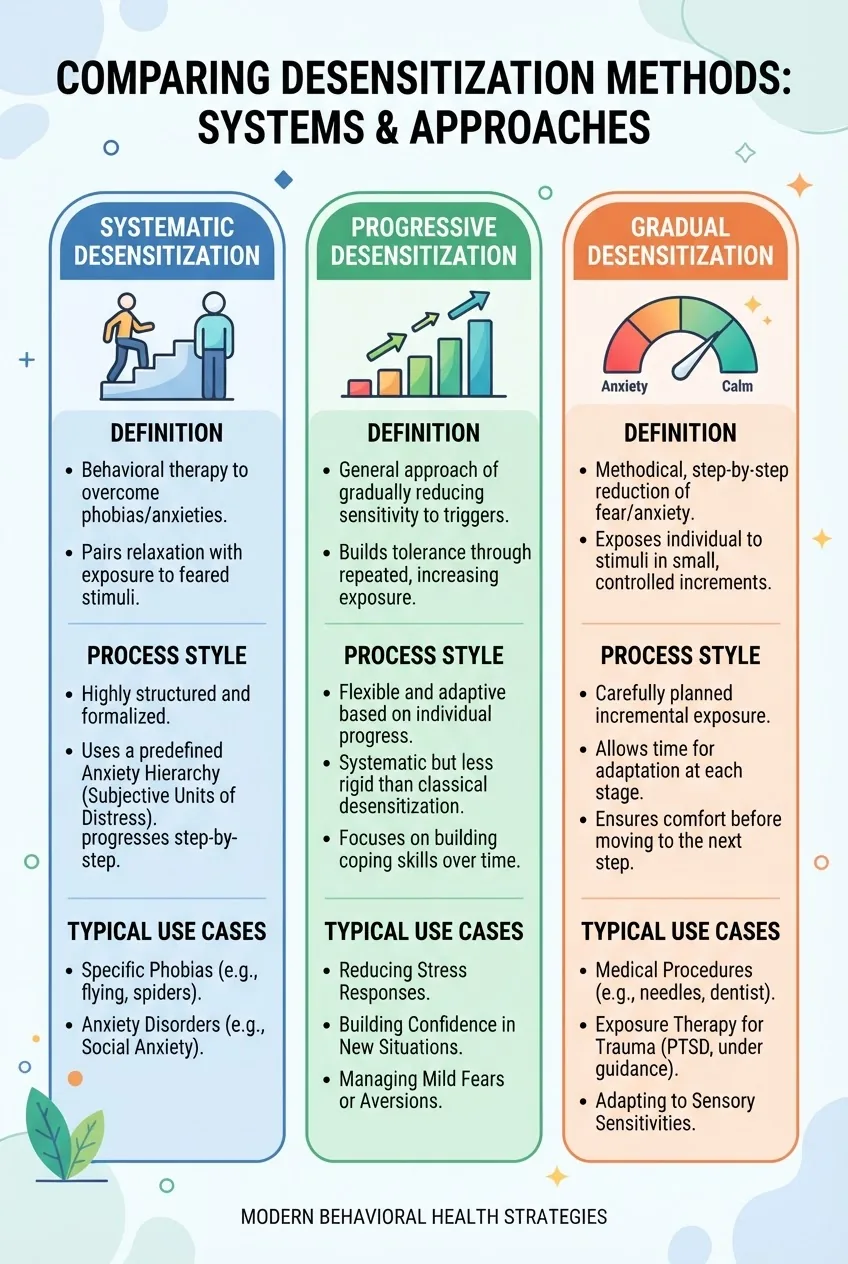
| Technique | Core difference | When to use |
|---|---|---|
| Systematic desensitisation | Pairs relaxation training with graded exposures. | Best when relaxation skills are needed to manage high arousal, e.g., strong physical anxiety. |
| Progressive desensitization | Emphasises incremental increases in stimulus intensity with less focus on relaxation pairing. | Useful when patient tolerates exposure but needs structured stepwise escalation. |
| Gradual desensitization | A looser term — any slow, staged exposure progression, can include imaginal/in vivo mixes. | Practical for complex or situational fears where rigid hierarchy is impractical. |
Explanation: progressive desensitization often refers to increasing stimulus intensity in small steps without explicit relaxation pairing; gradual desensitization is a broader term capturing any measured escalation. Clinicians frequently blend elements: early sessions emphasise relaxation (systematic desensitisation), later sessions shift to progressive practice with behavioural experiments.
For deeper comparisons with cognitive and behavioural packages see Cognitive Behavioural Therapy (CBT).
Transition: Knowing these options helps choose the right approach for specific anxiety presentations; the following section summarises which conditions respond well to desensitisation.
Conditions Treated with Systematic Desensitisation
Systematic desensitisation is effective for many anxiety disorders where specific cues trigger a learned fear response. Major presentations include:
- Specific phobias (e.g., animals, heights, injections) — classic high-response candidates.
- Social anxiety disorder — used for performance fears, meeting strangers, and social interactions via tailored hierarchies.
- Panic disorder with situational triggers — when panic is reliably triggered by discrete situations, desensitisation can reduce anticipatory avoidance.
- Situational avoidance problems (e.g., public transport fears).
For a broader taxonomy of disorders and their presentations see different anxiety types and symptoms.
Clinical case (Sydney practice): A 28‑year‑old professional presented for social anxiety focussed on speaking at team meetings (baseline LSAS high, SUDS 75 for meetings). Over ten sessions using systematic desensitisation — taught diaphragmatic breathing, built a 12‑item hierarchy from 15 SUDS to 95 SUDS, and progressed with in vivo exposures — the patient delivered a 5‑minute team update with peak SUDS 30 and reported a 60% reduction in avoidance by session 8. The clinician scheduled booster sessions at 1 and 3 months.
For diagnostic detail related to social phobia see social phobia DSM-5 criteria and for where desensitisation fits among broader anxiety treatments see the generalised anxiety disorder resource.
Transition: Evidence is key to clinical choices — next we summarise research on effectiveness and success rates.
Effectiveness and Evidence for Systematic Desensitisation
Multiple randomized controlled trials and meta-analyses show behavioural exposure approaches reduce anxiety symptoms with moderate to large effect sizes. Systematic desensitisation, specifically, produces reliable short-term reductions in phobic avoidance and subjective fear.
Selected evidence highlights:
- Meta-analytic comparisons often place exposure-based techniques (including systematic desensitisation) in the highest-evidence category for specific phobias and social anxiety (effect sizes commonly reported in the 0.6–1.0 range). Peer-reviewed journal analyses in the Journal of Anxiety Disorders report these ranges across multiple trials.
- According to a 2023 Australian Psychological Society report, structured exposure interventions with outcome monitoring show improved remission rates in routine clinical settings compared with unstructured therapy.
- Clinical trials show session counts: many patients achieve significant change within 6–12 sessions; intensive single‑session treatments are effective for some specific phobias but require specialised training (Journal of Anxiety Disorders evidence review).
Study summaries (examples):
– A randomized trial comparing relaxation-paired desensitisation with exposure-alone for spider phobia found both groups improved similarly on behavioural approach tests; relaxation pairing offered faster early reductions in subjective anxiety (peer-reviewed study, Journal of Anxiety Disorders).
– A 2021 meta-analysis of social anxiety interventions noted that exposure components, when combined with skills training, improve functional outcomes; outcomes were consistent across settings, including outpatient clinics (peer-reviewed meta-analysis).
Limitations in the evidence base: heterogeneity in protocols (imaginal vs in vivo, number of sessions) makes direct success-rate comparisons imperfect, but overall consensus supports use of desensitisation for phobias and many social anxiety presentations.
For Australian clinical guidance on evidence-based psychotherapy see the National Health and Medical Research Council (NHMRC).
Transition: Evidence supports wide use, but careful candidate selection matters; the next section explains who typically benefits most and who may need alternative approaches.
Who Is a Good Candidate for Systematic Desensitisation?
Good candidates typically share the following characteristics:
- Clear, circumscribed triggers rather than diffuse worries.
- Motivation to engage in regular homework and in-vivo practice.
- Ability to learn and apply relaxation techniques (or willingness to be taught).
- Absence of acute suicidality or severe substance dependence that impairs engagement.
Screening criteria and contraindications to consider:
- Contraindicated or deferred if active trauma memories dominate fear responses — consider trauma-focused interventions first.
- Caution where panic disorder has frequent unpredictable attacks; combine with interoceptive exposure and medical review where needed.
- Children require developmentally adapted hierarchies and parental involvement.
To align treatment with symptom intensity, check levels of anxiety severity.
Transition: Next we describe how clinicians in Sydney integrate the method into practice, referencing local standards and practicalities.
Integrating Systematic Desensitisation in Clinical Practice in Sydney
Australian clinicians should align desensitisation with professional standards and local health systems. According to a 2023 Australian Psychological Society report, therapists are recommended to document informed consent, monitor outcomes, and use stepped care when needed.
Practical clinic steps:
- Initial planning: incorporate desensitisation into a broader CBT-informed treatment plan and obtain baseline measures.
- Documentation: maintain hierarchy records, SUDS logs, home-practice records, and outcome measures at 4‑session intervals.
- Multidisciplinary coordination: liaise with GPs for medication considerations and with psychiatrists when comorbidities complicate treatment.
- Local referral lines and supports: include local Sydney community mental health and peer support contacts in discharge planning.
Clinician judgement examples: in Sydney outpatient clinics I adjust the progression pace when public transport exposures involve complex logistics — setting micro-steps such as sitting on a bus without traveling, then one-stop rides, then longer trips. I also schedule exposures at times minimizing external stressors (e.g., not during work transitions).
Find more comprehensive local options at Social Phobia Therapist and Social Anxiety Treatment Options.
External professional standards: refer to the Australian Psychological Society for guidelines on informed consent, supervision, and practice standards.
Transition: No therapy is perfect — the next section sets out the main limitations and how to manage them clinically.
Limitations and Potential Challenges of Systematic Desensitisation
Systematic desensitisation has notable limitations clinicians must manage:
- Slower for some patients: avoiding exposure or poor homework adherence delays gains.
- Not optimal for complex trauma: when fear responses are embedded in traumatic memories, trauma-focused therapies may be required first.
- Physical symptoms can complicate exposure (e.g., gastrointestinal symptoms during anxiety): these may need medical assessment.
For complications from somatic symptoms see physical manifestations of anxiety, and for stomach-focused symptoms see physical symptoms like stomach issues.
Where anxiety severity or comorbidity warrants medication, combine therapy with pharmacology under medical supervision; see options outlined in medication options for anxiety.
Common practical challenges and mitigation:
- Patient resistance to exposure — use motivational interviewing and start with low SUDS tasks.
- Relapse risk — schedule boosters and provide maintenance homework.
- Logistics for in vivo exposure — use imaginal or virtual exposures when real-world access is limited.
Transition: If you’re ready to find local help or continue self-guided work, the following resources and next steps will get you there.
Resources and Next Steps: Finding a Therapist in Sydney
- Decide service level: choose between outpatient clinics, private practice, or group formats. If affordability is a concern, ask about sliding-scale or Medicare‑reimbursed allied mental health sessions.
- Locate qualified clinicians: search APA, AHPRA-registered psychologists, or local clinic listings. Ask if clinicians use exposure-based therapies and outcome monitoring.
- Prepare for first contact: bring baseline measures (GAD‑7/LSAS), a short hierarchy list, and your treatment goals to the initial appointment.
- Consider group options: small exposure-focused groups can be effective for social anxiety — see local listings for availability.
- Complementary resources: peer support, online workbooks, and guided audio for relaxation practice.
Additional networks and materials: view this anxiety support resources page for expanded help and crisis lines.
Consider group support for anxiety if you prefer peer-based exposure work.
Transition: Before you attempt to apply this method, read the common mistakes section below so you avoid frequent practitioner pitfalls.
Common mistakes and how to avoid them
1) I used too-fast progression: early in my practice I advanced patients before their SUDS fell reliably; the result was increased avoidance. Fix: require consistent 25–40% reduction across two sessions before moving up.
2) I relied only on imaginal exposure: one client plateaued because real-world cues produced stronger fear. Fix: plan scheduled in vivo steps within weeks 3–6 where possible.
3) I let relaxation be a safety behaviour: some patients became dependent on deep breathing to avoid any anxiety. Fix: phase out active relaxation on higher steps to teach toleration and distress tolerance.
Checklist: Verify your implementation
- Have you completed baseline measures (GAD‑7/LSAS) and documented goals?
- Does the patient practice relaxation 10–20 minutes daily with measurable SUDS reduction?
- Is there a 10–15 item hierarchy with explicit SUDS ratings and exposure parameters?
- Are exposures documented with session SUDS, frequency of homework, and outcome measures every 4 sessions?
- Is there a relapse prevention plan with boosters scheduled at 1 and 3 months?
- Have you checked for trauma history and medical contraindications?
When to call in a professional
Call or refer to a specialist when the patient has active suicidal ideation, severe substance dependence, complex trauma where exposures trigger dissociation, or when progress stalls after 6–8 sessions despite good adherence.
Final note: Systematic desensitisation is an evidence-backed, hands-on approach to reduce specific and social anxieties. It works best when combined with clear measurement, patient homework, and clinician flexibility. If you’re in Sydney and want guided care, consult a registered psychologist experienced in exposure-based treatments.
Conclusion — key takeaways and CTA:
Systematic desensitisation combines relaxation and graded exposure to weaken conditioned fear. Expect 6–12 sessions for meaningful improvement, use clear hierarchies and outcome monitoring, and seek clinician supervision for complex cases. To get started, schedule an assessment with a licensed psychologist or view local options for Social Phobia Therapist and Social Anxiety Treatment Options.
Important information:This article is general information only and is not medical advice. It was written from publicly available sources by a non-clinician, and this website is not a clinic. Please speak with your GP or another qualified health professional about your own situation. If you need urgent help, call 000, or contact Lifeline on 13 11 14 or Beyond Blue on 1300 22 4636.