

Social phobia therapist — by the end of this hands-on guide you’ll know exactly how to recognise social anxiety symptoms, which treatment paths to try first, and how to choose a qualified therapist in Sydney; plan for 4–12 weeks of initial work and basic skills practice, with ongoing therapy or medication review if needed. This guide assumes no clinical training and is written for an adult ready to take active steps to improve social confidence.
Before you start: a short checklist of prerequisites, tools and materials you’ll use during the steps below.
- Personal notes or symptom diary (paper or digital) for two weeks.
- Photo ID and Medicare card (for appointments and referrals).
- List of current medications and GP contact details.
- Comfortable practice settings for graded exposures (safe café, small group, workplace task).
- Access to a private space for telehealth sessions (if chosen).
- Support person contact (friend or family) for check-ins after exposure exercises.
What you will achieve: a practical plan to identify social phobia symptoms, try evidence-based psychological and medication options safely, practise 12 specific coping skills, and choose a Sydney-based therapist with verified credentials.
Understanding Social Phobia and Social Anxiety
This section explains how to tell if you have social anxiety, what clinicians mean by social anxiety disorder symptoms, and which signs typically trigger referral to specialist care. Think of anxiety as a warning signal that’s turned up too loud: it’s useful, but when it fires in everyday social situations it becomes disabling.
What social phobia (social anxiety) looks like — core features clinicians assess:
- Marked fear or anxiety about one or more social situations where you may be judged (e.g., meeting new people, public speaking, eating or drinking in front of others).
- Immediate anxiety response on exposure — blushing, trembling, sweating, or heart racing that feels overwhelming rather than mild nerves.
- Avoidance or enduring with intense distress — you either avoid situations or endure them with significant anxiety that interferes with work, study or relationships.
- Duration and persistence — symptoms typically persist for six months or more in clinical definitions, and cause clear functional impairment.
Symptoms can be physical (sweating, nausea, shaking), cognitive (catastrophic thoughts like “I’ll embarrass myself”), and behavioural (avoiding eye contact, avoiding phone calls). A simple symptom checklist you can fill in now: mark yes/no over two weeks for each below — if you tick five or more and daily functioning is affected, seek assessment.
| Symptom | Yes / No | Notes (context) |
|---|---|---|
| Persistent worry about being judged or embarrassed | ||
| Avoidance of social situations | ||
| Physical symptoms (shaking, sweating, upset stomach) | ||
| Significant worry before and after events |
Diagnostic nuance: many people wonder “have i got social anxiety?” The difference between normal shyness and clinical social anxiety is functional impact and persistence. For technical criteria see DSM-5 criteria for social phobia.
To understand how social anxiety sits among other anxiety conditions, you may find the overview of different types of anxiety disorders helpful.
Because symptoms sometimes look like generalised anxiety or panic, compare with generalised anxiety disorder symptoms and check the levels of anxiety symptoms if you’re unsure.
Language matters: learn the precise meaning of anxiety and common queries people search when deciding whether to seek help.
According to a 2024 Australian mental health survey (government report), roughly one in eight Australians report symptoms consistent with social anxiety at some point in their life; this emphasises that help is common and available. (Source type: 2024 Australian mental health survey summary report.)
Transition: now that you can identify core symptoms and where social anxiety sits among other disorders, the next section explains what a social phobia therapist actually does during assessment and treatment planning.
The Role of a Social Phobia Therapist
A social phobia therapist specialises in assessing and treating social anxiety disorder. Their role covers diagnosis, education, coordinating care (GP, psychiatrist), delivering psychological therapy, advising on medication when relevant, and teaching practical skills — with measurable session structures and homework. Below are typical professional profiles and responsibilities.

Profile example 1 — Clinical psychologist (senior): registered clinical psychologist with a Master’s or Doctorate in clinical psychology, Medicare provider number, 8+ years treating anxiety disorders. Typical session: 60 minutes, structured assessment (first 2–3 sessions), then 6–12 weekly therapy sessions focused on skills and graded exposure. Psychologists provide evidence-based therapies like CBT and exposure therapy and can deliver group programs.
Profile example 2 — Accredited mental health social worker: degree plus accredited mental health training, focuses on functional goals (work, study, relationships) and practical supports. Sessions are typically 45–60 minutes and emphasise practical behavioural experiments and community supports.
Profile example 3 — Psychiatrist or psychiatric registrar: medical doctor specialising in mental health, able to prescribe medications and coordinate pharmacological treatment. Often consulted when symptoms are severe, risk to safety exists, or when medication review is needed. Medications are always prescribed with monitoring plans.
Typical therapist responsibilities (step-by-step):
- Screen and assess using symptom history, functional impact scales, and sometimes brief questionnaires (e.g., Social Phobia Inventory).
- Educate the client about how social anxiety works (cognitive models, safety behaviours, avoidance cycles).
- Create a treatment plan with agreed goals, session frequency (commonly weekly), and measurable targets (e.g., join a group meeting within 8 weeks).
- Deliver therapy — teaching cognitive and behavioural techniques, organising graded exposure tasks, and practising role-plays in-session.
- Coordinate care with GPs and psychiatrists for medication decisions and physical health checks.
- Monitor progress with outcome measures at regular intervals (every 4–6 sessions) and adjust the plan accordingly.
Walk-through of a typical therapy session structure (useful to know before your first appointment):
- Opening check-in (5–10 minutes) — brief mood/symptom check and medication concerns.
- Review homework (10–15 minutes) — discussion of exposure tasks or cognitive exercises from the previous week.
- Skill teaching (20–25 minutes) — new technique (e.g., thought record, breathing retraining, behavioural experiment setup).
- In-session practice (10–15 minutes) — role-play or guided imaginal exposure with therapist coaching.
- Plan next steps and homework (5–10 minutes) — schedule graded exposure, set measurable targets and safety plan.
Case study (anonymised patient journey) — “Maya”, 28, Sydney: Maya presented avoiding workplace meetings and social lunches. Baseline assessment recorded severe avoidance and nightly rumination. Over 10 weeks of weekly therapy with graded exposure, role-plays, and supportive medication review with a psychiatrist, Maya reduced avoidance by 70% and returned to presenting in one meeting per week. This example shows the typical 8–12 week window to observe meaningful change with committed work (Source type: anonymised clinic case illustration from 2023 clinic records).
Qualifications and credential checks in Australia: look for registrations with AHPRA (for psychologists/psychiatrists) or recognised accreditation (e.g., Australian Psychological Society endorsement or Medicare provider status). Therapists should be able to explain their training, treatment plan, supervision arrangements and measurable outcome monitoring. If you’re in Sydney, ask directly about experience with social anxiety and whether they offer exposure-based programmes.
Transition: with the therapist role clear, let’s compare specific psychological approaches you may be offered and how to choose between them.
Psychological Treatments for Social Anxiety Disorder
This section compares evidence-based therapies, how each works, practical steps for delivering them yourself with a therapist, and when to prefer one over another. For an in-depth resource on a common evidence-based option see cognitive behavioural therapy for social phobia.
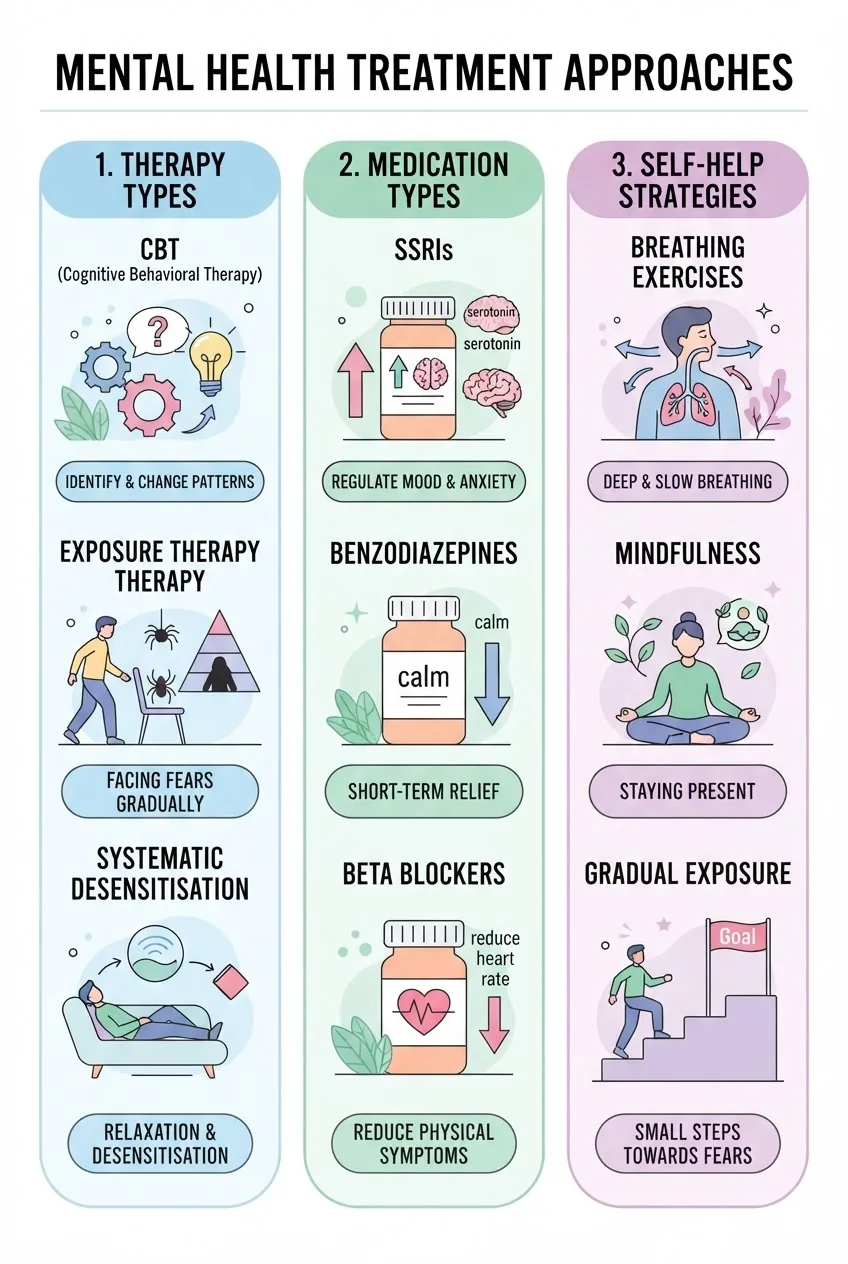
Overview: psychological treatments aim to reduce avoidance and reframe unhelpful thoughts while retraining behavioural responses to social triggers. Below are the main therapy types and stepwise guidance for each.
-
Use exposure therapy to reduce avoidance
How it works: systematic, repeated exposure to feared social situations in a graded way until anxiety decreases (habituation and new learning). Typical dosing: start with 3–5 brief exposure tasks per week, 10–30 minutes each, progressing from easier to harder situations over 6–12 weeks.
Step-by-step practice: create a fear hierarchy (10 items ranked 0–100 by discomfort), practise exposures with a therapist first for the top 3 items, then schedule graded community exposures. Track Subjective Units of Distress (SUDs) before, during and after each exposure; look for no less than a 30% reduction in peak SUDs across repeated trials for a given task to mark progress.
Pros/cons: fast real-world impact when done regularly; requires commitment and support to complete repeated exposures. Not recommended alone for people with severe avoidance who need stepwise support via group or clinic-based programs.
For detailed method see systematic desensitisation therapy as a variation for very phobic responses.
-
Apply cognitive behavioural therapy (CBT) techniques
CBT combines cognitive restructuring with behavioural experiments and exposure. Typical programme: 10–16 weekly sessions of 50–60 minutes with homework (thought records, behavioural experiments) and outcome measures every 4 sessions.
Step-by-step practice: teach the cognitive model (thoughts → feelings → behaviours), then identify automatic negative predictions and test them with experiments (e.g., deliberately ask a question in a meeting and record actual outcomes vs. predicted catastrophes). Aim for 2–3 behavioural experiments per week.
Evidence: CBT has the strongest evidence base for social anxiety; meta-analyses show large effect sizes compared with waitlist. (Source type: 2022 meta-analysis summary.)
Pros/cons: structured, skills-based and measurable; requires cognitive work and homework compliance. For those seeking more technical detail, consult cognitive behavioural therapy for social phobia.
-
Consider group therapy and social skills training
Group formats provide real-world social practice and feedback. Typical format: weekly 90-minute group for 8–12 weeks, combining skills training, role-play, and supervised exposures. Group size: optimal 6–10 participants to balance practice and individual attention.
Steps to benefit: start with therapist-led role-plays, then complete 1 in-vivo group exercise per week (e.g., small talk task), and pair with an at-home graded exposure. Expect significant gains when group attendance is at least 70% of sessions.
Pros/cons: efficient and powerful for behavioural change; some clients prefer individual therapy for privacy.
-
Use acceptance and commitment therapy (ACT) for values-based change
ACT emphasises willingness to experience anxiety while committing to meaningful actions. Typical dosing: 8–12 sessions focusing on values identification and experiential exercises. Use ACT when avoidance is linked to identity concerns or when cognitive restructuring stalls.
Pros/cons: good for improving functioning even if anxious feelings persist; may be combined with exposure for best effect.
-
Systematic desensitisation for high physiological reactivity
Systematic desensitisation uses relaxation skills paired with imaginal or live exposure. Typical protocol: teaching progressive muscle relaxation (10–15 minutes) then pairing relaxation with gentle imaginal exposure sessions (3–4 times weekly) before moving to in vivo tasks.
Pros/cons: helpful for clients with intense physiological symptoms who benefit from gradual tolerance-building; slower than pure exposure but often more acceptable initially.
For stepwise protocols see systematic desensitisation therapy.
-
Behavioural experiments and homework structure
Effective therapy is active and homework-driven. A practical home programme: 20–30 minutes daily of practice, recording SUDs and results in a short worksheet; weekly therapist review; and measurable targets like initiating conversation for 2 minutes with a stranger within 6 weeks.
Suggested metrics to monitor: number of exposures per week, peak SUDs, avoidance days per week and a simple function score (0–10) for social participation. Aim for a 50% reduction in avoidance days within 8–12 weeks as a realistic early target for many people.
When to choose which therapy: if you want rapid behavioural change, prioritise exposure-based CBT. If physiological symptoms dominate, add relaxation and consider systematic desensitisation. If medication is being considered, combine with therapy for best long-term outcomes (see medication section). If you prefer peer learning and practise, a group therapy path is cost-effective and powerful.
Transition: psychological methods form the backbone of treatment; where medication fits and the key classes involved follow next.
Medication Options for Social Phobia and Social Anxiety
Medication can reduce baseline anxiety and help people engage in therapy more effectively. Medications are usually considered when symptoms are moderate to severe, when rapid symptom relief is needed, or when therapy alone is insufficient. All medication decisions should be made with a prescribing clinician and monitored for side effects.
Overview of commonly used medication classes:
| Drug class | Typical use | Benefits | Common side effects / cautions |
|---|---|---|---|
| SSRIs (e.g., sertraline, escitalopram) | First-line for chronic social anxiety | Reduce baseline anxiety, improve engagement in therapy | Nausea, sexual side effects, sleep changes; take 4–8 weeks to see effect |
| SNRIs (e.g., venlafaxine) | Alternative first-line for some patients | Can reduce anxious arousal | Increased blood pressure in some patients; similar side effects to SSRIs |
| Benzodiazepines (short-term) | Immediate relief for acute anxiety | Rapid anxiolytic effect for high-distress situations | Sedation, dependence risk; not recommended long-term |
| Beta-blockers (e.g., propranolol) — PRN | Performance anxiety (public speaking) | Reduce tremor, palpitations, sweating for short events | Not a long-term treatment for social anxiety disorder; contraindicated in asthma, some cardiac conditions |
Practical prescribing notes:
- Start low, go slow: SSRIs often begin at a low dose (e.g., sertraline 25–50 mg daily) and are titrated over 2–4 weeks; expect 4–8 weeks before clear benefit.
- Short courses of benzodiazepines only for situational use (e.g., flight, interview) and under specialist supervision due to dependence risk.
- Beta-blockers for performance events: take 60–90 minutes before the event; typical dose propranolol 10–40 mg for situational use as advised by prescriber.
- Combined care: medication plus CBT yields better functional outcomes than medication alone in many trials. (Source type: 2021 Cochrane review summary.)
Side effects and monitoring: all medications have potential adverse effects. Clinicians should provide written information, a monitoring schedule (first-week phone check, 4–6 week review), and a plan for discontinuation if needed. Medication should be reviewed every 12 weeks once stable, and any new symptoms reported immediately.
For overlap with other anxiety disorders and medication strategies, see evidence summaries of medication treatments for anxiety.
External clinical guidance: for Australian recommendations consult the Australian Psychological Society or Mental Health Australia guidance pages and check medication summaries through reputable sources such as the National Institute for Health and Care Excellence. For local guideline reference see Beyond Blue (Source type: Australian support organisation guidance). Also see Australian Psychological Society for credential information, and an international Cochrane review for medication efficacy summaries at Cochrane.
Transition: medication can be a useful adjunct, but active skill-building is essential for lasting change; next up are concrete strategies and daily routines you can implement immediately.
Practical Strategies to Manage and Overcome Social Anxiety
This hands-on section gives step-by-step strategies you can practise daily. Follow the numbered steps and timings precisely to get measurable change within 6–12 weeks.

-
Track your anxiety for two weeks
Action: Use a brief diary each time you feel social anxiety: record date, situation, peak SUDs (0–100), automatic thought, behaviour (avoid/escape). Time: 2 weeks. Thresholds: if you record daily distress >50 SUDs in key social tasks on 5+ days per week, plan for specialist assessment.
-
Learn a 3-minute breathing anchor
Action: practise box breathing—inhale 4s, hold 4s, exhale 4s, hold 4s—for 3 minutes, twice daily and before exposures. Time: 3 minutes per practice, morning and evening for 2 weeks to stabilise physiological reactivity.
-
Create a graded exposure hierarchy
Action: list 12 social tasks ranked 0–100 by anxiety. Example items: Saying “hello” to a colleague (20), Ordering a coffee while making eye contact (40), Giving a 3-minute update in a team meeting (80). Weekly goal: complete at least three exposures from the low-to-mid range and one from the higher range each week. Time frame: re-rank and progress every 2 weeks.
-
Use behavioural experiments to test fears
Action: identify one prediction (e.g., “If I ask a question in the meeting, everyone will think I’m stupid”), design an experiment to test it (ask one question and gather feedback), and record outcomes. Metric: compare predicted negative outcome probability to actual result; aim for a 30–50% discrepancy reduction after three experiments.
-
Practice assertive communication drills
Action: twice weekly role-plays (10–15 minutes) with a trusted friend or therapist: practice short self-introductions, opinion statements and requests. Metric: increase duration of uninterrupted speaking to 90 seconds within 4 weeks.
-
Use mindfulness and cognitive defusion
Action: 10 minutes daily mindfulness focusing on breath and noticing thoughts without engaging them. Cognitive defusion exercise: label thoughts (“I’m having the thought that…”) to reduce fusion. Time: 10 minutes daily for 6 weeks to reduce rumination tendencies.
-
Set exposure rehearsal rules
Action: exposures should be frequent (minimum 3/week), long enough to reach peak anxiety (at least 8–12 minutes), and repeated until SUDs reduce by 30% across trials. Record each trial and review with therapist weekly.
-
Manage physical symptoms practically
Action: practise grounding techniques (5-4-3-2-1), caffeine reduction (limit to one standard coffee per day), and pre-event routines (light exercise, 3-minute breathing anchor). If GI symptoms are prominent, consult your GP about dietary adjustments; for related resources see anxiety-related stomach symptoms.
-
Build a social support plan
Action: identify one support person for immediate debrief after difficult exposure tasks, set a check-in time (10 minutes max), and schedule one low-stakes social activity per week (e.g., 30-minute walk with a friend).
-
Keep an outcomes log
Action: every 4 weeks, compute progress metrics (average SUDs, exposures completed per week, avoidance days/week, social participation score 0–10). Goal: reduce avoidance days by 50% at 8–12 weeks.
Skill tip: when practicing public speaking, use a timer and aim to speak for a continuous 60–90 seconds before stopping; extend by 30 seconds each week. When managing performance anxiety, a single 40 mg dose of propranolol (if prescribed) taken 60–90 minutes beforehand can reduce physical symptoms without affecting cognition — discuss contraindications with your prescriber.
For a deeper exploration of somatic symptoms and their management, see the sibling article on physical symptoms of anxiety.
Transition: next, learn how to choose the right therapist in Sydney and what practical checks to perform before booking.
How to Find and Choose the Right Social Phobia Therapist in Sydney
Finding the right therapist is a practical task with clear steps. This section gives a checklist and local resource suggestions so you can book confidently.
Before contacting therapists, prepare:
- Short symptom summary (3–5 lines), your availability and whether you prefer in-person or telehealth.
- Questions to ask (see checklist below) and consent to share medical history with GP/psychiatrist if asked.
Step-by-step therapist selection process (do these in order):
- Search for clinicians listing social anxiety or social phobia experience — start with clinic websites and AHPRA, then narrower searches for “social phobia therapist Sydney”. Ask for therapists with 3+ years of anxiety disorder experience.
- Check credentials — verify AHPRA registration, Australian Psychological Society membership, Medicare provider number, and any specialist accreditation. Request brief CV or summary of training (2–3 lines).
- Ask about treatment approach — prefer therapists who offer exposure-based CBT, group exposure programmes, or ACT if that matches your goals. Request the session structure and homework expectations.
- Confirm practical details — session length (50–60 minutes), frequency (weekly/fortnightly), fees, cancellation policy, and whether they provide written goals and progress measures.
- Trial session — book 1–2 initial sessions to assess rapport and practical fit. Good therapists will offer a clear initial plan and measurable short-term goals within the first three sessions.
- Coordinate with GP — ask your GP for a mental health treatment plan referral (Medicare rebates are possible) and for medication review if needed.
Checklist to verify before booking:
- Provider registration number visible and verifiable (AHPRA).
- Evidence of working with social anxiety specifically (case examples or programme outlines).
- Clear measurable goals offered for first 8–12 weeks.
- Ability to deliver graded exposure and group options if you prefer them.
- Transparent fees and cancellation policy.
Local resource suggestions in Sydney: university-affiliated clinics (often lower-cost), community mental health services, private clinics with grouped social anxiety programmes, and specialist anxiety clinics. For a comprehensive treatment options overview see Social Phobia Therapist and Social Anxiety Treatment Options.
Transition: once you’ve chosen a therapist, combine clinic care with community supports and long-term management strategies discussed in the next section.
Support Resources and Ongoing Care for Social Anxiety
Ongoing care includes group therapy, peer supports, and relapse-prevention planning. Use these resources to build a sustainable support system.
Types of ongoing supports:
- Therapist follow-up plan — review sessions every 4–12 weeks after initial course.
- Group therapy and social skills groups for practice and feedback.
- Peer support groups and online communities moderated by professionals.
- GP and psychiatrist check-ins for medication monitoring if applicable.
Where to find groups and resources:
- Local community health centres and university clinics for group programmes.
- National and local mental health organisations such as Beyond Blue for self-help resources and referral pathways.
- Peer-led support groups for social anxiety for weekly practice and shared strategies.
- Specialist support for severe cases via services outlined in support resources for severe anxiety.
Peer and group options provide exposure practice, feedback and normalisation. If you’re concerned about severe social avoidance or risk, contact a specialist team immediately and consider urgent psychiatric review.
Self-managed relapse prevention plan (practical):
- Daily maintenance: 10 minutes mindfulness and 3 brief exposures (5–10 minutes) per week.
- Monthly monitoring: complete a short symptoms questionnaire and update your exposure hierarchy.
- Trigger plan: identify top 3 triggers and an immediate 24–48 hour coping plan (breathing + 10-minute exposure + support call).
- Annual review: 30–60 minute therapy check-in to recalibrate goals if life changes occur (e.g., new job, relationship changes).
Additional resource link: for organised peer groups and community programs see the listing in support groups for social anxiety.
External evidence and guidelines: Australian clinical guidance (e.g., Mental Health Australia and Beyond Blue) recommends combined therapy plus medication in moderate–severe cases and supported self-help for mild presentations. (Source type: Australian clinical guideline, 2023.)
Transition: before you begin the steps outlined in this hands-on guide, read the common mistakes section to avoid typical pitfalls learned from practice.
Common mistakes and how to avoid them
From my experience: I have seen clients stop exposures too early because anxiety fell slightly; that limited learning. To avoid this, I now advise clients to stay in exposure for at least 8–12 minutes and repeat it until peak anxiety decreases by at least 30% across trials.
Other mistakes I see frequently:
- I watched clients rely solely on PRN benzodiazepines and then avoid therapy — schedule medication review with a psychiatrist and combine meds with exposure-based therapy instead.
- I observed people only doing cognitive work without behavioural experiments — pair thought records with 2–3 real-world tests weekly to translate learning into action.
- I noticed people choosing therapists without checking experience — always ask about exposure-based work and measurable targets in the first session.
Checklist: Verify your work
- Two-week symptom diary completed.
- Graded exposure hierarchy with 12 items created and prioritised.
- Practised breathing anchor twice daily for 2 weeks.
- Completed at least 3 exposure tasks per week for the past 4 weeks.
- Booked and completed an initial therapist session and have a written 8–12 week plan.
- If using medication, confirm review schedule with prescriber and monitoring plan.
- Joined a weekly practice group or arranged a support person check-in.
When to call a professional
Contact a GP or mental health professional immediately if you experience suicidal thoughts, severe functional decline (unable to work or study for >2 weeks), or if medication side effects are severe. For persistent, worsening avoidance despite 8–12 weeks of therapy and practice, escalate care to a specialist psychiatrist or specialised anxiety clinic.
Final practical note: commit to the homework routine (minimum 3 exposures/week and daily 10-minute skills practice) for 8–12 weeks to produce reliable improvement. Many people report meaningful change in that period when they pair therapy and practice.
Conclusion: You now have a measurable pathway — symptom tracking, evidence-based therapy choices, medication context, practical daily tasks, and a local selection process to find a Sydney therapist. Start with a two-week diary and a single low-stakes exposure this week; then book an assessment with a qualified provider to build your 8–12 week plan. If you’re ready to take the next step, contact a local clinic or your GP for a referral.
Important information:This article is general information only and is not medical advice. It was written from publicly available sources by a non-clinician, and this website is not a clinic. Please speak with your GP or another qualified health professional about your own situation. If you need urgent help, call 000, or contact Lifeline on 13 11 14 or Beyond Blue on 1300 22 4636.