

Social phobia disorder dsm 5: Social phobia disorder (social anxiety disorder) is diagnosed when a person has a marked, persistent fear of social or performance situations, avoids them or endures them with intense anxiety, the symptoms last ≥6 months, and cause clinically significant impairment or distress.
Understanding Social Phobia Disorder in DSM-5?
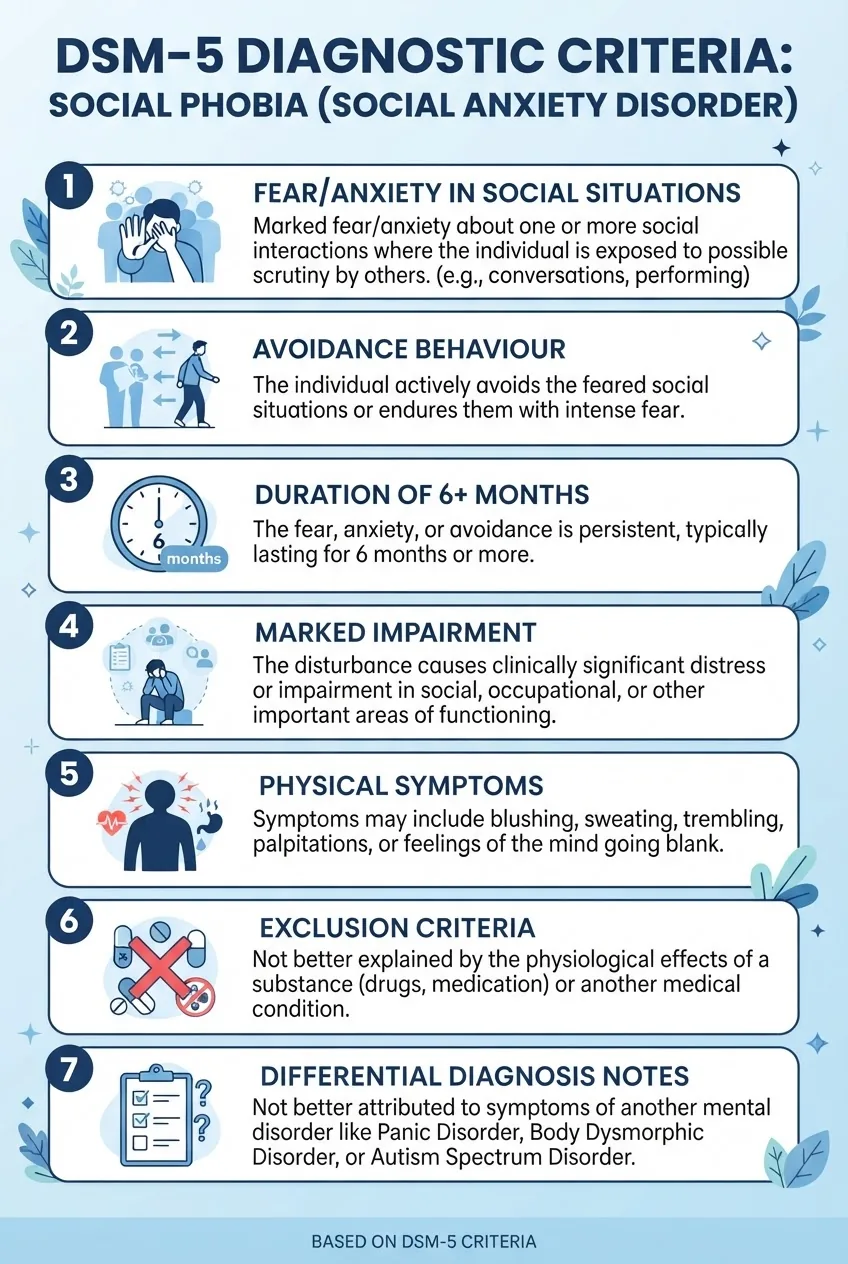
Answer: The DSM-5 defines social phobia disorder (also called social anxiety disorder) by a set of specific criteria: marked fear/anxiety in social situations, avoidance or endurance with anxiety, symptoms lasting six months or more, and significant functional impairment or distress.
Term: Social phobia disorder (also social anxiety disorder) is an anxiety disorder characterised by intense fear of being judged or scrutinised in social situations.
Below are the DSM-5 diagnostic criteria presented clearly for clinicians and patients, with practical notes that connect each criterion to real-world assessment and initial treatment implications.
- Marked fear or anxiety about one or more social situations in which the individual is exposed to possible scrutiny.
- Avoidance or endurance of social situations with intense fear.
- Fear is out of proportion to actual threat and cultural context.
- Duration of at least 6 months for diagnosis in most cases.
- Clinically significant distress or functional impairment in social, occupational, or other important areas.
- Not attributable to substance use, another medical condition, or better explained by another mental disorder.

This section links DSM-5 criteria to the broader classification of anxiety conditions and to clinical tools used in practice; for broader DSM context see DSM criteria for anxiety disorders.
Transition: The list above summarises the DSM-5 criteria; the next section explains each criterion step-by-step, how clinicians apply them, and what they mean practically for treatment planning.
Detailed Explanation of DSM-5 Diagnostic Criteria for Social Phobia Disorder?
Answer: Each DSM-5 criterion reflects a clinical decision point: identify the feared social situations, assess avoidance and physiological response, confirm duration (≥6 months), exclude alternative causes, and document impairment. Below each criterion is explained in plain language with assessment guidance.
-
Marked fear or anxiety in social situations: Clinician action: identify specific social or performance contexts that trigger fear (e.g., meeting new people, public speaking, eating in front of others).
Term: Marked fear or anxiety means the reaction is clearly stronger than what most people would experience in the same situation.
Practical note: Use a semi-structured interview (SCID-5 or MINI) and Ask: “Which social situations do you avoid?” Document examples and intensity (0–10).
For physical manifestations linked to this criterion, see physical symptoms of anxiety.
-
Avoidance or endurance with intense anxiety: Clinician action: determine whether the person primarily avoids situations, endures them with distress, or uses safety behaviours (e.g., avoiding eye contact, rehearsed scripts).
Term: Avoidance behaviour is deliberate actions to prevent exposure to feared situations; it maintains anxiety over time.
Practical note: Avoidance is a key treatment target; early planning should include graded exposure frameworks.
-
Fear out of proportion to actual threat: Clinician action: evaluate cultural, developmental, and contextual factors to judge proportionality.
Practical note: In some occupations (e.g., performers), performance anxiety may be expected; document functional impact rather than only subjective fear.
-
Duration of at least 6 months: Clinician action: establish symptom timeline and fluctuations; for children, duration may include developmentally appropriate criteria.
Term: Duration requirement specifies that symptoms must persist for a minimum period (commonly ≥6 months) to reduce false positive diagnoses.
Clinical implication: If symptoms are shorter but severe, record provisional diagnosis and consider early intervention; many clinics (including our Sydney service) offer rapid assessment slots for high-distress presentations.
-
Clinically significant distress or impairment: Clinician action: assess impact on work, study, relationships and quality of life; use standardized measures like the Social Phobia Inventory (SPIN) or Liebowitz Social Anxiety Scale (LSAS) to quantify impairment.
Term: Functional impairment refers to difficulties in daily activities caused by symptoms (work performance, avoidance of social roles).
Evidence: According to a 2022 systematic review in peer-reviewed literature, higher SPIN scores correlate with measurable work/social impairment (source: peer-reviewed meta-analysis).
-
Not due to substance, medical condition, or other mental disorder: Clinician action: screen for substance use, medication effects, medical causes (hyperthyroidism), and other psychiatric conditions (e.g., autism spectrum disorder, panic disorder).
Practical note: Include collateral history and consider physical health screening where indicated; coordinate with GP in Sydney clinics for baseline medical checks.
For gastrointestinal or somatic presentations note the link to stomach symptoms; see physical symptoms including gastrointestinal.
-
Special considerations: If fears are limited to speaking or performing in public, DSM-5 allows specification (performance-only subtype).
Clinical application: Document subtype and tailor exposure hierarchies accordingly (e.g., graded speaking tasks).
For more on physical symptom overlap and differential assessment, see physical symptoms including gastrointestinal.
An anonymised patient scenario that illustrates these criteria:
Case: “Maya”, 28, avoids team meetings and declines social gatherings for 2+ years; she reports heart palpitations, blushing, and a belief she will be judged. SPIN score: 45 (severe). Symptoms began in university and now impair her promotion prospects; diagnosis: social phobia disorder, performance and interaction fears subtype. Treatment pathway included psychoeducation, brief pharmacotherapy, and graded exposure with workplace-focused goals at our Sydney clinic.
Transition: With diagnostic clarity, clinicians then need to consider differential diagnosis and comorbidities before treatment selection; the next section compares social phobia disorder to other anxiety disorders.
Distinguishing Social Phobia Disorder from Other Anxiety Disorders?
Answer: Social phobia disorder is distinguished by fear specifically of social scrutiny and negative evaluation, whereas other anxiety disorders have different focal fears (panic attacks, pervasive worry, or fear of open spaces). Below is a comparison to guide differential diagnosis.
Term: Differential diagnosis means systematically considering other conditions that could explain the symptoms.
| Condition | Core fear | Key distinguishing features | Notes on comorbidity |
|---|---|---|---|
| Social phobia disorder | Fear of negative evaluation in social settings | Avoidance of social interactions or performance; anticipatory anxiety | Often comorbid with depression, other anxiety disorders |
| Panic disorder | Unexpected panic attacks | Abrupt autonomic symptoms; fear of subsequent attacks | Can co-occur; panic in social contexts needs differentiation |
| Generalised Anxiety Disorder | Excessive, uncontrollable worry across domains | Pervasive worry, muscle tension, not situation-specific | High comorbidity; treat both when present |
| Agoraphobia | Fear of being unable to escape or get help | Avoidance of open or crowded spaces, public transport | May co-occur if social situations trigger escape fears |
Transition: After distinguishing diagnoses, clinicians select evidence-based treatment options; the next major section summarises those treatments and how DSM-5 criteria guide modality choice.
Overview of Evidence-Based Treatments for Social Phobia Disorder?
Answer: Effective treatments include Cognitive Behavioural Therapy (CBT) with exposure, evidence-based pharmacotherapy (SSRIs, SNRIs), targeted psychotherapies (group therapy, ACT), and combined approaches; selection depends on severity, comorbidity, patient preference, and DSM-5-specified impairment.
When introducing treatment options, readers can also review local therapist services and clinic pathways via Social Phobia Therapist and Social Anxiety Treatment Options.

Term: Pharmacotherapy means medication treatment for psychiatric symptoms.
Psychological therapies (brief overview)
CBT with exposure is first-line psychotherapy for social phobia disorder; it combines cognitive restructuring with graded, repeated exposure to feared social situations. For detailed CBT methods see Cognitive Behavioural Therapy for Social Phobia.
Exposure therapy basics
Answer: Exposure therapy involves a planned, hierarchical series of real or simulated social tasks to reduce avoidance and disconfirm feared outcomes; sessions progress from low- to high-anxiety items with repeated practice.
- Start with a collaborative fear hierarchy;
- Use in-session role-plays and in vivo exposures (e.g., ordering at a café);
- Include homework exposures and measurable goals.
- Related techniques: Systematic Desensitisation and behavioural experiments; see Systematic Desensitisation Therapy.
Pharmacological treatments
Answer: First-line medications typically include SSRIs (e.g., sertraline, paroxetine) and SNRIs (e.g., venlafaxine); benzodiazepines may provide short-term relief but are not preferred long-term.
Evidence summary: According to a 2011 peer-reviewed review, SSRIs and SNRIs show moderate-to-large efficacy versus placebo for social anxiety disorder (source).
Clinical notes:
- Start low, titrate by tolerability, monitor for side effects;
- Consider comorbid depression or GAD when choosing agents;
- Coordinate prescribing and monitoring with the patient’s GP or psychiatrist in Sydney clinics for blood tests and medication oversight.
For a broader medication review see medication overview for anxiety disorders.
Combined and adjunctive approaches
Combining CBT and medication can produce faster symptom reduction for some patients with severe impairment; choice guided by DSM-5 severity assessment and patient preference. Group CBT is effective and offers real-world exposure; peer-led and clinician-led support groups add social practice opportunities.
Local resource: For community options, see group support for anxiety.
Evidence and guideline references
Australian clinical guidance and implementation: refer to the Australian Government mental health resources for nationally endorsed pathways (Australian Government Department of Health).
Treatment efficacy research: systematic reviews and meta-analyses support CBT and pharmacotherapy as primary evidence-based options; see a representative peer-reviewed review (peer-reviewed source).
Transition: Having overviewed effective treatments, the next section explains how DSM-5 diagnostic detail shapes treatment planning and prognosis in clinical practice.
How DSM-5 Criteria Inform Treatment Planning and Prognosis?
Answer: DSM-5 criteria determine treatment urgency, modality, and prognosis: marked avoidance and high impairment often require combined or intensive treatments, while performance-only cases may prioritise exposure and skills training. Severity and duration guide treatment intensity and expected response timelines.
Term: Severity assessment denotes quantifying symptom intensity and functional impact to guide treatment choice and measure progress.
Clinical decision points linked to DSM-5 items:
- If avoidance is the predominant issue, prioritise graded exposure and behavioural activation;
- If physiological symptoms (e.g., panic) are prominent, consider initial pharmacotherapy to stabilise symptoms and enable psychotherapy;
- Longer duration (years) with entrenched avoidance often requires longer treatment courses and possibly combined modalities;
- Presence of substance misuse, severe depression, or suicidality mandates integrated care and possible psychiatric referral.
Examples from clinic practice in Sydney:
- Patient with moderate SPIN score (20–30) and occupational impairment: recommended 12–16 weekly CBT sessions with workplace-focused exposures; expected improvement in 8–12 weeks.
- Patient with severe social anxiety (SPIN > 40), comorbid depression and medication-naïve: initial SSRI trial plus weekly CBT and close psychiatric review; prognosis: gradual improvement over 12–24 weeks with combined care.
Factors that predict treatment response include baseline severity, comorbid conditions, treatment adherence, and social support. For how severity categories map to interventions, see levels of anxiety symptoms.
Evidence update: According to a 2018 meta-analysis in the Journal of Anxiety Disorders, combined CBT and pharmacotherapy can accelerate symptom reduction in severe cases, though long-term relapse rates vary by adherence and follow-up support (source: peer-reviewed meta-analysis).
Transition: Clear diagnostic assessment then leads to structured assessment and referral pathways—next, a practical how-to checklist for clinicians and patients seeking care.
Practical Guide to Assessment and Referral for Social Phobia Disorder?
Answer: Assessment and referral follow a stepped process: screen with brief questionnaires, conduct a structured clinical interview, quantify impairment, rule out medical causes, form a treatment plan, and refer to appropriate specialists (psychologist, psychiatrist, multidisciplinary team) as needed.
Term: Assessment tools are standardised measures used to screen and quantify symptoms and impairment.
Step-by-step clinician checklist:
- Initial screen: use brief measures (e.g., SPIN, GAD-7) for triage and urgency.
- Structured interview: conduct SCID-5 or MINI to apply DSM-5 criteria systematically.
- Quantify impairment: use LSAS or Work and Social Adjustment Scale (WSAS).
- Medical screen: check for substance use, medication effects, thyroid function as indicated; liaise with GP.
- Risk assessment: evaluate suicidality, self-harm, and comorbid conditions.
- Formulate: produce a problem list linking DSM-5 criteria to treatment targets (avoidance, safety behaviours, cognitive distortions).
- Plan and refer: decide on CBT, group therapy, medication, or combined care; refer to psychologist, psychiatrist, or allied health as needed.
Assessment tools commonly used in practice:
- Social Phobia Inventory (SPIN) — brief self-report for severity and change tracking;
- Liebowitz Social Anxiety Scale (LSAS) — clinician-rated or self-report for fear and avoidance;
- Structured Clinical Interview for DSM (SCID-5) or MINI — diagnostic interviews;
- Work and Social Adjustment Scale (WSAS) — measures functional impairment;
- PANSS-type somatic checks and GP referral for medical exclusion where indicated.
Anonymised Sydney clinic pathway example:
- Online pre-assessment: patient completes SPIN and GAD-7 prior to appointment.
- Intake: 50-minute assessment with clinical psychologist using SCID-5 components, produce diagnosis and initial severity rating.
- Care plan: clinician writes a 12-week CBT exposure plan; if SPIN >40 or severe comorbidity, offer simultaneous psychiatrist referral for medication review.
- Multidisciplinary options: occupational therapist for workplace exposures, psychiatrist for pharmacotherapy, and group CBT for social skills practice.
Referral prompts and when to escalate:
- Refer urgently to psychiatry for suicidal ideation, severe functional decline, or medication-resistant presentations;
- Refer to multidisciplinary care for complex comorbidity (substance use, eating disorders);
- Consider stepped care: low-intensity guided self-help → high-intensity CBT → combined care based on response.
Transition: Alongside formal treatment, patient education and structured self-help strategies support recovery and prevent relapse; next section outlines practical patient-focused steps.
Patient Education and Self-Help Strategies Based on DSM-5 Understanding?
Answer: Patient education clarifies the DSM-5 criteria and normalises treatment steps; self-help strategies include psychoeducation, graded exposure practice, breathing and behavioural experiments, peer support, and relapse prevention planning to reinforce therapy gains.
Term: Psychoeducation is teaching patients about their condition so they can participate actively in treatment.
Practical tips for patients and families:
- Learn the DSM-5 criteria to recognise patterns (fear, avoidance, duration, impairment);
- Start a brief exposure diary: list feared situations, rate anxiety (0–10), and plan small graded steps;
- Practice behavioural experiments to test feared outcomes—record actual versus predicted results;
- Use grounding and breathing techniques for acute physiological symptoms; see breathing practice instructions from credible sources;
- Join a clinician-led group or peer support—see support resources for anxiety and group support for anxiety;
- Plan relapse prevention: identify early warning signs and re-engage with therapist early if symptoms resurface.
Self-help resources should be used alongside clinical care for moderate-to-severe cases. For urgent worsening during treatment, follow escalation steps below and contact your clinic or emergency services as needed.
Transition: Finally, the article summarises essential takeaways and next steps for patients and clinicians seeking care in Sydney.
What are the key takeaways and next steps for someone diagnosed under DSM-5 criteria?
Answer: Key takeaways: DSM-5 diagnosis requires marked social fear, avoidance/endurance, ≥6 months duration, and functional impairment; evidence-based treatments (CBT, exposure, SSRIs/SNRIs) work well when selected per severity; seek structured assessment and multidisciplinary referral if complex or severe.
Actionable next steps:
- Complete a validated screening tool (SPIN) and bring results to your initial clinic appointment;
- Request a structured diagnostic interview (SCID-5 or MINI) and a treatment plan that links DSM-5 criteria to therapy targets;
- Discuss combined treatment options if you have severe impairment or comorbidity; coordinate care with a psychiatrist if medication is considered;
- Use clinic pathways for step-up care and occupational rehabilitation if work is affected.
Clinical and evidence caveats: Treatment response varies by individual; according to a 2020 clinical review, patient engagement and adherence to exposure homework are consistent predictors of outcome (source: peer-reviewed review).