

This guide explains the levels of anxiety—mild, moderate and severe—how anxiety disorders are diagnosed in Australian clinical practice, and evidence-based treatments including therapy, medication and local Sydney referral pathways to help you decide when to seek help and what to expect.
Understanding the Levels of Anxiety Symptoms?
Answer: Levels of anxiety describe a spectrum from mild, transient worry to severe, disabling anxiety that impairs daily function; severity is judged by symptom number, intensity, duration and impact on work, relationships and self-care.
Term: mild anxiety refers to lower-intensity anxiety symptoms that are noticeable but allow continued functioning; moderate reduces performance or comfort; severe causes significant disruption and may meet criteria for an anxiety disorder.

Think of anxiety as a volume knob: mild anxiety is background noise that can be managed; moderate is louder and intrusive; severe is like the volume turned up so high it stops you doing key activities. Assessment looks at intensity, frequency, triggers and functional impact.
Common dimensions clinicians examine:
- Symptom intensity (how strong are feelings like worry, panic or fear).
- Functional impact (work, study, socialising, self-care).
- Duration and frequency (days per week, hours per day, persistence).
- Physical and cognitive symptoms (sleep, concentration, somatic complaints).
If you want broader context on anxiety types beyond levels, see different types of anxiety.
What Constitutes Mild Anxiety?
Answer: Mild anxiety includes low-to-moderate worry, occasional physical signs (e.g., restlessness, mild sleep change), preserved ability to work and maintain relationships, and effective coping with brief targeted strategies or low-intensity therapy.
Term: mild anxiety symptoms are early or low-intensity warning signs of anxiety that typically do not meet full diagnostic thresholds for an anxiety disorder but may progress without intervention.
Mild anxiety often appears in everyday situations—job interviews, deadlines, social events—and is usually proportional to the trigger. It can be episodic, resolve with self-help, or persist at a low level. Early intervention improves outcomes.
- Persistent but controllable worry about specific situations or tasks
- Mild restlessness or feeling on edge
- Intermittent difficulty falling asleep or light sleep disturbance
- Mild muscle tension or headaches
- Occasional concentration or memory lapses under stress
- Avoidance of small triggers that still allows most daily activities
- Heightened startle response but no panic attacks
- Functional impact is minimal to mild—work and relationships largely intact
Practical examples: feeling nervous before presentations, recurring low-level worry about finances, or mild social unease that you can usually manage by rehearsing or planning.
Moderate and Severe Anxiety Characteristics (brief summary)?
Answer: Moderate anxiety reduces daily functioning and may involve frequent panic symptoms; severe anxiety is persistent, causes marked impairment, and often meets diagnostic criteria requiring specialist care.
As symptoms escalate from mild to severe, intensity, frequency and functional loss increase. Panic attacks, pervasive avoidance, marked sleep disruption and significant physical symptoms typify moderate to severe presentations.
Key escalation markers:
- Escalation from situational worry to pervasive anticipatory anxiety
- Onset of panic attacks (sudden intense fear, palpitations, breathlessness)
- Marked avoidance of situations (work loss, social isolation)
- Frequent somatic complaints—chest pain, gastro-intestinal problems, chronic fatigue
- Reduced capacity for daily tasks or caregiving
For more on the physical side of anxiety, see physical symptoms of anxiety and physical manifestations like stomach issues.
How are anxiety disorders diagnosed?
Answer: Anxiety disorders are diagnosed via clinical assessment combining a structured diagnostic interview, symptom history, validated scales, medical review to exclude physical causes, and application of formal diagnostic criteria to determine disorder type and severity.
Term: clinical assessment means a mental health professional’s evaluation that includes interview, symptom measures, functional assessment and medical risk screening.
Typical diagnostic pathway in Australian clinical settings follows clear, repeatable steps a clinician uses to establish whether symptoms meet criteria for a specific anxiety disorder and to plan treatment.
- Initial presentation and triage: A GP or mental health clinician takes a focused history of symptoms, onset, duration and risk (suicide or self-harm). GPs can provide a Mental Health Treatment Plan in Australia to subsidise psychological treatment.
- Comprehensive psychiatric/psychological interview: The clinician asks about symptom clusters (worry, panic, avoidance), functional impairment, history of psychiatric illness, substance use, medical conditions and medications.
- Use of standardised diagnostic questions: Clinicians map symptoms to formal criteria—see the DSM-5 definitions for disorder-specific features—while considering ICD-11 where relevant. For DSM specifics see DSM criteria for anxiety disorders and social phobia DSM-5 criteria.
- Rule out medical causes: Basic physical exam and, when indicated, tests (thyroid, ECG, substance screen) to exclude physiological drivers of anxiety.
- Collateral information: With consent, clinicians may collect information from family, employers or schools about functional changes.
- Severity and differential diagnosis: Clinician differentiates anxiety from mood disorders, ADHD, PTSD, substance-induced anxiety and medical conditions using clinical judgment and screening tools.
- Formulation and diagnosis: The clinician synthesises history, scales and exam to assign a diagnosis (or subthreshold label) and rates severity to guide treatment intensity.
- Care planning and referrals: Based on severity, the clinician offers psychoeducation, low-intensity interventions, or refers to a psychologist, psychiatrist or local services for intensive treatment.
Australian clinical resources recommend this staged approach; for national guidance see the Australian Government Department of Health mental health resources listed below.
If you want an example of a typical diagnostic session used by Sydney clinicians: a standard 50-minute assessment includes symptom timeline, GAD-7 completion, impact review, safety screening and a provisional diagnosis with a treatment plan and follow-up scheduling.
For disorder-specific examples such as generalised anxiety, see generalised anxiety disorder symptoms.
Tools and Scales Used in Diagnosis?
Answer: Clinicians use validated self-report and clinician-rated tools—like the GAD-7 and Beck Anxiety Inventory—to quantify symptom severity, screen for disorders, and monitor treatment response.
Term: GAD-7 is a 7-item self-report screening tool that rates generalized anxiety symptom frequency over two weeks; scores indicate minimal to severe anxiety.
- GAD-7: Seven items scored 0–3; total 0–21. Scores 5, 10 and 15 indicate mild, moderate and severe anxiety respectively; used for screening and monitoring.
- Beck Anxiety Inventory (BAI): 21-item inventory focusing on somatic anxiety symptoms; useful when physical symptoms are prominent.
- Patient Health Questionnaire (PHQ-9): Primarily for depression but used alongside GAD-7 to assess comorbidity and suicide risk.
- Clinician-administered scales: Hamilton Anxiety Rating Scale (HAM-A) or clinician global impression ratings are used in specialised settings.
- Disorder-specific checklists: Social anxiety, panic disorder and PTSD checklists help determine the anxiety subtype.
- Functional measures: Work and Social Adjustment Scale (WSAS) to quantify disability and inform treatment intensity.
Clinicians combine these tools with clinical interview data—no single score makes a diagnosis; trends over time and functional impact are decisive. For a patient self-assessment walkthrough using the GAD-7, see the diagnostic walkthrough below.
What are the treatment approaches based on anxiety levels?
Answer: Treatment is stepped: mild anxiety often responds to self-help and low-intensity psychotherapy; moderate anxiety typically needs structured therapies like CBT and possibly short-term medication; severe anxiety requires multidisciplinary care, specialist therapy and pharmacotherapy.
Term: Cognitive Behavioural Therapy (CBT) is a structured psychological therapy that targets unhelpful thoughts and behaviours to reduce anxiety.
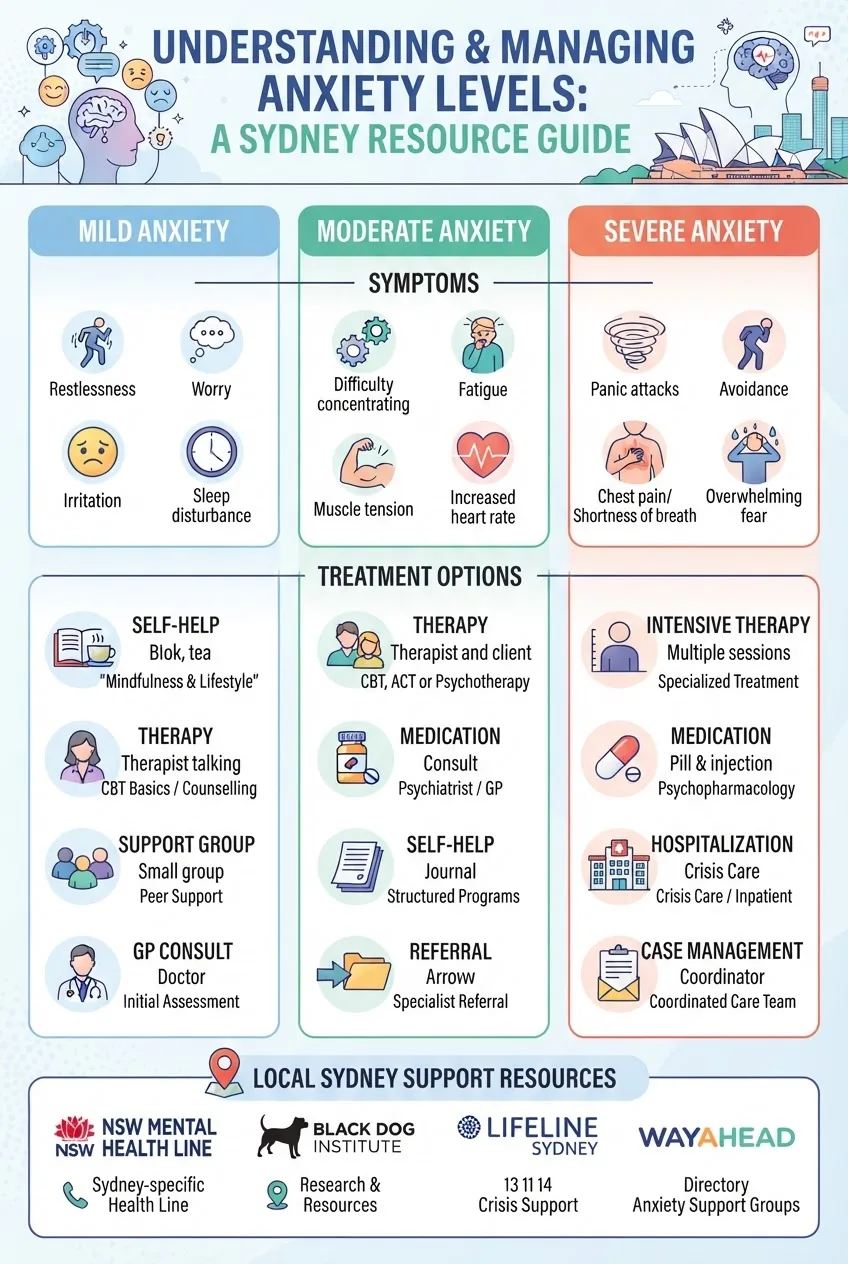
Treatment trade-offs depend on severity, comorbidities and patient preference. Below is a concise comparison of common options and when they’re typically used.
| Level | Typical first-line options | When to escalate |
|---|---|---|
| Mild | Psychoeducation, guided self-help, low-intensity CBT, lifestyle changes | Symptoms persist >4–8 weeks or functional decline |
| Moderate | Structured CBT, exposure therapy, short-term SSRI or SNRI when indicated, combined therapy | Frequent panic, growing avoidance, or comorbid depression |
| Severe | Specialist psychiatric input, longer-term pharmacotherapy, intensive psychological therapy, possible day-programs | Marked impairment, suicidal risk, failure of earlier steps |
Detailed options and evidence:
- Low-intensity interventions: Guided self-help, digital CBT programs, and short psychoeducation sessions are effective for many mild cases.
- High-intensity psychological therapy: Individual CBT, exposure-based therapies, acceptance and commitment therapy (ACT) for moderate-to-severe cases; for social anxiety, see cognitive behavioural therapy for social phobia and social anxiety treatment options.
- Pharmacotherapy: Selective serotonin reuptake inhibitors (SSRIs) and serotonin-norepinephrine reuptake inhibitors (SNRIs) are commonly used; benzodiazepines are generally reserved for short-term or severe distress. See medication treatment for anxiety for pharmacological options.
- Specialised techniques: Systematic desensitisation, exposure and response prevention (ERP), and adjunctive interventions—see systematic desensitisation therapy.
- Combined care: Therapy plus medication often yields faster symptom reduction for moderate-to-severe anxiety.
When discussing treatment choices, consider evidence: meta-analyses support CBT and SSRIs as first-line treatments for many anxiety disorders (clinical review consensus). Australian clinicians align choices with national guidance and patient preference.
If you need targeted help for extreme cases, see treatment for crippling anxiety.
Managing Mild Anxiety: When and How to Seek Help?
Answer: Seek help for mild anxiety when symptoms persist beyond several weeks, increase in frequency or begin to disrupt work, sleep, relationships or safety; early intervention with low-intensity therapy and lifestyle changes prevents escalation.
Steps to manage mild anxiety at home and when to consult a professional:
- Self-monitor: Keep a symptom diary for 2–4 weeks noting triggers, severity (use GAD-7), sleep and functional impact.
- Lifestyle changes: Improve sleep hygiene, regular exercise, reduce caffeine and alcohol, and practice relaxation or mindfulness.
- Guided self-help: Use evidence-based digital CBT or workbooks and consider a few sessions with a psychologist to personalise strategies.
- Early professional consultation: Book a GP visit if symptoms persist or you notice increased avoidance, panic, or functional decline—GPs in Australia can provide a Mental Health Treatment Plan to access subsidised psychology sessions.
- Preventive therapy: Short courses of CBT or acceptance strategies can consolidate coping and reduce relapse risk.
Hypothetical patient example (experience signal): Maria, a 32-year-old teacher in Sydney, had low-level worry about classroom performance for three months. After tracking symptoms and completing a GAD-7 (score 8—moderate), she attended four CBT sessions and adopted sleep and exercise changes. Within eight weeks her anxiety reduced to mild levels and work attendance improved.
If self-help doesn’t reduce symptoms after 6–8 weeks, or the GAD-7 indicates moderate-to-severe symptoms, consult a psychologist or psychiatrist for a stepped-up plan.
Treatment for Moderate to Severe Anxiety?
Answer: Moderate-to-severe anxiety typically requires structured psychotherapy (CBT, exposure, ERP), often combined with pharmacotherapy (SSRIs, SNRIs), specialist psychiatric review and coordinated care; hospitalisation is rare but used for acute risk.
Moderate to severe cases frequently need:
- Regular individual CBT (12–20 sessions or more) focusing on exposure and cognitive restructuring
- Consideration of SSRI or SNRI medication when symptoms are persistent or impairing, with psychiatric review for dose and monitoring
- Frequent monitoring for side effects, suicidality and comorbid conditions
- Referral to specialist services—public or private clinics, multi-disciplinary teams, or specialised day programmes
For extended support resources and intensive interventions, see treatment for crippling anxiety.
Medication considerations: SSRIs and SNRIs show good evidence for long-term benefit; benzodiazepines have risks of dependence and are limited to short use. For medication overviews and disorder-specific choices, see medication treatment for anxiety.
How can I seek professional support in Sydney: pathways and resources?
Answer: Sydney residents can access care via GP referrals (Mental Health Treatment Plans), private psychologists/psychiatrists, community mental health services, university clinics and local support groups; choose based on severity, cost and urgency.
Practical steps to access care in Sydney:
- Start with your GP: Book an appointment for assessment, risk screening and a Mental Health Treatment Plan if eligible for rebates for psychology sessions.
- Private psychologists: Search the Australian Psychological Society directory for clinicians offering CBT, exposure therapy or specialised social anxiety care.
- Psychiatric referral: For moderate-to-severe symptoms, medication needs, or diagnostic complexity, ask your GP for a psychiatric referral.
- Community mental health services: Local health districts provide clinics for people with higher needs or lower cost options; contact NSW Health for service maps.
- University or training clinics: Offer low-cost therapy delivered by trainees under supervision.
- Support groups and community organisations: Peer-led groups and NGOs provide ongoing support—see local listings below.
- Crisis support: For immediate risk call Lifeline (13 11 14) or emergency services if at risk of harm.
Local resources and links (Sydney-specific):
- Private psychology clinics across Sydney offering CBT and exposure therapies; search the Australian Psychological Society directory.
- Public mental health services via NSW Health local health districts for specialised care.
- University clinics providing reduced-fee therapy in central Sydney locations (check local university psychology departments).
- anxiety support groups and peer networks within community health centres.
Referral example for a Sydney resident: A GP at a local clinic completes a Mental Health Treatment Plan and refers a patient to a psychologist specialising in exposure therapy; if medication is needed, the GP may commence an SSRI or refer to a psychiatrist for complex cases.
Patient support resources (national and professional):
- Australian Government Department of Health mental health resources
- Australian Psychological Society clinical resources
- DSM-5 diagnostic standards (American Psychiatric Association)
If you prefer community connection, search local listings for groups and workshops or contact local health centres for waitlist information. For practical self-monitoring, keep using tools such as the GAD-7 to track progress and share results with your clinician.
How should I monitor anxiety symptoms over time?
Answer: Use validated scales like the GAD-7 weekly or fortnightly, maintain a symptom and trigger diary, and review functional measures (work, sleep, relationships) with your clinician to guide stepped care decisions.
Walkthrough: using the GAD-7 for self-assessment (experience signal)
- Complete the seven items rating symptom frequency over the past two weeks (0=not at all; 3=nearly every day).
- Calculate the total (0–21). Interpret scores: 0–4 minimal, 5–9 mild, 10–14 moderate, 15–21 severe.
- Record the score weekly and note triggers, sleep hours and work/social impact.
- Share results with your GP or psychologist to decide if treatment intensity should change.
Symptom diaries should include date, context, symptom intensity (0–10), coping strategies used, and impact on activity. Regular monitoring allows early intervention and objective tracking of treatment response.
Differential diagnosis is critical: clinicians distinguish anxiety from depression, bipolar disorder, ADHD, PTSD, medical conditions (e.g., hyperthyroidism) and substance effects by using history, collateral information and targeted tests.
For more on diagnostic nuance and DSM specificities, see DSM criteria for anxiety disorders and social phobia DSM-5 criteria.
Conclusion and next steps
Answer: Recognise anxiety on a spectrum—mild symptoms respond well to early, low-intensity care; moderate-to-severe anxiety needs structured therapy and possible medication; contact local Sydney clinicians or your GP for assessment and a personalised treatment plan.
Key takeaways:
- Mild anxiety is common and manageable but merits monitoring to prevent progression.
- Diagnosis combines clinical interview, standardised scales (GAD-7), medical review and application of diagnostic criteria.
- Treatment is stepped and evidence-based: CBT and SSRIs are core interventions depending on severity.
- Sydney residents can access care via GP Mental Health Treatment Plans, private specialists or community services; peer support complements clinical care.
If you are in Sydney and concerned about your anxiety, book a GP appointment to discuss assessment and referral options; early steps often lead to faster recovery. For specialist social anxiety pathways and targeted interventions, consider social anxiety treatment options.
Important information:
This article is general information only and is not medical advice. It was written from publicly available sources by a non-clinician, and this website is not a clinic. Please speak with your GP or another qualified health professional about your own situation. If you need urgent help, call 000, or contact Lifeline on 13 11 14 or Beyond Blue on 1300 22 4636.