

A group for anxiety is a community-based or clinician-facilitated meeting where people with anxiety or depression share experiences, learn coping strategies and receive emotional support; groups complement clinical care by offering peer connection, psychoeducation and practical exposure opportunities in a lower-cost, community setting.
What Are Anxiety Support Groups?
Answer: Anxiety support groups are organised meetings — peer-led or professionally facilitated — where people with anxiety-related concerns exchange support, learn evidence-based coping strategies and practise social exposures in a safe setting.
Term: Peer support is mutual emotional and practical assistance between people with lived experience; facilitator is the person who guides sessions, either a trained clinician or a trained peer.
Anxiety support groups range from informal peer circles to structured group therapy. Some focus on a specific diagnosis (e.g., social anxiety), while others are mixed anxiety–depression groups or skills-based courses. Groups emphasise shared experiences, normalising symptoms, and building coping strategies such as breathing exercises, behavioural activation and graded exposure.
Groups differ in role and structure:
- Peer support groups: run by volunteers or people with lived experience; emphasise shared story-telling, mutual aid and community connection.
- Professionally facilitated groups: led by psychologists, counsellors or social workers using clinical frameworks and structured activities.
- Skills-training groups: teach specific techniques (e.g., relaxation, problem-solving, CBT-informed skills).
- Drop-in community groups: low-barrier, often hosted by community centres or non-profits.
Members often report reduced isolation, improved coping and greater help-seeking behaviour; these outcomes are supported by community mental health literature and group-therapy meta-analyses that show small-to-moderate benefits for anxiety symptoms when groups follow evidence-informed formats.
For readers wanting clinical definitions or diagnostic context, see anxiety disorders DSM criteria and generalised anxiety disorder symptoms and treatment. If you’re new to the term, review the meaning of anxiety.

Types of Anxiety and Depression Support Groups Available?
Answer: You can choose from in-person peer groups, clinician-led group therapy, disorder-specific groups, co-morbidity groups (anxiety + depression), online support communities, and skills-based workshops — each with different structure, duration and eligibility.
Below is a numbered list of common group types and brief descriptions to help you compare options.
- Community peer support groups — Informal meetings hosted by community centres or non-profits; free or low-cost; emphasise mutual sharing and practical tips. Often open to anyone seeking connection.
- Clinician-led group therapy — Structured sessions run by a registered psychologist or clinician; use evidence-based frameworks (CBT, ACT); usually require referral or payment.
- Disorder-specific groups — Focus on social anxiety, panic disorder, agoraphobia or OCD; allow targeted skill-building and exposure practice in a tailored cohort.
- Mixed anxiety and depression groups — Address overlapping symptoms and coping strategies for mood and anxiety together; helpful where co-occurrence exists.
- Online anxiety support groups — Moderated forums, video groups, or scheduled Zoom sessions offering accessibility and anonymity; range from volunteer-moderated to clinician-led tele-groups.
- Skills-based workshops — Short, time-limited courses teaching relaxation, sleep hygiene, stress management, or exposure hierarchies; often offered by clinics and libraries.
- Youth and adolescent groups — Age-specific groups often run through schools, headspace centres or youth mental health services; include family-engagement sessions.
- Family and caregiver support groups — For relatives of people with anxiety or depression; focus on communication, safety planning and boundary-setting.
- Telephone or text-based peer support — Services like Lifeline or Beyond Blue text/chat functions provide immediate peer or volunteer support and referrals.
- Hybrid groups — Offer in-person meetings with concurrent online participation; useful for participants with mobility, scheduling or geographic limitations.
For an overview of how anxiety presents across different conditions and to choose disorder-appropriate groups, read anxiety different types guide.
Benefits and Limitations of Joining a Group for Anxiety?
Answer: Groups offer peer connection, cost-effective support, normalisation and opportunities for practice; limitations include confidentiality risks, variable facilitator skill, and insufficient intensity for severe or complex cases.
Term: Group facilitation is the set of skills and structure a leader brings to manage safety, confidentiality, and therapeutic goals in a group setting.
Benefits:
- Emotional relief and validation: Hearing others’ stories reduces isolation and shame.
- Shared experiences: Peer feedback offers practical, lived strategies for daily coping.
- Skill acquisition: Groups commonly teach anxiety coping techniques such as grounding, breathing and graded exposure.
- Stigma reduction: Regular group participation can normalise help-seeking and shift public perceptions.
- Cost and accessibility: Community groups and online options lower financial and geographic barriers.
- Motivation and accountability: Group norms support homework and gradual behaviour change.
Limitations and cautions:
- Confidentiality concerns: Peer groups may not have legal confidentiality protections; sensitive disclosures carry risk.
- Variable quality: Outcomes depend on facilitator training and group structure.
- Not a substitute for intensive care: Severe depression, active suicidal ideation or psychosis require immediate clinical treatment.
- Triggers and vicarious distress: Hearing others’ descriptions can increase anxiety for some members if not well-managed.
Severity matters when choosing a group — consult clinical guidance on symptom levels. For discussion of physical symptom overlap and severity impacts, see anxiety manifesting physically, review levels of anxiety symptoms, and consider common somatic presentations in stomach and anxiety disorder symptoms.
Safety note: Support groups are valuable but not replacements for medical assessment. If you experience thoughts of harming yourself or others, contact emergency services immediately or use the crisis resources listed below.
How to Find and Join Anxiety Support Groups Near Me in Sydney?
Answer: Search local directories, contact community mental health clinics, reach out to national services (Beyond Blue, Lifeline), use social prescribing via GPs, and check university and council community programs; prepare by checking eligibility, session format and facilitator credentials.
Term: Eligibility criteria are the rules a group sets about who may join (age, diagnosis, referral requirement, payment).
Step-by-step guide to finding and joining groups in Sydney:
- Define what you need: Decide if you want peer-led connection, clinician-led therapy, disorder-specific support or online anonymity.
- Use local search terms: Search phrases like “anxiety support groups near me” or “mental health support group near me” paired with “Sydney”, “NSW” or your suburb.
- Check trusted directories and hubs: Many Sydney community health centres list groups; use your local council website and community centres for schedules.
- Contact public and private clinics: Local mental health clinics and hospital outpatient services often run group programs; call to ask about upcoming cohorts and waitlists.
- Talk to your GP: A GP can refer you to community or clinic-run groups and may provide social prescribing or a Mental Health Treatment Plan that supports access.
- National services and NGOs: Beyond Blue and Lifeline list peer and clinician-led group options and can guide you to state resources.
- University and workplace programs: University counselling services and employer EAPs sometimes run targeted groups or can fund referrals.
- Assess logistics: Confirm meeting times, location or digital platform, cost, confidentiality rules and the facilitator’s qualifications.
- Attend an intro session: Many groups offer a first meeting or phone call to assess fit; ask about ground rules and safety planning.
- Prepare documentation: Some clinician-led groups require a referral or brief assessment—bring any relevant letters from your GP or mental health team.
Local contact examples (Sydney-focused):
- Sydney Local Health District Community Mental Health Teams — contact for community group programs and referrals through local hospitals.
- Headspace centres — youth-focused group programs for 12–25 year olds (multiple Sydney locations).
- Black Dog Institute — research and community outreach with workshops and online resources in NSW.
- Community centres and libraries — many run low-cost stress management and peer-support groups; check your local council events page.
Online search and directory resources:
- Australian Government Department of Health — national mental health guidance and links to state services.
- Beyond Blue — national support and online forums with local service directories (2023 reports on community help-seeking noted increased peer-service use).
- Australian Psychological Society (APS) — guidance on standards for clinician-led groups and how to verify practitioner registration.

Practical tips for first contact:
- Ask about facilitator credentials and supervision.
- Confirm confidentiality rules and mandatory reporting obligations.
- Ask whether the group has safety or crisis protocols and how they handle disclosures of self-harm.
- Request a brief intake call to see if the group’s tone and pace suit you.
What to Expect in Your First Anxiety or Depression Support Group Session?
Answer: Expect an initial welcome, introductions, explanation of group rules and confidentiality, a short check-in or icebreaker, and facilitator-led orientation to the group’s purpose and schedule.
- Welcome and housekeeping: Facilitator outlines session length, breaks, and confidentiality limits.
- Introductions: Brief round where participants state their name and why they’ve come; sharing is optional.
- Ground rules: Respect, listening, non-judgement, no cross-talk, and privacy norms are reviewed.
- Safety and limits: Facilitator explains mandatory reporting, crisis steps and whether session is recorded or monitored.
- Icebreaker or check-in: Short activity to orient members, often a one-sentence mood or brief scaling question.
- Structured activity or topic: The group may run a short psychoeducation segment, skills practice or discussion prompt.
- Closing and follow-up: Summary, suggested between-session practice, and details of next meeting or referral options.
- Opportunity to ask questions: New members can ask the facilitator about fit, workload and additional resources.
If you feel anxious during the first session, consider arriving early to speak with the facilitator, sitting near an exit, or arranging a check-in call afterward. Facilitators should provide a safe way to step out without drawing attention.
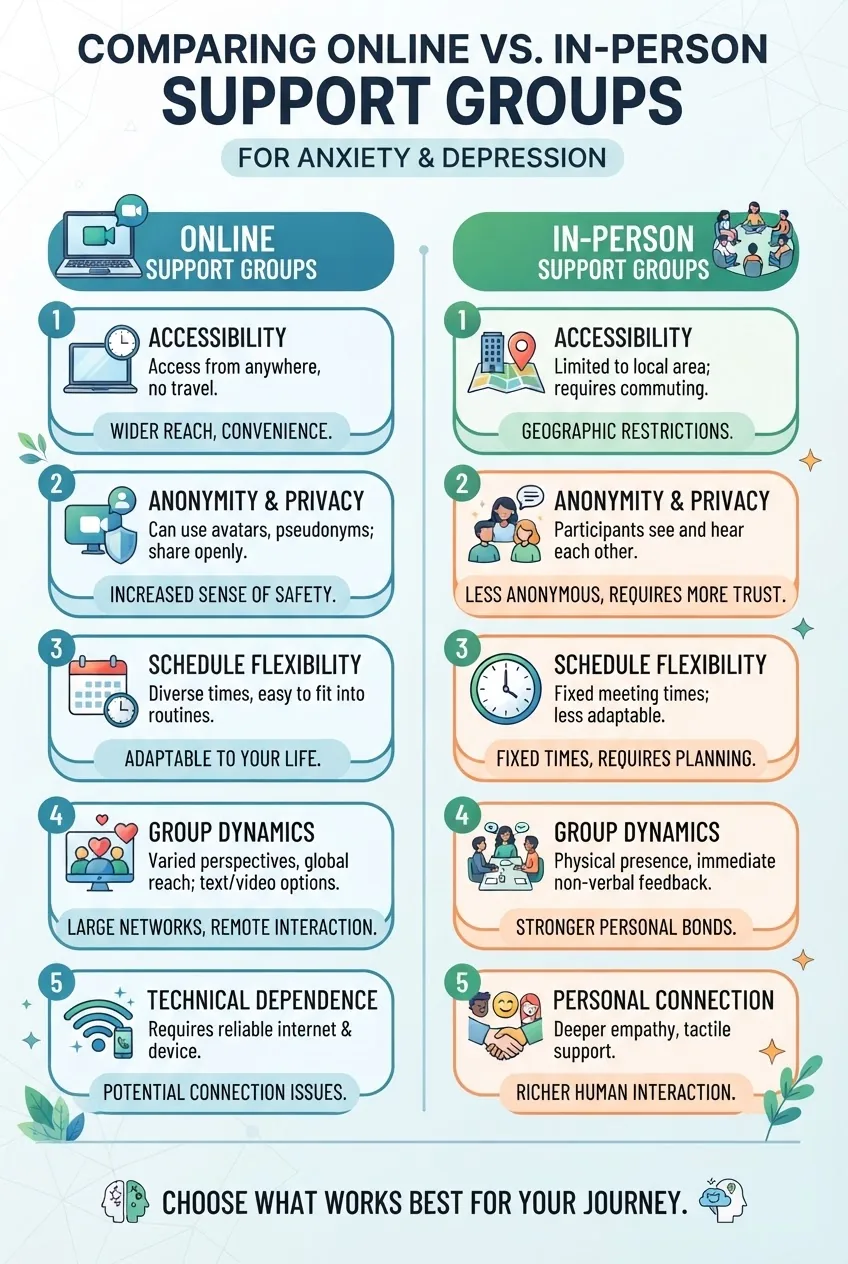
Online vs. In-Person Anxiety and Depression Support Groups: Pros and Cons?
Answer: Online groups provide accessibility and anonymity but may lack non-verbal cues and immediate crisis support; in-person groups offer richer interpersonal connection and hands-on exposure practice but require travel and may feel intimidating.
| Feature | Online Groups | In-Person Groups |
|---|---|---|
| Accessibility | High — join from anywhere, helpful for rural NSW or mobility limits. | Moderate — requires travel, local availability may vary. |
| Anonymity | Strong — can use usernames or cameras off. | Limited — face-to-face identity is visible. |
| Personal connection | Variable — depends on platform and facilitation. | Stronger — non-verbal cues and shared space foster cohesion. |
| Crisis handling | Challenging — facilitators need clear protocols for remote crises. | Easier — local facilitators can connect to emergency services directly. |
| Schedule flexibility | High — recordings and asynchronous forums possible. | Lower — fixed meeting times and in-person attendance needed. |
| Cost | Often lower or free; some private tele-groups charge fees. | Varies; community groups often free, clinician groups cost more. |
Choose based on needs: if social exposure practice is a goal, in-person groups can provide graded, real-life practice; if mobility or stigma is a barrier, online groups reduce friction. Hybrid options can combine the strengths of both.
Complementary Mental Health Resources and Crisis Support in Sydney?
Answer: Complementary resources include GPs, psychologists, community mental health clinics, crisis hotlines (Lifeline 13 11 14), Beyond Blue and state mental health lines; use these alongside groups for safety and stepped care pathways.
Key Sydney and national resources:
- General practitioners (GPs): First point for assessment, referrals and Mental Health Treatment Plans that subsidise psychological sessions.
- crippling anxiety treatment and support — specialised pathways and crisis planning for severe anxiety.
- Lifeline Australia: 13 11 14 — 24/7 crisis support and suicide prevention.
- Beyond Blue: Beyond Blue — online chat, forums and local referral information; According to the 2023 Beyond Blue report, peer-support uptake increased among young adults.
- NSW Health Mental Health Line: 1800 011 511 — statewide mental health triage and referrals (hours vary by service).
- Headspace (youth): Centres across Sydney offering online and face-to-face group programs for 12–25 year olds.
- Australian Psychological Society (APS): APS — use their “Find a Psychologist” search to locate clinicians running group therapy.
- Black Dog Institute: Evidence-based resources and digital programs related to mood and anxiety.
Research and guidance sources you can rely on:
- Australian Government Department of Health — provides national guidelines on service pathways and mental health funding models.
- Peer-reviewed reviews indicate group-based CBT and skills-training have measurable benefits for anxiety when delivered with fidelity and trained facilitation.
Case example (anonymised):
“A 28‑year‑old Sydney resident joined a clinician-led social anxiety group after GP referral; within 12 weeks they reported reduced avoidance and higher workplace participation. The group’s graded exposure tasks and peer feedback were cited as primary accelerants of change.”
If someone is in immediate danger, call 000. For non-urgent crises, Lifeline (13 11 14) or the NSW Mental Health Line (1800 011 511) can triage needs and connect you to local teams.
Tips for Maximizing the Benefits of Your Group for Anxiety?
Answer: Be consistent, set clear personal goals, actively participate, practise between sessions, and coordinate group work with your GP or therapist to ensure joined-up care.
- Attend regularly: Consistency builds trust and progress; aim for committed participation over time.
- Set measurable goals: Small, specific goals (e.g., “speak in a group once per meeting”) help track progress.
- Do the homework: Complete between-session exposure or CBT tasks to reinforce skills.
- Be honest and specific: Share concrete examples of what you want to change and what has helped.
- Coordinate care: Tell your GP or clinician about group activities so they can integrate care plans.
- Practice self-care: Use grounding, sleep hygiene and routine to stabilise symptoms outside sessions.
- Seek supervision or escalation if needed: If group tasks increase distress, discuss modifications with the facilitator.
When to Consider Professional Therapy Alongside Support Groups?
Answer: Seek professional therapy when symptoms are severe, persistent, impairing daily function, include suicidal ideation, or require specialist interventions (CBT, exposure therapy, medication assessment).
Groups are valuable for peer support and skill practice, but some presentations need individualised clinical care:
- Persistent avoidance that disrupts work, relationships or self-care.
- Severe panic attacks, frequent suicidal ideation, or co-occurring substance use.
- Complex trauma, psychosis, or conditions requiring medication management.
When discussing clinical options for social anxiety, consider combined pathways: see the pillar resource Social Phobia Therapist and Social Anxiety Treatment Options for how to pair groups with therapy. For therapy modalities and referral guidance, see cognitive behavioural therapy for social phobia and review diagnostic considerations in social phobia disorder DSM-5 criteria.
Medication can be indicated for certain disorders or symptom severity; when discussing pharmacology and combined care, consult resources such as drugs for agoraphobia and medication treatment. Alternative or adjunctive therapies like systematic desensitisation therapy may be recommended depending on assessment.
Work with a GP or psychiatrist to create a stepped-care plan: low-intensity group interventions, structured individual therapy (CBT), and medication where clinically indicated. This combined approach aligns with Australian best-practice stepped care models and APS guidance.
Resources for Families and Caregivers of People with Anxiety?
Answer: Families can access education groups, caregiver-focused peer support, practical communication strategies and crisis-planning resources to better support a loved one with anxiety.
Practical supports for families and caregivers:
- Attend family education sessions or caregiver groups to learn about symptoms and safety planning.
- Use reflective listening and avoid minimising feelings; validate and ask how you can help.
- Set boundaries and self-care practices to prevent burnout.
- Encourage coordinated care: assist with GP appointments, referral follow-ups and medication adherence when appropriate.
- Know crisis contacts (Lifeline 13 11 14; NSW Mental Health Line 1800 011 511) and when to seek emergency help.