

Generalised anxiety disorder (GAD) is a chronic anxiety condition characterised by excessive, persistent worry and physical symptoms such as restlessness, tension and sleep disturbance; effective management combines diagnosis using DSM-5 criteria, evidence-based psychotherapy (especially CBT), and medication when indicated to improve daily functioning.
Understanding Generalised Anxiety Disorder (GAD)
Answer: Generalised anxiety disorder is a long-term clinical condition defined by persistent, excessive worry about multiple life domains that is difficult to control and causes significant distress or impairment.
Term: Generalised anxiety disorder (GAD) — a mental health diagnosis for pervasive, excessive worry occurring more days than not for at least six months and accompanied by physical or cognitive symptoms.
GAD anxiety definition: imagine a smoke alarm that keeps sounding for weeks because it detects any small hint of heat — that persistent alert state maps to the hypervigilance and chronic worry in GAD. Pathophysiology of anxiety involves dysregulated threat processing across brain circuits (amygdala, prefrontal cortex), neurotransmitter imbalances, and stress-response systems that maintain the worried state.
GAD differs from short-lived stress or situational worry because it is generalized (multiple domains), persistent (months), and clinically impairing. If you suspect GAD, a structured diagnostic assessment by a clinician is required rather than self-diagnosis.
For readers wanting context on how GAD compares to other presentations, see different types of anxiety disorders and for basic terminology, see how to spell anxiety.

Generalised Anxiety Disorder DSM-5 Diagnostic Criteria
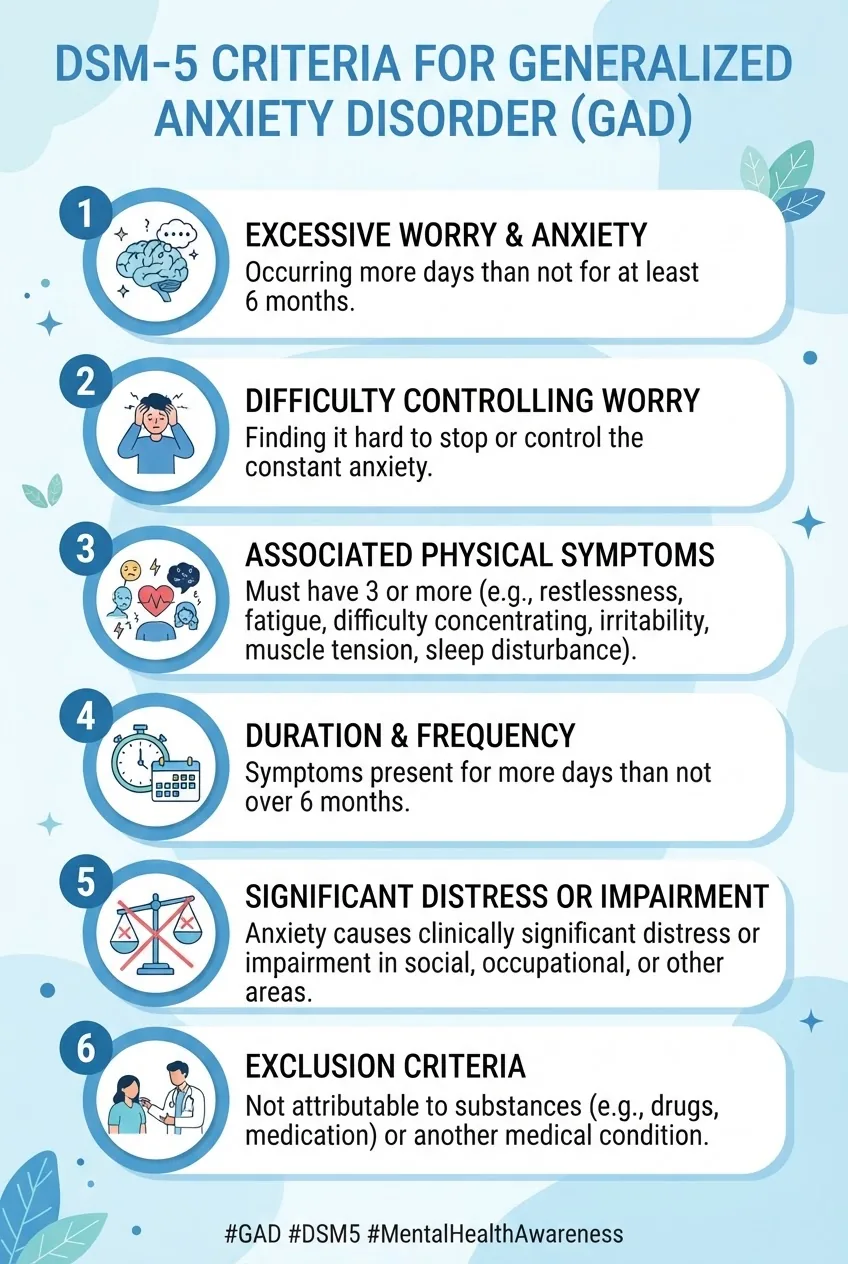
Answer: GAD is diagnosed using DSM-5 criteria requiring excessive worry more days than not for at least six months, difficulty controlling worry, multiple associated symptoms, distress or impairment, and exclusion of other causes.
Term: DSM-5 — the fifth edition of the Diagnostic and Statistical Manual of Mental Disorders published by the American Psychiatric Association, used for psychiatric diagnosis.
- Excessive anxiety and worry occurring more days than not for at least six months about a number of events or activities (work, health, family). Rationale: chronicity distinguishes GAD from transient anxiety.
- Difficulty controlling the worry — the person finds it hard to stop or manage worry. Rationale: inability to suppress worry differentiates pathological anxiety from situational concern.
- Associated symptoms — at least three (or one in children) of: restlessness, fatigue, difficulty concentrating, irritability, muscle tension, sleep disturbance. Rationale: physical and cognitive signs indicate systemic anxiety activation.
- Clinically significant distress or impairment in social, occupational, or other important areas of functioning. Rationale: diagnosis requires functional impact, not just internal discomfort.
- Not attributable to substance or medical condition — symptoms are not better explained by medication, drug use, or a medical disorder (e.g., hyperthyroidism). Rationale: exclude physiologic causes.
- Not better explained by another mental disorder — worry is not limited to symptoms of another disorder (e.g., panic disorder, social phobia, obsessive-compulsive disorder). Rationale: differential diagnosis ensures appropriate treatment pathway.
For broader DSM context, see DSM criteria for anxiety disorders, and to compare GAD criteria with social phobia criteria see DSM 5 criteria for social phobia.
Recognizing Generalised Anxiety Disorder Symptoms
Answer: GAD symptoms include persistent excessive worry plus psychological signs (rumination, concentration problems) and physical symptoms (tension, sleep problems, GI upset), occurring across contexts and causing functional impairment.
Term: GAD anxiety symptoms — the cluster of cognitive, emotional and somatic features commonly present in generalised anxiety disorder.
Recognising GAD requires assessing both psychological experience and physical manifestations; many patients first report unexplained somatic complaints. For additional detail on bodily symptoms, consult gastrointestinal symptoms of anxiety.
- Core psychological symptoms:
- Excessive, uncontrollable worry about multiple areas
- Persistent rumination and “what if” thinking
- Difficulty concentrating or mind going blank
- Irritability and intolerance of uncertainty
- Perceived inability to cope or decision paralysis
- Common physical symptoms:
- Muscle tension, aches
- Restlessness or feeling keyed up
- Sleep disturbance (difficulty falling or staying asleep)
- Fatigue or low energy
- Autonomic signs: sweating, palpitations, light-headedness
- Gastrointestinal upset: nausea, diarrhoea, IBS-like symptoms
- Cognitive-behavioural features:
- Safety behaviours (excessive planning, reassurance-seeking)
- Avoidance of uncertainty or challenge
- Overestimation of threat and underestimation of coping
Symptoms vary in severity; see levels of anxiety symptoms for how clinicians grade impact and diagnostic nuance, and more on physical manifestations in physical symptoms of anxiety.
Clinical assessment focuses on symptom frequency, intensity, and functional interference; many people present to primary care with somatic complaints before anxiety is identified. If symptoms suggest risk (suicidal thinking, severe functional decline), urgent clinical review is required.
Causes and Risk Factors for Generalised Anxiety Disorder
Answer: GAD arises from interaction of genetic vulnerability, early and recent environmental stressors, and neurobiological differences in stress and threat-processing systems.
Term: Risk factors — characteristics or exposures that increase the probability of developing GAD, such as family history, trauma, or chronic stress.
Genetic predisposition: family and twin studies show moderate heritability for anxiety phenotypes; genetic risk interacts with life events. Environmental triggers include childhood adversity (abuse, neglect), ongoing stress (financial, caregiving), and major life transitions.
Neurobiology of GAD: altered function in the amygdala (heightened threat detection), prefrontal cortex (reduced regulatory control), hippocampus (context processing), and dysregulated neurotransmitters such as GABA, serotonin, and noradrenaline underpin increased worry and physiological hyperarousal.
Psychological mechanisms: intolerance of uncertainty, negative problem orientation, and metacognitive beliefs (beliefs about worry) maintain anxious thinking. Learning history (avoidance reinforcement) strengthens worry habits over time.
Examples:
- Genetic + stress: a person with family history of anxiety who experiences job loss may develop persistent worry.
- Neurobiological vulnerability: heightened physiological reactivity after repeated stress increases baseline worry.
Evidence-Based Treatments for Generalised Anxiety Disorder
Answer: The best evidence supports cognitive behavioural therapy (CBT) as first-line psychotherapy, with SSRIs/SNRIs as first-line pharmacotherapy; combined therapy is often more effective for moderate-to-severe GAD.
Term: Evidence-based treatments — therapies supported by clinical trials and meta-analyses demonstrating benefit beyond placebo or usual care.
Treatment selection depends on severity, comorbidity, patient preference, access, and prior response. Australian clinical guidance (see beyondblue link below) recommends psychological therapy as first line for mild-to-moderate GAD and combined treatment for more severe cases.

| Option | Pros | Cons |
|---|---|---|
| Cognitive Behavioural Therapy (CBT) | Strong evidence, skills for relapse prevention, durable benefit | Requires weekly sessions and active practice; access may be limited |
| Acceptance and Commitment Therapy (ACT) | Good evidence for acceptance-based coping, flexible approach | Less standardized protocols; variable therapist training |
| Medication (SSRIs/SNRIs) | Effective for reducing core anxiety and somatic symptoms; rapid access | Side effects, need for adherence, withdrawal risk, variable response |
| Benzodiazepines (short-term) | Rapid symptom relief | Dependence risk; not recommended long-term |
| Combined therapy (CBT + medication) | Higher response rates for moderate-severe cases | More complex management; coordination required |
Clinical evidence: randomized controlled trials and meta-analyses show CBT reduces worry and functional impairment; meta-analyses of SSRIs/SNRIs show moderate-to-large reductions in symptoms compared with placebo (peer-reviewed meta-analysis).
Australian guidance: See resources from beyondblue and national health services for local treatment pathways and access to subsidised therapy options in Sydney and nationally (beyondblue).
Treatment outcomes and timelines: brief CBT protocols (8–12 sessions) often show meaningful symptom reduction within 8–12 weeks; medication typically requires 4–12 weeks to reach full effect. Longer-term maintenance or booster sessions reduce relapse risk.
Cognitive Behavioural Therapy and Other Psychotherapies for GAD
Answer: CBT is a structured, time-limited therapy teaching cognitive restructuring and behavioural experiments to reduce worry; other effective psychotherapies include ACT, problem-solving therapy, and targeted exposure techniques.
Term: CBT — cognitive behavioural therapy, a practical, evidence-based psychotherapy focusing on thoughts, behaviours, and exposure to feared situations or sensations.
CBT for GAD targets core maintaining factors: intolerance of uncertainty, negative problem orientation, and excessive worry as a maladaptive coping strategy. Typical elements include psychoeducation, cognitive restructuring, worry time, behavioural experiments, and exposure to avoided uncertainty.
Step-by-step overview of a single CBT session for GAD (walkthrough):
- Check-in (5 mins): review mood, sleep, and homework; set collaborative agenda.
- Focus on a recent worry episode (10 mins): identify triggers, thoughts, and behaviours.
- Introduce or practice a skill (15 mins): e.g., cognitive reappraisal or worry scheduling.
- Behavioural experiment planning (10 mins): design a test of a catastrophic prediction.
- Homework and summary (10 mins): assign practice tasks, relaxation exercises, and next steps.
Anonymised patient case example:
Case A: “M.” (female, 34) presented with 2+ years of daily worry about work and finances, insomnia, and muscle tension. After 12 CBT sessions practising worry time, cognitive restructuring, and behavioural experiments, M. reported 60% reduction in daily worry and improved work functioning; medication (an SSRI) was added at week 6 due to persistent sleep problems and provided supplementary benefit.
Certain CBT techniques overlap with social anxiety approaches; for therapist options when social anxiety features are prominent see social phobia therapist and social anxiety treatment options and techniques specific to social phobia in CBT for social phobia. Systematic desensitisation is another related method (see systematic desensitisation therapy).
Case selection: CBT is effective across ages and settings; ACT or problem-solving therapy may suit people who prefer acceptance-based or values-driven approaches. Therapist experience and fidelity to protocols predict better outcomes.
Medication Treatment Options and Considerations for GAD
Answer: First-line medications for GAD are selective serotonin reuptake inhibitors (SSRIs) and serotonin–noradrenaline reuptake inhibitors (SNRIs); benzodiazepines are reserved for short-term relief due to dependence risk.
Term: SSRI — selective serotonin reuptake inhibitor, an antidepressant class that increases synaptic serotonin to reduce anxiety and depressive symptoms.
| Medication class | Typical examples | Pros | Cons |
|---|---|---|---|
| SSRIs | Escitalopram, sertraline | Evidence-based, well-tolerated for many | Sexual side effects, GI upset, 4–8 week onset |
| SNRIs | Venlafaxine, duloxetine | Effective where SSRIs less helpful; target noradrenaline | Hypertension risk (venlafaxine), withdrawal symptoms |
| Benzodiazepines | Temazepam, diazepam (examples) | Rapid anxiolysis | Dependence, sedation, cognitive impairment; not long-term |
| Other agents | Pregabalin, buspirone, antipsychotic adjuncts | Alternative for non-responders | Variable evidence; side-effect profiles differ |
Medication management and timelines: SSRIs/SNRIs commonly require 4–12 weeks to observe full therapeutic effect; dose adjustments and at least 6–12 months of continuation (after response) are typical to reduce relapse risk. Withdrawal syndromes (discontinuation) can occur and require gradual tapering supervised by a prescriber.
Safety considerations: monitor for side effects, interactions, pregnancy planning, and suicidality risk during early treatment. Benzodiazepines are appropriate short-term (days–weeks) but avoid long-term use due to dependence risk. For broader medication context see medication treatment overview for anxiety disorders.
When to combine medication and therapy: consider combined treatment for severe functional impairment or partial response to either approach alone; collaborative care models in primary care can improve access and outcomes.
Managing GAD: Lifestyle, Support, and Relapse Prevention
Answer: Ongoing anxiety management includes structured self-help skills (sleep, exercise, mindfulness), social support, relapse prevention planning, and timely booster therapy when needed.
Term: Relapse prevention — strategies used after initial improvement to maintain gains and reduce the chance of symptom return.
- Skill maintenance — continue CBT techniques: worry time, behavioural experiments, thought records, and exposure to uncertainty.
- Lifestyle — regular exercise, sleep hygiene, balanced diet, reduced caffeine and alcohol can lower baseline arousal.
- Mindfulness and relaxation — daily brief mindfulness practice or progressive muscle relaxation reduces physiological tension.
- Support — peer support and structured groups complement therapy; see anxiety support groups and support resources for crippling anxiety.
- Relapse plan — agree with clinician on warning signs and early steps (e.g., return to therapy sessions, medication review).
- Accessibility in Sydney — many public and private providers offer CBT and psychiatrists in Sydney; Medicare and local health networks may subsidise sessions depending on referral pathways (check local clinic and beyondblue guidance).
If symptoms worsen during treatment, contact your clinician promptly to revisit the plan: increase session frequency, review medication adherence, or adjust medication. For immediate crises, local emergency services should be used.
Conclusion
GAD is a treatable, diagnosable condition: accurate assessment using DSM-5 criteria, evidence-based psychotherapy (CBT) and pharmacotherapy when needed produce meaningful recovery for most people. Start with a clinical assessment, discuss CBT options and medication timelines with a clinician, and combine skills, support and relapse planning to regain control.
If you are in Sydney and suspect GAD, contact a local mental health clinician or your GP for assessment and to discuss therapy access and Medicare-subsidised options; for trusted information and referral pathways see beyondblue and for diagnostic guidance see DSM-5 resources.