
Answer: Spravato clinics in Australia are supervised mental health clinics that deliver esketamine nasal spray (Spravato) under strict regulatory and clinical protocols to treat adults with treatment-resistant depression or acute suicidal ideation; prescribing and administration follow TGA guidance, with monitoring, informed consent and clinic-based dosing essential for safety and eligibility.
Spravato: a brand name for esketamine, an NMDA receptor antagonist used as a rapid-acting antidepressant in clinic settings.
Introduction to Spravato Clinics in Australia
Answer: Spravato clinics Australia are licensed outpatient or hospital-affiliated treatment centres where authorised clinicians administer esketamine nasal spray within a supervised, monitored setting per Therapeutic Goods Administration (TGA) requirements and clinic protocols.
Spravato clinics are specialised treatment centres—often located in private mental health clinics, community hospitals or integrated psychiatric practices—designed to deliver esketamine treatment safely. These clinics combine clinical assessment, supervised dosing, medical observation and follow-up care. Clinics must follow TGA guidance on storage, administration and monitoring.
Spravato is one option among many for depression management; see the broader review of antidepressant options at Top 10 Antidepressants Australia for comparative context.
Typical clinic features include a private consultation room for assessment, an administration room for supervised nasal dosing, a comfortable recovery area for post-dose monitoring (usually ~2 hours), and emergency equipment/staff trained to manage acute adverse events. Clinics also maintain detailed records for prescribing, dosing logs, and patient-reported outcome measures to track symptom response.
What is Esketamine and How Does It Work?
Answer: Esketamine is the S-enantiomer of ketamine that acts as an NMDA receptor antagonist, producing rapid antidepressant effects by modulating glutamate neurotransmission and inducing synaptic plasticity—clinically useful for treatment-resistant depression when used with an oral antidepressant.
NMDA receptor antagonist: a drug that blocks the N-methyl-D-aspartate (NMDA) receptor, affecting glutamate signalling in the brain.
Esketamine (marketed as Spravato) is administered as a nasal spray. Mechanistically, esketamine binds preferentially to NMDA receptors on inhibitory interneurons, reducing their activity and increasing glutamate release. This surge in glutamate stimulates AMPA receptors and downstream signalling pathways (BDNF, mTOR) which enhance synaptogenesis and may rapidly restore neural connectivity in circuits implicated in mood regulation. Describe simply: think of it as a fast-acting reset for certain brain circuits involved in depression.
Clinical evidence shows esketamine can produce symptom reductions within hours to days, unlike many oral antidepressants that require weeks. According to a 2023 systematic review published in a peer-reviewed journal, esketamine demonstrated clinically meaningful response and remission rates in adults with treatment-resistant depression when combined with a standard oral antidepressant (source type: peer-reviewed clinical study).
How esketamine differs from other antidepressant classes:
- Mode of action: Esketamine: NMDA receptor antagonism and glutamate modulation; SSRIs/SNRIs: primarily modulate monoamine neurotransmitters like serotonin and norepinephrine. SSRIs medication class, SNRIs medication class.
- Onset: Rapid (hours–days) vs weeks for most oral antidepressants. commonly used antidepressants like Lexapro, fluoxetine and related antidepressants.
- Setting: Clinic-based supervised dosing vs unsupervised oral dosing at home.
Evidence base and guidelines: The TGA approved esketamine for restricted use; Australian clinical guidelines and specialist consensus recommend Spravato for adults with treatment-resistant depression or where rapid symptom relief is clinically indicated. For in-depth comparisons with tricyclics, SNRIs and specific agents like Effexor XR, see tricyclic antidepressants overview and Effexor XR antidepressant.
Common clinical trial outcomes: randomized controlled trials reported higher short-term response rates versus placebo control when used with standard antidepressants (source type: peer-reviewed clinical trials). Long-term maintenance evidence is evolving; clinicians weigh rapid benefit against monitoring requirements and side effect profile.
Benefits and Considerations of Esketamine Treatment for Depression
Answer: Esketamine offers rapid symptom relief and a treatment option for people who have not responded to multiple oral antidepressants, but requires clinic-based administration, careful screening, and monitoring for dissociation, blood pressure rise and misuse risk.
Benefits (bullet list):
- Rapid onset of antidepressant effect—often within 24–72 hours in responders (source type: peer-reviewed clinical trials).
- Effective in many cases of treatment-resistant depression where two or more oral antidepressants have failed.
- Delivered as a nasal spray—non-invasive compared with IV ketamine infusion.
- Structured clinic pathway ensures safety monitoring, documentation and integration with psychotherapy or other supports.
- May reduce acute suicidal ideation more quickly than traditional agents in some patients (source type: clinical study).
- Administration protocols and dosing schedules are standardized across accredited clinics, helping predict workflow and costs.
Considerations and cautions (bullet list):
- Requires supervised administration and ~2-hour post-dose monitoring for vital signs and mental status.
- Common side effects: transient dissociation, dizziness, nausea, increased blood pressure; usually time-limited.
- Not routinely PBS-subsidised for all indications—cost and insurance coverage vary (see Costs section).
- Potential for misuse or diversion requires strict clinic storage and monitoring procedures.
- Long-term efficacy and safety data are more limited than for established oral antidepressants (source type: 2023 clinical guidelines).
- Needs co-prescription with an oral antidepressant in many clinical studies and practice settings; not a standalone replacement for maintenance therapy unless clinically determined.
Related options and broader treatment context: For patients whose symptoms include sleep disturbances or anxiety, clinicians may consider alternative or adjunctive strategies—see antidepressants for sleep and insomnia and antidepressants for anxiety and depression.
Also consider mood stabilisers or inhibitors when mood fluctuation is present; compare with mood stabilizers and inhibitors.
How Spravato Treatment is Administered in Australia
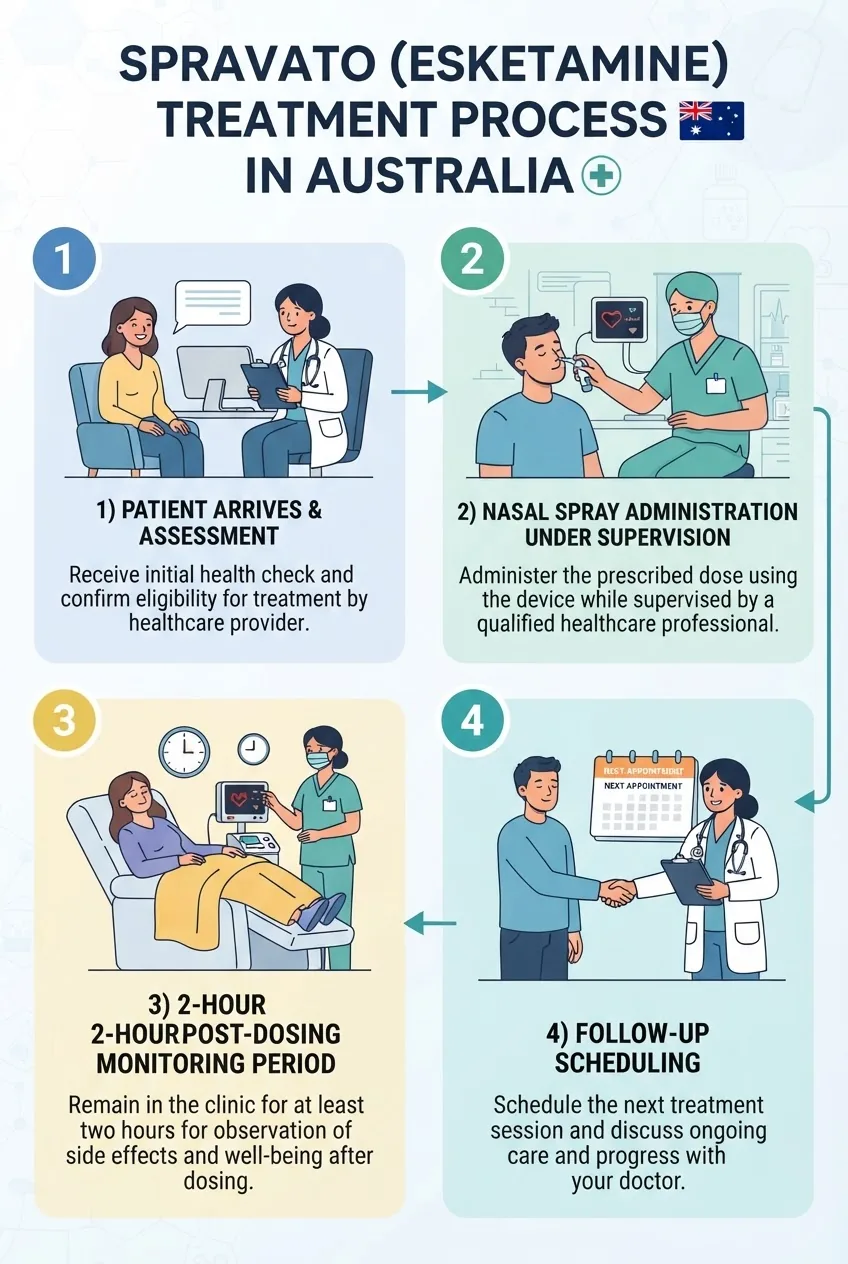
Answer: Spravato is administered as a supervised intranasal spray in clinic, following a multi-step protocol: assessment and consent, baseline vitals, supervised dosing, two-hour monitoring, and scheduled follow-ups; clinics document each step and manage adverse events per protocol.

-
Initial referral and clinical assessment:
Patient is referred by a GP or psychiatrist—or self-refers where clinics accept private patients—to an authorised prescriber for psychiatric assessment including medical history, current medications, substance use screen, cardiovascular assessment and suicide risk. Clinics document prior treatment failures to establish treatment-resistant depression criteria.
-
Informed consent and baseline measurements:
Clinician reviews benefits, risks, alternatives and documents consent. Baseline blood pressure, heart rate and mental state exam are recorded. Any contraindications (recent stroke, uncontrolled hypertension, pregnancy) are screened out.
-
Pre-dose preparation:
Patient rests in a private administration room. Clinic staff review post-dose transport arrangements—patients must not drive or operate machinery for the rest of the day.
-
Supervised nasal spray dosing:
Clinician or trained nurse supervises self-administration of Spravato under direct observation, ensuring correct inhalation technique and dose completion. Dosing is usually titrated and follows a protocol schedule (induction phase then maintenance).
-
Post-dose monitoring (approximately 2 hours):
Patient remains in a recovery area while staff monitor blood pressure and mental state at regular intervals; staff record any dissociation, sedation or cardiovascular changes and are prepared to escalate care if needed.
-
Discharge and follow-up:
Once stable and meeting discharge criteria, clinic schedules next appointment and provides written aftercare instructions. Ongoing symptom tracking and integration with psychotherapy are recommended.
-
Maintenance schedule and documentation:
Typical schedule: twice-weekly dosing in induction (first 2–4 weeks) then weekly or every 1–4 weeks for maintenance, individualized by response and tolerability. Clinics maintain dosing logs and outcome measures for each patient visit.
-
Emergency procedures and escalation:
Clinics maintain emergency protocols for severe hypertension, protracted dissociation or other urgent adverse events, with stabilisation pathways and links to local emergency departments.
Example anonymised clinic vignette: A 42-year-old Sydney patient with major depressive disorder unresponsive to two SSRI trials attended a private Spravato clinic. Following psychiatric assessment and consent, they had supervised dosing twice weekly for four weeks; within seven days they reported noticeable mood improvement and reduced suicidal thinking, with transient dizziness managed in-clinic. This vignette reflects common clinical pathways used in Australian clinics and documentation procedures.
Who Can Prescribe Spravato in Australia?
Answer: In Australia, Spravato must be prescribed by authorised medical practitioners—typically psychiatrists or specialists in mental health—who meet TGA and clinic credentialing requirements; GPs are generally not authorised to prescribe Spravato unless part of a shared-care or specialist-led arrangement.
Prescribing rights and regulatory context:
According to 2023 TGA guidance, Spravato requires clinic-based prescribing and administration under supervision. Prescribers must ensure appropriate patient selection, safety monitoring and record-keeping (source type: Australian Therapeutic Goods Administration guidance).
Who can prescribe (bullet points):
- Authorised psychiatrists and consultant-level mental health specialists with clinic credentialing.
- Some hospital consultants or ED psychiatrists in public or private hospitals under institutional governance.
- In specific shared-care models, a GP may continue prescriptions only under direct supervision and written protocol from the authorised specialist—see GP prescribing rights in Australia.
- Prescribers must follow TGA-specified storage, documentation and monitoring rules and the clinic’s governance processes.
Eligibility to prescribe typically requires professional indemnity, credentialing by the clinic, familiarity with esketamine protocols, and access to emergency response systems. Clinics often maintain a list of authorised prescribers and will only book patients with an authorised prescription.
Finding and Choosing a Spravato Clinic in Australia
Answer: Choose a Spravato clinic by verifying TGA-compliant protocols, authorised prescribers, transparent pricing and aftercare, clinic accreditation, patient reviews and proximity; compare practical factors like appointment availability, telehealth pre-assessments, and links with local psychiatric care.
Practical tips for selecting a clinic:
- Confirm the clinic follows TGA guidance and has authorised psychiatrists on staff.
- Ask for the clinic’s credentialing process, emergency procedures, and typical patient-to-staff ratios during monitoring periods.
- Review patient feedback and outcome reporting where available; seek clinics that share structured outcome measures and safety statistics.
- Check whether the clinic offers telehealth pre-assessments to reduce travel burden for initial screening.
- Compare appointment lead times—some metropolitan clinics have waitlists while regional services may be more limited.
- Confirm transport/home support requirements and whether the clinic can assist with safe discharge planning.
Mini comparison (example table):
| Feature | Private Clinic (Sydney) | Hospital-Affiliated Clinic | Regional Mental Health Service |
|---|---|---|---|
| Authorised Prescriber | Psychiatrist on-site | Consultant psychiatrist | Visiting psychiatrist |
| Wait time | 2–6 weeks | 1–4 weeks | Variable |
| Cost | Private fees per session | Variable; sometimes subsidised | Often lower, limited availability |
| Telehealth pre-assess | Common | Often available | Limited |
Finding clinics: search local directories, psychiatric practice listings and ask referring GPs or psychiatrists. Many clinics list eligibility criteria and booking steps online. Confirm whether the clinic accepts private patients only or works with public systems.
Costs, Insurance and PBS Coverage for Spravato Treatment
Answer: Spravato is largely a private out-of-pocket expense in Australia for most patients; PBS coverage is limited and varies by indication—patients should check Medicare, private health insurance policies and clinic fee schedules to estimate total cost, including consultation and monitoring fees.
Cost components (breakdown):
- Clinic consultation and psychiatric assessment fees (initial and follow-up).
- Per-session Spravato drug cost charged by the clinic or pharmacy.
- Administration and monitoring fees for room time and nursing observation (~2 hours per session).
- Ancillary costs: pathology, transport, aftercare support.
| Item | Typical Private Cost (AUD) |
|---|---|
| Initial psychiatric assessment | $200–$600 |
| Per-dose Spravato + administration | $400–$1200 |
| Monitoring/session (nursing time) | Included or $100–$300 |
Insurance and subsidy notes:
- As of 2024, PBS listings for Spravato are limited to specific indications; check Department of Health and Medicare resources for the latest subsidy status (source type: Australian Department of Health / Medicare guidance).
- Private health insurers may cover part of hospital-based administration when delivered as a private hospital admission, but outpatient clinic coverage varies—confirm with your insurer before treatment.
- Some clinics offer payment plans or package pricing for induction phases; clinics should provide an itemised fee schedule on request.
For comparative costs of ketamine infusion versus Spravato nasal spray, see ketamine infusion costs in Australia.
Safety, Side Effects and Monitoring During Spravato Treatment
Answer: Spravato is generally well-tolerated when used in supervised clinic settings, but common side effects include dissociation, dizziness, nausea and transient blood pressure increases; clinics implement vital-sign monitoring, mental state checks and emergency protocols to manage risks.
Common side effects and frequency (summary):
- Transient dissociation or perceptual changes (commonly reported in clinical trials).
- Dizziness, sedation, nausea and headache—usually resolve within hours.
- Transient elevations in blood pressure—monitored and managed in-clinic.
Serious risks and precautions:
- Severe hypertension—screen baseline and monitor post-dose; treat per clinic protocols if persistent. Clinics maintain escalation pathways to EDs.
- Potential for abuse or dependence—controlled clinic dispensing reduces diversion risk.
- Psychotomimetic effects in susceptible patients—contraindicated or used cautiously in people with psychotic disorders.
Monitoring protocols commonly used in clinics:
- Baseline and post-dose blood pressure recordings at predetermined intervals.
- Standardised mental state ratings and dissociation checklists recorded post-dose.
- Documented discharge criteria: stable vitals, return to baseline mental state and safe transport arrangements.
If patients are concerned about long-term brain effects of antidepressants, clinicians may discuss evidence and trade-offs; see long-term antidepressant effects on brain for related information. For questions about managing weight-related side effects across antidepressants, consult antidepressants without weight gain side effects and managing side effects of antidepressants.
For guidance on withdrawal or stopping antidepressants generally, including symptom management after cessation, see antidepressant withdrawal and benefits.
Patient Eligibility and Suitability for Esketamine Treatment
Answer: Eligibility typically requires confirmed major depressive disorder with inadequate response to at least two oral antidepressant trials, absence of contraindications (uncontrolled hypertension, pregnancy, active substance use), and capacity to consent and attend supervised clinic dosing.
Clinical criteria commonly used:
- Diagnosis of major depressive disorder confirmed by a psychiatrist.
- Documented treatment resistance: inadequate response to two or more adequate antidepressant trials (dose and duration).
- Age: adult patients (18+), unless local protocols specify otherwise.
- Stable medical comorbidities and controlled cardiovascular status.
- Ability to attend clinic for supervised dosing and post-dose monitoring, with safe transport home.
- Absence of active substance misuse, uncontrolled psychosis, or pregnancy/breastfeeding.
Exclusion checklist (quick summary):
- Uncontrolled hypertension or unstable cardiovascular disease
- Pregnancy or breastfeeding
- Current substance dependence (clinician discretion)
- Primary psychotic disorder or active psychosis
- Lack of safe transport or inability to comply with monitoring
Assessment process steps:
- Referral and psychiatric assessment (history, previous medications).
- Medical review including BP, ECG if indicated, and pregnancy testing where relevant.
- Risk assessment for suicidality and plan for immediate safety if indicated.
- Informed consent covering benefits, alternatives and side effects.
What to Expect After Treatment: Follow-Up and Outcomes
Answer: After Spravato treatment, patients can expect structured follow-up with symptom tracking, scheduled maintenance dosing if effective, integration with psychotherapy, relapse prevention planning, and routine monitoring of physical and mental health outcomes.
Immediate post-treatment steps:
- Clinic will provide written aftercare instructions, including activity and driving restrictions for the day.
- Arrange next appointment; early responders typically receive maintenance scheduling within weeks.
- Report any delayed side effects or mood worsening to the clinic promptly.
Longer-term outcome management:
- Use standardised rating scales (PHQ-9, MADRS) to objectively track symptom change over time.
- Combine Spravato with psychotherapy (CBT, DBT) and social supports for durable benefit.
- Consider tapering strategies for oral antidepressants only under specialist supervision; maintain relapse prevention plans.
Relapse prevention and maintenance:
- Clinics often plan less frequent maintenance dosing (every 1–4 weeks) once stable.
- Continue oral antidepressant or adjunctive medication as clinically indicated.
- Coordinate care with GPs and community mental health teams for medication management and psychosocial interventions.
Symptom tracking advice for patients:
- Keep a daily mood and sleep log for the first month to identify early response or relapse signs.
- Report persistent or worsening symptoms immediately to your prescriber.
- Attend scheduled psychotherapy and follow-up appointments to consolidate gains.
Outcome evidence: Many patients show rapid symptomatic improvement; according to a 2023 peer-reviewed analysis, response rates at four weeks were significantly higher than placebo in treatment-resistant cohorts (source type: peer-reviewed clinical meta-analysis).
Conclusion and next steps: If you’re considering Spravato, consult your GP or psychiatrist for referral to a TGA-compliant clinic, prepare medical documentation of prior antidepressant trials, and confirm costs and logistics with potential clinics.
Key takeaways: Spravato clinics Australia provide a regulated pathway to receive esketamine for treatment-resistant depression, combining rapid-acting pharmacology with clinic-based safety monitoring; authorised prescribers and clinic protocols are essential, and costs/coverage vary—discuss eligibility and logistics with your mental health provider.