

Short answer: Anxiety is a persistent state of excessive worry or hypervigilance that can be chronic and pervasive, while a panic attack is a sudden, intense episode of fear with sharp physical symptoms; treatments overlap (CBT, medication) but differ in emphasis, timing and exposure strategies.
What Is Anxiety?
Short answer: Anxiety (when clinically significant called an anxiety disorder) is a pattern of persistent, excessive worry or fear that disrupts daily functioning and is often chronic rather than episodic.
Term: Anxiety disorder — a group of mental health diagnoses characterised by excessive fear, worry, or avoidance that interferes with life, as defined in diagnostic manuals such as the DSM-5.
Anxiety refers to a sustained emotional state involving worry about future events, rumination, heightened vigilance and physiological arousal (e.g., muscle tension, sleep disturbance). Common diagnostic categories include generalized anxiety disorder (GAD), social anxiety disorder, specific phobias and separation anxiety. Many people experience transient anxiety; a diagnosis is reserved for patterns that are persistent, disproportionate to the situation, and cause impairment.
The experience of anxiety typically includes a mix of psychological and physical symptoms that are lower in peak intensity than a panic attack but longer in duration and frequency. Symptoms can ebb and flow across months and years, often intensified by stressors such as work demands, relationship problems, financial pressure or health concerns.
Key features clinicians use to recognise anxiety include:
- Chronic worry spanning multiple topics (finance, health, performance).
- Difficulty controlling worry and repeated rumination.
- Functional impact such as avoidance, sleep problems or concentration difficulties.
- Physical symptoms like fatigue, muscle tension, digestive changes and restlessness.
From a biological perspective, anxiety involves dysregulation across neural systems that modulate threat detection, including the amygdala, prefrontal cortex and stress-hormone pathways; psychological contributors (cognitive biases, intolerance of uncertainty) also play a central role.

Clinical note: According to 2023 Beyond Blue statistics, anxiety disorders remain among the most commonly reported mental health concerns in Australia, affecting significant portions of the population across age groups (service users and primary care presentations). For local supports see the Australian Department of Health mental health pages and Beyond Blue resources below.
Self-help approaches that work well for anxiety include structured routines, mindfulness-based practices, graded behavioural activation (increasing pleasurable or valued activities), and cognitive restructuring to challenge negative predictions. When worry becomes rigid or unmanageable, targeted psychotherapy (especially CBT) or medication may be recommended.
Anonymised Australian case study (experience signal): “Amy,” a 28-year-old nurse in Sydney, had six months of daily catastrophic thoughts about making mistakes at work, chronic insomnia and constant muscle tension. After assessment she received a GAD diagnosis; a tailored CBT plan focusing on worry exposure, sleep hygiene and behavioural experiments reduced her daily worry and restored functioning in 12 weeks.
What Is a Panic Attack?
Short answer: A panic attack is a sudden, intense surge of fear or discomfort reaching a peak within minutes, accompanied by acute physical and cognitive symptoms such as heart palpitations, breathlessness and fear of losing control.
Term: Panic attack — a discrete episode of intense fear or discomfort with multiple physical and psychological symptoms, occurring suddenly and peaking within minutes (per DSM-5 description).
Panic attacks are abrupt and often terrifying events. They can occur in the context of an anxiety disorder, with a specific trigger, or unexpectedly (uncued). Unlike generalised anxiety, panic attacks are brief (usually minutes) but high in intensity and can feel physically overwhelming. They commonly activate the fight-or-flight response, producing symptoms that include:
- Palpitations, pounding heart or accelerated heart rate
- Sweating, shaking or trembling
- Shortness of breath or a choking sensation
- Chest discomfort and stomach distress
- Dizziness, lightheadedness or feeling faint
- Numbness or tingling sensations
- Feeling unreal (derealisation) or detached from self (depersonalisation)
- Intense fear of losing control, “going crazy,” or dying

Panic attacks can be situationally bound (triggered by a specific event like public speaking), situationally predisposed (more likely in certain contexts), or unexpected. A single panic attack is common and not itself a disorder; panic disorder is diagnosed when attacks are recurrent and associated with persistent concern or behavioural changes (see later section).
Physiologically, panic attacks reflect a rapid discharge of autonomic arousal: adrenaline release, hyperventilation-induced changes in blood gases, and heightened threat perception. Cognitive misinterpretations of bodily sensations (catastrophic appraisals) magnify intensity—for example, interpreting palpitations as a heart problem increases fear and fuels the attack.
For readers wanting more on extreme presentations including fainting: see the post about passing out from panic attacks.
Anxiety vs Panic Attack: Key Differences
Short answer: The primary differences are timing (anxiety: prolonged; panic attack: sudden and brief), intensity (panic: higher peak), and treatment focus (anxiety: broad cognitive-behavioural strategies; panic: interoceptive exposure and rapid symptom management).
This section compares symptoms, onset, duration, frequency, causes and core treatment approaches so you can quickly see how the conditions diverge and where they overlap.
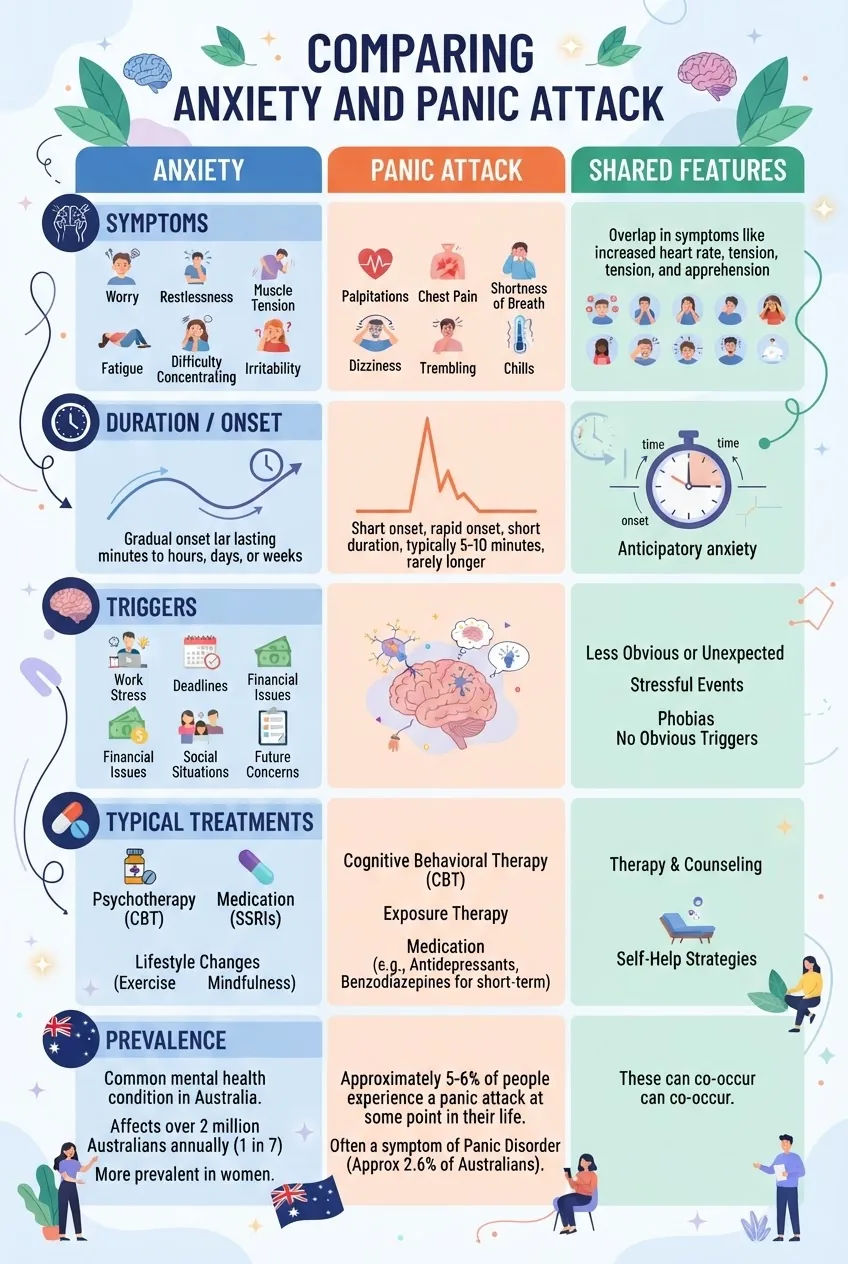
| Domain | Anxiety (GAD & related) | Panic Attack |
|---|---|---|
| Onset | Gradual, days to months of persistent worry. | Sudden, reaches peak within minutes. |
| Duration | Chronic; symptoms last for months and wax/wane. | Typically 5–30 minutes for acute episode; residual anxiety can last longer. |
| Intensity | Moderate but persistent; lower peaks. | High-intensity peak; intense physical sensations. |
| Symptoms | Worry, rumination, restlessness, muscle tension, insomnia. | Palpitations, breathlessness, dizziness, depersonalisation, fear of losing control. |
| Common triggers | Uncertainty, ongoing stressors (work, relationships, health). | Can be unexpected; also linked to specific situations or bodily sensations. |
| Treatment emphasis | CBT focused on worry, behavioural activation, SSRIs for longer-term management. | Interoceptive exposure, panic-focused CBT, short-term benzodiazepines as indicated, SSRIs. |
Explanatory prose: Symptom overlap is common: both produce autonomic arousal, sleep changes and concentration problems. The distinction matters clinically because treatment priorities differ. For instance, panic attacks respond well to interoceptive exposure (practising feared bodily sensations) and cognitive techniques addressing catastrophic interpretations of sensations, whereas generalised anxiety benefits from structured worry exercises and uncertainty tolerance work.
Frequency and pattern: Anxiety manifests as a high baseline of anxious thinking and physiological tension; panic attacks are discrete spikes. A person with panic disorder may still have baseline anxious days between attacks, and someone with GAD can also experience panic attacks—but the diagnosis and treatment plan depend on which pattern is primary.
When safety concerns arise (sudden chest pain, severe shortness of breath), medical assessment is essential. For resources on differentiating cardiac symptoms from anxiety-related chest discomfort see Anxiety heart attack symptoms and treatment options.
Fear and catastrophic beliefs often maintain panic: patients believe sensations mean imminent danger (e.g., “I’m having a heart attack” or “I’ll black out”), which escalates autonomic arousal. Treating these beliefs is central to panic-specific CBT.
Clinical perspective: A Melbourne clinical psychologist working with panic and anxiety notes: “We prioritise teaching clients skills to tolerate bodily sensations early in panic treatment, while anxiety treatments focus first on reducing persistent worry cycles; combining both approaches is necessary when both patterns co-occur.”
Panic Disorder vs Anxiety Disorder: Diagnostic and Clinical Differences
Short answer: Panic disorder is defined by recurrent unexpected panic attacks plus persistent worry or behavioural change related to attacks; anxiety disorders (like GAD) are defined by excessive worry across multiple domains without the required recurrent unexpected attacks criterion.
Term: DSM-5 — the Diagnostic and Statistical Manual of Mental Disorders, Fifth Edition, the standard classification used by clinicians in Australia and internationally for psychiatric diagnoses.
Clinicians use DSM-5 guidance to separate panic disorder from other anxiety disorders. Below are the core diagnostic features presented as a numbered list for clarity (paraphrased for accessibility):
- Panic disorder diagnostic criteria (DSM-5 paraphrase):
- Recurrent unexpected panic attacks.
- At least one attack followed by one month (or more) of persistent concern/worry about additional attacks or significant maladaptive change in behaviour related to the attacks (e.g., avoidance).
- Not better explained by another medical condition or substance use.
- Generalised anxiety disorder (GAD) diagnostic criteria (DSM-5 paraphrase):
- Excessive anxiety and worry occurring more days than not for at least six months about multiple events or activities.
- Difficulty controlling the worry and at least three associated symptoms (restlessness, fatigue, concentration problems, irritability, muscle tension, sleep disturbance).
- Significant distress or impairment and not better explained by another disorder or substance/medical condition.
- Comorbidity and differential diagnosis notes:
- Patients frequently meet criteria for more than one anxiety diagnosis; clinicians judge which disorder is primary or whether both should be treated concurrently.
- Rule out medical causes (thyroid disease, cardiac arrhythmia) and substance effects as contributors to panic-like symptoms.
Diagnostic timing and specificity matter for treatment planning. Panic disorder requires recurrent unexpected attacks and subsequent change in behaviour or worry about attacks. By contrast, an anxiety disorder like GAD is defined by chronic, pervasive worry rather than discrete high-intensity panic episodes.
Assessment tools used in practice include structured interviews (e.g., MINI, SCID) and validated questionnaires (GAD-7 for anxiety severity, PDSS for panic symptoms). Peer-reviewed evidence (see Journal of Anxiety Disorders and clinical practice guidelines) supports these structured approaches for reliable diagnosis.
Australian clinical practice: The Department of Health provides guidance on matching treatment intensity to disorder severity; beyond initial assessment, a GP or mental health professional may refer to a psychologist or psychiatrist for specialist management, including medication review and formulation-driven therapy.
Example clinical pathway: A patient presenting with two unexpected panic attacks and three months of worry about future attacks would meet the panic disorder profile if they also changed behaviour (e.g., avoiding exercise or crowds). That pathway triggers panic-focused CBT and consideration of SSRI pharmacotherapy. Conversely, a patient with persistent daily excessive worry for eight months about work and relationships without discrete panic episodes more closely matches GAD and receives worry-focused CBT and longer-term SSRI discussion.
What Causes Anxiety Disorders and Panic Attacks?
Short answer: Both anxiety disorders and panic attacks arise from an interplay of genetics, brain chemistry and learning history, with environmental stressors, trauma and health factors acting as triggers that shape individual vulnerability and symptom patterns.
Term: Triggers — immediate internal or external events that activate symptoms (for example, a stressful life event, perceived threat, or bodily sensation).
Causes can be grouped into biological, psychological and social/environmental categories. Each contributes differently to chronic anxiety versus discrete panic episodes.
Biological causes
- Genetics: Family studies show higher risk when first-degree relatives have anxiety or panic disorders, indicating heritable vulnerability.
- Neurobiology: Dysregulated circuits (amygdala hyper-reactivity, prefrontal cortex regulation deficits) and neurotransmitter systems (serotonin, noradrenaline, GABA) influence both conditions.
- Physiological sensitivity: Some people have heightened interoceptive sensitivity (greater awareness of bodily signals) which predisposes to panic when sensations are catastrophically interpreted.
Peer-reviewed research synthesises these findings; see articles in the Journal of Anxiety Disorders for reviews of biological mechanisms.
Psychological causes
- Learning and conditioning: Panic attacks can be classically conditioned to bodily cues or situational triggers (e.g., first attack in a crowded place leads to avoidance).
- Cognitive patterns: Negative bias, catastrophic interpretation of benign sensations, intolerance of uncertainty and rumination fuel chronic anxiety.
- Early life experiences: Childhood adversity, attachment disruptions and modelling of anxious behaviours increase risk over a lifetime.
Environmental and social factors
- Stressful life events — job loss, relationship breakdown, bereavement — often precipitate or worsen anxiety disorders.
- Trauma exposure increases risk for panic reactions and comorbid post-traumatic stress symptoms.
- Substance use (stimulants, alcohol withdrawal) and certain medical illnesses can provoke panic-like episodes.
Examples of triggers by condition:
- Anxiety disorder triggers: ongoing financial pressure, chronic health worry, high workload with prolonged uncertainty.
- Panic attack triggers: sudden bodily sensations (dizziness, palpitations), crowded spaces after a prior attack, intense stressors that amplify autonomic arousal.
Australian context and statistics: According to 2023 Beyond Blue statistics, many Australians report anxiety symptoms and help-seeking patterns vary; the Department of Health notes access to early intervention services improves outcomes when symptoms are identified promptly (see linked resources).
Case vignette (experience signal): An anonymised patient, “Robert,” age 45, presented after two unexpected panic attacks while driving. He had a family history of anxiety and recent workplace stress. Assessment identified high interoceptive sensitivity and catastrophic thinking; treatment targeted interoceptive exposure plus cognitive restructuring, reducing recurrent attacks within eight weeks.
Clinician perspective on causation: “Risk factors stack—genetics and temperament create a vulnerability, and life stress or medical events can trigger the first panic attack. Our role is to map that chain and target the mechanisms maintaining symptoms,” says a senior Australian clinical psychologist specialising in anxiety and panic presentations.
Limitations and individual variability: Not everyone with biological risk develops disorder; protective factors (social support, healthy coping, access to treatment) modify outcomes. Self-diagnosis is unreliable because similar symptoms can arise from medical conditions—seek a health professional for assessment.
Treatment Options for Anxiety and Panic Attacks: similarities and differences
Short answer: Effective treatments include psychotherapy (especially CBT and exposure therapies) and medications (SSRIs, SNRIs, short-term benzodiazepines sometimes); differences lie in emphasis—panic treatment prioritises interoceptive exposure and panic-focused CBT components, while anxiety treatments emphasise worry-management, intolerance of uncertainty and behavioural activation.
Term: CBT — Cognitive Behavioural Therapy, a structured, time-limited psychotherapy focusing on the links between thoughts, behaviours and emotions to change unhelpful patterns.
This section is divided into treatment types with explanation, typical course, pros and cons, and notes on how application differs for panic attacks versus chronic anxiety.
1. Cognitive Behavioural Therapy (CBT)
Direct answer: CBT is first-line psychotherapy for both anxiety disorders and panic disorder, adapted to emphasise worry exposure for anxiety and interoceptive exposure for panic attacks.
How CBT is tailored:
- For anxiety (GAD): CBT focuses on structured worry exposure (scheduled worry time), cognitive restructuring of catastrophic predictions, behavioural experiments, and skills for uncertainty tolerance.
- For panic attacks/panic disorder: CBT includes psychoeducation about panic physiology, cognitive restructuring of catastrophic interpretations of bodily sensations, interoceptive exposure (deliberately recreating sensations to reduce fear), and situational exposure for agoraphobic avoidance.
Walkthrough (experience & expertise signal) — panic-focused CBT session example:
- Assessment and psychoeducation on fight-or-flight physiology and how hyperventilation and catastrophic thoughts escalate panic.
- Interoceptive exposure exercises (e.g., controlled hyperventilation, spinning to provoke dizziness) performed in a safe therapeutic setting while using coping statements.
- Graded situational exposure to feared contexts (e.g., short car rides, public transport) after interoceptive habituation reduces fear of bodily sensations driving avoidance.
- Relapse prevention and consolidation of skills for independent practice.
Pros: Strong evidence base, good durability of effect, adaptable to individual needs. Cons: Requires active participation and repeated practice; access and cost can be barriers.
2. Exposure Therapy (including interoceptive exposure)
Direct answer: Exposure therapy—repeated, controlled contact with feared situations or bodily sensations—reduces avoidance and disconfirms catastrophic beliefs; interoceptive exposure is especially valuable for panic disorder.
Term: Exposure therapy — a behavioural treatment that systematically and safely exposes a person to feared stimuli to extinguish avoidance and reduce fear response.
How it differs by condition:
- Anxiety disorders: Exposure often targets avoided behaviours (social situations, driving) and is combined with cognitive techniques to modify fear predictions.
- Panic disorder: Interoceptive exposure deliberately recreates feared bodily sensations (e.g., elevated heart rate) so the person learns those sensations are tolerable and not catastrophic.
Pros: Rapid reduction of avoidance, strong evidence for panic and phobia-related disorders. Cons: Can be distressing initially and requires skilled guidance to avoid reinforcement of fear.
3. Medications (SSRIs, SNRIs, benzodiazepines)
Direct answer: Selective serotonin reuptake inhibitors (SSRIs) and serotonin–norepinephrine reuptake inhibitors (SNRIs) are commonly used for long-term management; benzodiazepines can be effective short-term for severe acute anxiety but carry dependency risks.
Term: Benzodiazepines — a class of sedative medications that reduce anxiety rapidly but have risks of tolerance, dependence and withdrawal; typically used short-term. SSRI — Selective Serotonin Reuptake Inhibitor, a class of antidepressant medications used long-term to reduce anxiety symptoms.
Medication considerations:
- SSRIs/SNRIs: Effective for both GAD and panic disorder; benefits often start after 2–6 weeks and require sustained use for months. Pros: good evidence for preventing relapse when continued; cons: side effects (nausea, sexual dysfunction), delayed onset.
- Benzodiazepines: Provide rapid relief for panic symptoms; pros: fast-acting for acute distress; cons: sedation, impaired alertness, risk of dependence—use short term and with caution.
- Other options: Pregabalin, tricyclics and augmenting agents are used selectively under specialist supervision.
Clinical trade-offs: For panic disorder with severe avoided behaviour, combining SSRI with panic-focused CBT provides strong outcomes. For GAD, SSRIs plus CBT targeted at worry yield durable improvement. Medication selection should be guided by comorbidities, pregnancy planning, substance use history and patient preference.
4. Combined treatment approaches
Direct answer: Combining CBT with medication often gives faster symptom reduction and may improve long-term outcomes; the balance depends on severity, comorbidity and patient preference.
Evidence supports combined treatment in moderate-to-severe cases and when rapid symptom control is necessary. In Australia, integrated care involving GPs, psychologists and psychiatrists is common: a GP may prescribe an SSRI and refer for CBT, with psychiatry consulted for complex cases.
5. Brief interventions and crisis management
Direct answer: Short-term strategies include breathing retraining, grounding techniques, and brief benzodiazepine prescriptions for acute crisis; they are adjuncts, not substitutes, for definitive therapy.
Examples:
- Paced breathing to correct hyperventilation during panic.
- Grounding techniques (5-4-3-2-1 sensory method) to reduce dissociation.
- Short benzodiazepine trial (few days to weeks) under supervision when attacks are disabling; plan for taper and transition to CBT/SSRI.
6. Self-help and lifestyle interventions
Direct answer: Lifestyle measures—regular exercise, sleep optimisation, limiting caffeine/stimulants, stress management and structured routines—support formal treatment and reduce symptom burden.
Self-management strategies that can be effective alongside therapy:
- Regular aerobic exercise to reduce baseline anxiety;
- Reducing caffeine and nicotine which can provoke panic-like sensations;
- Sleep hygiene to restore resilience;
- Mindfulness or acceptance-based techniques to tolerate uncertainty and bodily sensations;
- Peer support and psychoeducation via Australian services (Beyond Blue).
7. Pros and cons summary table
| Treatment | Best for | Pros | Cons |
|---|---|---|---|
| CBT | GAD, panic disorder | Durable, evidence-based, skills-focused | Requires homework and access to trained therapists |
| Interoceptive exposure | Panic disorder | Targets panic mechanisms directly | Initially uncomfortable; needs supervision |
| SSRIs/SNRIs | Moderate-severe anxiety/panic | Prevents relapse if continued | Delayed onset; side effects |
| Benzodiazepines | Short-term acute relief | Rapid symptom control | Dependence risk; not for long-term |
Selecting a treatment requires weighing symptom pattern, severity, past response, medical history and personal preference. For an accessible explanation of therapy pathways and what to expect when seeing a specialist, see our pillar resource on Therapist for Panic Attacks: Treatment Options and What to Expect.
Evidence note: Randomised controlled trials and meta-analyses in major journals consistently rank CBT and SSRIs as effective for anxiety and panic disorder, while benzodiazepines show efficacy for acute symptoms but poorer long-term outcomes due to dependency concerns.
When to See a Therapist for Panic Attacks or Anxiety
Short answer: See a therapist when symptoms cause functional impairment, are persistent despite self-help, include frequent panic attacks, or when worry leads to avoidance—early specialist input improves outcomes.
Term: Therapy benefits — measurable improvements in symptom severity, coping skills, relapse prevention and daily functioning resulting from evidence-based psychological treatment.
How to decide and practical steps (how-to):
- Recognise red flags for referral:
- Severe functional impairment (unable to work/study), daily debilitating worry, or recurrent panic attacks interfering with life.
- Persistent inability to control worry for six months (possible GAD) or repeated unexpected panic attacks with subsequent avoidance (possible panic disorder).
- Safety concerns, suicidal ideation, substance use or major medical issues—seek urgent assessment.
- Start with a GP for assessment and to rule out medical causes; GPs in Australia can initiate care, prescribe medication and refer to psychologists/psychiatrists under Medicare-subsidised care plans.
- Look for clinicians with experience in CBT and panic-focused interventions; ask about training, typical session structure and outcome measures used.
- Expect an initial assessment session to include clinical history, symptom scales (e.g., GAD-7, PDSS), functional goals and a recommended treatment plan.
- If you have panic attacks, ensure the therapist includes interoceptive exposure, breathing retraining and situational exposure in the plan; ask about medication liaison with a GP or psychiatrist if needed.
Australian resources and access: Beyond Blue and the Department of Health provide searchable lists of services and crisis lines; for immediate help call Lifeline (13 11 14) or refer to local emergency services if experiencing severe medical symptoms or suicidal crisis. See external resources below for links to national guidance.
Practical expectations of treatment: Typical CBT courses are 8–16 weekly sessions; many people see meaningful change by 8–12 sessions for panic disorder, while GAD may require longer engagement depending on severity. Medications usually take several weeks to show full effect and are often combined with psychotherapy.
Tip: If waiting lists are long, ask your GP about interim strategies, guided self-help resources, and digital CBT programs available in Australia while you wait for face-to-face therapy.
Referral call-to-action: If recurrent panic attacks or persistent anxiety are reducing quality of life, consider contacting a specialist clinic to discuss assessment and treatment planning. Learn more about therapy services at our clinic page: Therapist for Panic Attacks: Treatment Options and What to Expect.
External authoritative resources (trust & authority signals): For clinical guidelines and patient-facing information consult the Australian Department of Health on mental health (Department of Health — Mental Health), Beyond Blue resources for anxiety (Beyond Blue), and global summaries such as the WHO mental health fact sheets (World Health Organization — Mental Disorders).
Disclaimer: Individual variation is large—this guide summarises typical pathways. Consult qualified health professionals for personalised assessment and treatment planning.
Conclusion: Anxiety and panic attacks overlap but are distinct in onset, duration and treatment emphasis. Panic attacks need rapid symptom-focused strategies (interoceptive exposure, panic-focused CBT) while anxiety disorders require sustained work on worry and uncertainty. When symptoms impair daily life, seek assessment and evidence-based care; early intervention improves outcomes.
Key takeaway: If your experience is frequent, intense or changing how you live—reach out for a structured assessment to match the right mix of therapy and medication for your needs.