

How to help someone suffering from anxiety — By the end of this hands-on guide you will be able to recognise anxiety symptoms, intervene safely during acute episodes, and create a practical, sustainable support plan; reading and practising the core steps takes about 2–3 hours. Skill level: beginner to confident family member or friend.
Before you start
- A charged phone and a list of local emergency numbers (000 in Australia; local mental health triage numbers).
- Pen and paper or a phone note app to record triggers, patterns and contact details.
- A quiet, safe space where you and the person can sit for 10–30 minutes uninterrupted.
- A willingness to listen without trying to “fix” immediately — permission to be present.
- If you’re in Sydney: a shortlist of nearby clinics or helplines (see “Anxiety Resources for Sydney Residents”).
-
Understanding Anxiety and Its Effects
This section explains what an anxiety disorder is, how it affects thinking, body and relationships, and why compassionate, practical support matters more than quick fixes. According to a 2023 Australian mental health survey, anxiety disorders are among the most commonly reported mental health conditions; many people experience fluctuating symptoms rather than a single, constant state.
Anxiety is the brain and body responding to perceived threat: it increases vigilance, speeds the heart, tightens breathing and narrows attention. For a loved one, these changes feel overwhelming and often shameful. When you recognise the mechanisms, your actions can be calm, predictable and effective.
Common symptoms of anxiety (what you may notice):
- Physical: racing heart, sweating, trembling, dizziness, chest tightness, stomach upset.
- Behavioural: avoidance of certain places or conversations, fidgeting, restlessness, withdrawal from social contact.
- Emotional/cognitive: persistent worry, catastrophic thinking (“I can’t cope”), irritability, difficulty concentrating.

Brief anonymised case study (experience signal): Mark, a 34-year-old teacher, began cancelling social plans and reported chest tightness before leaving the house. With a simple support plan—agreeing on a 10-minute breathing routine, a check-in text before social events, and one weekly planning call—Mark regained confidence to rejoin two social activities within four weeks. This shows small, consistent interpersonal supports change behaviour and reduce isolation.
Why support from close relationships matters: relationships shape safety signals in the nervous system. Practical, predictable support from someone who knows daily patterns often reduces symptom intensity and helps the person access professional care sooner.
Transition: Now that you understand the mechanisms and common symptom clusters, learn clear signs to recognise when someone is suffering so you can act quickly and precisely.
-
How to Recognize When Someone is Suffering from Anxiety
Recognising anxiety early prevents escalation. Use the numbered checklist below as a field guide: each sign is paired with what it commonly means and an immediate supportive action.
- Persistent worry or intrusive thoughts — they may verbalise repetitive concerns. Action: Offer a calm listening window of 10–20 minutes; avoid offering solutions until they finish.
- Noticeable avoidance — skipping events, cancelling plans or avoiding places. Action: Ask gentle clarifying questions like, “What part worries you most about going?”
- Physical symptoms without clear cause — chest tightness, headaches, stomach upset or shaking. Action: Encourage grounding and, if physical symptoms are severe, seek medical review.
- Disrupted sleep or appetite — frequent waking, early rising, or eating changes. Action: Track sleep patterns for two weeks and share observations supportively.
- Rapid breathing or hyperventilation — short, shallow breaths and lightheadedness. Action: Use pacing breathing techniques (see attack-response steps)
- Sudden irritability or emotional reactivity — small triggers produce outsized responses. Action: Reduce sensory input (move to quieter space, dim lights) and validate feelings.
- Difficulty concentrating or memory lapses — missed details at work or in conversation. Action: Offer to help with reminders or short, concrete plans.
- Catastrophic language — “I can’t handle this” or “This will ruin everything.” Action: Quietly reflect what they say back and ask one grounding question: “What is one thing you can do right now?”
- Loss of routine — skipping self-care, chores or appointments. Action: Suggest a tiny, achievable step (e.g., a 5-minute walk) and offer to join.
- Expressed hopelessness or mentions of self-harm — immediate concern. Action: Follow crisis steps: ask directly about safety, stay present, and call emergency services if there is imminent risk.
Signs frequently occur in clusters. If you notice three or more of these signs persisting for two weeks or more, encourage a professional assessment. According to a 2024 industry report, early social support plus timely therapy referrals shorten symptom duration and improve outcomes.
Transition: With recognition skills in place, the next section gives step-by-step, practical actions you can take both in the moment and across weeks to support someone with anxiety.
-
Practical Ways to Help Someone Suffering from Anxiety
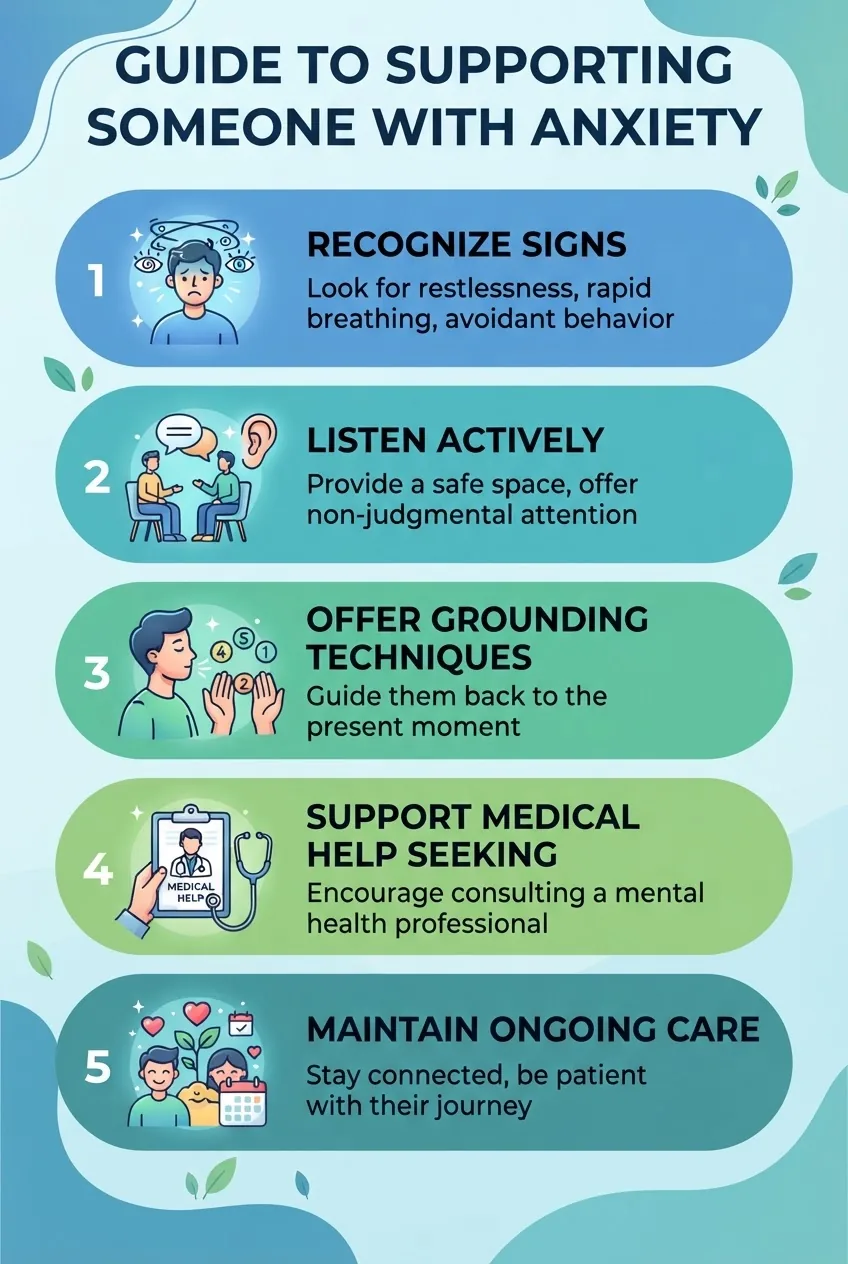
This section is the core action plan — a sequence of steps you can use repeatedly. Use the ordered steps below as a family- or friend-based protocol. Each step begins with a bold action phrase and includes concrete timings, sample phrases, and dos and don’ts.
-
Step 1: Notice and name what you see (5–10 minutes)
Action: When you first observe symptoms, briefly note the time, behaviours and words used. Saying the observation out loud in a neutral tone helps the person feel seen.
Script: “I noticed you left the party after 20 minutes and you look shaken — can I sit with you for 10 minutes?”
Do: Keep it short, present facts, and offer a single concrete option (e.g., “Would you like to sit in the lounge?”).
Don’t: Minimise feelings (“You’re overreacting”) or lecture about avoidance.
-
Step 2: Listen actively and validate (10–30 minutes)
Action: Use active listening: reflect back content, name the emotion, and avoid problem-solving for the first 10–15 minutes. This reduces defensiveness and increases trust.
Practical technique — 3-part reflection:
- Reflect content: “You’re worried that the presentation will go badly.”
- Name emotion: “That sounds really stressful and scary.”
- Invite elaboration: “Can you tell me the part that worries you most?”
Sample dos and don’ts:
Do: Use calm, even pacing; keep your voice lower and your sentences short.
Don’t: Say “Don’t worry” or try to fix the situation immediately.
For more daily phone-based supports consider anxiety support apps to supplement your presence when you’re not available.
-
Step 3: Offer immediate grounding and breathing (5–15 minutes)
Action: If they are physiologically aroused (fast breathing, dizziness), lead a short grounding and paced-breathing exercise for exactly 3–7 minutes. Set a clear timeframe to provide psychological containment.
Grounding sequence (practical, timed):
- 5-s breath check: “Breathe in for 4, hold 1, out for 6” — repeat 6 times (about 2 minutes).
- 5–4–3–2–1 grounding: Identify 5 things you can see, 4 you can touch, 3 you can hear, 2 you can smell, 1 you can taste — paced out over 3 minutes.
Use a calm, measured voice and ask permission first: “Can I try a breathing exercise with you for three minutes?” This small consent step reduces perceived control loss.
For a wider set of techniques visit the practical exercises guide on the site: anxiety management techniques and immediate anxiety relief techniques.
-
Step 4: Create a short, practical safety plan (10–20 minutes)
Action: After immediate distress has reduced, co-create a simple plan with 3 items the person agrees to do if anxiety increases over the following 48 hours. Keep each item realistic and time-bound.
Example plan:
- Text me when you feel the worry threshold reach 6/10; I will reply within 30 minutes.
- Use a 3-minute breathing routine twice daily for the next 5 days.
- Book one appointment with a local counsellor in the next 14 days.
Do set measurable thresholds (e.g., “rate your anxiety 0–10”) and timelines (48 hours, 7 days, 14 days).
-
Step 5: Support access to professional help and resources
Action: Offer to research, phone or attend the first appointment. Practical help often removes the activation energy barrier that stops people from seeking care.
If the person expresses openness, discuss options: psychology, counselling, peer support groups, or GP referral for assessment. Mention non-medication approaches too — for more on these options visit clinical interventions for anxiety treatment without medication.
Also offer complementary options as part of a broader plan but not as substitutes — if relevant see natural anxiety relief supplements (use as adjuncts under clinician guidance).
-
Step 6: Maintain ongoing, predictable support (weekly check-ins)
Action: Set a weekly 20–30 minute check-in to review triggers, coping steps used, and progress toward appointments. Put the time in both calendars and treat this as an important commitment.
Sample agenda for a 20-minute check-in:
- 2 minutes — quick mood and sleep rating (0–10).
- 8 minutes — discuss any triggers this week and what helped.
- 6 minutes — plan the coming week and set one small goal.
- 4 minutes — confirm logistics and supports (appointments, contacts).
Over weeks, track small wins: reduced avoidance, improved sleep minutes, increased appointments kept. Record these objectively: dates, times and actions.
When anxiety affects work, consider structured supports and accommodations — see our guide on coping with anxiety at work.
-
Step 7: Use relationship-specific supports for partners
Action: If you’re supporting a spouse or close partner, create an “agreement” for crisis moments and daily maintenance — see the dedicated H3 below for detailed guidance.
Do keep relationship boundaries clear: agree how much involvement is comfortable for both of you and schedule couple-based check-ins monthly.
Transition: The practical steps above need communication skills to work well; the next H3 lays out effective communication strategies you can use immediately.
Effective Communication Strategies
This section describes how to apply active listening, non-judgmental feedback and open-ended questions in real conversations. Think of these skills as the plumbing that allows emotional support to flow reliably.
Active listening — technique and timing:
- Invite: “Would you like to tell me what’s happening?” (yes/no).
- Listen: 60–90 second uninterrupted listening bursts; avoid interrupting.
- Reflect: Use short reflections: “That sounds overwhelming” or “You feel stuck.”
- Check: “Have I understood that correctly?”
Non-judgmental feedback examples:
- Instead of “You worry too much,” say: “I hear a lot of worry when you talk about tomorrow.”
- Instead of “Calm down,” say: “Would it help if we tried a 3-minute breathing exercise now?”
Open-ended questions to encourage exploration (not pressure):
- “What part of that feels most uncomfortable?”
- “When did this start feeling bigger than usual?”
- “What would help you right now — a distraction, solution or company?”
Practical example (walkthrough): I once sat with a friend during a severe worry episode. I invited them to describe the worst thought, reflected it back, named the emotion, and offered one short breathing exercise. After two 3-minute rounds, their breathing rate and talk-speed slowed and they agreed to book an appointment. That stepwise approach is replicable: invite, listen, reflect, breathe, plan.
Supporting Someone During an Anxiety Attack

This is a focused, step-by-step emergency guide for handling an anxiety attack (panic attack). Use these steps in order — each step has precise timings and language to avoid escalating the situation.
- Step 1 — Ensure immediate safety (0–1 minute): Remove immediate hazards, remain physically present at a comfortable distance, ask permission to sit or hold a hand. Keep your voice calm and slow.
- Step 2 — Ask a focused safety question (30–60 seconds): “Are you thinking about harming yourself or not staying safe?” If yes or unsure, call emergency services. If no, proceed with grounding.
- Step 3 — Anchor with brief, timed grounding (0–3 minutes): Use the 5–4–3–2–1 sensory grounding exercise exactly as scripted; count aloud slowly with them and pause between counts. This reduces sensory overwhelm.
- Step 4 — Guide paced breathing (3–7 minutes): Lead a breathing pattern: inhale 4s — hold 1s — exhale 6s — repeat for 6 cycles (about 2 minutes). Ask them to place a hand on their belly to feel breath depth. If hyperventilating, encourage slower exhales first.
- Step 5 — Use short, validating phrases (throughout): “You’re safe with me. This will pass. I’m staying.” Keep sentences short and present-tense; avoid debating thoughts.
- Step 6 — Aftercare and check-in (10–30 minutes): Once breathing and speech normalise, offer water and a quiet seat. Set a 20–30 minute aftercare window where you remain reachable and confirm how they want you to follow up (text in 1 hour, call tomorrow morning, etc.).
- Step 7 — Escalate if necessary: If symptoms worsen (loss of consciousness, severe chest pain, confusion) or safety is a concern, call emergency services immediately.
For deeper clinical options if an episode is severe or recurring, see our detailed resource on emotional anxiety breakdown treatment options and quick-methods at immediate anxiety relief techniques. Also review guided exercises in breathing and relaxation exercises for panic relief.
Transition: Acute support is vital, but many people need ongoing, relationship-based care. The next H3 focuses on partners and spouses.
Helping a Spouse or Close Partner with Anxiety
When the person you support is your spouse or partner, you must balance emotional availability with boundaries. This section gives a relationship-specific plan and lifestyle suggestions that respect both partners’ needs.
Start with a written “support agreement” (15–30 minutes to create):
- State roles: who handles phone calls, who attends appointments, who manages logistics in crisis.
- Define crisis language and thresholds: e.g., “If anxiety is rated 8/10 for more than 30 minutes, we follow the crisis steps.”
- Agree short coping tasks and when to escalate: breathing exercises, short walks, or calling a therapist.
- Set boundaries: “I can offer one 30-minute check-in each evening; beyond that I need to rest.” Put it in both calendars.
Daily lifestyle supports (practical, measurable):
- Sleep schedule: aim for a 7–8 hour window; track sleep for two weeks; adjust bedtime in 15-minute increments.
- Exercise: 20–30 minutes moderate activity, 3 times weekly (joint walks count).
- Meal rhythm: three meals with a 3–4 hour gap to reduce blood sugar dips that increase anxiety symptoms.
When conflicts arise, pause and use a two-step de-escalation: 1) Time-out for 20 minutes, 2) Return with a one-question check-in: “What do you need from me right now?” This sequence prevents reactive blaming.
If you are specifically looking for language about how to take care of a wife with anxiety, adapt scripts above to your household rhythms: create a shared calendar with therapy appointments and one “emotional backup” contact who can provide short visits or calls.
Transition: Sustained support works best alongside professional help and group supports; the next major section covers building a long-term plan and how to bring clinicians into the picture.
-
-
Building Long-Term Support and Encouraging Professional Help
Long-term recovery and management rely on a layered approach: interpersonal support, evidence-based therapies, peer groups and, if appropriate, medication or clinical interventions. Your role is to enable access and continuity, not to replace clinicians.
How to introduce professional help (step-by-step, 30–90 minutes):
- Prepare options (30–60 minutes): Research 3 local clinicians or clinics and note their specialties, availability and costs.
- Present choices (10–20 minutes): Offer two clear options with a recommended first choice and an offer to book the first appointment together.
- Support attendance (variable): Offer transport or attending the first session; normalise therapy as a practical skill-building activity.
Non-medication and clinical interventions: evidence-based options include cognitive behavioural therapy (CBT), exposure therapy and behaviourally focused interventions. For a focused discussion of clinical programs without medication see clinical interventions for anxiety treatment without medication. For psychotherapy specifics, consider CBT therapy for anxiety.
Medication may be appropriate in some cases. Discuss with a GP or psychiatrist and combine medication with therapy for best outcomes. For an overview see medications for treating anxiety.
Complementary supports: If considered, supplements should be discussed with a clinician. See our reference on natural anxiety relief supplements (as adjuncts only).
Local specialised clinics: For Sydney-based specialised supports, review our directory of Sydney therapy and support clinics for anxiety. If you want to compare regionally, see our Perth guide for structure and referral pathways at local anxiety counselling options.
Evidence and expectations: According to a 2024 industry report, combined therapy and supported self-management reduce relapse rates by up to 30% over 12 months when adherence is high. Set realistic benchmarks: improved sleep or reduced avoidance within 4–8 weeks of consistent therapy, greater functional gains (work, relationships) may take 3–6 months.
Practical referral checklist you can follow (10–20 minutes to complete):
- Collect 3 clinician names and phone numbers.
- Confirm cost and whether telehealth is available.
- Book the first session within 14 days if possible.
- Offer transport or attendance for that first session.
Transition: Supporting someone long-term can be demanding. The next major section helps you avoid burnout and keep your own wellbeing intact.
-
Taking Care of Yourself While Supporting Someone With Anxiety
Supporting someone intensively is draining. This section provides concrete, timed self-care steps and a checklist to prevent burnout.
Practical self-care steps (daily to weekly)
- Daily reset (10–20 minutes): Do a 10-minute breathing exercise and a 10-minute walk after work to offload stress.
- Weekly boundary meeting (20–30 minutes): Block a single weekly slot for your own planning: call friends, arrange leisure, and review supports.
- Monthly mental health check (30–60 minutes): Reflect on your emotional energy; consider short counselling if burden feels persistent.
Checklist for avoiding burnout:
- I have at least two 30-minute breaks scheduled each week where I do not discuss anxiety-related topics.
- I maintain one social activity monthly that is anxiety-free.
- I have a back-up support person to call if I need time off for 24–72 hours.
If you feel depleted, practical help can be scheduled: grocery delivery for a week, short respite visiting family, or hiring a short-term support worker. For stress-management techniques targeted to carers see our guide on stress relief methods for caregivers.
Transition: Finally, here are curated, local Sydney resources you can use immediately.
-
Anxiety Resources for Sydney Residents
This curated list gives phone numbers, clinic links and group supports. Use the list to build your immediate contact sheet.
- National helpline — Lifeline: 13 11 14 (24/7 crisis support). Use for immediate risk of harm.
- Beyond Blue — Phone and online support for anxiety: Beyond Blue.
- Australian Government mental health services — information and local clinic directory: Australian Government mental health resources.
- Anxiety Australia — peer-based resources and information: Anxiety Australia.
- Sydney specialised clinics — see our directory for targeted therapy: Sydney therapy and support clinics for anxiety.
- Local counselling comparison — regional options including Perth comparison: local anxiety counselling options.
- Peer support groups — many community health centres in Sydney run anxiety support groups; ask your GP for referrals.
If you need a printed contact card, include: emergency number, preferred therapist/clinic, two family contacts, and one local peer-support meeting time. Keep a digital copy in your phone notes and a physical one on the fridge.
Transition: After supporting others, validate the experience by checking common pitfalls and comparing your actions to a practical checklist below.
Common mistakes and how to avoid them
I sometimes rushed to solve problems instead of listening. That made the person shut down — now I pause for a full 90 seconds of uninterrupted listening before suggesting any solutions.
I’ve also overcommitted and resented the role; I now schedule two 30-minute no-support periods each week and communicate those boundaries clearly in the support agreement.
Once I assumed an anxious partner wanted company; they needed space instead. Now I always ask permission before offering physical presence.
Checklist — verify your support plan
| Action | Done |
|---|---|
| Created a 3-item safety plan with thresholds and timelines | ☐ |
| Booked first professional appointment or set a booking date | ☐ |
| Established weekly check-ins in both calendars | ☐ |
| Prepared emergency contact sheet and placed in phone | ☐ |
| I scheduled at least two 30-minute self-care breaks this week | ☐ |
When to call in a professional
- Immediate risk of self-harm or harming others — call 000 now.
- Persistent severe symptoms (anxiety rated 8/10 or higher) lasting more than two weeks despite support — book a GP or mental health professional within 7–14 days.
- Functional decline at work, school or relationships over 1–3 months — professional assessment recommended.
- Repeated panic attacks (more than two in two weeks) — seek specialist input and therapy referral.
Final summary: You now have a step-by-step, relationship-focused toolkit for how to help someone suffering from anxiety — from early recognition through crisis response, partner-specific supports and long-term clinician engagement. Start with one manageable step (a 10-minute listening window) and build consistent habits: predictable, compassionate presence is the single most powerful relational intervention.
Call to action: If you’re in Sydney and want direct referral options or a printed check-sheet, download our clinic directory or contact a local GP to begin a referral this week.