

bipolar depression dsm: Bipolar depression in DSM-5 is the major depressive phase of bipolar I or II disorder defined by DSM-5 criteria — at least five depressive symptoms over two weeks with marked impairment, occurring with a history or context of manic or hypomanic episodes; specifiers and course direct diagnosis and management.
Introduction to Bipolar Depression in DSM-5
Answer: Bipolar depression in DSM-5 is defined as a major depressive episode occurring within the course of bipolar I or bipolar II disorder, requiring the clinician to document symptom count, duration, functional impairment, and the presence or history of manic or hypomanic episodes to distinguish it from unipolar depression.
DSM-5: The Diagnostic and Statistical Manual of Mental Disorders, Fifth Edition is the APA’s standard diagnostic reference for psychiatric disorders, published with the most recent full edition in 2013 and subsequent practice updates.
Bipolar depression sits within the bipolar spectrum and is clinically distinct from major depressive disorder (unipolar depression) because treatment choices, risk of antidepressant-induced mania, and prognosis differ; accurate DSM-5-based diagnosis guides both pharmacologic and psychosocial interventions.
Epidemiologic and contextual notes: according to a 2023 peer-reviewed meta-analysis report, lifetime prevalence of bipolar spectrum disorders varies globally; region-specific figures are relevant for clinicians assessing risk — for local demographic context see depression prevalence in Australia.
Terminology clarification: Term: Bipolar depression refers specifically to depressive episodes occurring in bipolar I or II disorder rather than standalone major depressive episodes.

For clinicians in Sydney and elsewhere, the DSM-5 framework offers structured diagnostic thresholds and specifiers; however, clinical judgement, collateral history, and longitudinal course remain essential. The next section breaks the DSM-5 diagnostic criteria into an actionable checklist clinicians use at point of assessment.
Transition: The DSM-5 diagnostic checklist follows and should be applied alongside assessment tools and collateral information to reduce misdiagnosis risk.
DSM-5 Diagnostic Criteria for Bipolar Depression
Answer: DSM-5 requires documentation that a major depressive episode (MDE) meets symptom count, duration (≥2 weeks), and functional impairment criteria and that the depressive episode occurs in the context of bipolar I or II (i.e., history of manic or hypomanic episode); specifiers and exclusions modify the diagnosis.
DSM-5 criteria overview: The DSM-5 does not list a separate “bipolar depression” chapter; instead, it defines depressive episodes within bipolar I and II criteria and uses specifiers (mixed features, psychotic features, seasonal pattern, course) to characterise episodes.

-
Establish the presence of a Major Depressive Episode (MDE).
DSM-5 MDE criteria require at least five of nine specified symptoms present during the same 2-week period, representing a change from previous functioning, with at least one symptom being depressed mood or loss of interest/pleasure.
-
Confirm bipolar context: current or past manic/hypomanic episodes.
Diagnosis of bipolar depression requires evidence of bipolar disorder — specifically a history of mania (Bipolar I) or hypomania (Bipolar II). Without documented manic/hypomanic episodes, the diagnosis is unipolar major depressive disorder.
-
Assess functional impairment and rule out substance/medical causes.
Symptoms must cause clinically significant distress or impairment and not be better explained by a substance, medication, or a medical condition; medical and substance histories are essential.
-
Apply specifiers and course information.
DSM-5 specifiers — including mixed features, anxious distress, psychotic features, seasonal pattern, and rapid cycling — refine diagnosis and treatment planning.
-
Document episode chronology and recurrence pattern.
DSM-5 and clinical practice emphasise longitudinal course: number of episodes, inter-episode recovery, and response to prior treatments inform differential diagnosis and risk stratification.
-
Use structured clinical tools.
Standardised instruments like the Mood Disorder Questionnaire (MDQ), PHQ-9, Young Mania Rating Scale (YMRS), and clinician-administered SCID-5 enhance reliability when combined with clinical interview.
-
Consider comorbidities and complications.
Psychiatric comorbidities (anxiety disorders, substance use, ADHD, personality disorders) alter presentation and require concurrent assessment.
-
Include collateral sources and longitudinal records.
Family reports, previous medical records, occupational and educational history, and pharmacy records often reveal prior hypomania or mania that patients may not report voluntarily.
-
Record response to prior treatments.
Antidepressant-emergent mania or hypomania and treatment-resistance patterns are important signals suggesting bipolarity rather than unipolar depression.
Term: Major Depressive Episode (MDE) — a DSM-5 defined period of ≥2 weeks with specific symptom criteria (see next subsection).
The DSM-5 depressive disorders overview can help situate bipolar depression within the broader diagnostic framework; for a wider review see DSM-5 depressive disorders overview.
Transition: The next subsection details the MDE criteria used within bipolar disorder assessments and provides clinical examples demonstrating application.
Criteria for Major Depressive Episode in Bipolar Disorder
Answer: A Major Depressive Episode per DSM-5 is present when five or more of nine symptoms occur nearly every day for at least two weeks, include either depressed mood or loss of interest, and produce significant impairment or distress; in bipolar disorder, this episode must be considered against manic/hypomanic history.
Term: Depressive symptom — any of the nine DSM-5 symptoms: depressed mood, anhedonia, appetite/weight change, sleep disturbance, psychomotor changes, fatigue, worthlessness/guilt, concentration difficulty, suicidal ideation.
The nine DSM-5 symptoms for an MDE (enumerated clinically for assessment):
- Depressed mood most of the day, nearly every day.
- Markedly diminished interest or pleasure in activities (anhedonia).
- Significant weight loss/gain or appetite change.
- Insomnia or hypersomnia nearly every day.
- Psychomotor agitation or retardation observable by others.
- Fatigue or loss of energy.
- Feelings of worthlessness or excessive/inappropriate guilt.
- Diminished ability to think or concentrate; indecisiveness.
- Recurrent thoughts of death, suicidal ideation, or suicide attempt.
Clinical examples (composite):
- Example A: A 34-year-old with prior hypomania reports eight weeks of anhedonia, insomnia, low energy and passive suicidal ideation; five of nine symptoms meet criteria and history of hypomania supports bipolar II depression diagnosis.
- Example B: A 45-year-old with no recorded hypomania but two antidepressant-induced mania episodes in records suggests prior manic switch; collateral confirms mania — the current depressive episode is classified under bipolar I depression per DSM-5.
Severity thresholds: clinicians must evaluate symptom severity and functional impairment — DSM-5 requires clinically significant distress or impairment. Use scales (PHQ-9 severity ranges) alongside clinical interview for quantification.
Transition: After confirming MDE criteria, clinicians must discriminate bipolar I from bipolar II disorders to finalise diagnostic coding and inform prognosis and treatment.
Distinguishing Bipolar I and Bipolar II in DSM-5
Answer: DSM-5 distinguishes Bipolar I by the occurrence of at least one manic episode (often with depressive episodes), while Bipolar II requires at least one hypomanic episode and one major depressive episode, without ever having a full manic episode; this distinction carries treatment and risk implications.
Term: Manic episode — a distinct period of abnormally and persistently elevated, expansive, or irritable mood and increased goal-directed activity or energy lasting at least one week (or any duration if hospitalization is necessary) with marked impairment.
Term: Hypomanic episode — similar symptoms to mania but lasting at least four consecutive days, with observable change in functioning not severe enough to cause marked impairment or require hospitalization.
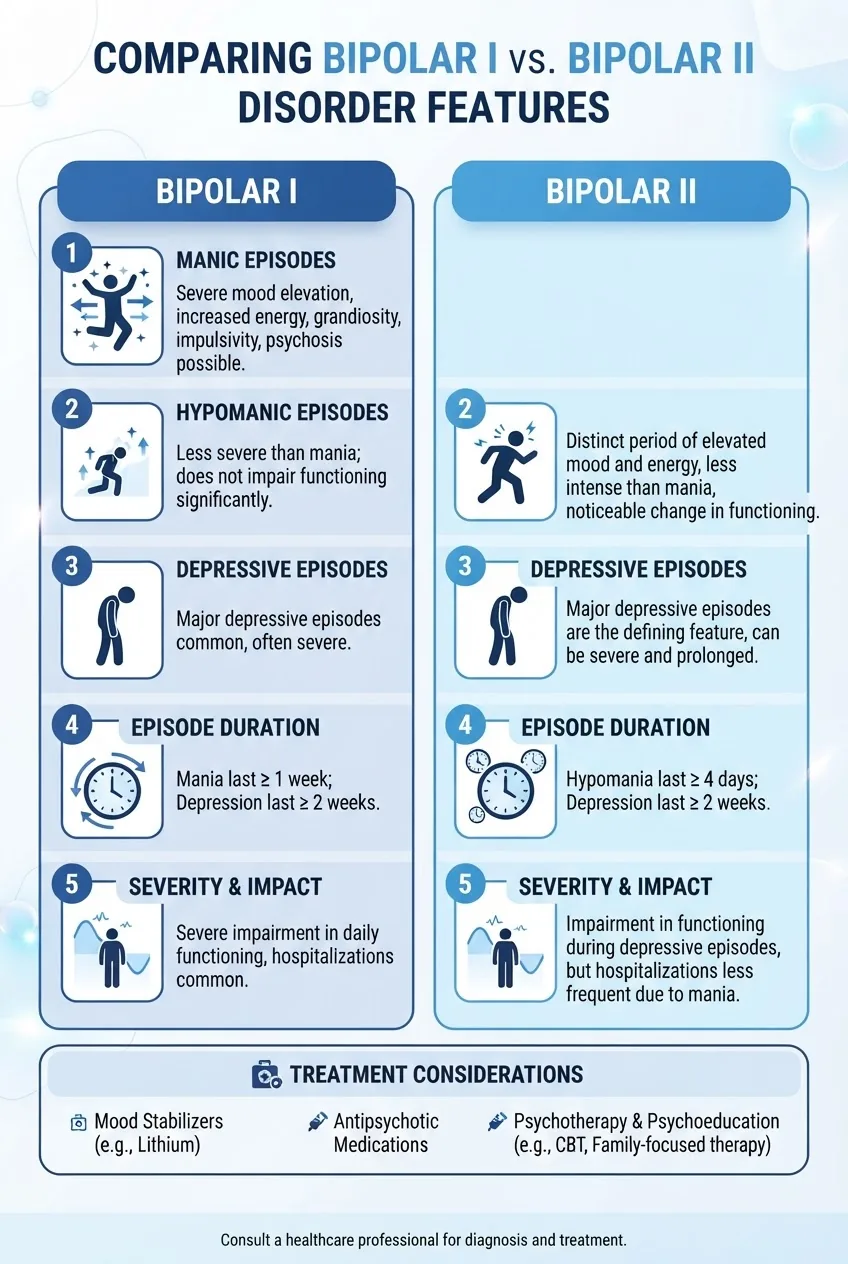
| Feature | Bipolar I | Bipolar II |
|---|---|---|
| Core mood episodes | Manic episodes (≥1); depressive episodes common | Hypomanic episodes (≥1) plus major depressive episodes; no history of mania |
| Duration of elevated mood | Mania ≥1 week (or any duration if hospitalised) | Hypomania ≥4 days |
| Severity / impairment | Marked impairment, possible psychosis, hospitalization risk | Observable change but not markedly impairing; no psychosis by definition |
| Treatment considerations | Often requires mood stabilisers and antipsychotics; caution with antidepressants | Mood stabilisers and psychotherapy are key; antidepressant use cautious and often combined with mood stabiliser |
Clinical implications: Bipolar I carries higher acute mania risk and often needs antipsychotic/mood stabiliser management for mania; Bipolar II often presents with more frequent or enduring depressive phases and a higher lifetime depressive burden. Recognising hypomania is crucial because patients often report hypomanic episodes positively and may not view them as pathological.
Transition: DSM-5 specifiers such as mixed features and rapid cycling further modify diagnosis and influence both prognosis and treatment approach; these are detailed next.
Mixed Features and Other Specifiers in Bipolar Depression
Answer: The DSM-5 mixed features specifier applies when depressive episodes have concurrent manic/hypomanic symptoms not meeting full criteria for a manic/hypomanic episode; other specifiers (anxious distress, psychotic features, rapid cycling) refine diagnosis and guide treatment selection.
Term: Mixed features specifier — a DSM-5 specifier used when features of the opposite pole are present during a mood episode (e.g., depressive episode with three or more manic/hypomanic symptoms).
Mixed features are important clinically because they predict poorer outcomes, greater suicidality, and differential medication response. For example, a depressive episode with increased energy, pressured speech, and racing thoughts (three hypomanic symptoms) would warrant the mixed features specifier.
Rapid cycling: defined in DSM-5 as four or more mood episodes (mania, hypomania, or depression) in 12 months; rapid cycling informs prognosis and often indicates need for tailored mood stabiliser strategies.
Examples of specifier use:
- Psychotic features specifier: applied when hallucinations or delusions occur during a depressive episode — impacts need for antipsychotic treatment.
- Anxious distress specifier: denotes concurrent anxiety symptoms; associated with worse outcomes and influences psychotherapy choices.
Transition: Accurate application of specifiers requires careful differential diagnosis to avoid mislabelling; the following section covers key diagnostic challenges and differential diagnoses clinicians commonly face.
Diagnostic Challenges and Differential Diagnosis
Answer: Diagnosing bipolar depression is challenging because symptom overlap with unipolar depression, atypical presentations, comorbidities, and incomplete patient recall of hypomania/mania lead to high misdiagnosis rates; clinicians must use collateral history, structured tools, and longitudinal records to differentiate conditions reliably.
Term: Differential diagnosis — the systematic process of distinguishing a condition from other disorders with similar presentations.
Key diagnostic challenges (bullet list):
- Under-recognition of hypomania: patients often view hypomanic episodes positively and omit them from history.
- Antidepressant-induced mania: switching on antidepressants can unmask bipolarity and confound diagnostic timelines.
- Comorbid substance use: substances can mimic or mask mood symptoms and cause mood instability.
- Overlap with atypical depression and persistent depressive disorder: symptom constellations and chronicity can resemble bipolar depressive patterns.
- Medical mimics: thyroid disease, neurological conditions, and metabolic disorders can present with depressive symptoms.
- Psychotic features: when present, psychotic depression requires differentiation from schizoaffective disorder or primary psychotic disorders with mood components.
- High-functioning presentations: individuals may maintain occupational function, obscuring severity — assess history, past functioning, and sleep/energy patterns.
Clinical strategies to reduce misdiagnosis:
- Use structured screening tools (MDQ, Hypomania Checklist, PHQ-9) in routine mood assessments to elicit hypomanic symptoms.
- Obtain collateral history from family, partners, or employment records to detect behavioural changes consistent with hypomania/mania.
- Review prior prescriptions and treatment responses — antidepressant-emergent mania is a red flag for bipolarity.
- Conduct medical and toxicology screens to exclude physiological causes.
- Consider longitudinal assessment and mood charting before finalising diagnosis in ambiguous cases.
Differential diagnoses to consider with action points:
- Major depressive disorder — assess for any history of manic/hypomanic episodes and treatment-response patterns.
- Atypical depression — check for leaden paralysis, hypersomnia, interpersonal rejection sensitivity; compare with atypical depression symptoms and treatment options.
- Persistent depressive disorder (dysthymia) — compare chronicity and severity; see depression DSM-5 criteria and persistent depressive disorder.
- Psychotic depression — document psychotic features and consult schizophrenia-spectrum differentials; see psychotic depression symptoms and treatment.
- High-functioning depression — probe for internal distress despite outward functioning and compare features with high functioning depression symptoms.
- Fatigue-dominant presentations — rule out medical causes; see fatigue or depression symptoms.
Case vignette (composite): A 29-year-old presented with recurrent severe depressive episodes treated with multiple antidepressants and poor response; collateral revealed periods of increased goal-directed activity and decreased need for sleep lasting five days — chart review and MDQ screening led to revised diagnosis of bipolar II, changing the treatment plan to include mood stabilisers.
Assessment tools and clinical pathways:
- Mood Disorder Questionnaire (MDQ) for hypomania screening.
- Structured Clinical Interview for DSM-5 (SCID-5) for diagnostic confirmation.
- PHQ-9 for depressive symptom severity tracking.
- Young Mania Rating Scale (YMRS) for mania severity when indicated.
For comparisons with broader terminology and synonyms used in clinical notes, consult depression synonyms and alternative terms.
Transition: Diagnostic clarity directly shapes treatment planning, especially where treatment resistance is present; the following section examines implications for treatment-resistant bipolar depression.
Bipolar Depression and Treatment-Resistant Depression: Clinical Implications
Answer: Treatment-resistant bipolar depression requires confirming accurate DSM-5 diagnosis (including specifiers and prior manic/hypomanic episodes), optimising mood stabilisers and evidence-based adjunctive therapies, and avoiding monotherapy antidepressants without mood stabilisers due to risk of mania and poor outcomes.
Term: Treatment-resistant depression (TRD) — commonly defined in clinical literature as failure to respond to two or more adequate antidepressant trials; when TRD occurs in bipolar disorder, diagnosis and treatment strategy must be re-evaluated.
Clinical workflow when TRD is suspected in bipolar spectrum patients:
- Reassess diagnosis using DSM-5 criteria and collateral histories to confirm bipolarity rather than unipolar TRD.
- Review prior medication trials for adequacy (dose, duration) and note any antidepressant-emergent activation or hypomania/mania.
- Prioritise mood stabilisers (lithium, valproate, lamotrigine) and consider atypical antipsychotics with evidence in bipolar depression (quetiapine, lurasidone).
- Consider evidence-based neuromodulation (ECT) for severe or refractory bipolar depression; refer to local guidelines for indications and safety.
- Implement structured psychotherapies (CBT, IPSRT, family-focused therapy) alongside pharmacotherapy.
- Engage multidisciplinary care — psychiatry, psychology, primary care, and social supports.
Pharmacologic nuance: lithium remains a first-line mood stabiliser with anti-suicidal effects; lamotrigine shows efficacy for bipolar depression prophylaxis; antidepressants may be used cautiously, typically combined with a mood stabiliser and with close monitoring for activation.
Clinical example (composite): A patient with multiple failed antidepressant trials and prior hypomania on collateral history had symptom remission after switching to lithium augmentation plus psychotherapy, illustrating the importance of correct DSM-5-aligned diagnosis before escalating TRD interventions.
Service and referral considerations: For comprehensive treatment pathways, clinicians should consult multidisciplinary protocols and local guidelines — for practical choices and stepwise options see major depressive disorder treatment guide and the pillar page describing available interventions at treatment for treatment-resistant depression.
Evidence references and authority: the APA DSM-5 is the diagnostic standard (see American Psychiatric Association DSM-5 resources) and contemporary meta-analyses in Journal of Affective Disorders summarise treatment outcomes in bipolar depression. For Australian guidelines and service frameworks refer to the Australian Government Department of Health resources at health.gov.au.
Practical note: clinicians should document diagnostic reasoning, include specifiers in diagnostic statements, and inform patients that DSM-5 criteria are guidelines requiring trained clinician interpretation.
Transition: The final sections summarise key clinical takeaways and provide references for further reading.
Summary and Key Takeaways
Answer: DSM-5 frames bipolar depression as a major depressive episode within bipolar I/II, requiring careful history of manic/hypomanic episodes, application of specifiers, and structured assessment to guide distinct treatment pathways; misdiagnosis has major treatment implications.
- Apply DSM-5 MDE criteria (≥5 symptoms for ≥2 weeks) and confirm bipolar spectrum history (mania/hypomania).
- Use structured tools (MDQ, PHQ-9, SCID-5) and collateral history to improve diagnostic reliability.
- Specifiers (mixed features, rapid cycling, psychotic features) affect prognosis and treatment choices.
- Treatment-resistant cases require reassessment for bipolarity and prioritise mood stabilisers and evidence-based neuromodulation when appropriate.
- Document rationale for diagnosis and engage multidisciplinary care; DSM-5 is a guideline, not a substitute for clinical judgement.
Final clinical CTA: If a patient presents with recurrent depressive episodes or atypical treatment responses, clinicians should re-evaluate for bipolar spectrum illness using DSM-5 criteria, structured instruments, and collateral data, and adjust treatment accordingly.
References and Further Reading
Answer: Key references include the APA DSM-5 manual, peer-reviewed meta-analyses in major affective disorder journals, and national clinical guidelines; clinicians should consult these primary sources for diagnostic text and treatment algorithms.
- American Psychiatric Association. DSM-5 diagnostic criteria and practice resources — official manual and updates. (See APA DSM-5 resources.)
- Review articles and meta-analyses in the Journal of Affective Disorders summarising bipolar depression diagnosis and treatment outcomes (2020–2024 reviews provide pooled data).
- Australian Government clinical guidelines and public health resources available via the Department of Health provide local prevalence data and service frameworks.
- Clinical assessment tools: SCID-5, MDQ, PHQ-9, YMRS — recommended for diagnostic reliability in clinical practice.
Suggested further reading for clinicians includes local clinical pathways on mood disorders, specialised bipolar disorder treatment guides, and up-to-date meta-analytic evidence on bipolar depression interventions.