

Short answer: Depression is rarely described as an absolute “cure”; instead, most clinicians use terms like remission or recovery—many people, including those with severe or treatment-resistant depression, can achieve sustained remission with appropriate treatment combinations, ongoing management and relapse prevention, while some require long-term care.
What is depression and how should we understand “cure”?
Answer: Clinically, depression is best understood as a treatable mental health condition where “cure” is replaced by measurable remission, recovery and ongoing management to reduce relapse risk.
Term: Depression (major depressive disorder) is a psychiatric diagnosis characterised by persistent low mood, loss of interest, functional impairment and associated cognitive, sleep and appetite changes lasting at least two weeks according to DSM-5 criteria.
Defining “cure” in psychiatry differs from infectious diseases; a cure implies eradication of disease with negligible recurrence risk. For depressive disorders clinicians favour “clinical remission” — marked reduction or disappearance of symptoms— and “recovery” — sustained remission over months to years. Term: Clinical remission means symptom levels fall below diagnostic thresholds and function improves.
Depression can be episodic (single or recurrent episodes) or chronic (persistent depressive disorder). Biological and environmental causes combine—genetic vulnerability, neurochemical changes, adverse life events, chronic stress and medical comorbidities all affect prognosis. Term: DSM-5 is the diagnostic manual clinicians use to classify depressive disorders and guide treatment planning.
Where terminology matters: using “remission vs cure” helps set realistic expectations—remission acknowledges measurable improvement but retains attention to relapse prevention, which is essential for long-term outcomes.
For readers wanting to deepen understanding of subtypes and how diagnostic differences affect outcomes, see Bipolar depression diagnostic criteria and alternative terms for depression. For biological and psychosocial causes, consult causes and pathogenesis of depression.
Clinical note: Psychiatric diagnosis and treatment planning begins with a structured assessment: symptom history, risk (suicide/self-harm), medical review, substance use screening and functional impact, often guided by DSM-5 criteria and validated rating scales.
Transition: With that conceptual frame, we can address the core question directly and separate myths from evidence-based perspectives.
Can depression be cured? What do medical experts actually say?
Answer: Most experts avoid the absolute “cure” label—evidence supports that many people achieve full remission and sustained recovery, but some experience recurrent or chronic illness requiring long-term management.
Myth vs fact: mental models often overstate permanence either way. Myth: “If I take an antidepressant briefly, I’ll be cured forever.” Fact: response and relapse depend on episode severity, treatment adherence and risk factors. Myth: “Depression can never be cured.” Fact: many single-episode depressions remit fully after effective treatment, yet recurrence risk remains.
Evidence highlights:
- Response rates for first-line treatments (psychotherapy or antidepressants) are substantial: systematic reviews report 50–70% response depending on modality and patient characteristics (According to a 2022 systematic review published in the Journal of Clinical Psychiatry).
- Long-term remission rates vary; maintenance therapy reduces relapse (According to a 2023 Australian Government mental health report).
- Severe and treatment-resistant cases have lower initial response rates but benefit from augmentation and advanced interventions (According to a 2021 meta-analysis in a peer-reviewed psychiatry journal).
Clinical nuance: “Full recovery” implies restored function and low symptom burden for a sustained period; clinicians track remission with rating scales (e.g., PHQ-9, MADRS) and functional assessments. Term: Treatment-resistant depression (TRD) is commonly defined as failure to respond to two or more adequate antidepressant trials.
Practical framing: Treat depression like other chronic conditions (e.g., diabetes)—acute control is achievable; prevention, maintenance and relapse planning are integral. External authoritative guidance is available from the Australian Government Department of Health (Department of Health) and WHO mental health fact sheets (World Health Organization).
For clinical context behind diagnoses that influence prognosis, see DSM 5 depressive disorders overview. For subtype implications on curability, see Atypical depression symptoms and treatments.
Transition: Severe depression raises distinct questions about prognosis and curability; the next section addresses those clinical challenges.
Is severe depression curable and what factors change the outlook?
Answer: Severe depression is more challenging but not categorically incurable—many people achieve remission with intensive, multi-modal care; however risks (hospitalisation, suicide) and longer treatment courses are common.
Term: Severe major depressive disorder denotes high symptom burden with marked functional impairment, often suicidal ideation or psychotic features; it typically requires urgent and intensive treatment.
Clinical challenges:
- Higher initial non-response rates to single interventions.
- Increased need for combination treatments—antidepressant plus psychotherapy, augmentation agents, or somatic interventions like ECT or TMS.
- Risk escalations (self-harm, suicidality) demand safety planning and possible inpatient care.

Patient scenario (anonymised, hypothetical): A 46-year-old Sydney woman with severe depression and suicidal ideation failed two SSRI trials; after inpatient stabilisation she received ECT followed by combined psychotherapy and maintenance antidepressant; at 12 months she achieved sustained remission and gradual return to work. Case summaries like this reflect clinical pathways used in specialised clinics.
Severe subtypes: psychotic depression and bipolar depression alter curability and require different protocols—see psychotic depression symptoms and treatments and Bipolar depression diagnostic criteria.
Diagnostic complexity: differentiating severe unipolar MDD from bipolar spectrum disorders or medical contributors (thyroid disease, neurological conditions) changes treatment choice and prognosis. Screening for overlapping symptoms (e.g., fatigue) is vital—see fatigue versus depression symptoms.
Evidence snapshot: ECT remains the most effective acute intervention for severe, treatment-resistant episodes (response rates often exceed 60–80% in older studies; According to a 2020 peer-reviewed review), while TMS offers a non-invasive alternative with moderate response rates. Ongoing maintenance strategies lower relapse risk.
Transition: Understanding typical episode durations helps set expectations for treatment timelines and monitoring.
How long does depression last and what influences its course?
Answer: Duration varies widely—single depressive episodes commonly last 3–6 months untreated, many resolve with treatment within weeks to months, but chronic or recurrent forms can persist years without sustained management.
Typical timelines and variability:
- Untreated episode duration: median ~6 months for a single major depressive episode in older cohort data (According to a 2019 longitudinal cohort study).
- With treatment: many patients show measurable improvement within 4–8 weeks; significant remission often occurs by 12 weeks for responders.
- Chronic depression: persistent depressive disorder (dysthymia) lasts two years or more by definition and requires prolonged treatment.
- Recurrence risk: about 50–85% across a person’s lifetime, increasing with each additional episode (According to a 2023 Australian Government mental health report).
Example timeline (generalised):
- Weeks 0–4: Initial assessment, safety planning, treatment selection; partial symptom change may appear.
- Weeks 4–12: Expect measurable symptom reduction for many; adjust dose or therapy if no improvement.
- 3–12 months: Achieve remission for responders; continue maintenance for at least 6–12 months after remission in first episodes, longer for recurrent cases.
- Beyond 12 months: Evaluate need for continued medication maintenance and psychosocial supports to reduce relapse.
Transition: Next, review the specific treatments that influence these outcomes and the relative benefits of medication, psychotherapy and combination approaches.
Which treatment options influence depression outcomes and how do they compare?
Answer: Medication, psychotherapy and combined treatment each change outcomes—combined approaches generally yield higher response and remission rates, while choice depends on severity, subtype and patient preference.
Term: Antidepressant classes include SSRIs (selective serotonin reuptake inhibitors), SNRIs (serotonin-norepinephrine reuptake inhibitors) and atypical antidepressants; each has different mechanisms and side-effect profiles.
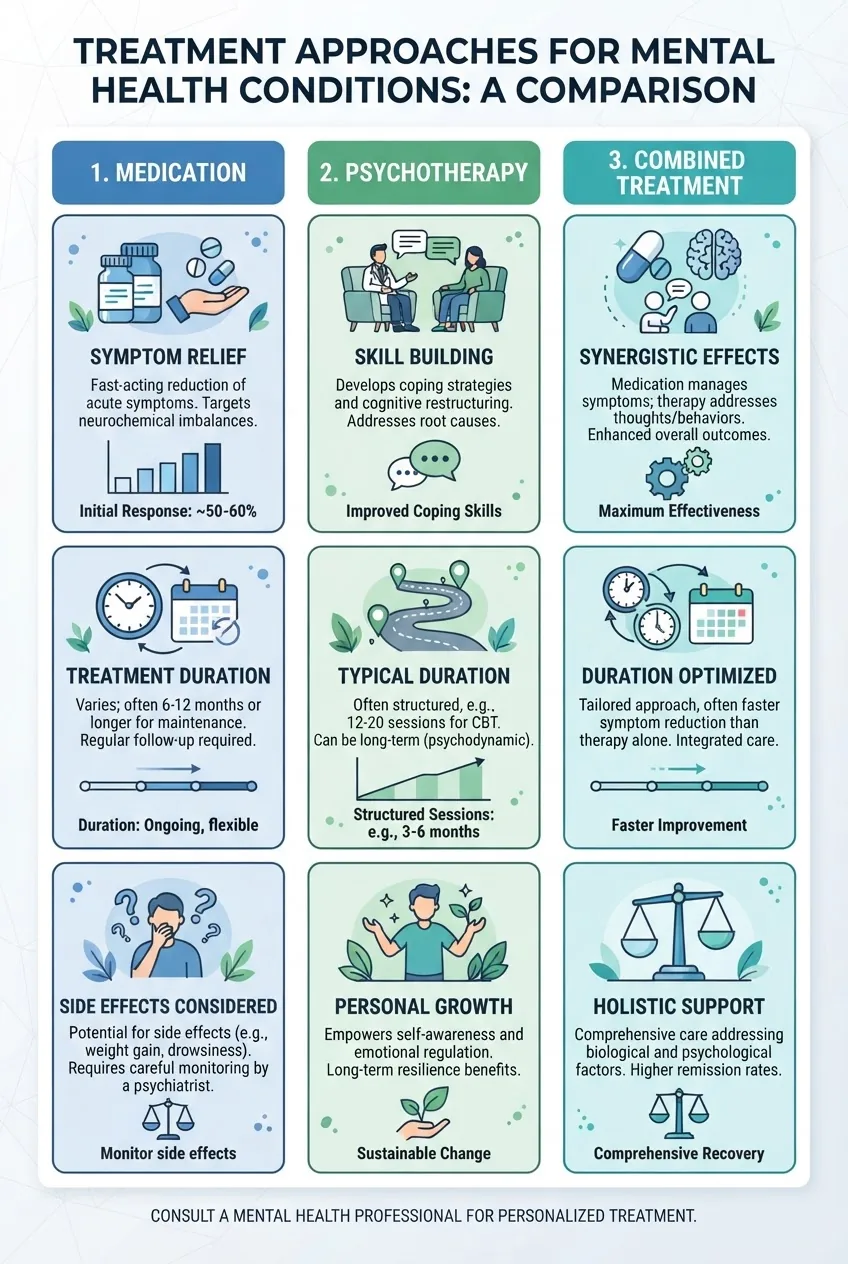
| Option | Typical response/remission | Duration & notes |
|---|---|---|
| Antidepressant medication (SSRIs, SNRIs, atypical) | ~40–60% response on first adequate trial (According to a 2022 systematic review) | 4–12 weeks to response; maintenance often 6–12 months or longer for recurrent cases |
| Psychotherapy (CBT, IPT, behavioural activation) | ~40–60% response; effectiveness comparable to meds for mild–moderate depression | Typically 8–20 weekly sessions; durable benefits with relapse prevention skills |
| Combined therapy (medication + psychotherapy) | Higher response/remission rates (often 60–80% depending on severity) | Preferred for moderate–severe depression; coordinated care improves functional recovery |
Medication details:
- SSRIs (e.g., sertraline, escitalopram) increase serotonin availability; commonly first-line due to tolerability.
- SNRIs (e.g., venlafaxine, duloxetine) affect serotonin and norepinephrine—often chosen if SSRI insufficient.
- Atypical antidepressants (e.g., bupropion, mirtazapine) have different receptor targets and can be useful for specific symptom clusters.
Psychotherapy options:
- Cognitive Behavioural Therapy (CBT) targets distorted thinking and behavioural patterns.
- Interpersonal Therapy (IPT) addresses relationship difficulties that sustain depressive episodes.
- Behavioural activation focuses on increasing rewarding activities to counter avoidance.
Emerging and adjunctive treatments:
- Ketamine/esketamine for rapid reduction of suicidal ideation in TRD (According to 2021 clinical trials).
- Psychological adjuncts (mindfulness-based cognitive therapy) reduce relapse risk for recurrent depression.
- Somatic treatments (ECT, TMS) for severe or resistant cases show strong efficacy in appropriate candidates.
Comparative guidance: For high-functioning presentations where life responsibilities matter, consider tailored brief therapy and occupational supports—see high functioning depression management strategies. For comprehensive MDD treatment strategies, see major depressive disorder effective treatments.
Clinical trade-offs and shared decision-making:
- Antidepressants can cause side effects (sexual dysfunction, GI upset, sleep changes) that must be weighed against functional gains.
- Psychotherapy requires time and engagement; access can be limited by cost and availability.
- Combination therapy typically yields the best balance of symptom reduction and functional recovery for moderate-to-severe cases.
Transition: When standard treatments fail to deliver adequate response, clinicians move into treatment-resistant strategies; the following section details these latest approaches and local availability in Sydney.
How is treatment-resistant depression managed and what new approaches are available?
Answer: Treatment-resistant depression (TRD) is managed with stepwise escalation—optimising antidepressants, augmentation, evidence-based somatic treatments (ECT, TMS), novel agents (ketamine/esketamine), psychotherapy adjustments and clinical trials where available.
Term: Treatment-resistant depression commonly means inadequate response to two or more antidepressant trials at adequate dose and duration; evaluation includes adherence, comorbidities, and correct diagnosis.
Optimisation and augmentation
Direct answer: Before labeling TRD, clinicians confirm medication adherence, adequate dosing and minimum trial length (generally 6–8 weeks), treat comorbid anxiety or substance use, and consider augmentation with atypical antipsychotics, lithium or thyroid hormone, which improve outcomes for some patients.
Evidence: Augmentation with atypical antipsychotics (e.g., aripiprazole) or lithium shows benefit in RCTs (According to a 2020 meta-analysis); risks include metabolic and neurological side effects requiring monitoring.
Electroconvulsive therapy (ECT)
Direct answer: ECT is highly effective for severe and resistant depression, producing rapid symptom relief in many patients, particularly those with psychotic features or high suicide risk.
Clinical notes: ECT response rates can exceed 60–80% in treatment-resistant cohorts; common short-term cognitive side effects are managed with treatment planning and follow-up. Access is available at specialised psychiatric services in major Australian hospitals and private clinics.
Transcranial magnetic stimulation (TMS)
Direct answer: TMS is a non-invasive neuromodulation option for TRD with moderate response rates and favourable side-effect profile, typically requiring daily outpatient sessions for 4–6 weeks.
Evidence: Systematic reviews show TMS benefits in patients failing at least one medication trial (According to multiple peer-reviewed trials).
Ketamine and esketamine
Direct answer: Intravenous ketamine and intranasal esketamine can produce rapid symptom reduction, including suicidal ideation, for some TRD patients but require supervised administration and ongoing follow-up.
Safety and evidence: Short-term efficacy is robust in controlled trials (According to 2019–2022 clinical trial data), but long-term safety and strategies for maintenance remain under study; treatment is available at specialist clinics in Australia under careful protocols.
Psychotherapy adjustments and specialised models
Direct answer: For TRD, switching to or adding specialised psychotherapies (CBT for chronic depression, schema therapy, behavioural activation) and addressing psychosocial barriers can improve outcomes, especially when combined with somatic treatments.
Practical pathway: Many Sydney clinics follow stepped care—comprehensive reassessment, optimisation, augmentation, somatic options, and referral to tertiary services or clinical trials if needed. For an in-depth medication/therapy protocol list, see Treatment for Treatment Resistant Depression: Medication and Therapy.
Local availability and clinic notes: Major Sydney mental health services (public and private) provide assessment, ECT and TMS; ketamine programs operate in specialist clinics with anesthetic and monitoring capacity. For patients, clinicians provide stepwise plans detailing expected timelines and monitoring schedules.
Patient scenario (anonymised, hypothetical): A 32-year-old man with TRD received two adequate SSRI trials and CBT with partial response; after augmentation with lithium and a course of TMS he achieved significant symptom reduction within 10 weeks and began a maintenance psychotherapy program.
Transition: Preventing relapse is crucial after remission; next, targeted practices that support long-term mental health.
How can relapse be prevented and what supports maintain long-term mental health?
Answer: Preventing relapse requires an active plan: medication adherence, ongoing therapy or booster sessions, lifestyle measures, psychosocial supports and early-warning monitoring to intervene quickly if symptoms recur.
- Continue prescribed medication as advised: Maintain recommended maintenance duration—6–12 months after first episode; longer for recurrent or severe cases; discuss tapering only with your prescriber.
- Ongoing psychotherapy or booster sessions: Periodic CBT or IPT boosts help consolidate coping skills and reduce relapse.
- Lifestyle foundations: Regular physical activity, good sleep hygiene and balanced diet support resilience.
- Social connectedness: Maintain supportive relationships and community engagement; peer support groups can aid recovery.
- Early-warning signs and action plan: Work with your clinician to identify symptom patterns and rapid response steps (e.g., medication review, increased therapy frequency).
- Manage comorbidities: Treat anxiety, substance use and medical conditions that raise relapse risk.
- Plan for transitions: During life changes (new job, childbirth) arrange additional supports and check-ins.
For targeted relapse strategies after severe episodes, see severe depression relapse prevention.
Transition: Knowing when to seek professional help—and where to find it locally in Sydney—can shorten delays to effective care.

When should I seek professional help, and what Sydney resources are available?
Answer: Seek professional help if symptoms impair daily functioning, persist beyond two weeks, or if you experience suicidal thoughts—Sydney offers public mental health services, private psychiatrists, specialised clinics and crisis lines for urgent support.
Early warning signs: escalating withdrawal, persistent hopelessness, sleep disturbance, appetite change, marked functional decline, or suicidal ideation. For diagnosis distinctions, see persistent depressive disorder diagnostic guide.
Sydney resources snapshot:
- State public mental health services and emergency departments for crisis care.
- Private psychiatrists and psychologists for outpatient care; many offer telehealth.
- Specialist clinics providing ECT, TMS, and ketamine programs in metropolitan Sydney.
- Lifeline (telephone crisis support) and local community mental health organisations offer immediate help; for national stats and prevalence context see depression prevalence in Australia.
Important: If you have immediate thoughts of harming yourself call emergency services or a crisis line. Term: Psychiatric evaluation typically includes risk assessment, medical review, and discussion of treatment options tailored to severity and goals.
Transition to close: Below are final takeaways and steps readers can take to act on this information.
What key takeaways should people know about cure, remission and next steps?
Answer: The term “cure” is rarely used—aim for remission and sustained recovery through evidence-based treatments, personalised care, and relapse prevention; seek specialist assessment for severe or treatment-resistant cases.
Summary actions:
- Accept that remission and recovery are realistic goals for many; plan for maintenance and relapse prevention.
- Work with clinicians to select evidence-based combinations (medication + therapy) where appropriate.
- Escalate care to specialised treatments for severe or treatment-resistant presentations and ask about local clinical trial options.
- Use Sydney-specific resources and emergency services when risk is present.
If you’re ready to act: arrange a psychiatric assessment or GP review to discuss tailored treatment options, ask about measurement-based care (regular symptom rating), and request a written relapse prevention plan. For specialist guidance on TRD medication and therapy combinations, see Treatment for Treatment Resistant Depression: Medication and Therapy and consult local services listed above.
Final note on limitations: Evidence continues to evolve—new interventions (e.g., esketamine, rapid-acting agents) show promise but require long-term study. For authoritative public guidance consult the Australian Government Department of Health (https://www.health.gov.au/) and WHO resources (https://www.who.int/health-topics/depression).
Conclusion: While absolute “cure” is uncommon language in modern psychiatry, remission and long-term recovery are realistic and achievable for many people with depression—including severe and treatment-resistant cases—through timely, evidence-based, personalised care. Contact your GP or a Sydney mental health clinic to begin an assessment and build a treatment and relapse-prevention plan.