

major depressive disorder treatment: by the end of this hands-on guide you will be able to assess symptom patterns, select and sequence evidence-based treatments, and apply day-to-day management strategies suitable for complex or treatment-resistant presentations. Time required: plan 3–6 clinical sessions (3–12 weeks) to implement and adjust a treatment plan. Skill level assumed: informed patient, caregiver or clinician with basic health literacy.
Before you start
- A current symptom log (daily mood, sleep, appetite, medication, side effects) for 2 weeks.
- A list of current medications and medical history, including alcohol or substance use.
- Access to a GP or mental health clinician in Sydney for local referrals and Medicare/NDIS info.
- Phone numbers for crisis lines and your preferred clinic; emergency plan if suicidal thoughts increase.
- Time: 30–60 minutes per session for assessments; set aside 15–30 minutes daily for self-monitoring.
-
Assess symptoms and differentiate diagnoses.
Understanding Major Depressive Disorder and Its Symptoms
major depressive disorder (MDD), often called clinical depression, is a sustained episode of low mood, loss of interest and reduced functioning lasting at least two weeks. This section helps you recognise signs and separate unipolar MDD from other conditions like bipolar depression.

Core signs to track (use your symptom log):
- Persistent low mood or depressed mood most of the day
- Marked loss of interest or pleasure in previously enjoyed activities
- Sleep disturbance (insomnia or hypersomnia)
- Appetite/weight changes — loss or gain
- Psychomotor agitation or slowing
- Fatigue or loss of energy
- Difficulty concentrating, indecisiveness
- Recurrent thoughts of death, suicidal ideation or plans
Compare these with overlapping concepts:
- Clinical depression vs general sadness: duration (weeks), functional impairment, and associated cognitive changes distinguish MDD.
- bipolar depression diagnostic criteria — consult when there is a history of elevated mood, hypomania or mania.
- depression DSM-5 criteria — useful for structured clinical assessment.
- alternative depression terms — to navigate varying terminology in clinical notes and literature.
- fatigue versus depression — to avoid misattribution of symptoms.
- DSM-5 depressive disorders overview — places MDD within the diagnostic spectrum for clarity.
Practical step: use the first two weeks of your symptom log to map frequency, severity (0–10), and trigger patterns; flag suicidal ideation immediately to emergency services.
-
Map risk factors and likely causes.
Causes and Risk Factors of Major Depressive Disorder
Depression results from an interaction of biological, psychological and social factors. Use this map to prioritise interventions that target the most modifiable drivers in your case.
Common contributors:
- Genetic vulnerability: family history of MDD or bipolar increases risk.
- Neurobiology: altered monoamine neurotransmission, inflammatory signalling, HPA-axis dysregulation; see detailed review in a peer-reviewed meta-analysis.
- Medical comorbidity: thyroid disease, chronic pain, diabetes, neurological disorders can precipitate depressive episodes.
- Medication/substance effects: certain drugs (e.g., beta-blockers, corticosteroids, alcohol) can worsen mood.
- Psychosocial stressors: unemployment, bereavement, relationship breakdown, social isolation.
- Early life adversity: trauma, neglect, adverse childhood experiences.
- Socioeconomic and regional factors: living in high-density urban areas, social disadvantage or recent migration.
Australia-specific context: according to a 2023 Australian Government mental health report, regional access and socioeconomic stressors remain key modifiable risks; use local services for targeted support (Australian Government Department of Health).
Practical step: mark top three likely contributors in your file and list possible remedies (medication check, treat medical causes, social supports, trauma-focused therapy).
-
Review and choose treatment categories.
Overview of Major Depressive Disorder Treatment Options
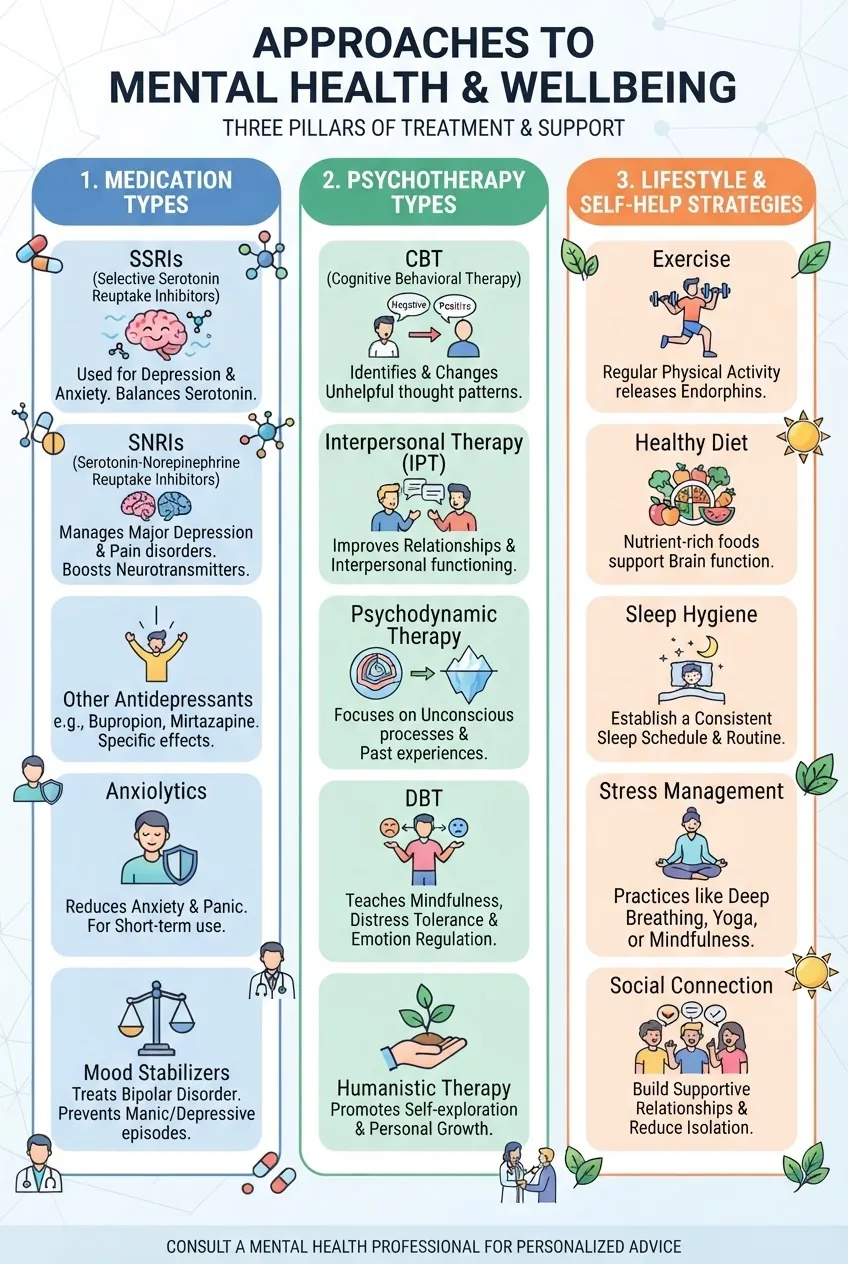
Treatment is modular: pharmacotherapy, psychotherapy, somatic treatments and lifestyle/self-help. Selection depends on episode severity, prior response, coexisting conditions, and patient preference.
Categorised options:
- Medications: SSRIs, SNRIs, atypical antidepressants, tricyclics, MAOIs, augmentation agents.
- Psychotherapies: cognitive behavioural therapy (CBT), interpersonal therapy (IPT), behavioural activation, trauma-focused therapies.
- Somatic treatments: electroconvulsive therapy (ECT), transcranial magnetic stimulation (TMS), ketamine/esketamine, structured inpatient care.
- Lifestyle and self-help: exercise prescription, sleep hygiene, alcohol reduction, structured routines, social re-engagement.
- Multimodal and stepped care: sequencing and combining modalities to maximise response while minimising side effects.
Note: for specific subtype adaptations, consider atypical depression treatment options when mood reactivity or hypersomnia are present.
Clinical references: follow Australian clinical guidelines for stepped care (Australian Government Department of Health) and NIMH summaries for evidence levels (NIMH).
Practical step: create a 12-week trial plan that designates primary treatment, measurable targets (PHQ-9 drop of ≥5 points by week 6), and contingency steps if no response.
-
Start medication when indicated and monitor carefully.
Medication Treatments for Major Depressive Disorder

Medication is indicated for moderate-to-severe episodes, psychotic features, severe functional impairment, or when psychotherapy alone is insufficient.
Key antidepressant classes, mechanisms and practical notes
Class Mechanism Typical agents Notes/side effects Selective serotonin reuptake inhibitors (SSRIs) Increase synaptic serotonin by blocking reuptake Sertraline, escitalopram, fluoxetine Well-tolerated; GI upset, sexual dysfunction, initial anxiety; start low, assess 4–6 weeks. Serotonin–noradrenaline reuptake inhibitors (SNRIs) Block serotonin and noradrenaline reuptake Venlafaxine, duloxetine Useful for comorbid pain; monitor blood pressure (venlafaxine at higher doses). Atypical antidepressants Various mechanisms (e.g., NDRI, NaSSA) Bupropion, mirtazapine Bupropion: less sexual side effects; mirtazapine: appetite/sedation effects helpful for insomnia/weight loss. Tricyclics (TCAs) Block reuptake of monoamines; anticholinergic effects Amitriptyline, nortriptyline Effective but cardiotoxic in overdose; ECG recommended in older patients. Monoamine oxidase inhibitors (MAOIs) Inhibit monoamine breakdown Phenelzine, tranylcypromine Dietary tyramine interactions; reserved for resistant cases or atypical presentations. Practical prescribing steps
- Start low and titrate: e.g., sertraline 25–50 mg daily, increase every 1–2 weeks to effect.
- Expect delayed onset: initial partial response at 2–4 weeks, meaningful response in 6–8 weeks.
- Monitor side effects weekly for 4 weeks: use your symptom log for sedation, GI symptoms, sexual side effects, and suicidality.
- Assess adherence and interactions: cross-check with other medications and substances (e.g., St John’s Wort risks serotonin syndrome).
- If partial/no response: consider dose optimisation, switching class, or augmentation with antipsychotic, lithium, or thyroid hormone per specialist advice.
Special situations:
- Pregnancy and breastfeeding: weigh risks and benefits with an obstetrician and psychiatrist.
- Older adults: start at half adult starting doses; monitor hyponatraemia and orthostatic hypotension.
- Psychotic depression: combination of antidepressant plus antipsychotic or ECT often required — see psychotic depression treatments.
Evidence and authority: treatment sequencing and augmentation strategies are summarised in NIMH resources and clinical trials; see NIMH and a 2022 meta-analysis for augmentation efficacy (NIMH, The Lancet Psychiatry).
-
Deliver psychotherapy according to needs and track outcomes.
Psychotherapy and Behavioral Strategies
Psychotherapy is first-line for mild-to-moderate MDD and an essential adjunct for moderate-to-severe cases. Choose therapy based on presenting problems, availability and patient preference.
Step-by-step therapy selection and implementation
- Identify the primary problem: cognitive distortions, interpersonal loss, behavioural withdrawal, trauma history.
- Match therapy: cognitive behavioural therapy (CBT) for negative thinking and behavioural activation; interpersonal therapy (IPT) for role transition and grief; trauma-focused therapies for PTSD comorbidity.
- Set measurable targets: weekly activity scheduling, exposure tasks, or thought records; review progress every 4–6 sessions.
- Frequency and duration: standard CBT: 8–20 weekly sessions; IPT: 12–16 sessions; psychotherapy may be intensified to twice weekly in acute suicidal risk under specialist care.
- Combine when needed: CBT + medication for moderate-severe MDD improves outcomes relative to either alone in many trials.
How to apply behavioural strategies at home
Use these practical steps between sessions:
- Activity scheduling: plan 3 purposeful activities daily (15–60 minutes each) and record mood pre/post (0–10).
- Behavioural experiments: test negative predictions with small, measurable tests (e.g., attend a 30-minute group and note actual vs expected outcome).
- Thought records: write automatic negative thought, evidence for/against, and balanced alternative; practice 3 times weekly.
- Interpersonal tasks: map support network, schedule two social contacts weekly, and practice assertive communication in one interaction per week.
Clinical caveat: if suicidal ideation escalates or psychotic features appear, move to urgent specialist review; psychotherapy alone is insufficient in those contexts.
-
Implement lifestyle prescriptions and self-help routines.
Lifestyle Changes and Self-Help Techniques to Manage Depression
Behavioral activation and targeted lifestyle prescriptions reliably reduce depressive symptoms. Use the list below as daily and weekly thresholds.
- Exercise: 30 minutes moderate aerobic exercise, 5 days per week, or 150 minutes/week total. Start with 10–15 minutes if deconditioned and increase by 5 minutes every three days.
- Sleep hygiene: fixed wake time, 7–9 hours nightly target, no daytime naps >20 minutes, wind-down routine 60 minutes before bed (no screens), light exposure within 30 minutes of waking for 15 minutes.
- Nutrition: regular meals with lean protein and whole grains; limit alcohol to <2 standard drinks/day and avoid binge patterns.
- Social contact: schedule 2 social interactions/week, aim for at least one in-person per week.
- Mindfulness and stress reduction: 10 minutes daily of guided breathing or mindfulness practices; apps can support adherence.
- Structured routine: daily plan with 3 priorities, including self-care and one activity linked to pleasure or achievement.
breaking the depression cycle — use behavioural activation to interrupt downward spirals.
high functioning depression management — adapt routines to those who preserve external function but feel internally depleted.
Practical step: commit to a 6-week lifestyle plan with weekly check-ins and measurable targets (sleep window, exercise minutes, social contacts). Track adherence in your symptom log.
-
Recognise and apply specialist options for non-response.
Managing Treatment-Resistant Major Depressive Disorder
Treatment-resistant depression (TRD) is commonly defined as failure to respond to two adequate antidepressant trials. A stepwise specialist approach improves outcomes.
Key clinical strategies:
- Confirm diagnosis and adherence: re-evaluate for bipolar spectrum, substance use, medical causes, and confirm adequate dose/duration (6–8 weeks at therapeutic dose).
- Switching versus augmentation: switch antidepressant class or augment with antipsychotic (e.g., quetiapine), lithium, or atypical agents, based on prior tolerability.
- Somatic options: consider ECT for severe, psychotic, or acutely suicidal cases; consider TMS for focal treatment-resistant presentations; ketamine/esketamine for rapid antidepressant effect in specialist settings.
- Integrated psychotherapy: combine evidence-based psychotherapy with biological treatments for synergy.
- Specialist referral: refer to a psychiatrist or specialised TRD clinic for multimodal care and clinical trials.
treatment for treatment resistant depression
Clinical example (Sydney case study): In Sydney, a 42-year-old teacher with recurrent MDD failed two SSRI trials. After a 6-week medical review, the team switched to venlafaxine, augmented with low-dose quetiapine and commenced weekly CBT. At 12 weeks PHQ-9 dropped from 22 to 8 and return-to-work graded plan began. This illustrates sequencing: reassess, optimise, augment, and combine.
severe depression relapse prevention
Referral thresholds: no meaningful improvement after 2 adequate trials, increasing suicidality, psychotic features, or severe functional impairment — escalate to psychiatry or an inpatient pathway.
-
Create a safety and recovery plan and know when to escalate.
When to Seek Professional Help and What to Expect
Knowing when to seek help is essential for safety and recovery. If household safety or active suicidal plans exist, call emergency services immediately or present to the nearest emergency department.
Urgent signs requiring immediate care:
- Persistent suicidal ideation with intent or a plan
- Rapid deterioration in functioning or severe psychomotor slowing
- Severe self-neglect, dehydration or inability to meet basic needs
- New psychotic symptoms (auditory hallucinations, fixed delusional beliefs)
What to expect when you contact a clinician:
- Initial risk assessment and safety plan within 24–72 hours
- Comprehensive review of medications, medical causes, and psychosocial stressors
- Shared decision-making on treatment options; written plan with measurable targets
- Referral pathways to psychiatry, ECT services, or inpatient care if required
Legal and disability considerations: questions like is depression a mental disability under Australian law depend on functional impairment and context; ask your GP about National Disability Insurance Scheme (NDIS) eligibility and local support services. For prognosis queries like can depression be cured? see the linked guide for an evidence-based discussion.
Authority and resources: Australian clinical pathways and crisis contacts are listed on the Australian Government Department of Health. For evidence syntheses on treatments and natural history, consult the NIMH and peer-reviewed trials in journals such as The Lancet Psychiatry.
Common mistakes and how to avoid them
I have observed these common failures in practice and how I correct them:
- Rushing to change medication after 2 weeks — I now always wait 6–8 weeks at a therapeutic dose before declaring failure, unless safety concerns demand earlier change.
- Under-documenting side effects — I instruct patients to record daily side effects for the first month so minor issues can be managed before causing non-adherence.
- Failing to rule out bipolar spectrum — I ask targeted screening questions for past periods of high mood; missing this leads to treatment choices that can worsen course.
- Using generic lifestyle advice — I now prescribe exact exercise minutes and sleep windows rather than vague “get more exercise.”
Checklist — Are you on track?
- Two-week symptom log completed and reviewed.
- Medical causes screened (thyroid, B12, CBC, LFTs as indicated).
- If using medication: dose reached therapeutic range for ≥6 weeks or appropriately adjusted.
- Psychotherapy initiated or planned with measurable weekly goals.
- Daily lifestyle targets set: exercise minutes, sleep window, social contacts.
- Safety plan in place with emergency contacts and crisis steps.
- Specialist referral made if no response to two adequate trials or urgent risk present.
When to call in a professional
Call a GP or mental health clinician now if suicidal thoughts become active, if psychosis emerges, or if you cannot meet self-care needs. For non-urgent escalation, seek psychiatry referral after two failed adequate trials, rapidly worsening symptoms, or complex comorbidity requiring multimodal treatment.
Conclusion and next steps
You now have a stepwise plan: assess and document symptoms, map causes, select evidence-based treatments, and execute lifestyle prescriptions. Start a structured 12-week plan with measurable targets, keep a daily log, and escalate to specialised care if two adequate trials fail or risk increases. To begin, book a GP review and bring your two-week symptom log and medication list for a focused treatment discussion.
CTA: If you’re in Sydney and need specialist assessment, contact your GP for a psychiatry referral or visit local mental health clinics listed on the Australian Government Department of Health site (health.gov.au).