

treatment for treatment resistant depression explained clearly: this hands-on guide will leave you able to outline a stepped clinical pathway, choose evidence-based medication and therapy options, and set up monitoring for safety and quality of life within a realistic 4–12 week planning window. Skill level assumed: clinician, GP, or informed caregiver working with a treating psychiatrist.
By the end you will have: a structured assessment checklist, a prioritised list of medication and augmentation strategies, protocols for neuromodulation and ketamine sessions, and practical support measures for patients living with TRD.
Before you start
- Access to complete medication history, current dose and duration, and medical comorbidity notes.
- Baseline rating scales: PHQ-9, MADRS or HAM-D recorded within 7 days.
- Consent forms for advanced treatments (ECT, TMS, ketamine) and emergency contact details.
- Local referral pathways to psychiatry, neuromodulation services and community supports in Sydney.
- Monitoring tools: ECG capability, serum lithium and thyroid testing access, and weekly nurse or clinician follow-up capacity.
Transitioning into the core clinical content below, we begin with definitions and scope to align terminology and diagnosis before operational steps.
Understanding Treatment Resistant Depression
Treatment resistant depression (TRD) — sometimes called refractory depression or medication resistant depression — describes Major Depressive Disorder that has not achieved satisfactory response after adequate trials of standard antidepressant treatments. Clinically, TRD is commonly defined as failure to respond to two or more antidepressant trials of adequate dose and duration (usually ≥6 weeks each) delivered with good adherence.
Why the label matters: calling a case “TRD” changes the pathway from single-drug switching to a multimodal escalation strategy that combines targeted medications, augmentation agents, and non-pharmacological therapies.
Key terms and distinctions to use consistently:
- Primary non-response: minimal symptom change after an adequate trial.
- Partial response: symptomatic improvement but residual functional impairment.
- Relapse: return of symptoms after remission.
Contextual resources: for patients whose depression presents atypically, review atypical depression symptoms and treatment options before labelling TRD.
For diagnostic clarity against formal criteria, check the DSM 5 criteria for depression and local prevalence figures at depression prevalence in Australia.
Terminology alternatives are useful in patient discussions; see alternative terms for depression for accessible language options.
Transition: with definitions clear, the next section covers mechanisms and risk factors that make depression resistant to treatment.
Causes and Mechanisms Behind Treatment Resistant Depression
Understanding the pathophysiology and clinical factors that underpin treatment failure helps choose the right escalation strategy. Mechanisms are multifactorial—biological, psychological, and social—and often overlap.
Biological drivers
Neurobiological contributors include altered monoaminergic signalling, glutamatergic dysregulation, neuroinflammation, hypothalamic–pituitary–adrenal (HPA) axis dysfunction, and disrupted neuroplasticity. Genetic polymorphisms (e.g., CYP450 variants) can alter drug metabolism reducing effective exposure.
Pharmacological and adherence factors
Common practical causes of apparent resistance: inadequate dose, too-short trial (<6 weeks), poor adherence, drug–drug interactions, or subtherapeutic blood levels (e.g., of lithium or tricyclic antidepressants). Always confirm adherence objectively where possible.
Comorbidities and secondary causes
Medical contributors: thyroid disease, inflammatory conditions, chronic pain, substance use, and neurological disorders. Psychiatric comorbidity such as anxiety disorders, personality disorders, and undiagnosed bipolar spectrum illness increase risk of poor antidepressant response—see bipolar depression diagnostic criteria when mood polarity is uncertain.
Psychosocial and environmental risk factors
Early trauma, ongoing psychosocial stress, social isolation, and low socioeconomic status worsen prognosis. Treatment must address these alongside biological interventions.
Diagnostic assessment steps (practical)
- Confirm diagnosis: verify symptom duration and severity against DSM-5 criteria; consult DSM 5 depressive disorders overview for differential diagnosis.
- Medication history: document agents, doses, duration, tolerability, and objective adherence evidence (pharmacy records if available).
- Investigations: TSH, full blood count, B12, inflammatory markers (CRP), and relevant toxicology; order ECG when considering tricyclics or QT-prolonging agents.
- Psychiatric comorbidity screen: assess for bipolar features, psychosis, personality disorder traits, and substance dependence.
- Functional baseline: PHQ-9/MADRS scores, occupational function, and caregiver reports.
Further reading on biological mechanisms appears in detailed overviews of the pathogenesis of depression.
Transition: after a systematic assessment, the next large section details medication strategies and practical comparisons.
Medication Options for Treatment Resistant Depression
When standard SSRI/SNRI monotherapy fails, clinicians consider switching, combining, or augmenting. Below is a comparison table of commonly used agents and augmentation strategies, followed by practical guidance and selection criteria.
| Agent/Strategy | Mechanism | When to use | Key monitoring/side effects |
|---|---|---|---|
| SSRIs (e.g., sertraline, escitalopram) | Selective serotonin reuptake inhibition | First-line or switch strategy; ensure adequate dose/duration | GI upset, sexual dysfunction, hyponatraemia in elderly |
| SNRIs (venlafaxine, duloxetine) | Serotonin and norepinephrine reuptake inhibition | Switch if SSRI failure or prominent anergia/pain | BP rise (venlafaxine), withdrawal symptoms |
| Atypical antidepressants (bupropion, mirtazapine) | Dopaminergic/noradrenergic or noradrenergic/antihistaminergic | Augmentation for fatigue/weight loss or insomnia/weight gain, respectively | Seizure risk with bupropion at high doses; sedation with mirtazapine |
| Tricyclics (amitriptyline, nortriptyline) | Broad monoamine reuptake inhibition | Consider after SSRI/SNRI failure; serum level monitoring for nortriptyline | Anticholinergic effects, arrhythmia risk—ECG required |
| Lithium augmentation | Unknown mood-stabilising augmentation; neuroprotective effects | Strong evidence as augmentation for MDD non-responders | Serum levels (0.4–0.8 mmol/L), renal and thyroid monitoring |
| Atypical antipsychotic augmentation (quetiapine, aripiprazole) | Dopamine/serotonin receptor modulation | Partial response to antidepressant, psychotic features or agitation | Metabolic syndrome, extrapyramidal symptoms (monitor weight, lipids) |
| Ketamine / esketamine (rapid-acting) | NMDA receptor antagonism; glutamate surge and synaptogenesis | Rapid reduction in suicidal ideation or severe TRD when available | Acute dissociation, BP rise—clinic-based monitoring required |
| Switching strategy | Change to drug with different mechanism | When partial/no response despite adherence | Manage washout (MAOIs) and cross-taper where necessary |
How to choose: prioritise safety profile, comorbidity, prior response, and patient preferences. For major depressive disorder baseline strategies see major depressive disorder treatment before escalation to TRD protocols.
Augmentation strategies are commonly effective: lithium augmentation has consistent meta-analytic support; atypical antipsychotics (aripiprazole, quetiapine) show benefit in partial responders. Practical selection criteria:
- If insomnia/weight gain prominent: consider mirtazapine.
- If somatic pain/fatigue: consider venlafaxine or bupropion.
- If prior good response to lithium: use lithium augmentation with target trough 0.4–0.8 mmol/L and renal monitoring every 3 months initially.
- For psychotic features, refer for combined antipsychotic strategy and consult psychotic depression treatment options.
Practical dosing and timelines: ensure at least 6 weeks at therapeutic dose (e.g., sertraline ≥100 mg/day, venlafaxine ≥150 mg/day where tolerated) before declaring failure. After augmentation, reassess at 2 weeks for early signals and at 6 weeks for meaningful response.
Clinical trial evidence and guidelines: consult international practice guidelines (APA) and NICE for structured augmentation algorithms; see the APA patient resources on depression and NICE guidance on depression management for protocol detail.
For laboratory and safety monitoring reference the Australian Department of Health recommendations on medication safety and mental health service frameworks; see Australian Government Department of Health resources.
Transition: medication strategies often need to be augmented or replaced by non-pharmacological therapies; the next section covers these in detail.

Therapeutic Approaches Beyond Medication
Therapies beyond medication can be decisive in TRD and include brain stimulation techniques, structured psychotherapies, and rapid-acting biological agents.

-
Offer Cognitive Behavioural Therapy (CBT) or other evidence-based psychotherapies
CBT, behavioural activation, and interpersonal therapy remain key. Deliver at least 12 sessions over 12–16 weeks; consider higher-intensity psychotherapy for patients with complex comorbidity. For TRD, integrate problem-solving modules and relapse prevention plans.
-
Consider Electroconvulsive Therapy (ECT)
ECT is the most effective acute intervention for severe TRD, psychotic depression, and severe suicidality. Procedure outline: general anaesthesia and muscle relaxant, bilateral or unilateral electrode placement, 2–3 sessions/week for 6–12 sessions. Monitor cognition and use objective cognitive testing pre/post-ECT.
Selection: severe life-threatening features or non-response to pharmacological escalation. Refer to an ECT-accredited service for consent and peri-procedural optimisation.
-
Apply Transcranial Magnetic Stimulation (TMS)
TMS is a noninvasive neuromodulation option indicated for TRD without psychosis. Typical course: 5 sessions/week for 4–6 weeks (20–30 sessions). Each session lasts ~20–40 minutes; stimulation targets left dorsolateral prefrontal cortex. Response rates vary; maintenance TMS may be scheduled weekly afterwards.
Procedure steps: baseline psychiatric assessment, motor threshold calibration, daily sessions, weekly outcome measures (PHQ-9/MADRS).
-
Ketamine and esketamine clinic-based therapy
Ketamine (IV) or intranasal esketamine can produce rapid symptom relief within hours to days, particularly for suicidality. Typical IV protocol: 0.5 mg/kg over 40 minutes in clinic with monitoring for 2 hours post-infusion; induction often 2 infusions/week for 2–3 weeks then tapering to maintenance every 1–4 weeks depending on response.
Ensure blood pressure monitoring and treatment for acute dissociative effects. Use in combination with a maintenance plan involving psychotherapy and conventional antidepressant strategy.
-
Psychedelic-assisted therapy (research context)
Psilocybin and MDMA-assisted therapies are emerging in clinical trials for TRD. Currently, they should be delivered within controlled research settings or accredited programs; rigorous psychotherapy before and after dosing is essential.
Refer patients to registered clinical trials where available; see PubMed and trial registries for up-to-date studies (search).
-
Combined psychosocial supports
Structured case management, vocational rehabilitation, family therapy, and peer support groups improve adherence and quality of life. For high-functioning patients, consult high functioning depression management strategies to preserve role functioning.
Transition: after reviewing specific therapies, we next describe integrating medication and therapy in multimodal plans with a practical clinical case example.
Integrating Medication and Therapy: Multimodal Treatment Strategies
A multimodal approach combines targeted pharmacology with a chosen neuromodulation or psychotherapy, personalised to clinical features and patient goals. Integration improves response rates and addresses the lived experience of TRD.
Clinical case example (anonymised):
Case A: “Maria,” 42, with MDD non-responsive to two SSRI trials and partial response to venlafaxine. She has residual anergia and insomnia, no psychosis. Strategy: cross-taper to venlafaxine 225 mg/day, add mirtazapine 15 mg at night for sleep and appetite, and begin weekly CBT plus referral for TMS. Lithium considered if partial response after 6 weeks. Outcome measures set at baseline and every 2 weeks.
Stepwise multimodal protocol (practical):
- Assess and document: baseline mood score (MADRS), safety assessment, and informed consent. Schedule weekly contact for first 4 weeks.
- Initiate or adjust pharmacotherapy: choose switching/augmentation based on history (see medication table). Start low and titrate weekly to target dose over 2 weeks unless intolerant.
- Parallel therapy initiation: start structured psychotherapy (CBT/BA) within 1 week of medication change; plan 12 sessions over 12–16 weeks.
- Consider neuromodulation: for severe cases, schedule ECT or TMS pathways within 2–3 weeks of poor pharmacologic response.
- Monitor and adapt: use PHQ-9 and side-effect checklist weekly; if <25% improvement at 4 weeks, escalate (add augmentation or neuromodulation).
Refer to the primary clinic pillar for integrated protocols and patient pathways for treatment for treatment resistant depression when planning long-term combined care.
Transition: the research landscape is rapidly evolving; the next section summarises the newest treatments and evidence.
New and Emerging Treatments for Treatment Resistant Depression
Research has expanded beyond monoaminergic drugs into rapid-acting and neuromodulatory therapies. Below is a concise summary of contemporary advances and the current level of evidence.
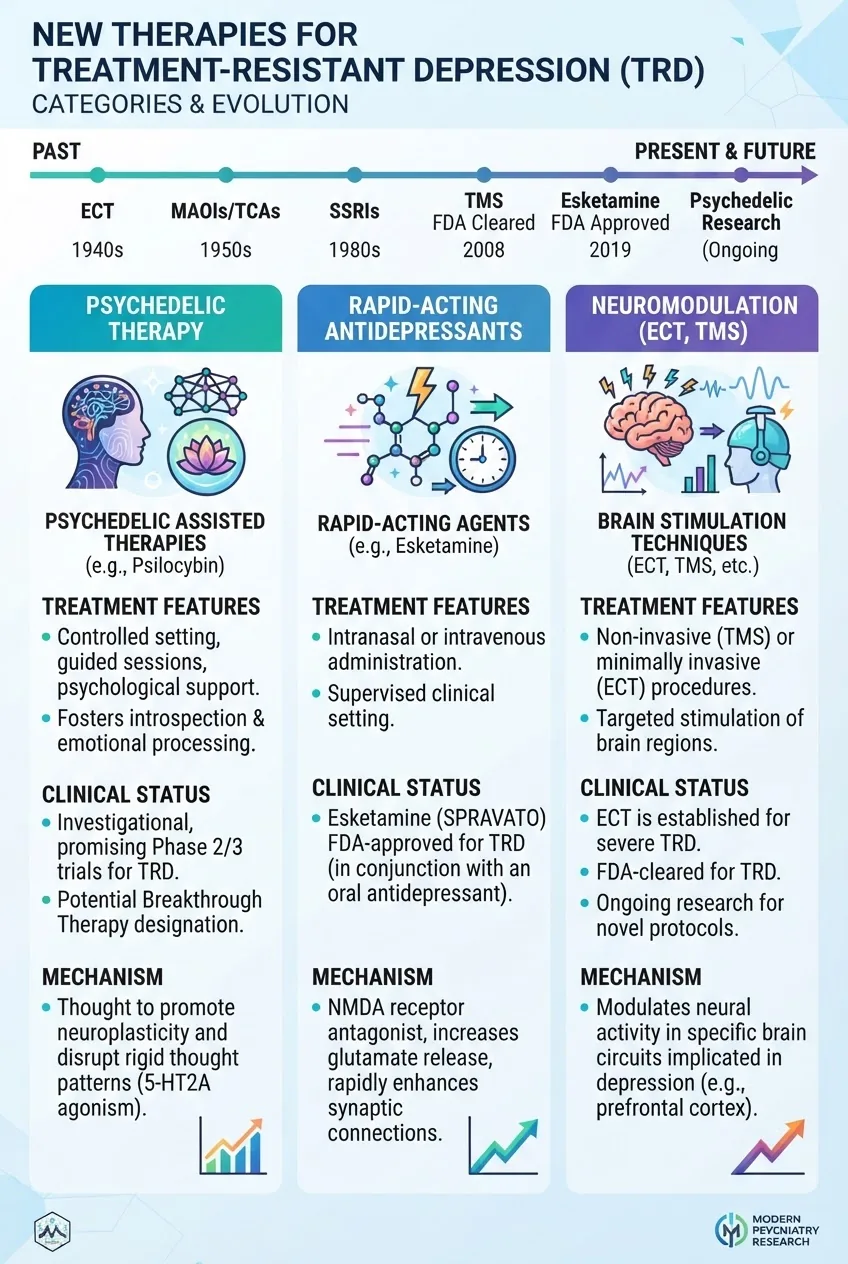
Rapid-acting agents:
- Ketamine and esketamine: robust short-term reductions in suicidality and depressive symptoms; repeated dosing often required. According to a 2022 systematic review on PubMed, effect sizes are large short-term but medium-term durability is variable (PubMed search).
Psychedelic-assisted therapies:
- Psilocybin trials show promising remission rates in small RCTs when combined with psychotherapy; larger phase 3 trials are ongoing. According to a 2023 peer-reviewed clinical trial report on PubMed, psilocybin produced clinically meaningful improvements vs comparator in selected cohorts (PubMed search).
Novel pharmacological targets:
- Agents targeting glutamate, GABA, and neuroinflammation are in trials. Precision medicine approaches (biomarker-directed choices) are exploratory but show potential.
Implementation caveats:
- Many new treatments are available only in specialist or trial settings in Australia; ensure patients meet eligibility and safety criteria.
- Discuss long-term plan: rapid relief must translate to durable remission via maintenance therapy and psychosocial supports.
For clinicians: review methodological considerations in TRD trials—small sample sizes, heterogeneity of prior treatments, and high placebo response in some trials—before generalising outcomes into practice. For ongoing trial enrolments and up-to-date evidence, search PubMed and clinicaltrials.gov regularly (PubMed).
Transition: alongside treatments, supporting patients’ lived experience is essential for sustained outcomes.
Living with Treatment Resistant Depression: Patient Perspectives and Support
Living with treatment resistant depression involves chronic symptom burden, fluctuating motivation, social role impact, and frequent healthcare contacts. Practical supports improve adherence and quality of life.
Key challenges patients report:
- Repeated treatment failures leading to hopelessness and loss of agency.
- Functional impairment at work and in relationships despite active treatment.
- Side effects that reduce willingness to continue medications.
Practical advice and resources:
- Set realistic time frames: explain that some strategies require 4–12 weeks to judge meaningful change; rapid-options like ketamine can reduce acute risk but need maintenance plans.
- Use collaborative care: involve carers, peer support, and a case manager to coordinate appointments, medication monitoring, and crisis plans.
- Functional goals: set small measurable goals (e.g., 30 minutes of activity/day, graded return-to-work steps) and record progress weekly.
- Self-management tools: behavioural activation scheduling, sleep hygiene packs, and coping plans for crisis moments.
For questions about prognosis and the limits of treatment, point patients to a balanced resource: can depression be cured? and discuss expectations honestly: many patients achieve partial or full remission with tailored multimodal care.
When depressive cycles persist, structure work with psychoeducation on the depression cycle and breaking the vicious loop and consider relapse prevention therapy modules.
Distinguish fatigue from core depressive symptoms using validated screening tools; see guidance on fatigue versus depression symptoms to avoid misattribution of persistent tiredness.
Transition: patients and clinicians must systematically manage side effects and risks to maintain engagement with complex treatment plans.
Managing Side Effects and Risks of TRD Treatments
Side effects are a major barrier to adherence. Below are common medication and therapy risks with concrete management tips.
- SSRIs/SNRIs: sexual dysfunction — discuss dose adjustment, change class (bupropion add-on), or referral to sexual health specialist.
- Atypical antipsychotics: metabolic syndrome — baseline weight, lipids, glucose and repeat at 6 weeks, 3 months, then quarterly.
- Lithium: renal and thyroid function — measure serum levels 5–7 days after dose change and every 3 months once stable; target 0.4–0.8 mmol/L in augmentation.
- Ketamine/esketamine: transient dissociation and BP rise — monitor vitals pre-, during, and for 2 hours post-session; avoid in uncontrolled hypertension.
- ECT: cognitive effects — perform baseline cognitive testing and employ spacing/maintenance strategies to reduce memory impact.
Practical monitoring checklist:
- Baseline ECG for TCAs and antipsychotics with QT risk.
- Routine metabolic panel every 3 months with antipsychotic use.
- Immediate review for suicidal ideation escalation—have crisis plan and emergency contact numbers ready.
For relapse-risk management protocols, see guidance on severe depression relapse prevention.
Transition: the hands-on section below provides the step-by-step clinician workflow to operationalise the above recommendations.
Hands-On Steps: Implementing a TRD Treatment Pathway
This numbered procedural section is the heart of the hands-on guide. Each step starts with an action-first bold phrase and includes timings, thresholds, and measurable checks.
-
Confirm diagnosis and baseline metrics (0–7 days)
Action: complete DSM-5 diagnostic checklist and score PHQ-9 and MADRS. Thresholds: PHQ-9 ≥15 or MADRS ≥20 indicates moderate–severe depression requiring expedited intervention. Collect TSH, FBC, B12, CRP, liver function tests, and urine toxicology within 7 days.
-
Review and verify medication history (0–7 days)
Action: obtain pharmacy dispensing records, note doses and duration. Adequate trial = ≥6 weeks at therapeutic dose (e.g., sertraline ≥100 mg/day). If trials inadequate, document and extend trial rather than escalate.
-
Assess for bipolar spectrum and psychosis (0–7 days)
Action: screen with Mood Disorder Questionnaire and psychosis items. If positive, consult or refer for specialist review—do not augment with antidepressants alone without mood stabiliser consideration.
-
Decide on medication strategy (Week 1–2)
Action: choose switch vs augmentation using the decision algorithm: if prior partial response, choose augmentation (lithium or atypical antipsychotic); if no response and intolerance, switch to different class. Document informed consent and monitoring plan.
-
Initiate psychotherapy in parallel (Week 1–2)
Action: begin weekly CBT/BA or IPT sessions (12 sessions minimum). For remote patients, arrange telehealth weekly 50-minute sessions with homework and behavioural activation scheduling.
-
Plan for neuromodulation where indicated (Week 2–4)
Action: refer for TMS (schedule 5/week × 4–6 weeks) or ECT (2–3/week until response). For ketamine, set IV infusion protocol: 0.5 mg/kg over 40 minutes with BP every 15 minutes during the 2-hour monitoring window.
-
Set measurement-based care and follow-up (Weekly for 6 weeks)
Action: PHQ-9 weekly, side-effect checklist, dose adjustments if intolerable. If <25% improvement at 4 weeks, escalate to next-level intervention (add augmentation or neuromodulation).
-
Safety and crisis planning (Immediate and ongoing)
Action: complete suicide risk assessment every contact; if imminent risk, activate emergency protocols. Maintain written crisis plan with 24/7 contacts and escalate to emergency services when necessary.
-
Long-term maintenance and relapse prevention (3–12 months)
Action: once remission achieved, plan maintenance pharmacotherapy for 6–12 months minimum, schedule psychotherapy booster sessions, and consider maintenance TMS/ECT schedules as indicated.
-
Document outcomes and enter patient into registry (Optional)
Action: record outcomes in local TRD registry or audit system to contribute to quality improvement and to monitor treatment durability at 3, 6, and 12 months.
Transition: the following section captures common mistakes encountered in clinical practice and how to avoid them.
Common mistakes and how to avoid them
(From my clinical experience)
- “I sometimes accepted a single short SSRI trial as failure.” Fix: I now require at least a 6-week trial at therapeutic doses, and I check pharmacy records before declaring non-response.
- “I once added multiple agents at once and couldn’t tell which helped.” Fix: I stagger changes—one major change at a time and reassess at 2 and 6 weeks to attribute response and side effects correctly.
- “I underestimated functional goals.” Fix: I set concrete, small activity targets (20–30 minutes/day) and track them weekly; this improves engagement and shows progress even before mood shifts.
Checklist: Verify these before you close a care plan
- Diagnosis confirmed and baseline PHQ-9/MADRS recorded
- Medication history documented with adequate trial confirmation
- Laboratory and ECG monitoring planned where indicated
- Psychotherapy scheduled (start date within 14 days)
- Safety/crisis plan completed and shared with patient and carer
- Follow-up appointments set weekly for 4 weeks, then biweekly
- Referral made to neuromodulation or specialist services if indicated
When to call in a specialist
Refer to psychiatry or specialised TRD clinics immediately if any of the following apply: active psychosis, imminent suicide risk, rapid deterioration, failure of two adequate antidepressant trials plus augmentation, or suitability for ECT/ketamine/TMS. For complex comorbidity (bipolar spectrum, significant substance use), involve specialist services before major pharmacologic adjustments.
Transition: final summarising takeaways follow.
Conclusion
Treatment for treatment resistant depression requires systematic assessment, measured medication strategies (switching or augmentation), and timely integration of psychotherapy and neuromodulation. Use measurement-based care, set clear functional goals, and engage patients in shared decision-making. New rapid-acting agents and psychedelic approaches offer promising options in specialist settings; always balance rapid relief with long-term maintenance planning.
If you are implementing a TRD pathway in your clinic, start with the checklist above, ensure monitoring capability (lithium levels, ECG, metabolic screens), and build referral links for TMS/ECT/ketamine in your region of Sydney. For further reading, consult the Australian Government Department of Health resources (Health.gov.au) and guideline summaries from APA and NICE (APA, NICE).
Call to action: If you or a patient are struggling with persistent depression despite treatment, contact a psychiatrist or a TRD specialist at a local clinic to review options such as augmentation, TMS, ECT or ketamine — early referral improves outcomes.